

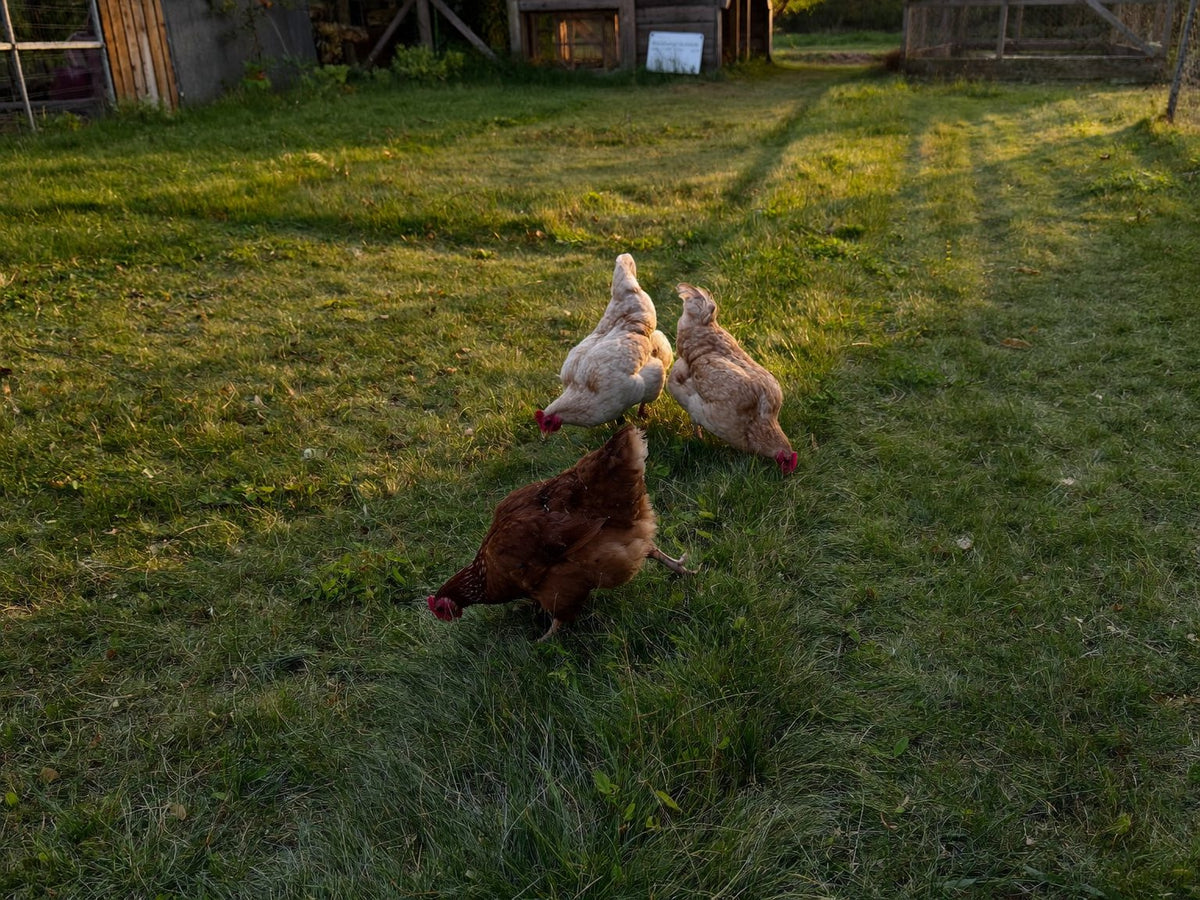
A chicken tractor is a portable, open-floored coop you move onto fresh grass every day or two. The floor is the whole distinction: if a wheeled coop has a solid panel or a pull-out droppings tray under the roosting area, it's a coop on wheels rather than a tractor. Both move; they just handle the mess differently. Whichever word a listing picks, the ones built to roll are gathered in coops built to move.
The floor test, the space-per-hen division and the moving trigger on this page all come from Penn State, Virginia Cooperative and University of Minnesota extension publications, quoted where they are used and linked at the foot.

What is a chicken tractor?
A chicken tractor is a light, portable coop with an open bottom, built so one or two people can move it by hand. Wheels or skids at one end, a handle at the other, a covered roosting box, and a wire run the hens reach through the open floor.
The name comes from what the flock does once you park it. They scratch, they eat weeds and insects, they leave droppings on the ground, and then you move them before the patch wears out. The hens do the tilling. Hence tractor.
Four parts show up on almost every design, whatever the shape:
- An open or part-open base, so the birds stand on grass rather than plywood.
- Wheels or skids at one end, so that end takes the load while the other lifts.
- A tow handle or lift bar, usually opposite the wheels.
- An integrated run, wired in and sharing a frame with the roosting box.
Shapes vary more than the parts do. A-frames, hoop tractors over cattle panel, low rectangular boxes, two-storey designs with a ramp. All of them are the same four parts arranged differently. Take away the open floor and you still have a perfectly good coop. You just don't have a tractor.
Chicken tractor vs coop on wheels: the floor is the difference
A coop on wheels has a solid floor. A chicken tractor doesn't. Everything else — the wheels, the handle, the run, the nesting box — can be identical on both, which is exactly why the two words get used as if they mean the same thing.
They don't. With a solid floor, the birds stand on a panel and you clean it. With an open floor, the birds stand on grass and the ground does the cleaning when you move. That single difference changes the chore list, the bedding bill and where the droppings end up.
Run that test yourself, on whatever listing is open in front of you, and run it before anything else — the floor is the one field the marketing words will not settle for you. Search the description for "pull-out tray", "slide-out tray" or "droppings tray": each of those means a solid panel under the roost, and therefore a coop on wheels rather than a tractor. A title that says "chicken tractor" settles nothing on its own, because nothing stops a wheeled coop with a solid floor being described that way. When the floor is not described at all, assume solid — it is the cheaper thing to build, and it is the way to bet.
If the floor is what you care about, ask before you order and we will confirm how it is built on any coop you are looking at. It is a five-minute question for us and a permanent difference to your cleaning routine. If you already know you want a solid floor and a tray under the roost, start from coops built to move.
What is a chicken tractor used for?
Keepers use a chicken tractor to put a small flock on clean ground without fencing the whole yard. You move the coop, the hens get new grass and new insects, and the droppings land somewhere different each time instead of concentrating in one square.
University of Minnesota Extension states the case for portable housing plainly: "Moveable shelters are a valuable tool for pasturing chickens and reducing cleaning time. Simply move the location of the house when manure begins to build up." Read what that says and what it doesn't. It's about where the manure goes and how much of it you shovel. It is not a promise about your hens' health, and we won't make one either.
Three jobs, in the order keepers actually care about them:
- Fresh forage. The flock gets grass, weed seeds and bugs it hasn't already picked over.
- Spread droppings. Manure lands across a strip of lawn instead of a permanent pile.
- No bare patch. A fixed run in a wet climate goes to mud and stays there. Moving is how you avoid that outcome without building a second run.
And three things a tractor does not do, because the honest list matters more than the cheerful one. It does not empty the nesting box for you — that is what a droppings tray under the roost is for, and it still needs pulling whether the coop moved that morning or not. It does not make the coop lighter. And it does not keep rain off any better than a fixed coop with the same roof. None of the three is a reason to skip a tractor; all three are reasons to read the roof, the tray and the weight before you buy one, and to ask us for any of the three that a listing leaves out.
How often do you move a chicken tractor?
Most keepers move a small tractor every day or two. There is no fixed schedule worth printing, because the right interval depends on how many hens are under how much footprint, how fast your grass recovers, and how much rain you've had.
The extension guidance is condition-based rather than calendar-based, and that's the honest way to state it: move it when the ground under it starts to look worn or the droppings start to build up. Four hens on 20 square feet will show you that signal much faster than four hens on 40.
Weather and surface change the answer more than most articles admit. Wet ground marks up in a day. Frozen ground doesn't mark at all but will fight the wheels. A slope means the coop wants to travel downhill on its own, which is a good reason to park across the fall line rather than along it.
The variable nobody publishes is whether you'll actually keep doing it. That comes down to two numbers — assembled weight and wheel diameter — and those are the two the listings leave out.
Work the footprint out yourself before you shortlist anything, because it is the one number that does two jobs at once: length times width in inches, divided by 144, gives the square feet of lawn the coop stands on. That single figure does two jobs — it sets how much ground each move covers, and it tells you whether the coop clears your side gate. Where a listing gives a length and no width, the width is the first thing to ask for, and we will get it for you. Then start from coops built to move and send over the two you are stuck between.
How many hens fit in a chicken tractor?
Work it out from the covered roosting area rather than from the headline number, because the two answer different questions. Divide the covered roosting area by a published space-per-hen figure, and treat the run area and the coop area as two different numbers — because they are.
There is no single agreed figure, and any article that gives you one is hiding the spread. Three land-grant extension services publish three different answers for indoor floor space per bird:
| Source | Indoor coop space per bird | Outdoor run space per bird |
|---|---|---|
| Penn State Extension, Small Scale Poultry Housing | 1.5 sq ft (laying hens) · 2 sq ft (large chickens) | 8 sq ft (laying hens) · 10 sq ft (large chickens) |
| Virginia Cooperative Extension, Small-scale Poultry Housing | 3–4 sq ft | 10 sq ft |
| University of Minnesota Extension, Raising chickens for eggs | 3–5 sq ft | not stated |
That's a range of 1.5 to 5 square feet per hen from three credible US sources. The "4 square feet per bird" you see repeated everywhere sits at the top of it.
Now run a real listing through it. Take a coop stating a main house of 13 sq ft, a headline capacity of 4–6 chickens, and 5–8 written twice into its own description. At Virginia's 3–4 sq ft that is three or four hens. At Penn State's 2 sq ft it is six. Only Penn State's lowest published figure — 1.5 sq ft for laying hens, and that figure assumes outdoor access — gets you to eight. Every one of those answers is defensible; the listing just never tells you which rule it used.
So the listing isn't lying. It's quoting the most generous rule available and not telling you which one. We'd rather show the division. The same arithmetic laid out step by step, with the extension figures beside it, is in our coop size guide — run your own shortlist through it, then pick from coops built to move.
What to check before you buy a chicken tractor
Eight fields decide whether a wheeled coop gets moved or quietly becomes a shed, and you can run them down a listing in about a minute. Wheels, floor construction, stated hens and overall dimensions are the easy four. Wheel diameter, assembled weight, ground clearance and where on the frame the wheels sit are the four that decide the outcome — and those are the four to ask for before you order, on any coop, from anyone.
Ready for a coop that moves? Take 10% off your first one — the code lands by email. GET MY 10% CODE
Now run your own yard down a shorter list. Three measurements decide whether a tractor works where you live, they take about five minutes with a tape measure, and every one of them can be taken before you open a single listing.
| What to measure | How to take it | What it rules in or out |
|---|---|---|
| The narrowest gate or gap on the route | Inside edge to inside edge at the tightest point, not across the post tops | A hard ceiling on the coop's widest dimension. A coop that will not pass this does not get moved twice, whatever else it does well |
| The tallest obstacle on the route | A surface root, a rut, the lip where lawn meets paving. Measure the worst one you find | Compare it against half the stated wheel diameter — that halving gives you the axle height, and the axle is what has to climb. Obstacle taller than axle means a bigger wheel or a coop light enough to lift |
| The fall across your parking spots | Sight it from the side, or lay a plank and a spirit level across the widest part | Real slope means parking across the fall line rather than along it, and it argues against four free-swivelling wheels, which have nothing holding them on a grade |
Back to the floor field for a moment, because it is the one that shapes your week. A tray under the roost changes where the cleaning happens rather than how much of it there is. You pull a tray instead of raking grass, which is a good deal easier in January and a fair reason to want a solid floor even if the tractor idea appeals. It is also why the floor line and the wheel line have to be read together: one sets the chore, the other sets whether the chore ever gets done.
Wheel size is worth a look before you buy: a stated 3.9 inches is a small wheel, and small wheels want short grass and flat ground — on rough pasture they stop at the first tussock. Halve any diameter you are given and you have the axle height, which is the tallest thing that wheel climbs. Assembled weight is the other figure to chase, because it decides whether one adult can do the job alone: message us with the coop and we will get the weight from the manufacturer before you order.
If you're choosing between two coops and the weight is the deciding factor, just ask — we'd rather confirm it for you than have you guess from a photograph. Send the two links over, or pick from coops built to move and we will check whichever pair you land on.
Chicken tractors vs stationary coops: what you give up
A tractor trades shelter and capacity for fresh ground. You give up mass, insulation and storage, and you take on a chore you have to do on days you don't feel like it. For some yards that's a great trade. For plenty of others it isn't.
Weather exposure. Light structures move well because they're light. A fixed coop with heavier walls handles wind and cold with less fuss. If your winter is genuinely hard, a mobile coop needs a sheltered parking spot, which means you need one.
Storage. A stationary coop usually has somewhere to keep feed, a scoop and a spare waterer. Most tractors have nowhere. That gear ends up in the garage, and you carry it out twice a day.
Capacity. Weight goes up faster than usable space. Somewhere around ten hens a wheeled coop stops being a one-person job, and by twenty birds you are looking at a walk-in build rather than a tractor. Past a certain size, "portable" quietly becomes "two people and a plan".
Terrain. Small wheels and uneven ground don't get along. Slopes, tree roots, mole hills and long grass all cost you effort every single move. On a mown, near-level lawn a tractor is genuinely easy. On a half-acre of rough pasture it's a workout.
Here's our stance, and it's the reason this page exists. If your yard is flat, mown and bigger than the coop's footprint by a factor of three or four, buy the mobile coop — it's the better piece of equipment and the chore is smaller than it sounds. If your ground is rough, if you're keeping more than about ten hens, or if you know you won't move it in February, buy a fixed coop with a good run and don't pay for wheels you'll never turn. Getting that call wrong costs you a few hundred dollars and a coop that sits in one place growing a mud ring — which is precisely the problem the wheels were supposed to solve.
If you want the case for mobility argued properly, including what it does and doesn't fix, we made it in why move your chicken coop. If you've already decided and just want something you can lift rather than tow, start with the portable coops.
Further reading: UNH Extension's egg-production primer covers the housing basics from the flock's side.
Weighing a tractor against something you can stand up in? Mobile vs walk-in coops scores both honestly — and once you have made that call, the wheeled half of it is all in coops built to move.
Frequently asked questions
What is a chicken tractor?
A chicken tractor is a portable chicken coop with an open bottom, moved by hand onto fresh grass so the flock stands on new ground rather than on a floor you clean. It usually combines a roosting box and a wire run in one frame, with wheels or skids at one end and a handle at the other. The open floor is the defining part — a wheeled coop with a solid floor is a mobile coop, not a tractor.
How often to move chicken tractor?
Most keepers move a small tractor every day or two, but the trigger is the ground rather than the calendar. University of Minnesota Extension advises moving portable housing when manure begins to build up. Fewer hens under a bigger footprint means longer between moves; wet weather shortens it. If the grass under the run is flattened and yellowing when you lift it, you left it too long.
How many chickens in a chicken tractor?
Two to six standard hens covers most backyard tractors, and the limit is the covered roosting area rather than the run. Published guidance ranges from 1.5 sq ft per hen (Penn State Extension) to 3–5 sq ft (University of Minnesota Extension), so a 13 sq ft coop holds between three and eight birds depending on which figure you use. Work from the coop area the manufacturer states, not the headline hen count.
How to move a chicken coop?
Lift the handle end until the wheels take the weight, then walk it forward in a straight line — pulling is easier than pushing and much easier on your back. Check the hens are inside or clear of the frame first, and move onto ground you've already looked at, because a wheel that drops into a hole tips the whole coop. On a slope, park across the fall line rather than along it.
How to put wheels on a chicken coop?
Wheels bolt to the frame rails, not to the floor panels, and they go at one end so the opposite end lifts. Two wheels and a handle is the standard arrangement; four fixed wheels make a coop that rolls in one direction and fights you in every other. Bigger diameter rolls over more — a stated 3.9 inches is a small wheel and suits short, level grass, so halve whatever diameter you are given and compare it with the tallest thing on your route.
Written by the Moveable Chicken Coop Team We read the floor construction first on every coop we look at, because that one field is what separates a tractor from a coop that merely rolls. If a listing you are weighing does not state it, ask us and we will confirm it before you order. More about how we choose coops → /pages/about
Last reviewed: 26 July 2026
Sources
- University of Minnesota Extension, "Raising chickens for eggs", https://extension.umn.edu/small-scale-poultry/raising-chickens-eggs — accessed 26 July 2026
- Penn State Extension, "Small Scale Poultry Housing", https://extension.psu.edu/small-scale-poultry-housing — accessed 26 July 2026
- Virginia Cooperative Extension, "Small-scale Poultry Housing", publication 2902-1092, https://www.pubs.ext.vt.edu/2902/2902-1092/2902-1092.html — accessed 26 July 2026
- Stated coop figures quoted above — a 13 sq ft main house and a 4–6 hen headline on a 59-inch wooden mobile coop, and a 3.9-inch wheel diameter — as published by PawHut, accessed 26 July 2026.