

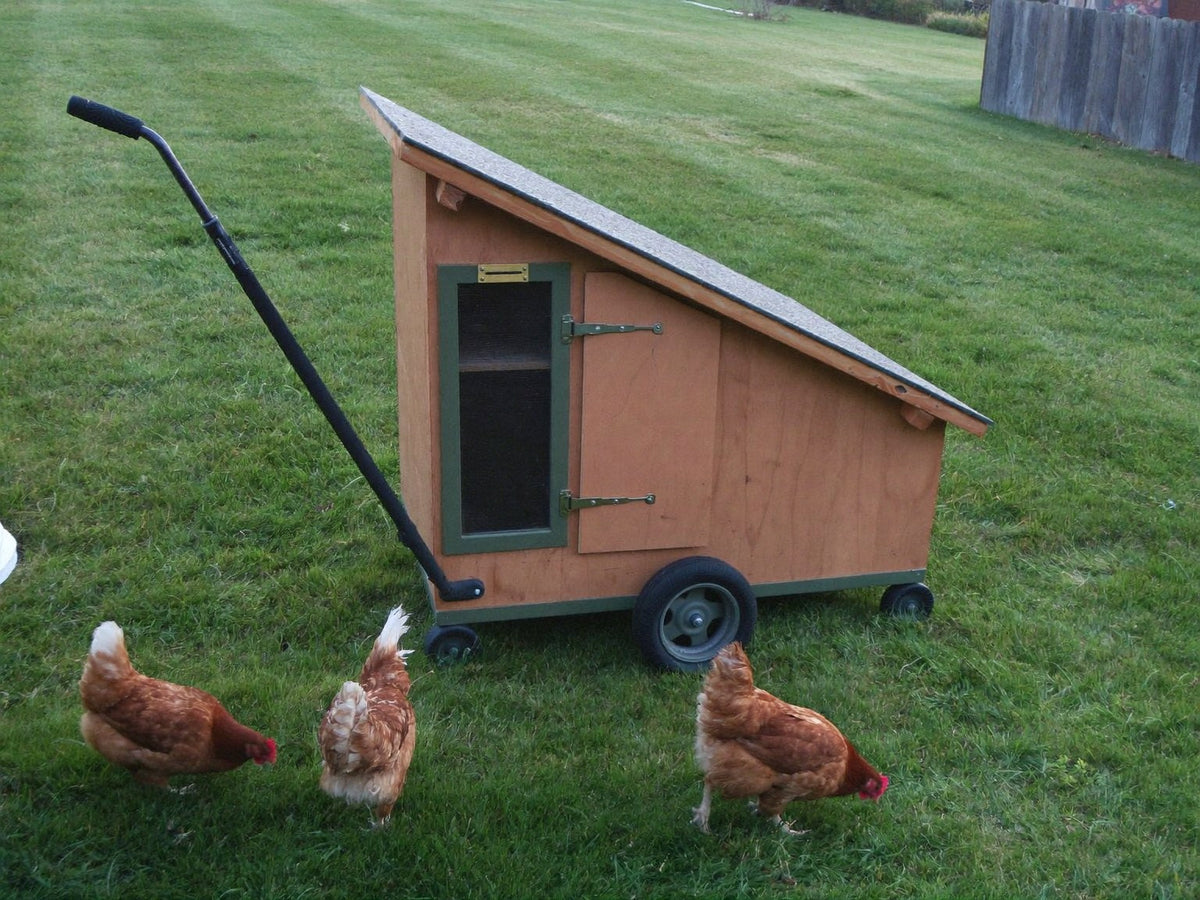
You move a coop because hens produce droppings continuously and grass recovers slowly. A coop that stays put concentrates everything four hens make onto the same 20 square feet, week after week, until that patch is bare and stays bare. Move the same coop its own length each morning and it touches roughly 7,600 square feet of lawn in a year instead of 20. That's the entire argument — it's manure logistics, not lifestyle. Everything else about coops that move follows from it, including the parts that don't work.
The ground-coverage arithmetic below is footprint times moves, worked in the open so you can redo it with your own coop and your own cadence; the cleaning and siting claims are quoted from University of Minnesota, Penn State and Virginia Cooperative extension publications, linked at the foot.

The same patch of lawn: left, after a coop stays put; right, when the coop keeps moving.
Why move a chicken coop?
Because the ground under a coop wears out and the coop doesn't. Grass under a run gets scratched, compacted and manured faster than it can regrow, and once the roots are gone the patch turns to dust in July and mud in November. Moving the coop is how you spend that wear across a lawn instead of into a hole.
Nothing about that is complicated, which is why so few people bother explaining it. The keeper's version is shorter still: move the coop, not the mess.
Two things follow. First, the size of the fix depends entirely on how far and how often you move, not on how nice the coop is. Second, it's a chore. A coop on wheels doesn't move itself, and a coop you stop moving in December is just a coop with wheels on it.
What happens to the ground under a coop that never moves
A fixed run goes through the same three stages in almost every backyard. First the grass thins where the hens dust-bathe and scratch. Then the remaining cover gets grazed and manured faster than it regrows. Then you have bare soil, which is compacted, slow to dry and unpleasant next to a house.
How fast depends on stocking density, rainfall and your soil. Sandy ground drains and recovers. Clay does neither. Six hens on a small run in a wet spring will strip it in weeks; two hens on a big run in a dry climate might hold cover for a season.
The important part is that a fixed run doesn't reach an equilibrium. It reaches bare and stays there, because nothing is adding grass back. That is why the standard fix for a permanent run isn't grass at all — it's a deep layer of wood chips or sand that you top up, plus a bedding routine inside. That's a perfectly good system. It's just a different one, with a different chore attached.
Moving is the other option. You accept a small job most mornings and skip the permanent run entirely.
How much ground does a moving coop actually cover?
Multiply the coop's ground footprint by the number of moves. A coop covering 20.8 square feet, moved its own length once a day, passes over roughly 7,600 square feet of lawn in a year — about a sixth of an acre. The same coop, parked, covers 20.8 square feet forever.
Here is that arithmetic laid out so you can find your own coop inside it. Measure the footprint in inches, multiply length by width, divide by 144, and read the row nearest your answer. The last column assumes one move a day onto ground you have not used yet — halve it if you move every other day, and halve it again if you loop back round a small lawn.
| Ground footprint | Roughly, in feet | Covered in a year of daily moves | What that means in your yard |
|---|---|---|---|
| 10 sq ft | 3.5 × 3 ft | ~3,650 sq ft (0.08 acre) | The easiest of these to move by a distance, and it still touches ground a fixed run never reaches |
| 15 sq ft | 5 × 3 ft | ~5,500 sq ft (0.13 acre) | Comfortable one-person territory on level grass, most mornings, most weather |
| 20 sq ft | 8 × 2.5 ft | ~7,300 sq ft (0.17 acre) | Long and narrow covers the same ground per move as a square of the same area and threads a gate far better |
| 25 sq ft | 7 × 3.5 ft | ~9,100 sq ft (0.21 acre) | About a fifth of an acre a year. At this size measure your narrowest gate before you measure anything else |
| 30 sq ft | 6.5 × 4.5 ft | ~11,000 sq ft (0.25 acre) | A quarter-acre a year, and the size at which "portable" starts to mean two people on wet ground |
Two honest caveats, because the number is only useful if you know what it assumes. It assumes you move a full body-length every day and never revisit the same strip, which no real yard allows — a loop that comes back round after a few weeks is the realistic version, and that rest period is the point rather than a flaw. And a footprint is not the same as usable hen space; the run and the roosting box occupy the same outline.
Even halved, the gap is the whole story. Same coop, same hens, same droppings. One version spreads them over thousands of square feet. The other puts them in a square you'll be looking at from the kitchen window for years. Find your own footprint band in the table, decide whether that much lawn is worth a minute a morning, and if it is, the coops built to move are where to start.
Does moving the coop mean less cleaning?
Less shoveling in one place, not less work overall. Moving relocates the manure instead of collecting it, so the run stops needing a clear-out — but the roosting box, the perches and the nesting boxes still need attention on the same schedule as any other coop.
University of Minnesota Extension frames portable housing exactly that way: "Moveable shelters are a valuable tool for pasturing chickens and reducing cleaning time. Simply move the location of the house when manure begins to build up."
Read the second sentence carefully. The trigger is manure build-up, not a day of the week. It is also a statement about cleaning time, not about your hens' health, and we're not going to inflate it into one.
The hardware agrees with the limit. That is what a pull-out or slide-out droppings tray under the roosting area is for: the birds spend the night standing over one spot, and no amount of wheeling changes what happens beneath a perch. So budget the same weekly ten minutes for the roost whichever kind of coop you end up with — moving saves you the run, never the perch. If that trade still sounds worth it, the coops built to move are where to start.
What moving doesn't fix
It doesn't waterproof anything. A light coop moved onto low ground in a wet week is a light coop full of standing water. Where you park matters as much as how often you move.
It doesn't reduce weight. Wheels change how the load travels, not what it weighs, and assembled weight is the number that decides whether you'll still be doing this in February. Chase three figures before you order: the assembled weight, the ground clearance measured at the lowest rail, and the wheel diameter. Clearance can hide under another name — look for "height to the floor", where a stated 7.5 inches is what it looks like — and a stated 3.9-inch wheel halves to an axle sitting 1.95 inches up, which is the tallest obstacle that wheel can climb. Ask us for any of the three and we will get them from the manufacturer.
It doesn't fill in a gap under the frame. Ground is never as flat as it looks, and the run edge is where that shows — so site the coop on the flattest ground you have, and check the perimeter after each move.
And it doesn't make hardware unnecessary. Wire, latches and how the frame meets the ground do their own job, and a coop that moves needs those checked at every new spot rather than once at installation. None of the four is a reason not to move a coop; all four are things to look at before you buy one, which is exactly what the coops built to move listings are there to be read for.
Mobile, portable, tractor: three words, three different things
The three words get used interchangeably and shouldn't be. A mobile coop has wheels and a solid floor. A portable coop is light enough to lift or drag, wheels or not. A chicken tractor has an open floor, so the birds stand on the grass and the ground does the cleaning when you move.
The floor is what separates them, and it is the field worth checking first on anything you are about to buy. The long version of that distinction — and how to read a listing for it when the description does not say — is in what is a chicken tractor.
If lifting rather than rolling is what your yard needs — narrow gates, steps, a gravel path — start with the lighter portable coops instead of the wheeled ones.
Sold on moving the coop? Your first coop on wheels is 10% off. SEND MY 10% CODE
Who should buy a coop that moves, and who shouldn't
Buy one if your lawn is mown and roughly level, if your flock is somewhere between three and eight birds, and if your yard is at least three or four times the coop's footprint. On that ground the chore takes under a minute and the payoff is a lawn with no permanent scar on it.
Don't buy one if the only flat ground you have is gravel or paving, if you're keeping more than about ten hens, or if you're honest with yourself and know the coop will be moved twice in April and never again. In those yards a fixed coop with a deep-litter run is the better machine, and paying for wheels you won't turn is just a more expensive way to end up with a bare patch.
And don't picture the wheels as an extra bolted to a coop you'd otherwise buy. A coop that rolls is built around rolling: the floor, the frame and the footprint are all designed for it, which is why a moveable coop and a fixed coop of the same length are two different products rather than two versions of one. So mobility isn't a level you upgrade to — it's a specification, like footprint or tray type, that either suits your ground or doesn't. What any given coop costs is on its own listing, where it stays current, and that's a better place to settle the money question than a paragraph written months earlier. Mobility is a design choice, and its real cost is paid in minutes, not dollars.
Which is the honest bottom line. Mobility is not something you buy. It's something you do, most mornings, for as long as you keep hens. If that sounds fine, it is fine. If it sounds like a chore you'll drop by August, believe yourself, and buy the coop that doesn't need it.
Working out how many hens your yard can take is the other half of this decision — the arithmetic is in our coop size guide. More on how we pick what to stock is on our about page.
Further reading: University of Minnesota Extension's backyard-flock guide is a solid second opinion on run and range management.
Sold on moving? How to move a chicken coop covers the cadence, the one-person mechanics and the moving-day checklist — and when you are ready to pick one, the coops built to move are all in one place.
Frequently asked questions
Where to put a chicken coop?
On the highest, best-drained ground you have, with morning sun and some afternoon shade, and far enough from the house that smell and flies aren't a daily issue. Avoid the low corner where water collects after rain — that spot will be mud all winter regardless of what you put on it. If the coop moves, plan a loop of parking spots rather than one location, and keep the whole loop out of the wet ground.
How high should a chicken coop be off the ground?
Raised coops are usually set somewhere between a few inches and two feet, which keeps the floor out of standing water and gives the birds shade underneath. There is no single required figure, and where one does appear it may be filed under another name: "height to the floor" is the phrase to search a listing for, and a stated 7.5 inches is what it looks like when it turns up. If clearance matters to you, ask for the number before you buy rather than measuring it off a product photo.
How to secure chicken coop to ground?
Ground anchors, screw-in earth augers or paving slabs on the frame rails are the usual answers for a coop that stays put, and they're worth doing in any location that gets real wind. A coop you move is a different problem: anything you fix into the soil has to come out again every time. Weight at the corners does the job instead, without having to come back out of the soil at the next stop, and parking in the lee of a fence or hedge takes some of the load off before it arrives.
How to clean a chicken coop with a dirt floor?
Rake out the top layer of soiled litter, then add fresh bedding on top rather than stripping to bare soil each time — the deep-litter approach. Keep it dry, because wet litter is what produces ammonia and flies. On an open-floored coop that moves, the ground handles most of this for you, and the job shrinks to the roosting box and the perches.
Written by the Moveable Chicken Coop Team We cross-check manufacturer dimensions against published extension guidance, so the ground a coop actually covers is arithmetic rather than a claim. Where a spec sheet leaves a figure out, ask and we will confirm it before you order. More about how we choose coops → /pages/about
Last reviewed: 26 July 2026
Sources
- University of Minnesota Extension, "Raising chickens for eggs", https://extension.umn.edu/small-scale-poultry/raising-chickens-eggs — accessed 26 July 2026
- Penn State Extension, "Small Scale Poultry Housing", https://extension.psu.edu/small-scale-poultry-housing — accessed 26 July 2026
- Virginia Cooperative Extension, "Small-scale Poultry Housing", publication 2902-1092, https://www.pubs.ext.vt.edu/2902/2902-1092/2902-1092.html — accessed 26 July 2026
- Stated coop figures quoted above — a 3.9-inch wheel diameter and a 7.5-inch height to the floor on wooden mobile coops — as published by PawHut, accessed 26 July 2026.