

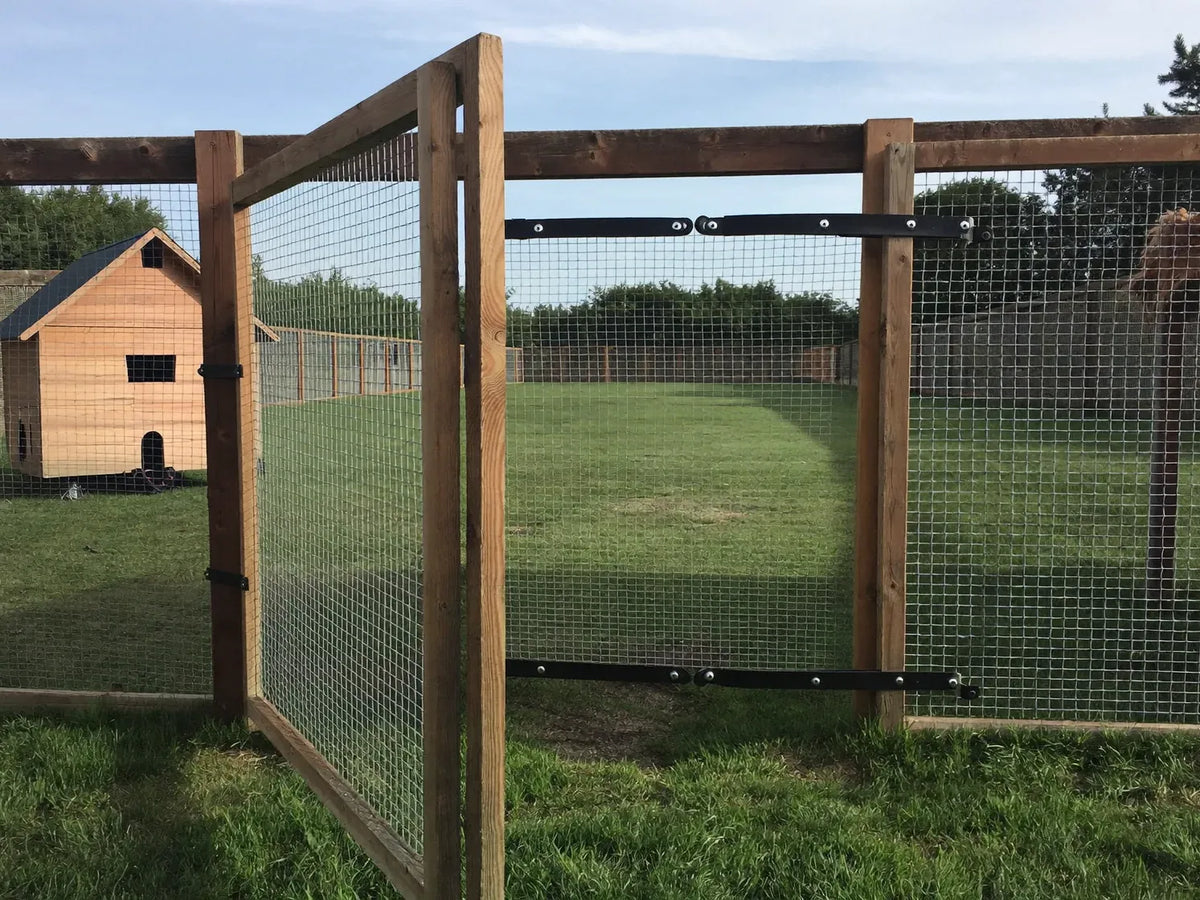
A chicken run door is a person-sized gate in a mesh fence, and it is a different object from the door in the coop wall. Where it sits on the perimeter and what happens at the ground under it decide whether it works. Check the listing for a width and a height on the gate, because those two figures settle more than they look like they do: a gate published at 1.6 ft wide by 5.6 ft high, on an enclosure whose eaves stand at 3.7 ft, cannot fit in a side wall at all. Where a listing leaves those figures blank, we get them from the manufacturer for you — start from the coops that come with a run.
Run-fencing guidance below is quoted from extension publications named under Sources; where a judgement is ours rather than theirs, the sentence says so.
What is a chicken run door?
A chicken run door is the gate in the run's own fence — the one you go through to reach the feeder, the waterer and the far corner. It is not the pop-hole in the coop wall, and it is not built like one.
The difference is structural. A coop door is a panel in a solid wall that already carries itself. A run gate is a hole cut in a mesh perimeter, so it has to terminate the mesh at a frame, carry its own weight, and close onto something solid at every edge including the bottom one.
The two doors also fail differently. A coop door that sticks is an annoyance at dusk; a run gate that no longer meets its frame is a boundary that is open all night without looking open. So read the gate as its own purchase: a width, a height, a hinge side, a latch you can work one-handed, and a bottom edge that closes onto something.
Neighbouring guides cover the other doors. The size and type of the coop's own opening is a decision in its own right, automatic kits are a coop-wall device, and the run itself has its own guide. If the gate is the part you are stuck on, name the coop and we will lift its gate width and its position straight off the maker's drawing — start from the coops that come with a run.
Where the gate goes decides how far you carry everything
Gate placement is the specification nobody writes down. Run gates go unmentioned across the extension publications opened for this guide, and a spec table has no field for where a door sits on a perimeter. One way in at one end of a long run means every scoop of feed, every bucket of water and every rake of soiled ground travels the whole length of it, twice.
| What the listing gives you about the way in | What you can settle from it | What to do next |
|---|---|---|
| A gate width and a gate height | Which wall it can be in. A gate taller than the eaves line cannot sit in a side wall, so it has to go in an end | Compare the gate height against the eaves height before you plan where the feeder and waterer live |
| Overall run dimensions, but no gate figure | The walk you have signed up for. From a gate in the end of a run 9.2 by 31.2 ft, the far corner is about 32 ft away | Take the diagonal yourself, then decide whether the drinker goes at the far end or by the gate |
| A fastening word — "lockable hasp", "slide latch", "access doors" | How it holds shut, which is a different question from how wide it opens or which end it sits in | Ask for the width and the position. Both are on the maker's drawing, and we will go and read them off it |
The first row is where the arithmetic actually bites, so it is worth walking through. A door 67.2 inches tall will not fit under an eaves line 44.4 inches off the ground, and a side wall's top edge is that eaves line along its whole length, so the gate has to be in a gable end. The figures are the manufacturer's; reading "eaves height" as the side-wall height is ours, and the inference only rules the side walls out — it does not say where along the end the gate sits.
Two consequences follow if that gate is the only way in. Everything you carry passes through 19.2 inches of width, narrower than an interior doorway at home. And the corner diagonally opposite is roughly 32 ft away, which is the walk you make each time a waterer needs topping up in high summer. Measure the doorway you use at home, stand at one end of the run's footprint and pace the diagonal, and you will know before you order whether that suits you.
Chicken run door ideas that hold up outdoors
Run-door ideas come down to what happens at the four edges of a hole in a fence. The bottom edge is where almost all of it goes wrong, because the ground moves and the gate does not.
Ground clearance is a seasonal figure, not a fixed one. Hang a gate to clear the grass by half an inch in July and it binds in November, when the frame swells and the ground heaves. Hang it high enough never to bind and you have built a gap. The workable version closes onto a bottom rail instead of bare ground, so the clearance is set by timber you can plane.
A gate is where the run's mesh has to end twice — once at the frame it is cut out of, and once across the leaf that swings. A gate framed in timber with nothing stretched across it is a hole in a wall you paid to mesh.

The buried line is the other thing a gate interrupts. What the extension services publish about burying and toeing out the wire, and what a run that moves gives up by being unable to do either, is set out in the outdoor run guide; what none of them says is what to do across the span where a gate breaks that line, and that span is the one you cannot dig.
Latches beat locks on a gate you open twice a day, and the catch to look for holds under a push rather than only under a pull. A spec line usually gives you the fastening as a single word — a "lockable hasp", "slide" latches — and stops there. Check the same line for a mesh aperture and a wire gauge, because those two decide what a gate's mesh is actually worth; where they are not printed, ask for them before you order rather than after.
No extension publication opened for this guide says which way a run gate should swing, so this is our call: outward on level ground, so the swing never sweeps the flock standing at your feet, and inward only where an outward swing would foul on a rise. A gate hung on a coop you bought puts screws into a panel that cannot give them back, so read the maker's warranty terms first, and name the coop if you want their position on it in writing before you start.
Worked out where your gate needs to go? Take 10% off a coop that comes with the run already attached. GET MY 10% CODE
Can a chicken run door be automatic?
Automatic door kits are coop-wall devices. A kit drives a light panel up and down in runners, so it needs a hen-sized opening and a flat mounting panel around it to carry them — which describes the wall of a hen house and does not describe a gate in a mesh fence. A run gate is person-sized, hangs on hinges, and has fence on both sides.
The phrase points at something simpler than the hardware: the flock let out at first light without anyone getting up for it. University of Minnesota Extension states the routine plainly — "To protect them from predators, let them out of the coop each morning and put them back in at dusk each night." A kit moves the pop-hole at both ends of that routine, but it is the light or the clock that decides, not the flock — our automatic coop door guide works through what happens to the hens that range late.
So the fence and its gate come first and the automated pop-hole second. A motorised pop-hole opening onto a run with a gap under its gate has moved the question outdoors rather than answered it, and what the hardware around a run actually is has a guide of its own.
What we'd check before ordering
Four measurements settle a run gate, and a tape gets all four: how wide it opens, which end of the run it sits in, the gap under it when closed, and how high off the ground the latch sits. A listing may hand you the first. The other three are yours to take on delivery, or ours to put to the manufacturer before you order.
Our stance, plainly. On a coop that moves we would take a run you can reach every corner of over a run you can walk into. Walk-in height buys standing room and costs weight, and weight is what you feel on the third move rather than the first.
Being wrong here is cheap in money and expensive in temper. A gate that binds on risen ground has to be forced back into its frame every time it is shut, and a latch that needs a free hand cannot be worked at all while both of yours are on a full waterer. Neither failure shows up in a spec table, and both decide whether the run is shut at dusk.
Point us at the gate you cannot get a figure for and we will lift its width and its position off the manufacturer's drawing, including on the runs whose listings mention a door and stop there. Ask first or order first — that part is up to you. If you want the run already attached, start with the coops that come with one; if you want to stand up inside it, compare the walk-in coops and runs; if the flock will spend its days out on grass, the coops that move are where to look. Or start from one page of coops and say which one has you stuck.
Sources: Penn State Extension, "Small Scale Poultry Housing" (Gregory P. Martin and Phillip Clauer, updated June 25, 2026) — accessed August 20, 2026 · Virginia Cooperative Extension, "Small-scale Poultry Housing", publication 2902-1092 (APSC-186NP) (Leonie Jacobs and Phillip J. Clauer, April 28, 2023) — accessed August 20, 2026. Penn State's and Virginia Tech's pages share co-author Phillip J. Clauer and are one voice published twice, not two services agreeing · University of Minnesota Extension, "Raising chickens for eggs" (Betsy Wieland and Nora Nolden; Sabrina Florentino, Extension educator; reviewed 2025) — accessed August 20, 2026. None of the three states anything about a run gate — not its placement, not a latch type, not a hinge side, not a ground clearance. Gate and enclosure figures quoted in the body — a lockable door of 1.6 by 5.6 ft on a walk-in shell stated at 9.2 by 31.2 ft, under a 6.5-foot ridge and 3.7-foot eaves — are read from PawHut’s own published specifications, accessed August 20, 2026.
Frequently asked questions
How to connect chicken coop to run?
Bring the run's fence up to the coop's outside wall and fix the frames to each other, so the joint has no gap at the ground where the two meet. Some coops arrive built that way. Others state instead that they connect to separate run models sold on their own, which makes the joint yours to make and yours to inspect. Where a listing says nothing either way, ask before you order two things that have to meet.
How to build a chicken coop run door?
Work in this order. Decide which end of the run the gate goes in, because that fixes how far you carry everything. Frame the opening in the fence first, then build the gate to that frame, then hang it, then mesh it, then fit the latch. Mesh it after it hangs, not before: a panel meshed flat goes out of square as soon as it takes its own weight on the hinges.
Can I leave chicken coop door open overnight?
Virginia Cooperative Extension ties it to the run: lock the flock in before dark where the outside run will not hold, because most predation occurs at night. The trouble is establishing that it will hold. Leaving the pop-hole open makes the run's gate, its ground line and its mesh the only boundary overnight, and a gate's mesh gauge and aperture are rarely figures you can read off a page. Shut the door, and inspect the gate in daylight.