

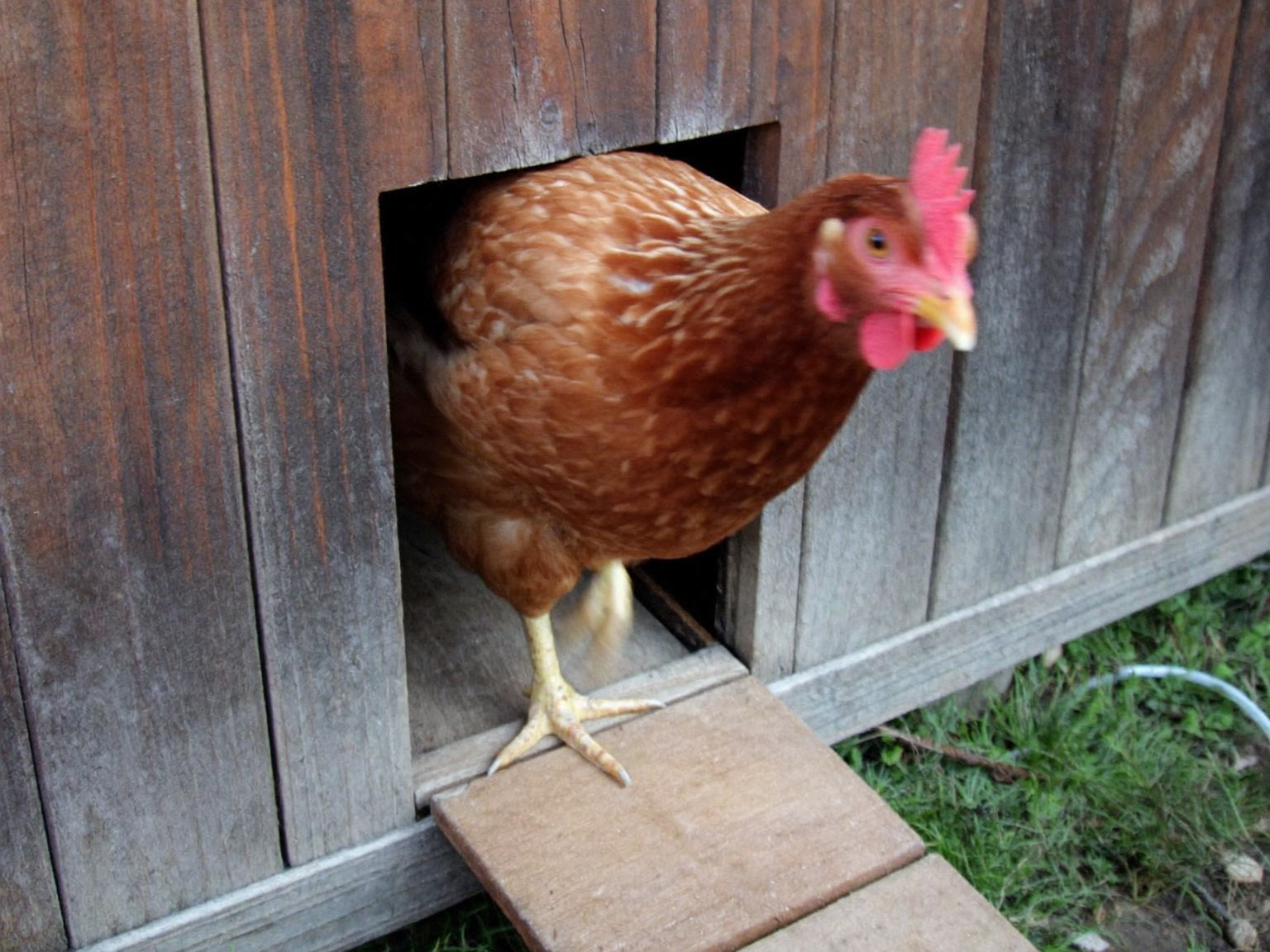
An automatic chicken coop door fits if two numbers agree: the opening the kit is built for, and the pop-hole your coop already has. Everything else — solar or battery, timer or light sensor — is preference. Below: how to get that opening, the mounting panel the kit actually needs, and how to pick the trigger. If the coop you're weighing up doesn't print its pop-hole, tell us which one and we'll get the figure from the manufacturer before you order a coop with an attached run.
Every opening dimension here was read off published manufacturer documentation, and every housing rule off Penn State, Virginia Tech or the University of New Hampshire — five documents, each linked at the foot. Two of the five carry the same co-author, Phillip J. Clauer, and much of the same text, so this guide never counts them as corroborating one another.
What does an automatic chicken coop door actually do?
An automatic chicken coop door opens the hens' own doorway in the morning and closes it at dusk, driven by a timer, a light sensor or a phone app. It automates the shutting-in and nothing else.
Virginia Cooperative Extension gives the reason a shutting-in routine exists at all. Where the outside run is not secured, "you need to lock up your poultry before dark, as most predation occurs at night." A motor does that on the evenings nobody is home at dusk, and it does it at the same light level every night, whatever time dinner finishes.
Worth drawing the line early, because most pages in this category blur it. A door decides when the coop is closed. What a closed coop resists is a different question, settled by mesh aperture, wire gauge, latch count and what sits under the wall line — and that has a guide of its own on what the hardware actually is.
So the door is a scheduling tool, and it earns its keep on the evenings nobody is home at dusk. Whether one will fit is settled by a single measurement, which is the next section. If you're still choosing the coop the door will hang on, start with the coops that have a run attached — on those, the pop-hole between house and run is the opening in question.
The pop-hole opening is the number that decides fit
Automatic doors are built to a fixed opening size, so fit is arithmetic rather than judgement: find the pop-hole dimensions on the coop side, then set them beside the kit's published opening. The whole job is getting that first pair of numbers, and how you get them depends on what's in front of you.
| What you find when you go and look | What it means for an automatic kit | What to do next |
|---|---|---|
| The listing prints a pop-hole in figures — width × height | You can fit-check on the page, before either purchase | Write the two numbers down beside the kit's published opening. If they agree, nothing else about the door needs deciding |
| The listing gives a door count — "4 access doors" — and no dimensions | A count tells you how many panels there are to clean through. It says nothing about whether a motor fits any of them | Ask for the pop-hole opening in inches before you compare anything. A count and a dimension are not the same claim |
| The listing describes doors in words — "sliding door", "double hinged front doors with a lockable hasp" | Words name a mechanism, not a size, and the mechanism matters too: a panel in a bottom track changes what the kit has to clear | Ask for the opening and how the panel runs — sliding, hinged or lift-out |
| You already own the coop | Nothing on any listing beats a tape on the wall you're going to drill | Measure width and height at the narrowest point of the frame, then measure the flat panel around it — see the next section for why |
| You're buying the coop and the door together | The opening you buy decides which kits will ever fit it, for the life of the coop | Pick the coop first and get its opening confirmed, then buy the kit to that number. Start with the coops that move, where the pop-hole gets used hardest |
Row two is worth understanding rather than resenting. Nobody decided to withhold the opening; it simply lives on a different piece of paper from the one the description was written off. Which is why asking works. A dimension that was never a secret is a dimension somebody can go and look up, and that is a far shorter conversation than a returned kit.
Two published figures give you a target to hold the answer against. The documentation behind the two automatic-door kits cited at the foot of this page states openings of 19.5 cm wide by 30 cm high — 7.7″ × 11.8″ — and 26 cm by 29 cm, 10.5″ × 11.5″. A pop-hole in that neighbourhood has kits built for it off the shelf. One much narrower, or much taller, is the case to check individually before you commit to either half of the purchase.
Extension guidance sets the biological floor and stops short of a figure. Penn State Extension's housing publication gives the rule as "Be sure doorways are large enough for the birds to move through easily" — correct, and deliberately unmeasured, because a bantam and a Jersey Giant do not want the same hole. The kit openings above are the practical range that hardware is actually built around.
So: get the number before you order, not after. Send us the coop you're looking at and we'll get the pop-hole opening from the manufacturer's drawing — that is a phone call for us and a returned kit for you.
Coops with the run attached — and we'll confirm any figure a listing leaves out, before you order. SEE THE SPECS
What else has to fit besides the hole?
The mounting footprint. A door kit needs a flat, unobstructed panel around the opening to carry its runners, its motor and the travel of the door itself, and the component figures the door manufacturers do publish — runner length, clearance, opener height — add up to a panel much larger than the hole.
Two sets of published figures, both cited at the foot of this page, show the size of the gap. One all-in-one unit measures "31.5cm x 44cm (12.5" x 17.5")" over a door opening of "26cm x 29cm (10.5" x 11.5")", with "25cm (10")" protruding from the top of the unit when the door is fully open. So the unit alone is already half again the height of the hole it covers, before anything is fixed to the wall around it.
A separate locking-door kit publishes the figures that make the point completely. Its documentation states a door of "25cm x 30cm (10" x 12")" running in runners "59.5cm (23½") long", and asks you to "allow at least 7.5cm (3") between the top of the runners and the base of the door opener". Stack those against the opener it lists at "9.3cm (3.7")" tall — 23.5 + 3 + 3.7 — and the flat panel you're measuring for is closer to 30 inches than to 12. That total is our own addition of published figures rather than a number any manufacturer prints; redo it with your own kit's manual before you mark the wall, because the three components differ between kits.
The panel, then, is the second measurement to take yourself, on the coop, before anything is ordered: the height of unbroken flat wall above and below the pop-hole, and the width clear of hinges and nest-box returns. Two minutes with a tape settles it. If the coop isn't in your garden yet, tell us which one you're looking at and we'll ask the manufacturer what sits above and below that opening before you commit — that is what `sales@moveablechickencoop.com` is for.

Solar, battery and mains: the power question
Power is the decision that outlives the purchase. Mains means a cable run to wherever the coop stands. Batteries mean a replacement schedule you will forget at least once. A solar chicken coop door means sun actually landing on the panel — which makes it a siting question, not a shopping one.
On a fixed coop, sun exposure gets settled once, at build time. On a coop that moves, it is re-decided every move. The July parking spot with full afternoon light becomes the October spot behind a fence, and a panel that charged fine all summer starts missing dawn. The same siting logic that decides where the vents face decides where the panel faces — on wheels you answer it again every time you move.
Cold is the other calendar. A light-triggered door does its earliest closings in December, which is also when the battery is coldest, so the stated operating-temperature range is the line to read before the first freeze. What the cold does to the rest of the coop is worked through in our winter coop guide.
The practical move is to decide the power source standing in the spot the coop will actually live in, at the time of day the door has to work. If that spot is going to change with the season, buy for battery or mains and treat solar as a bonus — and look first at the coops built to be moved, because those are the ones whose parking spot changes.
How does the door know when to close?
Three triggers are sold: a clock, a light sensor, or an app that sets and overrides the times remotely. A clock closes at the same minute all year. A light sensor tracks the season. An app adds an override from anywhere.
A light sensor follows the day, which is what you want, but it closes on a threshold rather than on a headcount. Hens that range late come home late. If your kit offers a closing delay, that is what it is for: the door shuts a set interval after the light threshold, not on it. Counting the birds back in is still a job for a person — no motor performs it.
The safety behaviour is a per-product specification, and it's the line worth hunting for in the manual: what the door does if something is in the opening when it tries to close. Some kits state that they stop, some that they reverse. Manuals are published free, before purchase, and that is the paragraph to find — search the PDF for "obstruction" and read whatever comes back. Do that before you choose the trigger, because it decides more than the timer ever will.
Pop-hole measured? Take 10% off the coop around it. TAKE 10% OFF
Failure modes, and the manual door you still need
Four failure points are worth putting to the manufacturer before you buy, because the manual answers all four: the power source, the track, the trigger timing and the mounting. The question to ask on each is the same one — what does the door do when this fails, and can I still open it by hand?
Hand recovery is why the hinged and sliding panels around the pop-hole still earn their keep. A kit that quits at dusk leaves you opening the coop the old way, in the dark, in whatever the weather is doing — so when you're comparing coops, count the panels that open by hand and ask what each one reaches. A coop you can get into from two sides is a coop you can rescue.
Litter is the quiet failure. A door sliding in a bottom track — check whether yours does, since some run in side runners instead — sits at floor level, exactly where shavings, sand and straw migrate, so whichever bedding you use, that track joins the cleaning round. On a coop that moves, add the mounting to the same round: screws in a fir panel take a load every time the coop is towed. Put both on the same monthly walk-round and neither one surprises you.
Why does a chicken coop have two doors?
A coop has two doors because the two do different jobs: a hen-sized pop-hole for the flock, and a larger one for the keeper, who has to reach the litter, the nest boxes and the far corner. The joke answer, that four would make it a sedan, is older than the internet.
University of New Hampshire Extension sets the published floor at one: "There should be a door and at least one window, preferably on the south side of the coop." One is the minimum anybody prints; two is what the market actually builds, and neither figure is a ceiling. Where a listing offers more than two, read the count as a map of what has to be reached from outside — a nest box, a droppings tray, a run gate each tend to earn their own panel.
Only the pop-hole is a candidate for an automatic kit. Everything else is a human-sized panel on a latch, and those panels decide how easily you reach the corners on cleaning day — worked through in the interior layout guide. When you're shortlisting, open every photo of the back and the ends before you judge a coop on the front: the panel you'll use most is rarely the one in the hero shot. Browse the coops with a run attached with that in mind.
A DIY door lets you choose the numbers
Build the opening yourself and the fit problem inverts: you set the pop-hole to the kit you intend to use, or to the birds, instead of discovering the mismatch after delivery. Cut the hole to the kit's published opening. If the coop is one you bought rather than one you built, check the manufacturer's warranty terms before the saw comes out — cutting the shell can affect them, and a modification isn't something we can advise on or cover.
Two Penn State details are worth building in while the saw is out. Ramps need grip — PSU specifies "slats spaced three inches apart or a textured surface like a roofing shingle on the surface of the ramps" — and elevated openings need a ramp at all, so that "the birds do not crowd over a high sill or jump onto hard ground from elevated doorways." If a listing describes a door that folds down into the ramp, that one panel is doing both jobs; check the grip on it, because a smooth fold-down panel is a slide.
Cut lists, plan sheets and the rest of the build live in our DIY coop guide. A pop-hole is one panel of a much longer job — and if the cut list starts to look like a fortnight, the coop kits arrive with the opening already square.
What would we check before ordering?
Get the pop-hole opening first, then the flat panel around it, then work out where the power comes from in the spot the coop will actually sit. Have all three before the kit ships and the fitting itself is straightforward — though on a coop you bought rather than built, read the warranty terms before you drill into it.
Our stance, plainly. On a coop that moves, we would fit the automatic door last. Buy the coop, park it, move it a few times, and learn where the sun lands and how the wall panel behaves under tow. A kit chosen for a coop's first parking spot has been chosen for one week of its life.
Being wrong isn't expensive in money so much as in wall. An opening cut in the wrong place doesn't un-cut, and a kit that overhangs a hinge line or a nest box has to come off and go somewhere else. The smaller failure stings more often: a hen on the wrong side of a closed door at dusk, because the trigger fired on a light threshold and the bird was late.
So the offer stands, and it's the reason this page opens with a table instead of a shortlist. Tell us which coop you're weighing up and we'll get the pop-hole opening from the manufacturer's drawing before you order — that's `sales@moveablechickencoop.com`, and it costs you a sentence. Then start where the answer matters most, among the coops that move, because those are the ones whose parking spot changes.
Tell us the coop and we'll get the opening from the manufacturer. What a chicken tractor actually is · SEE THE COOPS
Sources: Penn State Extension, "Small Scale Poultry Housing" (Gregory P. Martin and Phillip Clauer, updated June 25, 2026) — accessed August 11, 2026 · Virginia Cooperative Extension, "Small-scale Poultry Housing", publication 2902-1092 (APSC-186NP) (Leonie Jacobs and Phillip J. Clauer, April 28, 2023) — accessed August 11, 2026 · University of New Hampshire Extension, "Producing Your Own Eggs" — accessed August 11, 2026 · Omlet Customer Services Knowledge Base, "What size is the door opening needed for the autodoor?" (undated) — accessed August 11, 2026 · ChickenGuard Help Center, "ChickenGuard Product Measurements" (April 2, 2024) — accessed August 11, 2026. The Penn State and Virginia Tech publications share a co-author, Phillip J. Clauer, and are not independent of each other; they are cited here for separate claims. Automatic-door opening, unit and runner dimensions in this guide are taken from the two manufacturer help-centre pages listed above; the 30-inch flat-panel total is our own addition of those published figures.
Frequently asked questions
How big should a chicken coop door be?
Big enough for the birds to move through easily — that is Penn State Extension's rule, and it publishes no figure. Door manufacturers do. The two automatic-door kits cited at the foot of this guide state openings of 19.5cm by 30cm (7.7 by 11.8 inches) and 26cm by 29cm (10.5 by 11.5 inches), which is the neighbourhood off-the-shelf hardware is built for. Measure the opening your coop already has before you order either one.
What is the best automatic chicken coop door?
We don't rank door brands, because the deciding measurement isn't ours to take — it's the opening on your coop. The criteria that decide it are yours: the opening your coop already has, the flat panel around it, the power source available where the coop sits, the closing trigger you want, and what the manual says the door does if something is in the way when it closes. Check those 5 against the manufacturer's own documentation.
How to install automatic chicken coop door?
Installation is a measuring job before it is a drilling job. Mark the kit's published opening on a flat, unobstructed panel, check the runner length and any clearance the manufacturer asks for above the opening, then cut. One published locking-door kit, cited below, uses runners 23.5 inches long and asks for at least 3 inches above them — which is how a 12-inch door ends up wanting nearly 30 inches of panel. Read your own kit's figures.