

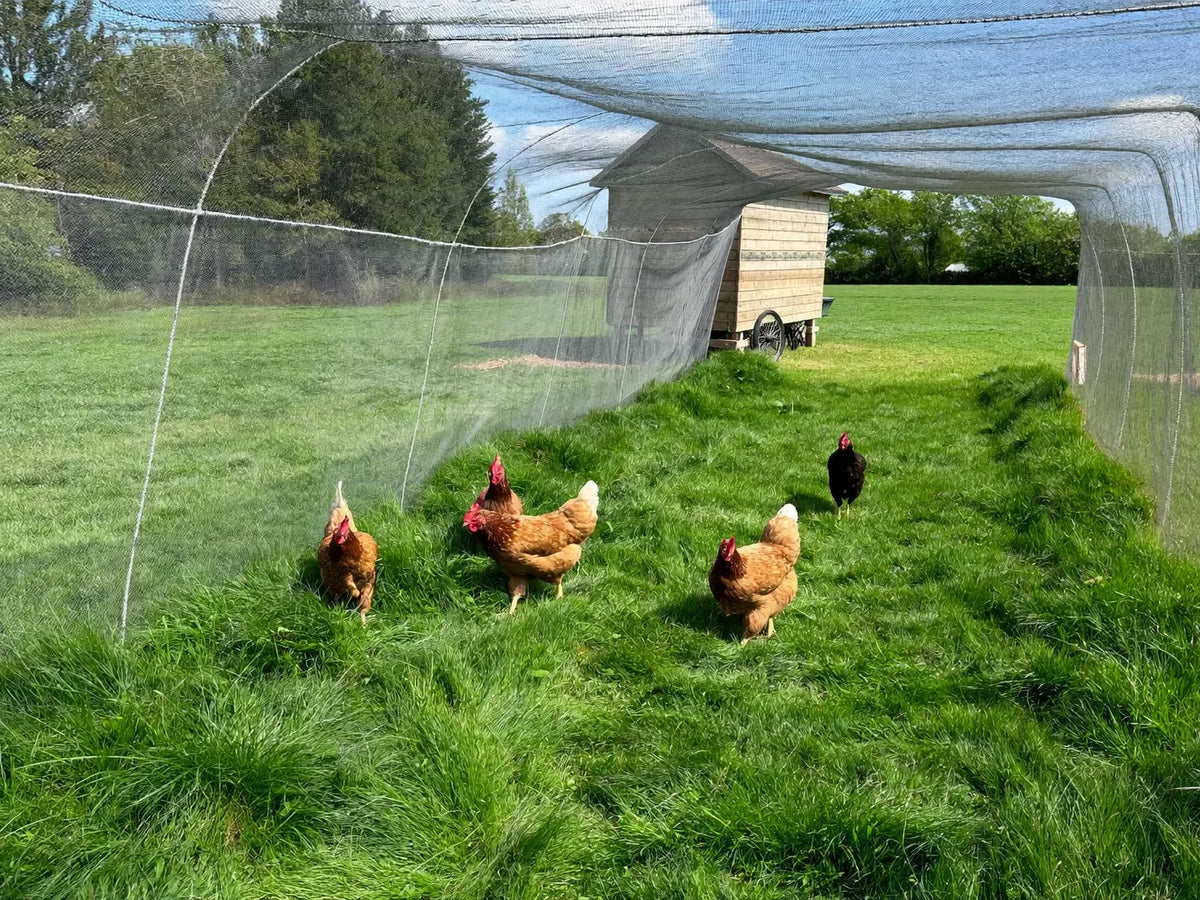
An outdoor chicken run is the fenced, meshed daytime space a flock uses outside the hen house — the part the birds actually live in, and the part that is hardest to size from a product page. Penn State Extension gives it a column of its own: 1.5 sq ft inside per laying hen, 8 sq ft outside. A run that travels with the house is what we know best, and the coops that arrive with a run attached name it in the title. Whether the title is followed by a measurement is the thing to check — and where it is not, that is the figure we get from the manufacturer for you.
Space figures, heat thresholds and overhead-cover instructions all carry a citation under Sources, naming the extension service and the authors who published each one.
The run and the hen house are measured separately
A hen house is for sleeping and laying. The run is for scratching, dust-bathing, eating and getting away from another bird, and the one extension voice that sizes both gives the run the larger number, on both of its tables. Reading one figure as the other is the error that costs a flock its room.
Penn State Extension's Table 1 is headed Minimum Space Requirements for Poultry and carries two columns: "Sq ft/bird inside" and "Sq ft/bird outside runs". For laying hens it publishes 1.5 inside and 8 outside. For large chickens, 2 and 10. For bantams, 1 and 4. The outside figure for a standard laying hen is 5.33 times the inside one.
Virginia Cooperative Extension publishes two columns of its own, under a different heading — Recommended space provision for some main bird types — and with different numbers: 3 to 4 sq ft inside for laying hens, 10 outside. Even the column labels differ: Penn State's reads "Sq ft/bird outside runs", Virginia's "Sq ft/bird outside run". One table is headed as a minimum and the other as a recommendation — and a line above its own table, Virginia calls its indoor figures minimum requirements too. Read the heading and the paragraph around it before you take the number.
The two tables are not two votes. Phillip J. Clauer co-authors both pages, with Gregory P Martin at Penn State and Leonie Jacobs at Virginia Tech, so the two tables are one extension voice printed under two mastheads. Virginia's page is also honest about the evidence underneath all of it: "There is very little research on space requirements for small-scale poultry housing."
The other two services we cite never size the run at all. University of Minnesota Extension gives the indoor figure only — "Be sure to have a minimum of 3 to 5 square feet of indoor space per bird" — and University of New Hampshire Extension does the same, "Mature laying hens should have at least three square feet of floor space per bird", before handling the outdoors in a sentence instead of a number: "If you prefer to let them outdoors during good weather, make a small, well-fenced yard."
Virginia writes the coupling between the two spaces out loud: "Minimum space requirements indoors will be greater if birds do not have access to the outdoors." The indoor figure depends on whether there is a run at all, not on how far it travels. Turning any of this into a flock size is the honest capacity math in our coop size guide, which tabulates all of the published figures side by side. Do the multiplication before you shop: flock size times 8 square feet is the run you are looking for, and the coops that arrive with a run attached are where to start looking for it.
How to size a run from what the listing gives you
A run gets named in the title, described in a phrase, and measured only sometimes — so the first job with any listing is to work out which kind of number you have been handed, because each kind supports a different sum. Four versions turn up, and every one of them can be converted into a hen count if you know what to do with it.
| What you are given about the run | What you can work out from it | What to do next |
|---|---|---|
| Run dimensions — a length, a width and a height | The floor, by multiplying the first two. Divide by 8 sq ft and you have the hen count the run supports outdoors | Do the division before you read the maker's own hen rating, then compare the two |
| A run area already converted to square feet | The same answer without the arithmetic — but only if the figure matches the frame it claims to describe | Ask for the frame dimensions panel by panel and multiply them yourself as a check |
| Areas level by level — a ground run under a raised deck | Which level the birds actually range on. Only the ground figure is run; the deck above it is house | Size the flock on the ground figure alone, and treat the deck as roosting space |
| One overall footprint, house and run together | The space the coop occupies in your yard, which is a siting number rather than a stocking one | Ask for the run's own length and width. That line exists on the maker's frame drawing, and we will go and ask for it |
Worked through on a real published example, the first row goes like this. An outdoor run stated at 54 × 31.5 × 38.25 inches converts to 11.8 sq ft, and a second sheltered strip beneath the living area adds 5.7 — together 17.5 sq ft of run against 6.1 sq ft of living area. At Penn State's 8 sq ft per laying hen outside, that run holds two birds, whatever the title says.
The third row is the one that catches people. Where a coop publishes 20.8 sq ft on the ground under a 13.2 sq ft raised roosting deck, only the 20.8 is run — two to three standard hens at the published outdoor figure. Where the listing's own hen rating disagrees with itself, 2–4 in the title against 3–6 in the description, take the number your own arithmetic supports.
Then there is the mesh. A run's mesh can be named without ever being specified, and the two are not the same thing. Check the listing for a wire gauge and a mesh aperture — the two figures that say what the mesh is made of rather than what it is called. Where neither is given, ask before you order: name the run and both questions go to its maker in one message, gauge and aperture together, and we repeat the answer to you word for word, blank or not.
Portable chicken run: the spec that decides it is weight
Portable is a claim about weight. A portable chicken run is one a person can lift, drag or wheel to a new patch without taking it apart, so the deciding number is what it weighs assembled — and that is the first figure to look for, because it is the one a description is least built to hold.
Two more figures are worth hunting for, and one of them hides under another name. A wheel diameter tells you what the wheel can climb, and 3.9 inches is a published example of one. Ground clearance may not be called clearance at all: "height to the floor" is the same measurement in different words, and 7.5 inches is a published example of that. Where a listing gives you neither, that is the email worth writing: we will chase the assembled weight, the wheel diameter and the clearance in one go.
So read the design instead of the number. Four swivel wheels roll in any direction and want flat ground under all four. Two wheels and a tow handle turn the run into a wheelbarrow, which needs one end lifted and climbs a slope far better — a long tow handle across a seven-foot frame is a long lever, working against a weight the listing has not given you.
A run with no wheels is portable only if the frame comes apart or a second adult is standing next to you. Panel runs are the honest version of that: light sections you unclip and reset, at the cost of a base that never quite meets uneven ground. The portable coops on wheels sit at the other end of that trade, where the run travels attached rather than being lifted separately. Read the wheel count and the handle first, then ask us for the assembled weight before you commit to moving it every few days.
Decided the run matters more than the house? Take 10% off the coop that carries both. GET MY 10% CODE
How does a moveable chicken run survive being dragged?
Four things have to be true. The floor has to be open ground, the frame has to be rigid enough that the panels do not rack, the mesh has to reach the ground without a buried edge, and the ground itself has to be flat enough that the run does not leave a gap behind it.
University of Minnesota Extension is the cleanest citation for why anyone bothers: "Moveable shelters are a valuable tool for pasturing chickens and reducing cleaning time." The same page names the payoff in the yard rather than in the coop — a move "offers new space for chickens to graze and peck, and it provides free fertilizer for the lawn." A moveable chicken run is a manure spreader you did not have to buy.
Minnesota is equally clear about what a run that stays put asks of you instead: "the coop and outdoor area should be cleaned weekly or as needed to control manure and odor buildup", plus a yearly job in spring — "Rake and clean out the yard." Moving swaps a weekly rake for a two-minute push, and the trade runs the way you would want it to.
Where you put it down matters as much as how often. Penn State's siting rule applies to the run and says so: build on high, well-drained areas, because that "prevents prolonged dampness and water saturation of the floor of the coop and outside runs". The same page adds the orientation: face the front of the coop, the windows and the outside run to the south, which lets the sun warm and dry the coop and soil.

The mechanics of the move itself, and how often to make it, are in how to move a chicken coop, and whether an open floor makes the whole thing a tractor is settled by one field in what a chicken tractor is. Before either of those matters, push an empty wheelbarrow along the route you have in mind and notice where it fights you — then look at the coops built to move, which carry the run on the same frame as the house and turn a two-person job into a two-minute one.
Covered chicken run: netting, fabric and a roof do different jobs
A covered chicken run can mean three structures solving three problems. Netting stops what flies in and passes rain straight through. Fabric stops rain and blocks air. A built roof does both, and adds weight to something that may have to be dragged across a lawn.
For overhead protection the published guidance is specific about the material and quiet about everything else. Virginia Cooperative Extension: "To prevent problems with birds of prey, cover the top of your outside runs with mesh wire or netting." It also gives the only overhead spacing figure we could find in any extension publication — "a 3-4 feet grid over the pen constructed of mesh or twine" — and Penn State carries the same instruction, from the same co-author, so count it once.
University of New Hampshire Extension shares no author with either of those pages, and it lands on the same side: "A roofed yard is best." That sentence sits directly after "Remember, everything eats chicken so they are very vulnerable to predation", so read it as a predator instruction and not a weather one. Netting, fabric and a roof still do different jobs, and a run can honestly need more than one of them at different ends.
On a bought coop the cover is a fitted part rather than a weekend project, and it is usually described in words rather than in a thickness, a grommet spacing or a UV rating. How a cover gets worded, and how far the fabric actually reaches, is worked through in our tarp guide. What matters for a run is the trade this section is about: every square foot of fabric you add is a square foot of sky the run no longer has.
Anything below the top rail is a different discipline — mesh aperture, wire gauge, latch type, and what happens where the panel meets the soil. Those belong to how predator-resistant a coop really is, which goes through the hardware properly rather than in a paragraph. For the top rail itself, decide now which of the three you need and at which end, then point at a run from the coops that arrive with the run attached and we will have its maker name the cover fabric before you order.
Shade, air and water in a hot chicken run
A run bakes before a hen house does, because it is the part with no roof over most of it. University of Minnesota Extension puts the thermoneutral zone for most poultry between 60 and 75 degrees Fahrenheit, and the birds start spending energy on cooling above it.
Minnesota names the sequence plainly: "As air temperatures increase towards 85 degrees Fahrenheit, the bird will try to lose heat through evaporative cooling, panting." Panting is not free — the same page notes that it "creates more heat through muscle activity", and that during heat stress birds "increase their water intake by 2 to 4 times the normal amount".
Three levers work on a hot chicken run, and only one of them is a purchase. Shade is the one you can act on this afternoon, and where it ranks against ventilation in the literature is settled in our summer prep guide rather than re-argued here. Penn State suggests growing it, low shrubs with good leaf cover giving the birds "cover and shade", which is a fine plan that arrives two summers late.
Air is the second lever, and it is the one a mesh run already has. Minnesota's line for it is plain: "In most cases, you can manage heat in your flock through air flow." On a run that mostly means not wrapping it. A cover pulled down all four sides in August turns a mesh run into a box — the same trade a winter tarp makes, in the other season, and where the openings belong on the house is our ventilation guide.
Water comes third and costs almost nothing. Two drinkers in a hot run, one of them in shade, is the cheapest thing on this page, because a single fount in full sun runs warm and runs dry at the same hour. Virginia's line is to place the waterer in the outside runs when possible, rather than only inside.
The run that moves has a lever the others do not. Shade at 8am is not shade at 2pm, and a coop on wheels follows it across the lawn for free. If yours stays put, the shade has to come to the run instead — a cover over one end, planting, or shade cloth fixed to the coop or the run frame. Work out where the shade in your yard lands at two in the afternoon before you decide which you need; if the answer is nowhere useful, that is the argument for the coops built to move.
When does a large chicken run stop being moveable?
At the point where two people and a flat lawn stop being enough. A large chicken run is bought for the same reason a large coop is — more birds, more room per bird — but every foot of frame added is weight and rack, and there is a size past which nothing rolls.
The category draws the line at about twelve feet. Up to roughly that length a run and its roofed resting areas can still ride on four heavy-duty wheels and be pushed by two people. Go past it — a walk-in shell at 9.2 by 31.2 feet, 286 sq ft of floor — and there are no wheels on it at all, because there is no arrangement of wheels that would help.
Size that decision to the flock you have rather than the flock you might have, because the surplus gets carried across the lawn every time. A run big enough to walk into is a run big enough to want a level, prepared spot, which is what the walk-in enclosures and the larger coops are built around — and a shorter run on wheels is what you buy if the plan is fresh grass every few days.
One thing to check before scale tempts you: a stated area on a run-only listing is the least reliable number in this whole category, because the label and the frame are written by different people. Ask for the frame dimensions instead, panel by panel, and work the area out yourself. Name the run and we will have its maker give up those frame dimensions panel by panel.
What a run that moves costs you, and what it saves
It costs you the permanent perimeter. The published ground defence for a fixed run is a buried one — bury the wire along the pen border at least 12 inches deep, and toe the fence outward about 6 inches — and a run that moves every few days can do neither of those things. That instruction is printed by two services, and the same co-author stands behind each of them, so count it once.
So the night lock-up does the work the ground cannot — the reason for the routine, and the latch hardware that carries it, are in our door guide. On a coop-and-run rig the hen house is the part that latches, which makes the latch on the house the specification to read hardest, not the mesh on the run.
What it saves is the raking. A run that stays in one place needs the manure taken out of it on a schedule, which is Minnesota's weekly job; a run that moves leaves the droppings spread thin and takes the flock somewhere else. What that does to a lawn over a year, with the arithmetic, is in why we move coops at all.
Our position, plainly. Buy the run attached to the house if your ground will let you move both — flat, mown, no gravel path in the way — and start with the coops that arrive with the run attached or the ones built to be pushed. If the only level ground you have is paved, a run that stays put is the better machine, and the walk-in enclosures are where the standing headroom is: 6.5 feet at the ridge and 3.7 at the eaves is a published example of what that buys you.
Measuring for a specific gap in the yard? Give us the run you are considering and we will come back with its length, its width and its mesh spec, straight from the people who built it. The full range, static and rolling, is on one page of coops.
Sources: Penn State Extension, “Small Scale Poultry Housing” (Gregory P Martin, Ph.D., PAS and Phillip Clauer, updated June 25, 2026) — accessed August 20, 2026 · Virginia Cooperative Extension 2902-1092, “Small-scale Poultry Housing” (Leonie Jacobs and Phillip J. Clauer, April 28, 2023) — accessed August 20, 2026 · University of Minnesota Extension, “Raising chickens for eggs” (Betsy Wieland and Nora Nolden; Sabrina Florentino, reviewed in 2025) — accessed August 20, 2026 · University of Minnesota Extension, “Preventing heat stress in poultry” (Sally Noll and Sabrina Florentino, reviewed in 2026) — accessed August 20, 2026 · University of New Hampshire Extension, “Producing Your Own Eggs” (no author shown; Kendall Kunelius listed under Contact; no date shown) — accessed August 20, 2026. Penn State and Virginia Cooperative Extension share a co-author, Phillip J. Clauer, and are treated here as one voice published twice. Run, wheel and enclosure figures quoted in the body — an outdoor run of 54 by 31.5 by 38.25 inches at 11.8 sq ft with a 5.7 sq ft strip beneath, levels of 20.8 and 13.2 sq ft, a 3.9-inch wheel diameter, a 7.5-inch “height to the floor”, and a walk-in shell of 9.2 by 31.2 ft at 286 sq ft under a 6.5-foot ridge and 3.7-foot eaves — are read from PawHut’s own published specifications, accessed August 20, 2026.
Frequently asked questions
How to keep mice out of chicken coop and run?
Mice come to a run for what is lying in it and what is stacked against it, so start with the harbourage rather than the traps. Clear long grass, stacked timber and clutter away from the run frame, and keep the feeder off the run floor overnight. A run that moves gets a fresh floor every few days, which breaks up burrowing before it starts. Feed storage, exclusion sizing and trapping are in our pest control guide.
What to put on chicken coop run floor?
Grass, if the run moves. A run that travels sits on fresh ground every few days and the lawn does the work, which is the whole reason a coop rolls. A run that stays put strips to bare soil within weeks, and then the answer is a deep layer you top up rather than a surface you lay once - wood chips, or sand, with the trade-offs set out in our sand guide.
How to set up a chicken coop and run?
Pick the ground before you pick the spot. Penn State Extension says to build on high, well-drained areas, which prevents prolonged dampness and water saturation of the floor of the coop and outside runs. Face the front of the coop, the windows and the outside run to the south so the sun warms and dries the soil. Then level the frame and walk the perimeter for gaps before the birds go in.