

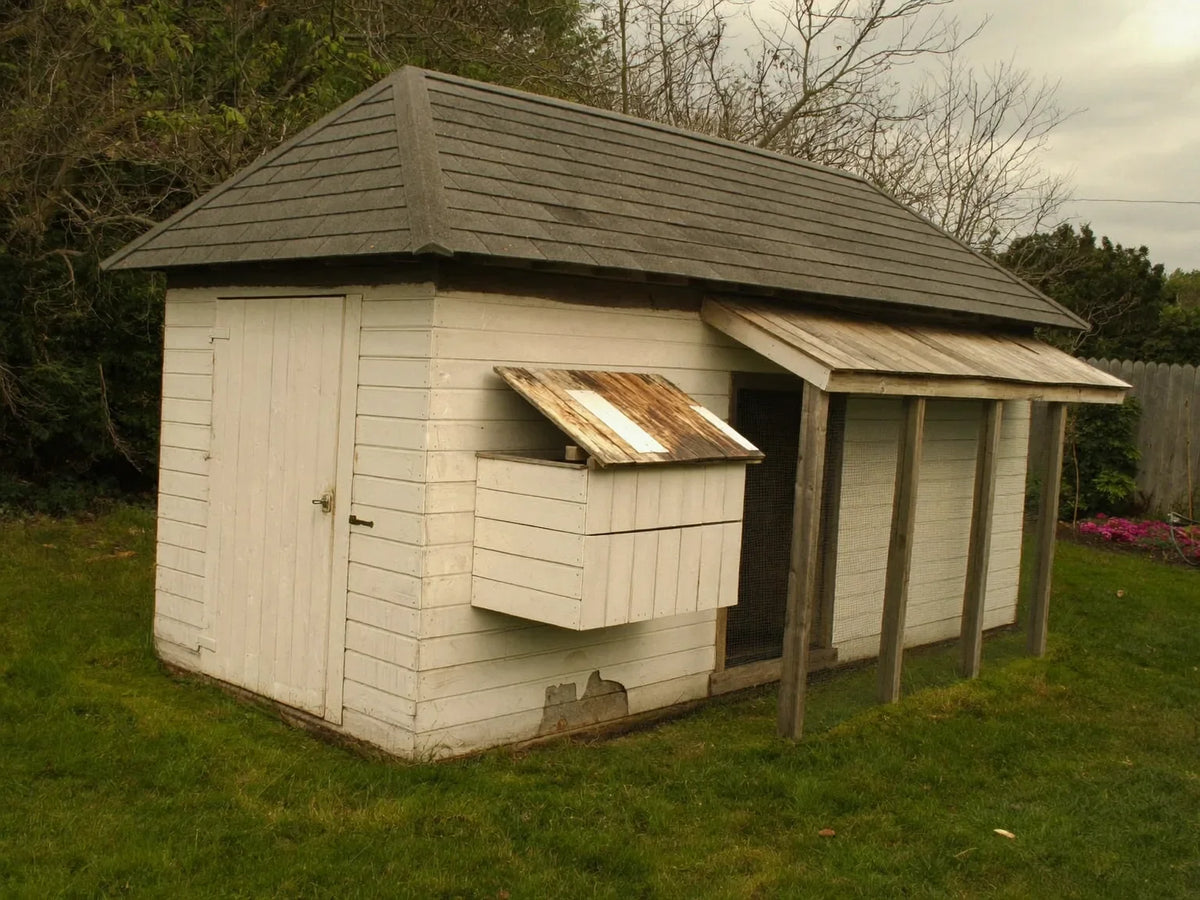
A white chicken coop is a painted coop, and the paint is the one spec almost nobody publishes. Only a film-forming paint gets you a bright white — Purdue Extension and the USDA Forest Products Laboratory say so in a single sentence — and a film that opaque is also the part that chalks, blisters and gets pecked at. Read a listing for three separate things, because they are three different rows: a colour, a coating, and what that coating is made of. Start with the coops themselves. Here is what the coatings actually are, what the safety literature names, and what you can put on top of them later.
The lead limit, the VOC advice, the film-versus-penetrating rule and the repaint sequence below are quoted from extension services and federal agencies named at the foot; where a finish row gives an adjective instead of a binder, we ask the maker.
Is a white chicken coop a good idea?
White is a good choice for a coop and a poor one for a low-maintenance coop. It can only be reached with a film-forming paint, which peels once water gets behind it, and it shows every splash. The gain is that nothing hides on it.
Visibility is worth more on a coop than on a house wall. The failures you want to catch early — a lifted edge, a wet corner, a patch a hen has been working at — all announce themselves on a pale surface.
The extension literature has exactly one instruction about painting a poultry house, and where it sits is the interesting part. Penn State Extension's Small Scale Poultry Housing mentions paint once in the whole publication — "Structures should be kept painted and well-maintained." — and that sentence lives under the heading Appearance, in a paragraph about the neighbours. The paragraph around it argues that a coop "should never detract from the over-all appearance of the surroundings" and warns that "Unsightly structures are not good for the image of bird producers and may lead to new laws restricting the raising of birds in your area."
So the one published reason to paint a coop is a zoning reason, not a bird reason. Nothing in that publication ties paint to health, warmth, hygiene or lifespan. Read against the rest of the page — which does give numbers for floor space, roosts, nests, feeder space and ventilation — the silence is the finding.
Virginia Cooperative Extension carries the same paragraph under Housing Appearance, with two changes worth having: "Exteriors of structures should be kept painted and well-maintained", prefaced "Although this may be less relevant". The word Exteriors narrows it to the outside face. The hedge is the service's own estimate of how much any of this matters.
Penn State and Virginia are not two votes. Phillip J. Clauer co-authors both pages, with Gregory P Martin at Penn State and Leonie Jacobs at Virginia Tech, so the paragraph rests on a single extension author printed twice, not on two services in agreement. The other two services we read on housing — University of New Hampshire and University of Minnesota — contain no paint content at all.
Purdue Extension and the USDA Forest Products Laboratory supply the sentence that makes white a decision rather than a preference: "Paints are the only way to achieve a bright white finish." Those are two institutions on one byline — Daniel L. Cassens at Purdue and William C. Feist at the Forest Products Laboratory — rather than two publications agreeing, and every quotation below marked "Purdue" comes from that one document. Every other exterior finish in their taxonomy either tints the timber or soaks into it. If white is the look you want, you have chosen a film, and everything below follows from that.
Painted chicken coops: what is actually on the wood
Painted chicken coops arrive wearing one of about five finishes, and the listing usually names none of them. What you get is an adjective bolted to the word paint — waterproof, weather-resistant, environmental — with no chemistry, no standard and no cure time behind it.
The five behave very differently, and the differences decide what you can put on top later.
| Finish | What it does to the wood | Comes in white? | How it gives up | What can go over it later |
|---|---|---|---|---|
| Paint (film-forming) | "Applied to the wood surface and do not penetrate it deeply"; the grain is "completely obscured, and a surface film is formed" | Yes — "the only way to achieve a bright white finish" | "Can blister or peel if the wood is wetted" | More paint, after scrubbing and a bond test |
| Solid-colour stain | Heavily pigmented, "similar to thinned paints"; oil-based versions "form a film much like paint" | In effect yes — it behaves as paint | "Can also peel loose from the substrate" | Paint, or more solid-colour stain |
| Semitransparent penetrating stain | Soaks in, stays porous, does "not form a surface film like paints" | No — "They are not available in white" | Thins and greys rather than peeling; "will not blister or peel even if moisture gets into the wood" | Only more of the same — "not effective when applied over a solid color stain or over old paint" |
| Water-repellent preservative | Wax, fungicide and resin in solvent, with no pigment, so the colour follows the timber | No | "The life expectancy is only 1-2 years" | Another coat, or paint if the product is a paintable grade |
| Clear varnish or film finish | A clear film over visible grain | No | "In severe exposures, clear film finishes may last barely one year" | Nothing, until it is fully sanded off |
NCR-135 is forty years old, and we cite it because it is still the only thing in the extension system that treats an exterior wood finish as a decision rather than a taste. The physics in it has not moved: a film sits on top and can lift, a penetrating finish soaks in and cannot.
Now the listings. Now the listings, and the one distinction to hold on to while you read them. A finish row saying "eco-friendly water-based paint" has named a binder: water-based means a latex film, and that single word decides what you can put on top of it later. A row saying "environmental paint" has named an adjective and stopped short of the chemistry. On a product page the two read almost identically. Only one of them has answered anything.
| The phrase in front of you | What it does commit to | What is still worth asking |
|---|---|---|
| “Water-based paint” | A binder. Water-based means a latex film, which is the family a later latex coat will bond to | Nothing about lead, VOCs or cure time. Those are three separate questions and worth asking together |
| “Environmental paint”, “eco-friendly” | An adjective. No standard is named, so there is nothing testable in it | What the binder actually is — which is also what settles whether you can repaint it |
| “Weather-resistant paint”, “waterproof paint” | A performance word about rain, not a chemistry | Whether it is a film or a penetrating finish. The two fail in opposite ways, and only one can be recoated with the other |
| “Natural fir wood” with a colour named beside it | Less than it looks like. Fir is a yellowish timber, so a stated colour can be the tone of bare wood or a coat on top of it | Whether there is any coating there at all. Ask before you plan to paint over it |
| “Anti-rust galvanized steel sheet” plus a coating colour | A metal substrate and a factory coating on it — a genuinely different maintenance job from paint on timber | Whether the coating runs on both faces, and what protects a cut edge |
| A colour, and no finish row anywhere on the page | What it looks like in the photograph | Everything else. Send us the model: the binder is on the maker’s own spec sheet even when it never reaches the ad |

Row four is the whole problem in miniature. A listing whose material row reads "Natural fir wood" and whose colour row reads "Yellow" could be bare timber described by its tone, or fir under a yellow coat. Nothing else on the page decides between them, and fir is genuinely a yellowish wood, so both readings survive. Treat that as a question with an answer rather than a dead end, and get it answered before you plan a repaint.
Four things are worth checking for by name, because they are easy to read past: a lead figure, a VOC figure, a cure time and a coating standard. And check what any certification on the page is certifying — FSC-certified wood certifies forest management, which says nothing at all about lead, solvents or cure time. Point us at the coop and the binder comes back named in the maker's own words rather than the listing's.
What about lead paint and a hen that pecks?
A hen pecking at flaking paint is a real question with a published answer. University of Maine Cooperative Extension has fielded it, and its advice is to "keep chickens away from structures painted with lead-based paint".
The keeper who asked had hens escape and found them "pecking up and eating paint that had flecked off our 1860's house". Note where the paint was: on the house, not on the coop. That is the shape the extension advice is written around, and it points at the yard rather than at the coop you are choosing.
The rule this question usually reaches for is 16 CFR Part 1303, the Consumer Product Safety Commission's lead-paint ban. Its current text caps lead at 0.009 percent of the dried paint film — reduced from 0.06 percent, effective August 14 2009 — and it applies to products manufactured after February 27 1978. Worth reading, though, is what section 1303.4 actually lists as banned: the paint itself, "toys and other articles intended for use by children", and "furniture articles". Livestock housing is not one of the three.
So the ban is a fact about paint you buy, not a certificate for a factory finish on something else. That is not an accusation about any coop; it is a note about what the rule covers. Where a coating is unstated, the answer is to ask the manufacturer rather than to guess from the category.
The Maine answer also quotes a New York City study of hens with continuous access to lead-contaminated soil, which found all but one egg under 100 micrograms of lead per kilogram, "at concentrations that were not higher than those in foods considered acceptable for commercial distribution". Read the direction of that carefully: it measured soil exposure, not paint flakes, so it is reassurance about a run on old ground rather than a verdict on a coating. The same page's practical suggestions are about the ground too — clean cover material over a run, feed in feeders rather than scattered on bare soil, and "Consider providing a calcium supplement, which may help to reduce the amount of lead that gets into chickens' eggs."
One more scoping note, because it is easy to get backwards. The only thing Penn State tells you to keep out of the birds' beaks by name is not paint: "Make sure that the birds cannot pick at or eat insulation (spray foam, board or loose insulation)." Whether that caution extends to a peeling coat is a reading, and our guide to what belongs inside a coop is where the interior question is settled.
Know which finish you want before you buy? Take 10% off the coop it goes on. TAKE 10% OFF
Fresh paint, a small box, and how long to wait
A coop is a small box in which a fresh coating has to finish off-gassing, and nothing we opened for this guide publishes a waiting time for one. The EPA gives the mechanism instead: "Paints, varnishes and wax all contain organic solvents".
Solvents leave on their own schedule. Products "release organic compounds while you are using them, and, to some degree, when they are stored", and "elevated concentrations can persist in the air long after the activity is completed."
The instruction that follows is short enough to act on: "Increase ventilation when using products that emit VOCs" and "Meet or exceed any label precautions." A coop is the one structure already built to do the first of those, which is why the vents matter as much on the day you paint as they do in July — our ventilation guide has what the makers state and what they leave out.
Be careful with the EPA's numbers, though, because they are not coop numbers. The "up to ten times higher" indoor figure and the largest number on that page — levels up to 1,000 times background — are measured in homes, and the second one is for paint stripping rather than painting. Neither transfers to a ventilated box on a lawn, and we are not going to pretend otherwise by carrying them across.
What does transfer is the weather, because a film that has not cured is a film that is still releasing solvent and still soft enough to mark. Purdue and the Forest Products Laboratory give the conditions: oil-based paint goes on at 40°F or above, "A minimum of 50°F is desired for applying latex-based paints", and "For proper curing of the paint film, the temperature should not drop below 50°F for at least 2 hours after paint application." They add the trap the timing sets up, which is painting late in the day in spring or autumn, "when heavy dews form before the surface of the paint has thoroughly dried."
Our own reading, and label it as ours: paint the coop empty, with the bedding out and everything propped open, and give it warm weather rather than a fixed number of hours. A hen judges a wet coat by tasting it.
Is a black and white chicken coop a bad idea?
A black and white chicken coop is two coats on one building, and the two halves fail differently. Dark coats blister when they go on cool and are then hit by sun; pale coats hold on and go shabby instead.
Purdue names the dark-colour failure precisely: "Temperature blistering is most common with thick paint coats of dark colors applied in cool weather", and it appears "within a few hours to 1 or 2 days after painting". The mechanism is in the preceding sentence — oil-based paints "should not be applied on a cool surface that will be heated by the sun within a few hours" — so this is a failure of application, not a claim about a black coop being hot to live in. Which colour runs warmer is settled in our summer prep guide rather than re-argued here.
In the range, black rarely arrives on its own. Where a listing offers white at all, it offers the same three together — gray, white and black — and never white by itself; a large fir coop with a run offers grey and black without white. So a listing that mentions black and white is usually offering a choice of single colours, not a coop that arrives in two.
One note, because the searches run together. Black and white chickens and white chickens are questions about birds, not buildings. Plumage colour is not a coop specification — University of Minnesota Extension's laying-hen page files colour under the breed, listing "Many color varieties" against Wyandottes and Orpingtons, and never under the housing — and the surface whose colour changes the temperature inside a coop is the building's, not the hen's. Breed colour deserves its own guide, and this one is about the coating.
What fades, what shows dirt, and what a hose does to it
Watch where a sunlight claim lands, because it is rarely attached to the thing you were asking about. "UV-resistant" and "anti-UV" are real phrases on real listings; the question is which component each one is bolted to.
The wording runs like this: a "UV-resistant asphalt" roof; "Waterproof, anti-UV material"; a "Removable UV-resistant waterproof cover over the metal run"; an "Anti-UV" cover on a walk-in. Every one of those is a claim about a component you can point at. The closest anything comes to covering the wall itself is a steel coop whose weather row reads "Rainproof, windproof, UV-resistant, corrosion-resistant per the manufacturer" — a claim about the whole building, and still not a claim about a paint film.
Sunlight is what ends a paint film, so that is a gap worth noticing rather than a technicality. Purdue's own service-life figures are for a house wall, not a coop: "one coat of a good house paint over a properly applied primer (a conventional two-coat paint system) should last 4 to 5 years, but two coats can last up to 10 years." A house wall does not get dragged across a lawn, hosed weekly or scrubbed with a brush, so treat those as a ceiling and not a forecast.
Dirt is the other half, and the honest version is that every colour shows something. Pale coats show droppings and mud; dark coats show chalking, lime and hard-water spotting. The colour that wins is the one you will still be willing to scrub in November. What the literature does insist on is that the surface be scrubbable at all: Penn State and Virginia both ask you to "Use building materials which will be easy to clean and disinfect" — one voice again, the same Clauer pair — and a sealed painted face meets that where bare rough timber does not.
There is one collision worth spelling out before you reach for a bucket. Purdue's refinishing routine says "Mildew should be removed with a dilute household bleach solution", and the same publication's warning box opens "Do not mix bleach with ammonia or with any detergents or cleansers containing ammonia". That warning is written about cleaning products — but a coop is also the one structure whose bedding produces ammonia continuously. Our reading, and it is ours rather than Purdue's: strip the bedding, air the coop out, and only then bring bleach near it, and never alongside an ammonia-based cleaner. Which bedding is generating what is covered in our bedding and flooring guide.
Purdue adds a detail that lands oddly well on a coop: the surfaces that need cleaning most are the ones sheltered from sun and rain, "such as porches and side walls protected by overhangs", because "These areas tend to collect water soluble materials that interfere with adhesion of the new paint." On a coop that is the underside of a nest-box lid and the wall beneath a generous roof overhang — the parts you never think to wash. The overhang itself is worth getting right for other reasons, which our coop roof guide works through.
Can you repaint a coop that arrived painted?
Yes, and the finish it arrived in decides what you may put on top. Paint goes over paint. A penetrating stain does not — Purdue's rule is that semitransparent stains "are not effective when applied over a solid color stain or over old paint."
The door only swings one way, so it is worth knowing before the first coat rather than after it.
The preparation is the job. Scrape off everything loose, sand the remaining edges to feather them into bare wood, scrub what is left with a brush and water, rinse, and let it dry. Any bare wood that appears should be treated with a water-repellent preservative, "allowed to dry for at least two days, and then primed."
Then there is a test worth doing, because it takes a day and saves a summer. Purdue's check for whether a latex coat will bond to a weathered surface is to paint a small hidden patch, let it dry overnight, press an adhesive bandage firmly onto it, and "Jerk it off with a snapping action." Tape clean means the bond is good. Paint on the tape means the old surface is "too chalky and needs more cleaning or the use of an oil-base primer."
Start at the ends and edges of every board, because that is where the failure begins. Purdue treats lap and butt joints and the ends of panels as a special case in its own right, "since paint normally fails in these areas first" — which is exactly the place a coop's boards meet a nest lid, a door frame and the ground. If you are building rather than buying, our DIY coop guide covers the sequence from the frame up.
One practical caution on a coop you bought. A coat of anything is a modification, and modifications are where warranty terms get specific about what is still covered. Hand the coop over and two questions go to its manufacturer in one message: what the terms say about recoating, and what the factory finish actually is.
Choose a coop for the things you cannot change afterwards — the floor, the roof, the way it moves — and treat the finish as the part you can. If white is what you are after, read the colour row before you look at the photograph — browse the coops — and bear in mind that a coop with a run attached hands you more painted surface to keep up. Say which coop and which colour, and we will have the finish confirmed by its maker before you order.
Sources: Penn State Extension, “Small Scale Poultry Housing” (Gregory P Martin, Ph.D., PAS and Phillip Clauer, updated June 25, 2026) — accessed August 21, 2026 · Virginia Cooperative Extension 2902-1092, “Small-scale Poultry Housing” (Leonie Jacobs and Phillip J. Clauer, April 28, 2023) — accessed August 21, 2026. Penn State and Virginia share a co-author, Phillip J. Clauer, and print the same housing paragraphs, so they are one extension voice published twice · University of Minnesota Extension, “Raising chickens for eggs” (Betsy Wieland and Nora Nolden; Sabrina Florentino, reviewed in 2025) — accessed August 21, 2026 · Purdue University Cooperative Extension Service NCR-135, “Selection and Application of Exterior Finishes for Wood” (Daniel L. Cassens, Purdue, and William C. Feist, USDA Forest Service Forest Products Laboratory; revised March 1986) — accessed August 21, 2026 · University of Maine Cooperative Extension, “What do I do if my chickens consumed paint with lead in it?” (FAQ: Livestock, May 31, 2023) — accessed August 21, 2026 · US Consumer Product Safety Commission, 16 CFR Part 1303, “Ban of Lead-Containing Paint and Certain Consumer Products Bearing Lead-Containing Paint” (eCFR current text) — accessed August 21, 2026 · US Environmental Protection Agency, “Volatile Organic Compounds’ Impact on Indoor Air Quality” — accessed August 21, 2026.
Frequently asked questions
What paint is safe to use on a chicken coop?
Judge a coop paint on the things you can actually check rather than on the adjective on the label. Buy paint sold for consumer use in the United States, where 16 CFR 1303 caps lead at 0.009 percent of the dried film. Follow the tin — the EPA's own advice is to "meet or exceed any label precautions" and to increase ventilation while you work. Then let it cure with the coop empty and everything propped open.
What color should i paint my chicken coop?
Pick the colour you will still be willing to maintain. A pale coat hides chalking and fading but shows every splash; a dark coat hides muck and is the one Purdue Extension warns about, because "temperature blistering is most common with thick paint coats of dark colors applied in cool weather". Whichever you choose, paint in mild weather and keep the film thin and even rather than heavy.
How to waterproof chicken coop?
Paint is not waterproofing. Purdue Extension and the Forest Products Laboratory put a water-repellent preservative on before the primer and ask for liberal treatment of "lap and butt joints and the ends of panel products", which is where a film gives up first. The roof and its overhang do the real work, which our coop roof guide works through; the coating only protects what is left over.
How to maintain wooden chicken coop?
Wooden coops fail at joints and end grain first, so maintenance is mostly water management. Purdue Extension's routine is scrape off what is loose, feather the edges smooth with sandpaper, scrub the rest with a brush and water, rinse and let it dry. Treat any bare wood with a water-repellent preservative and give it two days before priming. Do it in mild weather, and check the ends and edges of every board first.