

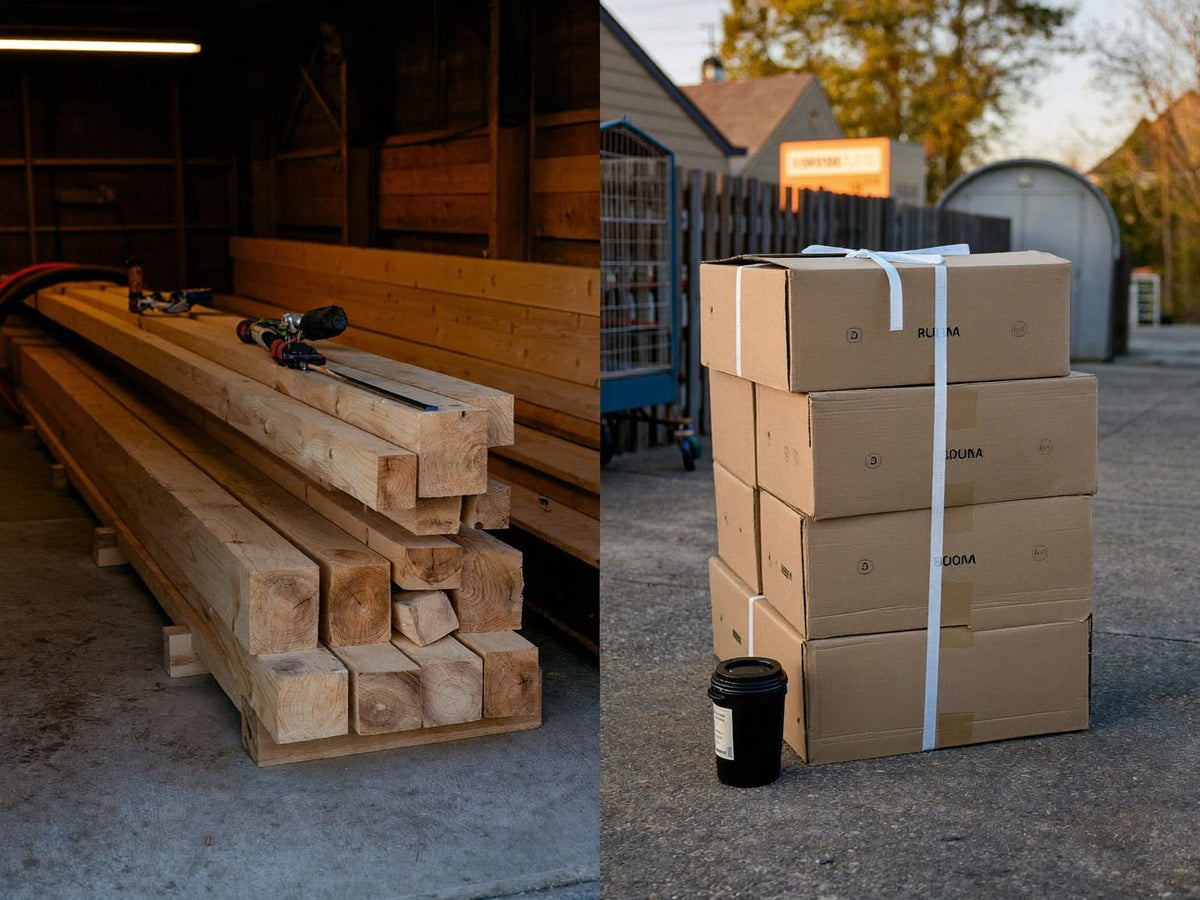
Building is usually cheaper in materials and almost never cheaper in total, because the expensive input is your weekend. This page does the sum both ways: the seven line items a DIY chicken coop really costs, the arithmetic that tells you whether a bought coop is good value for the ground it stands on, and the hours nobody puts on a materials list. A self-build beats the low end on materials if you already own the tools — and loses badly if you have to buy a saw, or if the half-finished frame is still in the garage in October. Here is both sides, priced where we can price them honestly, next to the coops we actually sell.
No lumber total is printed anywhere on this page, and the section that explains why is the most useful one on it. The hen-space figures behind the pallet and shed arithmetic are Virginia Cooperative Extension's and Penn State's, cited in full at the foot.

Is it cheaper to build or buy a chicken coop?
On materials, usually yes — a small coop's worth of framing lumber, cladding, roofing and wire generally comes in under what a comparable finished coop costs, because you're not paying for a shipping carton or a retailer's margin. On total cost, usually no, once the tools and the hours are counted honestly.
The gap narrows fast as the coop gets smaller. A very small bought coop carries almost as much hardware, as many hinges and as many corners as a big one, spread over a fraction of the area — which is why price per square foot of floor climbs sharply as coops shrink. Run that sum on any two listings you are weighing up and you will see it inside a minute; the arithmetic is in the third section below.
So the real question isn't which is cheaper. It's which cost you'd rather pay: money, or Saturday. Work through both sides here, then price the answer against the coops with runs, where most four-to-six-hen buyers end up.
What a DIY coop actually costs
Seven line items, every time. The quantities come off the plan's cut list; the prices come off the shelf at your local yard on the day you buy. The fourth column is the one worth reading twice — it is where the money actually goes.
| Line item | Where the quantity comes from | What to specify | Where the cost hides |
|---|---|---|---|
| Framing lumber | The cut list | Nominal 2 × 2 and 2 × 4 | Priced first by everyone, and the least likely line to surprise you |
| Cladding or sheathing | The elevations | Exterior-grade sheet or board | Sheet goods come in fixed sizes. Offcuts are money on the floor unless the cut list nests the parts |
| Roofing | The roof plan | Single-slope sheet or shingle | The line left off the back-of-the-envelope sum more often than any other |
| Wire mesh | The run elevations | Aperture and gauge, both stated | Sold by the roll, not by the running foot. A short run still buys a whole roll |
| Hardware | The materials list | Hinges, latches, screws | The second trip to the store. Count hinges off the plan before you leave the house |
| Finish | Coverage stated on the tin | Exterior paint or stain | Two coats, plus the drying days between them, which are days the hens are not housed |
| Wheels and axle | Moveable builds only | Diameter and rated load | Rated load, not diameter, is what fails. An under-rated castor is a one-season part |
Now the part most articles handle badly: the total. Framing lumber is a commodity — it moves week to week and varies by region and by yard. The NAHB publishes the framing lumber composite for precisely that reason — in the week to 17 July 2026 it moved 0.2%, according to Madison's Lumber Price Index. A single dollar figure typed into an article eighteen months ago and never revisited is worse than an empty column, because the empty column at least tells you to go and look.
What we can tell you is where the money hides. It isn't the lumber. It's roofing, wire and hardware — the three lines people leave off the back-of-the-envelope sum and then buy in a second trip. And it's tools, if you don't own a circular saw, a drill and a square, at which point the "cheap" build stops being cheap on the first purchase.
Take the cut list from our free plans, price the pile at your yard, and you'll have a real number for your zip code — which is the only kind worth having.
What the easy chicken coop costs: the bought option, priced
Here is the side you can measure exactly, on any listing, in under a minute. The useful figure isn't the sticker — it's what you pay per square foot of ground the coop actually occupies. Divide the price by the stated length times the stated width, both converted to feet, and compare that number instead of the sticker.
| What you're comparing | The sum to do | What the answer tells you |
|---|---|---|
| Coops of different sizes, against each other | Price ÷ (stated length × stated width, in feet) | Which is genuinely better value per foot of ground. The sticker on its own cannot tell you |
| A bought coop against your own build | Priced cut list ÷ the same footprint | Whether the build is winning on materials or only on optimism |
| A coop with a big run against a compact henhouse | The sum twice — once on total footprint, once on henhouse floor alone | Run area is cheap per foot; sheltered floor is expensive. If the two answers diverge sharply, you are mostly buying run |
| A very small coop against a mid-size one | The same sum on both | Small nearly always loses. Hinges, latches and corners don't shrink with the floor |
| A listing that gives one dimension only | You can't run it yet | A length in the title and no width is a signal in itself. Ask for the second dimension before you compare — then start with the coops with runs, where footprint is the whole decision |
Two things fall out of running that sum a few times. Small costs more per square foot in every category of manufactured goods and coops are no exception — the corner count doesn't shrink with the floor. And a big covered run drags the figure down hard, which flatters a coop whose sheltered floor is actually tiny, so it pays to do the second sum as well as the first.
Priced the lumber yet? Sometimes 10% off a finished coop wins the math. GET MY 10% CODE
One more honest note on the bought side, because it is the number nobody puts in a headline. A flat-pack coop is not finished when it arrives, and the build-versus-buy sum is not fair until you count that too. Two things to look for on any listing: a stated assembly time, and a stated carton count. Where a listing gives them, believe them and put the afternoon in the diary — published assembly times for a compact coop can be as short as forty minutes with two people, which is genuinely realistic at that size. Where it doesn't, ask us and we'll get both from the manufacturer before you order, and plan for a couple of hours and a second pair of hands either way.
The hours nobody counts
A first coop build runs across five distinct jobs, and only one of them is the fun part. Marking and cutting. Assembling the frame square. Roofing. Wiring the run. Painting or staining, then waiting for it to dry.
The order doesn't matter here — what matters is that four of the five are slow, and two of them (roofing and wiring) are the ones beginners consistently underestimate, because both involve working around a shape that's already built.
Then there's the invisible time: reading the plan properly, two trips to the store, and the half-hour you spend at the start of day two working out what you were doing at the end of day one. Nobody puts that on a materials list, but it's real, and it's the reason so many builds stall.
Our position is straightforward: if you enjoy the work, none of this is a cost. Making things is a good way to spend a weekend and a coop is an excellent first carpentry project — forgiving tolerances, no plumbing, and the client doesn't complain. If you don't enjoy the work, all of it is a cost, and you should run the price-per-square-foot sum again on the coop you were about to dismiss.
Pallet chicken coops: what a pallet actually gives you
Less floor than you think. The standard North American pallet is the GMA footprint at 48 × 40 inches, which is 13.3 square feet of deck. Butt four of them into a square and the outside is about 4 × 4 feet, but once you allow for the frame thickness the interior comes out nearer 40 × 40 inches — roughly 11 square feet. At the 3–4 sq ft per standard hen that Virginia Cooperative Extension publishes, that's three hens. Not the eight the photographs imply.
The bigger issue is that a pallet is a frame, not a wall. GMA deck boards are 3½ inches wide with gaps between them, so every pallet you stand up as a wall needs cladding on one side before it's weatherproof or secure. Free pallets plus the plywood to sheet them is a different budget from free pallets.
Three practical checks before you use any pallet for a coop:
- Look for the heat-treatment mark. Pallets treated with methyl bromide exist; you don't want one holding your birds.
- Check what it carried. A pallet that spent its life under something spilled is not a bargain.
- Measure it. Pallet sizes vary widely outside the GMA standard, and a build designed around 48 × 40 falls apart if half your stack is a different footprint.
Pallets are genuinely good for one thing: the base and the frame of a run, where the gaps don't matter and the strength does. As coop walls, they're a saving on framing lumber only, and framing lumber was never the expensive part.
Turning a shed into a chicken coop
A shed conversion starts with more space than most purpose-built coops and one significant handicap: sheds are designed to keep weather out, which means they're designed to stop air moving. Ventilation is the whole project.
The arithmetic is friendly. A 6 × 4 ft shed gives 24 square feet of floor — six to eight standard hens at published space figures. An 8 × 6 gives 48 square feet, which is 12 to 16 hens, more than most backyard flocks will ever need.
Five things change on the way from shed to coop, and none is a step in a build sequence — they're decisions to make before you start:
Ventilation. Add vents high, above roost height, on more than one wall. Penn State Extension puts the requirement as ample air movement without a draft, and a sealed shed delivers neither air movement nor, once it's damp, anything pleasant.
The pop-hole. A shed has a people door, not a bird door. You need a low opening the hens can use without the big door being open, and it wants to be generous and roughly square.
Roosts and nests. Penn State's figures: roosts 18 to 24 inches above the floor, spaced a foot apart, about six inches of perch per standard bird, and never so high that birds are jumping down more than four feet. Nests at least 12 × 12 inches, two feet off the ground and four feet away from the roosts.
The floor. A wooden shed floor is fine with bedding on it, and considerably easier on your back than a concrete one. Whatever it is, keep it dry — every other problem in a coop follows moisture.
The run. A shed without a run is a box. Virginia Cooperative Extension's guidance for the pen border is to bury the wire at least 12 inches deep, which is the kind of specific, checkable detail worth having before you dig once.
If you already own the shed, this is nearly always the cheapest good coop available to you.
Homemade chicken coop mistakes that cost money later
Five mistakes, in rough order of how much they cost to fix afterwards: building too small, skimping on ventilation, buying the wrong wire, designing a floor you can't reach across, and leaving timber untreated.
Too small. The most common and the most expensive, because the fix is a second coop. Size on the flock you'll have in two years, not the four chicks in the box. Our coop size guide has the arithmetic.
Not enough ventilation. Costs you damp litter, ammonia and a coop that smells from the kitchen window. Cheap to add early, awkward to retrofit once the cladding is on.
The wrong wire. Aperture and gauge are two different numbers and both matter. Worth noting that this isn't only a homemade problem. On a bought coop, look for both figures rather than the words "wire mesh". When neither is there, ask before you order rather than after — and if you're buying the wire yourself, you at least get to know exactly what you bought.
A floor you can't reach across. Design for the scraper, not just for the hens. If you can't reach the far corner from an opening, you'll be crawling in every week for years.
Untreated timber in contact with soil. The cheapest lumber touching wet ground is a two-season coop. Either get the frame off the dirt or use material rated for it.
None of these is exotic. They're all decisions made on paper in about ten minutes, and all five are far cheaper to get right there than in the yard.
Who should build, and who shouldn't
Build if: you own a saw, a drill and a square; you want a specific size that nothing on the market matches; you have a free shed or a real supply of usable material; or you'd genuinely enjoy the weekend. Under those conditions a self-build wins on cost and on fit, and it isn't close.
Buy if: you need hens housed this month; you don't own the tools and would be buying them for one project; you're keeping four to six birds, where the standard sizes fit well; or you know from experience that your unfinished projects stay unfinished. Buying is also the right call if the coop has to move, because wheels, axle position and weight are the three things a first-time builder is least likely to get right.
The failure mode we see most is the middle path — an ambitious build started in spring, abandoned in July, with hens living in a dog crate and a stack of lumber warping under a tarp. That costs more than either honest option.
If you're leaning towards building, judge your plan before you cut: what a coop plan should include. If you're leaning towards buying, the coops with runs are where most four-to-six-hen buyers land.
Further reading: Virginia Cooperative Extension's housing notes are worth a read before you cut the first board.
Frequently asked questions
How much does it cost to build a chicken coop?
It comes down to your lumber prices on the day, which is why no honest single figure exists — framing lumber is a commodity that moves weekly and varies by region. Price it properly: take the cut list and materials list from a plan, price the pile locally, then add roofing, wire, hinges and fixings, which are the lines people forget. Add the cost of any tool you don't already own.
How much is a chicken coop?
There is no single answer, and the sticker is the wrong thing to compare anyway. Divide the price by the stated footprint in square feet and compare that instead. Small coops cost the most per square foot, because hinges, latches and corners don't get cheaper as the floor gets smaller. If a listing gives a length and no width, ask for the second dimension before you compare anything.
How to build a chicken coop out of pallets?
Use pallets for the base and the run frame, where their strength helps and their gaps don't matter, and clad them if you use them as walls — GMA deck boards are 3½ inches wide with spaces between. Four pallets butted into a square give about 11 square feet of interior floor, which suits about three standard hens. Check every pallet for a heat-treatment mark and for what it previously carried.
How to turn a shed into a chicken coop?
The floor area is usually already sufficient — a 6 × 4 ft shed holds six to eight standard hens at published space figures. The work is in ventilation, a low pop-hole for the birds, roosts 18 to 24 inches off the floor, nest boxes at least 12 × 12 inches set two feet up and four feet from the roosts, and an attached run. A shed is built to seal; a coop needs to breathe.
How to build a cheap chicken coop?
Reduce the footprint before you reduce the specification, because size is the only saving that doesn't come back later. Use free or reclaimed framing timber if you have it, but buy the wire and the hardware new — those are the parts that fail. Keep the roof to a single slope to cut both material waste and cutting time, and start from a plan with a nested cut list rather than improvising at the saw.
Written by the Moveable Chicken Coop Team We spend our days reading coop specifications and asking manufacturers for the fields they leave out, which is what makes an honest build-versus-buy comparison possible at all. If you want a figure confirmed before you commit either way, email or call us. More about how we choose coops → /pages/about
Last reviewed: 26 July 2026
Sources
- Virginia Cooperative Extension, "Small-scale Poultry Housing", publication 2902-1092, https://www.pubs.ext.vt.edu/2902/2902-1092/2902-1092.html — accessed 26 July 2026
- Penn State Extension, "Small Scale Poultry Housing", https://extension.psu.edu/small-scale-poultry-housing — accessed 26 July 2026
- NAHB, "Framing Lumber Prices" (Madison's Lumber Price Index, week to 17 July 2026), https://www.nahb.org/news-and-economics/housing-economics/national-statistics/framing-lumber-prices — accessed 26 July 2026
- PalletOne, "What is the Standard Pallet Size? 48″x40″", https://www.palletone.com/what-is-the-standard-pallet-size/ — accessed 26 July 2026