

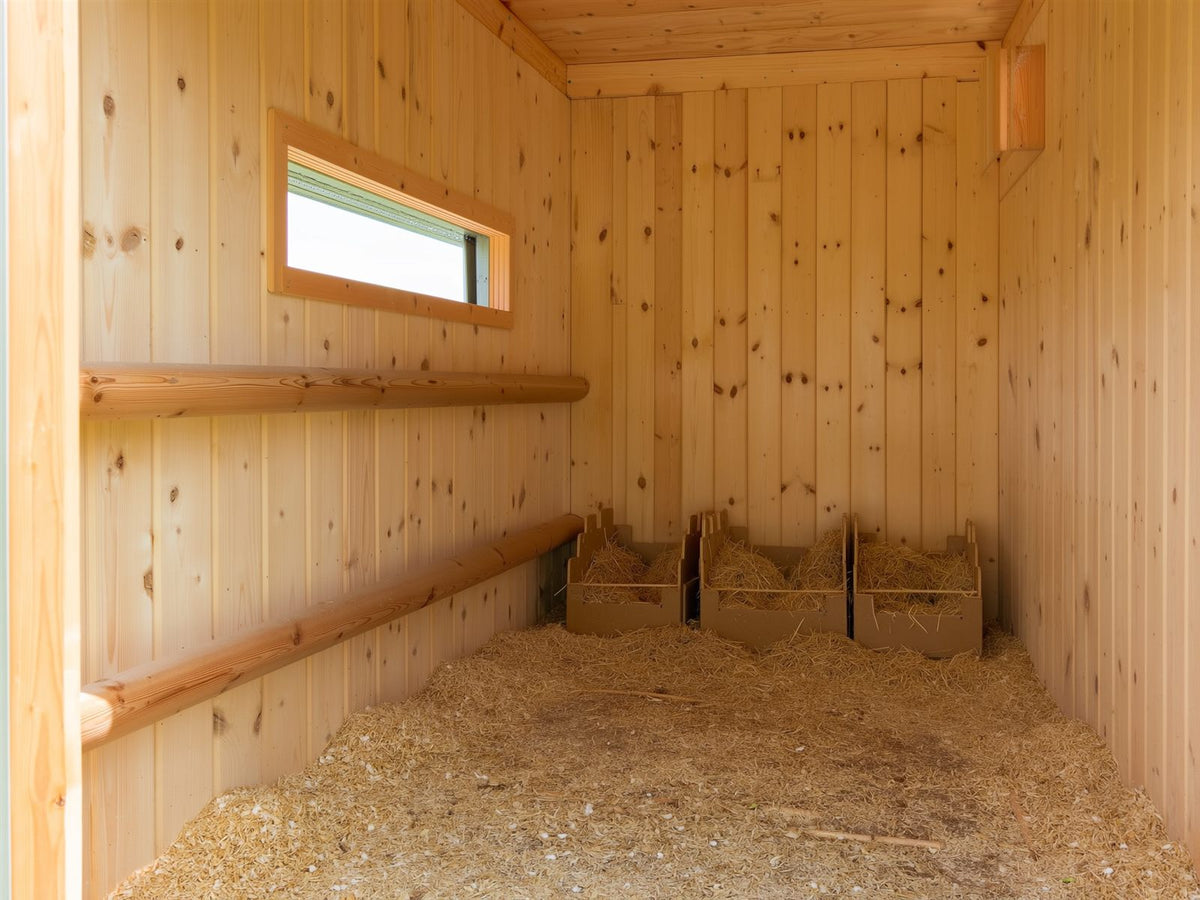
A chicken coop needs six things inside it: a roost, nest boxes, litter, ventilation, feed and water, and light. Penn State Extension puts the roost 18 to 24 inches above the floor and at least four feet away from the nests, and calls for two nests for the first four hens, then one more for every four hens after that. Which of the six come fitted varies by model, so read the spec line before you buy anything separately — and read it for the roost bar's length in inches, which is the one figure worth asking for when it isn't printed. Start from coops with the fittings already in.
Perch inches per hen, litter depth, the nest-box ratio, feeder space, bulb wattage: every number below names the extension service that published it, and links to it where it appears.

What should be inside a chicken coop?
Six fittings: a roost to sleep on, nest boxes to lay in, litter on the floor, ventilation above head height, a feeder and a waterer, and — only if you want eggs through winter — a light. Everything else is decoration.
Six fittings is a shorter list than most people expect, and the order matters. Hens sleep on the roost and lay in the boxes, and if the two sit too close together they will do both in the boxes. Penn State Extension is blunt about it: keep the roosts away from the nesting areas, or "this will quickly contaminate your nesting boxes and increase egg breakage and dirty eggs."
So the interior is a layout, not a shopping list. Three of the six fittings have to be positioned relative to each other before anything gets screwed down.
The coop and the run are two different rooms
Most "what goes inside" lists mix them up. The coop is the enclosed box the hens sleep and lay in — roost, nest boxes and litter go there. The run is the fenced area they spend the day in, and it needs shade, a dust-bathing patch and space, not bedding.
The distinction decides half the answers below. Litter depth applies to the coop floor, not the run. Ventilation is a coop problem, since the run is already open air. And on a coop that moves the run has no floor at all — the birds stand on grass and you shift the frame to a fresh patch, which is the whole argument for moving one.
6 fittings, and the numbers behind each one
Every fitting has a published figure attached to it, and those figures come from cooperative-extension services rather than from manufacturers. The table is the whole answer in one block. The sections after it explain the two places where the published numbers disagree with each other.
| Fitting | The published figure | Who publishes it |
|---|---|---|
| Roost | 6 in of perch per standard hen; 18–24 in above the floor; bars spaced 1 ft apart; never more than 4 ft up | Penn State Extension |
| Nest boxes | Two nests for the first four hens, then one per four more. At least 12 in × 12 in, with a 3–4 in lip. At least 2 ft off the ground and 4 ft from the roosts | Penn State Extension |
| Litter | Wood shavings or sawdust 6–8 in deep on the coop floor; about 2 in of clean dry material kept in each nest box | UNH Extension; Penn State Extension |
| Ventilation | "Ample air movement without a draft." No area figure is published — dampness and ammonia are the test instead | Penn State Extension |
| Feeder and waterer | At least 3 in of feeder space per bird, top lip set at the bird's back height; 1 water nipple per 6–8 birds | Penn State Extension |
| Light | 12–14 hours of light a day to keep hens laying; one low-intensity bulb, 40 W or less, at ceiling height | University of Minnesota Extension; Penn State Extension |
Read the ventilation row again, because it is the one that surprises people. There is no number. That is not an oversight in the table.
How much roost space per hen? Three services, three answers
Penn State Extension says six inches of perch per standard hen. Virginia Cooperative Extension says eight to ten. UNH Extension says a full linear foot. For six hens that is a roost between 36 and 72 inches long, depending which land-grant university you read first.
| Source | Perch space per standard hen | Roost length for 6 hens |
|---|---|---|
| Penn State Extension | 6 in | 36 in |
| Virginia Cooperative Extension | 8–10 in | 48–60 in |
| UNH Extension | 12 in (one linear foot) | 72 in |
Nobody is wrong. They are describing different birds in different climates: hens crowd together on the bar in winter and spread out in July, and a Rhode Island Red takes up more bar than a bantam. Virginia's own publication says the quiet part out loud — "There is very little research on space requirements for small-scale poultry housing."
Our view: build or buy to the middle figure, eight to ten inches a bird, and treat six as the floor rather than the target. The cost of getting it wrong is not theoretical. Hens compete for the highest bar and the bird at the bottom of the pecking order gets pushed off. She sleeps in a nest box instead — the exact outcome Penn State's four-foot rule exists to prevent — and you find it next morning in the eggs. The full roost numbers — bar size, height, spacing and a flock-by-flock length grid — are in our chicken roost guide.
If the coop is too narrow for a single long bar, add a second one rather than stretching the first. Penn State spaces roosts a foot apart, and two 30-inch bars give the same perch as one 60-inch bar in half the width. Bigger flocks are where this bites hardest, which is worth knowing before you size up to a large coop.
Here is the part you have to do yourself, because a perch count is not a perch length. Two perches could mean 30 inches of bar each or 60, and the six-to-twelve-inch rule needs the second number. So read the listing for a length in inches; where it gives you a count instead, treat the interior width as your ceiling and go and get the real figure. Tell us the model and the flock size and we will take it off the manufacturer's drawing, so you can choose from the coops for sale knowing how many birds actually fit at night.
Fittings list sorted? Take 10% off the coop you'll fit them in. GET MY 10% CODE
What to put in a chicken coop floor
Litter, and enough of it. UNH Extension recommends fresh wood shavings or sawdust six to eight inches deep. What sits underneath the litter matters less than how deep the litter is and how easily you can shovel it out on a wet Sunday in November.
Coop floors come in four constructions, and each changes the litter job rather than removing it:
- Solid timber floor. Warm, cheap, absorbs moisture. Needs the full 6–8 inches of shavings and a change-out when it packs down.
- Pull-out droppings tray. A metal or plastic tray under the roost that slides out. It makes the biggest single difference to how long a clean takes, so look for it by name on the spec line rather than in the photographs.
- Wire or slatted floor. Droppings fall through. Less litter to manage, colder underfoot, hard on feet if the mesh is wrong.
- Open to grass. No floor at all. The birds stand on the ground and you move the frame instead of cleaning it, which is the distinction to check across coops built to move.
If you would rather build up than muck out, University of Minnesota Extension describes the deep-litter method: start with about four inches of bedding, add until it is ten inches deep by winter, then carry on to twelve or fifteen. It composts in place and gives off a little warmth. It also needs more ventilation, not less.
One rule for every floor: dry beats warm. Wet litter is where ammonia comes from, and ammonia is an air-quality problem before it is a smell — Penn State Extension names it alongside excess moisture and carbon dioxide as what the stale air has to carry out of the house. Pick your construction before you order rather than after the first wet week, because the floor is the one fitting you cannot retrofit: coops built to move settle it by having no floor at all, and everything else settles it with a tray or a board.
How much ventilation does a chicken coop need?
Nobody publishes a number. Penn State Extension's requirement is "ample air movement without a draft," and its test is a symptom rather than a measurement: dampness and ammonia build-up mean there is not enough ventilation for the birds in the coop.
We went looking for the rule that circulates on hobby forums — one square foot of vent per ten square feet of floor — and did not find it in any extension publication linked below. That does not make it wrong. It does mean it is not extension guidance and should not be quoted as though it were.
What Penn State does specify is the geometry:
- On a small coop, windows or vents on one side usually provide plenty of air.
- Never put a vent directly over the perching area, or the birds sleep in a draft.
- Put openings on the side away from prevailing winds, and angle inlets upward so incoming air mixes with the warm dry air above.
- Ventilate and insulate together. One without the other puts moisture on the walls in cold weather.
The winter instinct is to shut everything and keep the hens warm, and it is the wrong instinct. Penn State's line is worth keeping: "Poultry can handle cold very well if they are dry." Cool and humid causes health problems; cold on its own does not.
Which leaves you one job the page will rarely do for you: turning a description into an area. A vent type — louvered top vents, a hinged side window — tells you air can move and nothing at all about how much. So multiply whatever dimensions you are given. A window stated as 15 by 2.8 inches is 42 square inches, which is a real number, a small one, and a completely different claim from "well ventilated". Where no dimensions are printed at all, send us the model and we will get the opening sizes from the manufacturer before you order, then compare the coops with a run attached on air rather than on adjectives.
Setting up the coop before the hens arrive
Order of operations matters more than speed. Fit the roost before the nest boxes, because Penn State Extension wants at least four feet between them, and wherever the bar ends up decides where the boxes are allowed to go.
Step 1 — Site it and level it
Penn State puts coops on high, well-drained ground and faces the front and windows south, so sun warms and dries the coop and the soil. A coop on a low spot is a wet coop, and wet is the thing you are managing all winter.
Step 2 — Fit the roost
18 to 24 inches up, bars a foot apart, never higher than four feet. Round the edges: a bar the hens grip badly is a bar they abandon for the nest boxes.
Step 3 — Hang the nest boxes low, dark and far from the bar
Two feet off the ground, four feet from the roosts, in a dim corner away from bright windows and traffic. The three-to-four-inch front lip keeps the material in and the eggs whole.
Step 4 — Lay the litter
Six to eight inches of shavings on the coop floor, two inches in each nest box. Penn State names pine shavings as the preferred nesting material.
Step 5 — Set feed and water at back height
Three inches of feeder space a bird, top lip level with the bird's back so they cannot scratch it full of shavings. Penn State puts the waterer out in the run where possible, which keeps that humidity out of the coop.
Step 6 — Run it empty for a day
Watch where rain gets in, where the light falls at dusk and whether the door latches when the wood swells. Every fault is cheaper to fix before there are hens standing in it.
Three things to leave out
Not everything sold for a coop belongs inside one. A heat source is the first, and the reason is in the ventilation section above: dry beats warm, so the fix for a cold coop is a drier one. A vent directly above the perch is the second — Penn State rules it out by name, and it is the easiest mistake to make when airflow gets added in a hurry at the end of a build. A bright window opposite the nest boxes is the third, because Penn State asks for a dim, secluded place to lay and a sunny wall is the opposite of one. None of the three costs anything to avoid and all three cost a rebuild to correct, which is why they belong on the drawing rather than in the yard. Settle them against a coop with its run already framed on before a single screw goes in.
Check the listing for these before you buy
Five fields decide whether a coop arrives ready to use or arrives needing a trip to the hardware store. Take them in this order, settle each one from the page in front of you where you can, and treat anything missing as a question rather than a dead end.
| Field | Why it decides the purchase | Where to get it when the page is quiet |
|---|---|---|
| Nest-box count | Two boxes cover the first four hens; add one more box per four hens after that | Count the openings in the product photographs, not the boxes in the description |
| Floor construction — tray, solid, wire or open | Decides how long a clean takes, and whether it is a tractor at all | The photographs answer it faster than the copy — look for a tray handle, a bare frame or a solid base |
| Perch count | Tells you a roost exists, which is not a given on run-style coops | Read it off the page, then multiply it by a length you have measured rather than one you assume |
| Perch length in inches | The number that actually decides how many hens fit at night | Take the interior width as your ceiling, then ask us for the bar length off the drawing |
| Ventilation opening area | The only way to compare two coops on air rather than on adjectives | Multiply any window dimensions the page gives; where it gives none, ask before you order |
Notice what those five fields have in common. The three that get printed are the three a camera can see — a row of nest boxes, a tray handle, a bar across the back wall. The two that go missing are the two only a tape measure can produce: how long that bar is, and how many square inches of vent there are. Disclosure tracks photographability, in other words, which is a far more useful thing to know than any complaint about candour, because it tells you exactly which two questions to ask. It also explains a generous box count: extra boxes are cheap and they photograph well, so hold any count against Penn State's two-nests-for-four-hens rule before you read it as extra room.
Ask for what a photograph cannot show and you generally get it, which is most of what we are for — send us a model and we will put the missing dimension to the manufacturer before you order. Then decide on the two things a fitting list can never settle: the flock-size arithmetic, which is in our coop sizing guide, and how much run comes with the house, which you can see at a glance across the coops with a run attached.
The two numbers worth asking every seller for
One line: state the roost length in inches. It is the number that decides how many hens actually fit at night, and everybody quotes floor area instead, because floor area is easy to measure and easy to flatter.
Floor area tells you whether the birds fit standing up. Roost length tells you whether they fit lying down, and hens spend more hours on the bar than anywhere else. A coop advertised for six hens with a 30-inch bar is a five-hen coop by Penn State's figure, a three-hen coop by Virginia's, and a two-and-a-half-hen coop by UNH's. Nothing on the page tells you that, and the hens tell you three weeks later by sleeping in the nest boxes.
Second: give the vent opening in square inches instead of calling it "well ventilated". Two coops can both be well ventilated and differ by a factor of four.
The workaround, meanwhile, is boring and it works: get both interior numbers before you buy rather than after. That holds whether you order a coop or draw your own from a plan, and it sits alongside the other check worth making before you commit — our guide to mesh, latches and aprons covers what a coop can and cannot keep out.
So start the message rather than the search. Send sales@moveablechickencoop.com the model and your flock size, and we will come back with the bar length and the vent dimensions off the manufacturer's drawing before you commit to anything. Or begin by browsing the full coop range — six fittings, and you now know which two of them to ask about.
Frequently asked questions
Why does my chicken coop smell like ammonia?
Ammonia means the litter is wet and the air is not moving. Penn State Extension treats it as a diagnostic rather than a nuisance: dampness and ammonia build-up are the sign that there is not enough ventilation for the number of birds in the coop. Deal with the moisture first — strip the wet litter, check the roof and the waterer for leaks, then open an inlet on the side away from the wind.
Where to place nesting boxes in chicken coop?
Low, dark, and well away from the roost. Penn State Extension puts nests at least two feet off the ground and at least four feet from the roosts, in a dim secluded spot, never opposite a bright window or beside a high-traffic doorway. The four-foot gap is not fussiness — it is what stops hens sleeping in the boxes, which is what makes eggs dirty and cracked.
Should I put a light in my chicken coop?
Only if you want eggs through winter. Hens need 12 to 14 hours of light a day to keep laying, according to University of Minnesota Extension. Penn State Extension calls for one low-intensity bulb, 40 watts or less, at ceiling height, and notes that a bird needs only one foot-candle to sustain year-round production. A light is optional. Ventilation and a dry floor are not.
Can I use pine shavings in my chicken coop?
Yes. Penn State Extension names pine shavings as the preferred nesting material and asks for about two inches of clean dry material kept in each box at all times. For the coop floor rather than the boxes, UNH Extension recommends fresh wood shavings or sawdust six to eight inches deep. The material matters less than keeping it dry — wet shavings are where the ammonia starts.
Should I paint the inside of my chicken coop?
Extension guidance does not ask for paint. Penn State Extension's requirement is that the coop be built so every area is easy to reach, clean and disinfect, and a sealed wipeable surface meets that where bare rough timber does not. If you do paint, let it cure completely before the hens go in, and make sure they cannot pick at peeling coating or at exposed insulation.
Written by the Moveable Chicken Coop Team Interior fittings are the half of a coop nobody photographs, so we go and read the maker's documentation and put what it says next to the extension figure it should be checked against. Where a fitting is described in words rather than inches, ask us and we will get the measurement before you order. More about how we choose coops → /pages/about
Last reviewed: 28 July 2026
Sources
- Penn State Extension, "Small Scale Poultry Housing", Gregory P. Martin and Phillip Clauer, updated 25 June 2026 — accessed 28 July 2026
- Virginia Cooperative Extension, "Small-scale Poultry Housing", publication 2902-1092 — accessed 28 July 2026
- University of New Hampshire Extension, "Producing Your Own Eggs" — accessed 28 July 2026
- University of Minnesota Extension, "Raising chickens for eggs" — accessed 28 July 2026