

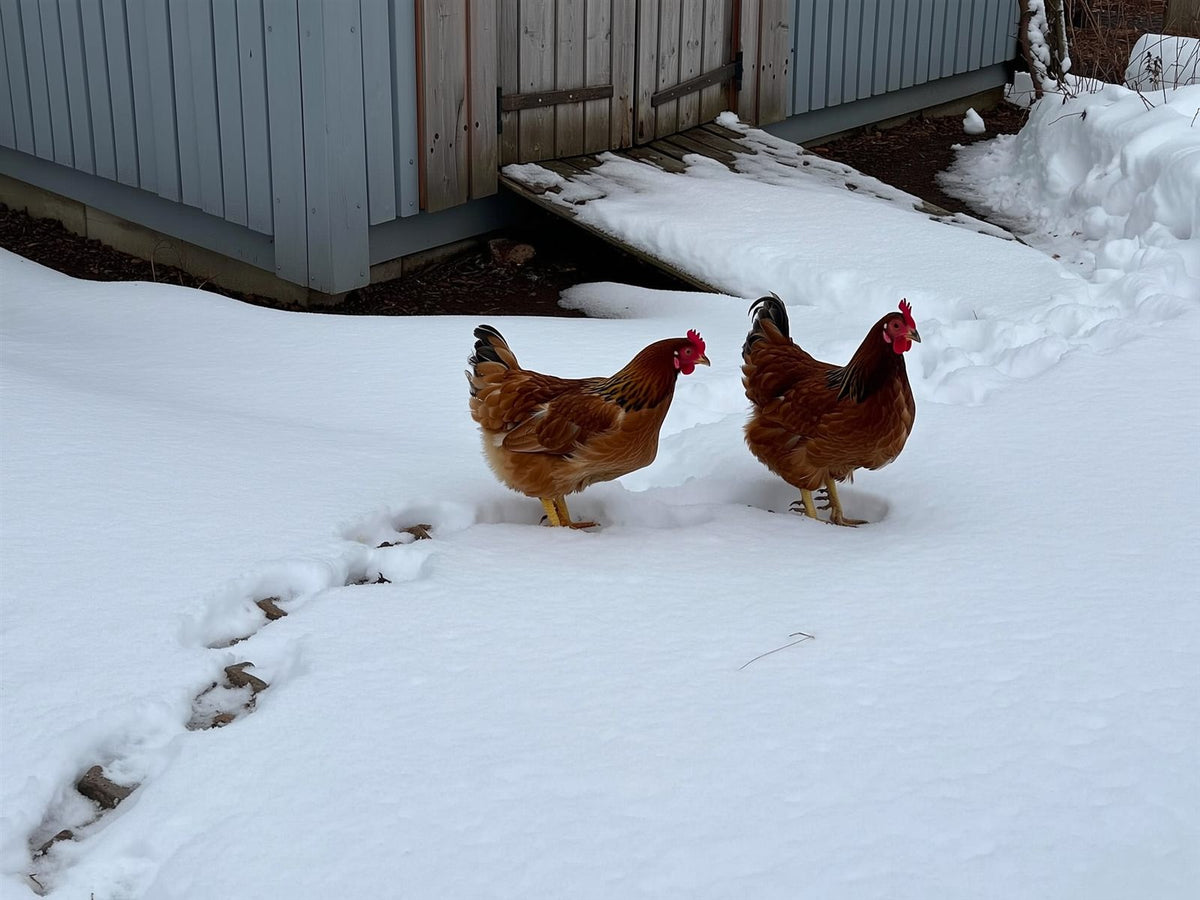
Most standard-breed chickens do not need a heated coop, even in winters that drop well below freezing. A healthy hen wears a down jacket year-round, and flocks manage cold far better than most first-winter keepers expect. The things that actually hurt birds in winter are moisture, drafts at roost level, and frozen water — and a heat lamp introduces a documented fire risk to solve a problem most coops don't have. This guide covers what cold really does to a flock, the ventilation balance a winter coop has to strike, and the short list of features worth checking before the first freeze.

How cold is too cold for chickens?
Cold-hardy breeds — the heavy, small-combed birds most backyard keepers already own — routinely tolerate temperatures well below freezing when they're dry and out of the wind. They fluff their feathers to trap warm air, roost side by side to share heat, and acclimate gradually as autumn cools. The birds most at risk are large single-combed breeds, whose combs and wattles can frostbite, and any bird that's wet. Watch the flock, not the forecast: birds standing comfortably, eating, and moving are handling it. What they need from you is housing that stays dry and windproof, which is a construction question before it is a heating one: a roof that sheds water clear of the walls, joints that don't whistle at roost height, and vents set above the birds rather than beside them. Check those three on any listing before you read its cold-weather claims — the coop range is the place to start.
Why moisture is the enemy, not temperature
A flock exhales a surprising amount of water overnight, and droppings add more. Trap that moisture in a sealed coop and it condenses on combs, wattles, and walls — and damp tissue frostbites at temperatures dry birds shrug off. The working rule: if you see condensation or frost on the inside of the windows in the morning, the coop needs more ventilation, not more insulation. Keep bedding dry, remove or cover damp litter, and let the droppings tray do its job through the week.
Ventilation versus drafts: the balance that decides your winter
Ventilation and drafts are different things, and the difference is height. Ventilation is air exchange above the birds' heads — vents up high near the roof line that carry moist air out. Drafts are moving air at roost level that strips heat off the birds directly. A winter-ready coop keeps the first and eliminates the second: high vents open, gaps and pop-holes at bird height closed after dark. If your coop has openable windows and roof-line vents, winterizing is mostly about which ones you close, not what you add.
Should you insulate a chicken coop?
Insulation helps in genuinely cold regions, but it comes second to ventilation, and it can backfire: an insulated, poorly vented coop is a condensation box. If you insulate, keep the high vents open, cover any foam where hens can peck it, and think of insulation as smoothing temperature swings rather than making the coop warm. In most of the continental US, a solid-timber coop with a waterproof roof and managed vents winters fine without it.
Are heat lamps safe in a chicken coop?
A 250-watt bulb above dry bedding, dust and feathers, usually held by a clamp, is the highest-risk object in the room. University of New Hampshire Extension advises against adding supplemental heat to a coop for exactly this reason: “The risk of a heat source causing a fire is too high with combustible bedding materials present and given the tendency of chickens to knock things over.” If you decide supplemental heat is truly justified, use a flat-panel radiant heater rated for coops, mount it fixed rather than clamped, keep it clear of bedding, and put it on a thermostatic plug so it only runs in extremes. But the honest answer for most flocks is that the money is better spent on a heated waterer.
The real winter chores: water and eggs
What winter actually adds is not heating the birds; it's keeping water liquid and collecting eggs before they freeze and crack. A heated waterer base, or simply swapping in a warm waterer morning and evening, solves the first. Collecting eggs by early afternoon solves the second. Winter raises the feed bill before it raises anything else: University of Minnesota Extension says a flock's intake “may increase up to 25 percent during cold weather,” and asks keepers to “have extra feed on hand and top off feeders routinely.” Grit is the other one — UMN wants “free access to poultry grit throughout the winter months,” because a bird under snow cover cannot pick up its own. The rest of the stocking-up is in our winterizing checklist.
Skipping the heat lamp? Put the savings — plus 10% — toward the coop itself. GET MY 10% CODE
Which coop features matter most for winter?
Construction decides a winter coop: walls that block wind at bird level, a roof that keeps bedding dry, and high vents that stay open. The table ranks each feature by the winter job it does.
| Feature | Why it matters in winter |
|---|---|
| Solid, weather-sealed timber or coated metal | Blocks wind at bird level; the walls are the draft barrier |
| Waterproof roof | Dry bedding is the whole game; a leaking roof ends it |
| High vents that stay open | Moves moist air out above the roost |
| Raised house | Keeps the floor off frozen, wet ground |
| Pull-out droppings tray | Removes the biggest overnight moisture source in seconds |
| Covered run section | Gives birds a dry, wind-shaded place to spend the day out of the house |
Take that list to whatever you are shopping and tick off the rows the listing actually answers. A row the listing leaves blank is an unanswered question and not a verdict on the coop: name the coop and the row for us at sales@moveablechickencoop.com and we will chase the figure from its maker before you order. Start with the walk-in coops and large coops if you winter a bigger flock, or run your setup through the coop finder.
Which breeds handle cold, and which struggle?
The heavy dual-purpose breeds most backyards already keep — Orpingtons, Australorps, Wyandottes, Plymouth Rocks — are built for cold: dense feathering, compact combs, calm metabolisms. The birds that need watching are the Mediterranean layers, Leghorns above all, whose large single combs frostbite first, and any lightweight ornamental breed. If your flock skews cold-tender, the answer still isn't a heater. University of Minnesota Extension puts petroleum jelly in the preventive column and draws the line itself: you can apply it “to chicken combs and wattles to help insulate them and prevent frostbite damage,” but “petroleum jelly does not treat frostbite.” For a bird that already has it, UMN's instruction is to “consult a veterinarian if you have a chicken with frostbite or infection.” Alongside prevention: dry bedding, and wind protection on the run.
Does the deep-litter method keep a coop warmer?
Modestly, yes. Deep litter — building bedding up through winter and turning it rather than replacing it — composts slowly in place. University of Minnesota Extension credits a deep pack — 4 to 6 inches of straw or shavings — with a little warmth as the manure breaks down, while noting in the same breath that the method “requires a deep cleaning in the spring.” The upkeep UMN publishes is a trigger, not a calendar: “As the top layer becomes soiled, stir the bedding to allow the manure to move to the bottom. Then, add fresh bedding to the top.” It also needs a floor that tolerates it and, again, ventilation: a composting pack in a sealed coop just makes humidity. If you'd rather not manage it, a pull-out droppings tray emptied often achieves the dryness half of the same goal.
How much room do wintered-in birds need?
Confinement is the hidden winter problem. Birds that free-ranged all summer suddenly share the run all day, and crowding is what turns a cold snap into a pecking outbreak. Hold the flock to the confined numbers in our size guide — 4 square feet of house plus 8 of run per standard hen — and add boredom relief: a hung cabbage, a straw bale to dismantle, dry ground to scratch. Space and occupation prevent more winter losses than any heater.
Further reading: University of Minnesota Extension's backyard-flock guide covers year-round care from a cold-climate program.
The five-minute winter routine, morning and night
Morning: swap or top up water before anything else — birds that just spent fourteen dark hours on the roost want to drink, and frozen water at dawn is a winter welfare failure that is easy to miss. Slide the droppings tray, check the feeder, collect any overnight eggs, and glance at the high vents to confirm they're open and unblocked by frost or bedding dust. Evening: collect eggs again by early afternoon on hard-freeze days, confirm the flock has gone up, and close the pop door at dusk. The whole cycle is five minutes each end of the day, and it replaces every gadget on the winter-accessory shelf except the heated waterer. If your mornings are dark and rushed, that's the argument for coops with outside-access nest boxes and trays — the winter chores that can be done without opening the run go from a chore to a pause on the way to the car.
One more date to watch: the molt
University of Minnesota Extension puts the molt in the early fall, not the depths of the year, and a bird caught mid-molt by the first hard freeze is genuinely cold-vulnerable in a way a fully feathered one is not. You can't schedule the molt, and UMN does not ask you to feed around it: “You can continue to feed your chickens their normal, balanced diet. A balanced diet plays a key role in feather and egg production.” What is left to do is wind protection on the run, and a closer eye on any half-dressed bird during cold snaps. By the time real winter settles in, a normal flock is back in full plumage and back to shrugging at the thermometer.
Sources: University of Minnesota Extension, "Caring for chickens in cold weather" (Colleen Carlson and Hannah Lochner, reviewed 2026) — accessed August 22, 2026 — University of Minnesota Extension, "Raising chickens for eggs" — accessed August 22, 2026 — University of New Hampshire Extension, "How Should I Take Care of Backyard Chickens in the Winter?" (Sean O'Brien, February 15, 2024) — accessed August 22, 2026.
Last reviewed: 22 August 2026
Frequently asked questions
At what temperature do chickens need supplemental heat?
Cold-hardy standard breeds generally don't need heat in typical US winters; a dry, draft-free coop matters far more than the thermometer. Supplemental heat is worth discussing only for extreme sustained cold, unusual breeds, or birds that can't roost together, and then a flat-panel radiant heater is the safer route than a heat lamp.
Should I close the coop vents in winter?
No. Close the drafts at bird level, keep ventilation open above roost height. Sealed coops trap moisture from breath and droppings, and damp air is what causes frostbitten combs, not cold air alone.
Do chickens stop laying in winter because of the cold?
Laying slows mainly because of shorter daylight, not temperature. University of Minnesota Extension puts optimal egg production at about 14 hours of light a day, so a drop in winter production is normal even in a well-managed coop.
Can chickens stay inside the coop all winter?
They can stay in the coop and run, but confinement raises the space requirement: plan on the confined numbers from our size guide (4 sq ft of house plus 8 sq ft of run per hen) rather than free-range assumptions, because winter boredom in a tight coop leads to pecking.