

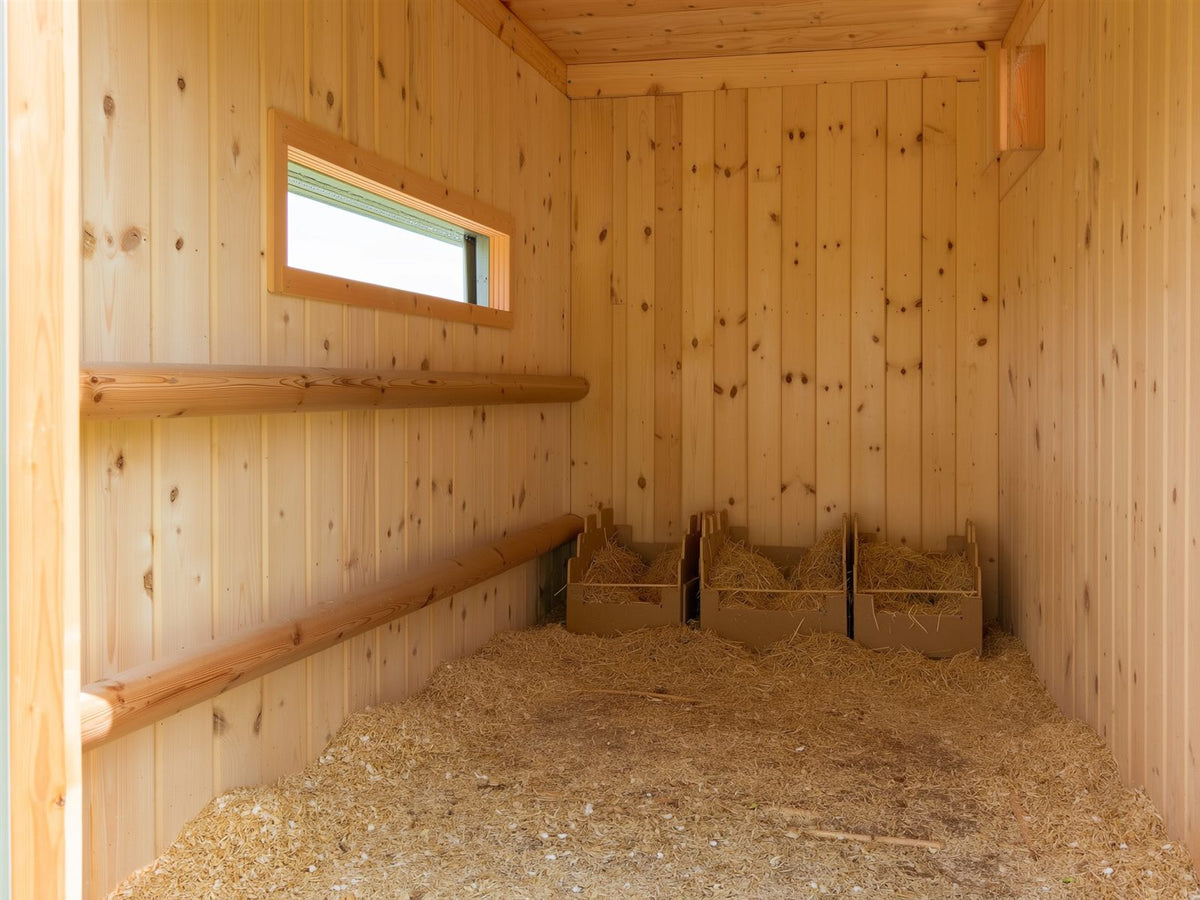
Chicken coop bedding is wood shavings or sawdust, kept 6 to 8 inches deep on the coop floor — UNH Extension's figure, and the one published number in a topic full of opinions. What sits under the bedding matters less than the depth of it, but it decides your cleaning job: a solid floor, a slide-out tray, wire mesh, or no floor at all on coops built to move. Bedding is one of the six fittings in our guide to what should be inside a chicken coop; this page is the floor in full — the depth, the deep litter method's actual numbers, the four constructions, and the liner question.
The bedding depth, the change-out schedule and the floor advice on this page are the University of New Hampshire's, the University of Minnesota's and Penn State's, quoted directly and cited in full at the foot.
What do you put on the floor of a chicken coop?
Litter — and the published recommendation is specific: fresh wood shavings or sawdust, 6 to 8 inches deep. UNH Extension adds the comparison most guides soften: shavings are "preferable to hay or straw, which is difficult to clean up once soiled."
Bedding and litter are the same thing in a coop; the words get used interchangeably and both mean the absorbent layer on the floor. Its job is moisture first and cushioning second — dry litter is what keeps feet, eggs and air clean, which is why every maintenance rule below is really a dryness rule.
The run is a different floor. Litter depth applies inside the house, where the flock sleeps and droppings concentrate; the run floor is ground, and on a floorless mover it is grass you rotate rather than material you change. Other materials circulate — sand has its own following and its own trade-offs, and we cover it separately — but shavings are what the extension publications actually name.
How deep should chicken coop bedding be?
Six to 8 inches, per UNH Extension, kept loose and dry — with 2 inches of clean, dry nesting material in the boxes, which is Penn State Extension's separate figure for a separate job. The floor number is the one people undershoot.
Depth is also the number that turns into money at the feed store, so here is the arithmetic nobody prints. Multiply floor area by depth and divide by 12 for cubic feet of material:
| Coop floor area | At 6 in deep | At 8 in deep |
|---|---|---|
| 5 sq ft | 2.5 cu ft | 3.3 cu ft |
| 10 sq ft | 5.0 cu ft | 6.7 cu ft |
| 15 sq ft | 7.5 cu ft | 10.0 cu ft |
| 20 sq ft | 10.0 cu ft | 13.3 cu ft |
| 30 sq ft | 15.0 cu ft | 20.0 cu ft |
Find the floor area of the coop you are weighing, take the nearest row above, and read across: even the smallest line on that grid is a real purchase, and a change-out is the same purchase again. How much floor your flock needs in the first place is sizing territory — that arithmetic lives in our coop size guide.
Maintenance is three habits, all UNH's: stir the litter frequently in winter "to keep it as loose and dry as possible," replace very wet litter near the water or feed right away, and do a full change monthly or as needed. Managed that way, the monthly change is genuinely all it takes.
What is the deep litter method?
The deep litter method turns the coop floor into a slow compost pile you manage in place. University of Minnesota Extension publishes the actual numbers: start with about 4 inches of bedding, add fresh material until it is 10 inches deep by winter, and keep going to 12 to 15 inches — the depth where composting actively begins.
The payoffs are stated, too. Composting releases heat, which keeps chickens warm in the cooler months, and it attracts natural fly predators. At the active depth, 6 months of composting can kill harmful bacteria. The same process can be run in a bin outside the coop if you'd rather compost there.
What the method is not: a way to skip work. UMN's instruction is to stir the bedding regularly to prevent crusting and clumping — the maintenance moves from changing litter to turning it, and the material bill goes up, not down, because you are always adding. Run the depth grid above at 12 to 15 inches and a 15 sq ft floor holds 15 to 19 cubic feet of bedding by midwinter.
Standard litter and deep litter are two regimes, not one rule. Six-to-8-inches-changed-monthly and 4-inches-built-to-15 disagree on every number because they are different systems — pick one deliberately rather than drifting between them, because half-deep litter that never composts is just deep dirty bedding.
Litter plan set? Take 10% off the floor you'll spread it on. TAKE 10% OFF
Chicken coop flooring: the four constructions
Coop floors come in four constructions, and the honest way to compare them is by what the litter job becomes on each. The floor doesn't remove the work; it decides the shape of it.
| Floor construction | What the litter job becomes |
|---|---|
| Solid floor (timber or panel) | The full 6–8 in of litter, stirred and changed on the UNH schedule. Warmest underfoot, most absorbent to manage |
| Slide-out droppings tray | The tray catches the overnight load under the roost and pulls out for emptying — the single biggest difference to how long a clean takes. Litter still goes on the floor around it |
| Wire or slatted floor | Droppings fall through, so less litter to manage — and colder underfoot, with mesh that must suit a bird's feet |
| Open to grass (floorless) | No litter at all. The ground is the floor and you move the frame to fresh grass instead of cleaning — the defining trait of a tractor-style coop |
Two published details refine the picture. Penn State Extension's advice for a built floor: slope it slightly toward the door "to prevent puddling in the building and make the building easier to spray out and dry between uses" — a washable, drainable floor is the goal behind every material debate. And the floor under the roost is where the cleaning work concentrates, which is why a tray placed anywhere else collects almost nothing — the bar-and-tray geometry is in our chicken roost guide.
The floorless option is the one that changes the question entirely. On a coop light enough to move, the litter problem inside the house shrinks to the enclosed sleeping box, and the ground under the frame recovers on rotation instead of accumulating.

Do you need a chicken coop floor liner?
The extension publications we cite never mention one. Liners, vinyl sheets and rubber mats are a real product category — but the guidance behind this page specifies depth, dryness and a washable floor, and says nothing about what brand of surface sits under the shavings.
Read that silence practically rather than cynically. A wipeable surface serves Penn State's spray-out-and-dry goal, and a liner can protect a timber floor from moisture it should never have been holding anyway. What a liner cannot do is substitute for the litter itself: 2 inches of shavings on smooth vinyl fails every dryness rule UNH publishes. If you add one, add it under the full 6-to-8-inch fill, not instead of it.
The same test applies to any floor accessory: does it make the floor drier, deeper-littered, or easier to wash out? If the answer is none of the three, it is décor.
The floor spec to check before you buy
Floor construction — a pull-out tray, a raised slatted level, or no floor at all — predicts your weekly workload better than any dimension on the page. It is worth hunting for in the description and the photographs, and worth asking about when neither settles it. Check it before the paint color.
The check takes one minute: find the floor construction, find whether a tray is included and whether it covers the area under the roost, and picture the monthly change-out — can you reach every corner with a scraper, and does anything unbolt to spray clean? A coop that fails the reach test doesn't stay cleaner; it stays dirty in the corners you can't reach.
Where a listing doesn't state the floor, we will get it from the manufacturer's drawing before you order — the offer stands on every coop we sell, and it is worth using — floor construction is the field that decides your Saturday morning for the next several years, and it is a one-line question to answer before you order rather than after.
Sources: University of New Hampshire Extension, "Producing Your Own Eggs" — accessed August 11, 2026 · University of Minnesota Extension, "Raising chickens for eggs" — accessed August 11, 2026 · Penn State Extension, "Small Scale Poultry Housing" (Gregory P. Martin and Phillip Clauer, updated June 25, 2026) — accessed August 11, 2026.
Frequently asked questions
How to clean a chicken coop?
Strip the old litter, replace anything wet, and lay fresh shavings back to the full 6-to-8-inch depth — UNH Extension says a properly managed litter only needs that full change monthly or as needed. Penn State's floor advice explains the deeper clean: a floor sloped toward the door can be sprayed out and left to dry between uses. Replace litter near the waterer whenever it turns damp, and keep the nest boxes topped up separately.
How often to clean chicken coop?
Monthly, or as needed — UNH Extension's schedule for a properly managed litter, with two standing exceptions: very wet litter near the water or feed gets replaced right away, and winter litter gets stirred frequently so it stays loose and dry. Under the deep litter method the full clean-out stretches much longer, because the bedding is deliberately composting in place and the daily job is turning it, not changing it.
Why does my chicken coop smell so bad?
Wet litter, almost always. The levers the extension guidance gives you: keep the bedding at the full 6-to-8-inch depth, stir it so it stays loose and dry, replace soggy patches near the waterer immediately, and do the monthly change-out. If the smell is sharp ammonia, moisture has beaten the airflow — the ventilation half of the fix is in our guide to what should be inside a chicken coop.