

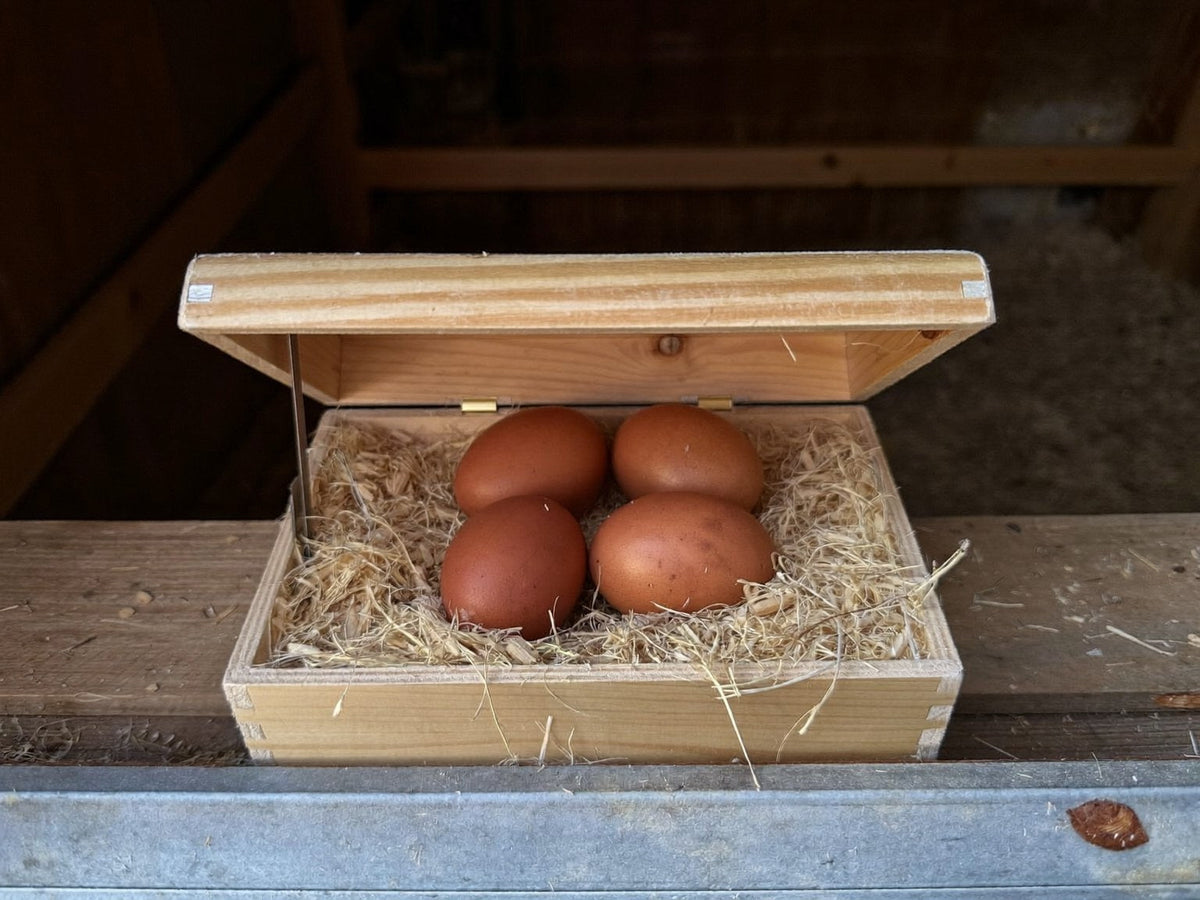
How many nesting boxes per chicken you need depends on which published rule you read. One box for every 4 to 5 hens is the flat ratio three extension services give — and Penn State Extension disagrees, asking for two nests in the first four hens' coop, then one more per four hens after that. Boxes are shared by design: hens queue, they don't reserve. And the answer is always a whole number, so it sits flat across several birds and then steps, which is the part a division never shows you. The rest of the interior list is in our guide to what should be inside a chicken coop; if you are still choosing the house they hang in, start with coops that come with a run. Here are the nest boxes in full.
The two published ratios, the 12-by-12 spec, the 2 inches of material and the placement distances all name the extension service they came from, and each one is linked where it appears.
How many nesting boxes do chickens need?
Plan on one nesting box per 4 to 5 hens — the ratio Virginia Cooperative Extension, UNH Extension and University of Minnesota Extension all publish — and know that Penn State Extension asks for more: two nests for the first four hens.
| Source | The published rule | Boxes for 4 hens | Boxes for 8 hens |
|---|---|---|---|
| Penn State Extension | "Provide two nests for the first four hens. Then add a nest for every four additional hens." | 2 | 3 |
| Virginia Cooperative Extension | "At least one nest for every 4-5 females in the flock" | 1 | 2 |
| UNH Extension | "One opening for every four hens" | 1 | 2 |
| University of Minnesota Extension | "One per 4 to 5 birds" | 1 | 2 |
The gap is widest exactly where most people start. For a first flock of 4 hens, Penn State wants double what everyone else asks. Our read: the floor of two is cheap insurance — the day one box is occupied by a broody hen who won't move, the second box is what keeps eggs off the floor. A box costs less than a habit of floor-laid eggs.
Worked out by flock size, with partial groups rounded up on the Penn State rule. Read down either column and the shape of the answer shows itself: it holds steady across several birds, then jumps by a whole box. Nobody sells four-tenths of a nest, so the question worth asking is never how many boxes per hen — it is which side of the next step is my flock on.
| Flock size | Flat rule (1 per 4–5 hens) | Penn State rule (2 + 1 per extra 4) |
|---|---|---|
| 2 hens | 1 | 2 |
| 4 hens | 1 | 2 |
| 6 hens | 2 | 3 |
| 8 hens | 2 | 3 |
| 10 hens | 2–3 | 4 |
| 12 hens | 3 | 4 |
The egg arithmetic explains why so few boxes work. University of Minnesota Extension puts a laying hen at roughly 6 eggs a week, so 8 hens produce about 48 a week — roughly 7 a day moving through 2 or 3 openings, spread across a morning. UNH Extension's collection rule keeps the traffic flowing: gather at least twice a day, ideally with one trip at noon. Find your flock in the table, note the number, and hold it against the count printed on whatever you are shortlisting — coops that come with a run print a box count on the spec line, and that is the figure this whole page is teaching you to read.
What size should a nesting box be?
At least 12 by 12 inches for a standard hen, with a 3-to-4-inch lip across the front to keep the material in — Penn State Extension's spec, and the only published box dimensions among the four services we read.
Bigger birds get bigger boxes: Penn State says to increase the nesting area for larger breeds. What it warns against is the opposite instinct — never make the box too large, "or multiple birds will try to enter and increase egg breakage." A nest is a booth, and a booth that seats two is how eggs get stood on.
You will meet two designs, and they count differently. A row of separate openings gives you one nest per opening. One wide communal box is a single opening no matter how wide it runs, because the ratio above is written per opening rather than per box. So when you compare two coops, count the openings on the front and measure one of them against 12 by 12 inches — then take the shortlist to coops that come with a run, where the box arrangement is visible in the photographs before you ever have to ask.
How many chickens per nesting box?
Four to five hens per box, comfortably — the same ratio read from the other direction, and the number to hold a listing's stated box count against. Sharing works because laying is staggered: UNH Extension notes hens lay mostly through the morning, not all at once.

More boxes than the rule asks for is fine, but it buys nothing. A six-box house for four hens is still a four-hen house — box count doesn't set flock size; floor area and roost length do, and those have their own guides: our coop size guide for the floor, our chicken roost guide for the bar.
There is a market reason counts run high. Nesting boxes are the fitting a photograph shows off best, so a generous count is easy to advertise and easy to admire. Read it as enthusiasm rather than extra hen room, and settle the two specs that really do set flock size before you order — floor area first, then bar length. Neither is hard to get hold of, and both are worth more to you than the box count. Browse the full range of coops with those two in hand rather than the box count.
What do you put in nesting boxes?
Two inches of clean, dry nesting material, kept topped up at all times — and Penn State Extension names pine shavings as the preferred choice. The padding is egg protection first, comfort second.
Penn State is blunt about the failure mode: "Many eggs are cracked due to a lack of protective padding in nesting boxes." UNH Extension says the same from the other side — bare nesting box floors result in broken, dirty eggs — and adds the operational rule: don't let the boxes run out of shavings, and collect eggs at least twice a day. Gathering a batch at noon means less breakage and fewer dirty eggs, because eggs that sit are eggs that get stepped on.
So the box's contents are a maintenance schedule, not a one-time fill. Check the depth when you collect and top up the week it thins — and if the boxes on the coop you are buying come with a lift lid you can reach from outside, that check costs about ten seconds a day instead of a trip through the run. It is worth knowing which of the two you are getting before the coop arrives, so start from the range and ask.
Where should nesting boxes go in the coop?
Low light, low traffic, up off the floor. Penn State Extension puts nests at least 2 feet off the ground and at least 4 feet from the roosts, in a darker, secluded spot — never facing a bright sunny window, never beside a high-traffic doorway.
The 4-foot gap from the roost is the load-bearing rule: it's what keeps hens from sleeping where they lay, and it means the bar's position decides where the boxes can go — fit the roost first. One exception worth knowing: Virginia Cooperative Extension notes meat-type birds don't need nest boxes at all; the ratio is a layer's rule.
Put those instructions in the order they fail and you have the answer to the question everyone actually types, which is why the hens are laying on the floor instead. Darkness first — a box facing a bright window is a box a hen will not settle in. Then the 4 feet from the roost, because a nest within reach of the bar becomes a bedroom and a bedroom stops being a nest. Then the 2 inches of padding, since a bare board is uncomfortable and hens vote with their feet. Then height off the floor, which is the one people fix first and the one that matters least. Work down that list before you buy a plastic egg or a fake nest, because three of the four levers are decided by where the boxes are hung — and on a coop that arrives assembled, they were decided at the factory.
Which makes the box arrangement worth checking before you order rather than after. If you want the boxes reachable from outside the run, that is a design feature to confirm on the model you are looking at — tell us which one and we will get the lid style and the box's internal size from the manufacturer. Coops that come with a run are the shortlist where it matters most, because that is where reaching the boxes means going through the birds.
Box count settled? Take 10% off a coop with the boxes built in. SEND MY 10% CODE
How to check a listing's box count before you order
Box count is the one interior fitting you can usually check on the page, so check it properly. Take the hen rating the listing claims, divide it by the number of separate openings, and compare the answer with four to five hens per opening. That single division tells you more about the listing than the count does.
The direction matters, and it only runs one way. A count that comes out below the ratio is a real signal: more birds per opening means busier boxes, more eggs sitting while a hen waits, and more of them stepped on. A count above the ratio tells you almost nothing — it is cheap to fit an extra box and it photographs well, and it does not make the floor any bigger.
| What the listing gives you | What it actually tells you | What to do next |
|---|---|---|
| A box count and a hen rating | Divide one by the other. Four to five hens per opening is comfortable | Inside that, the count is honest. Outside it, plan on adding a box or keeping fewer birds |
| A box count and no hen rating | Nothing about capacity — box count never sets flock size | Work from floor area and bar length instead, using our guide to sizing a coop by flock |
| One wide box described as several | The ratio counts openings, not boxes, so a wide box is one nest | Ask how many separate openings the front has before you order |
| A count well above the ratio | Photogenic rather than roomier | Ignore it as a capacity signal and go and check the floor area and the perch |
| A count, but no box dimensions or lip height | The arithmetic without the geometry | Ask for the internal size and the lip; 12 × 12 in with a 3–4 in lip is the benchmark to hold it against |
A box's internal dimensions are not a secret anybody is keeping — they are on the cutting list the panels were made from, and a cutting list is a thing a supplier can be asked for. It just does not fit in the two lines a product description gives to the interior.
So put the question to us before you order rather than to a tape measure afterwards. Send sales@moveablechickencoop.com the model and your flock size and we will come back with the box's internal size, the lip height and the lid style. Then buy on the two numbers that actually set your flock — floor area and bar length — from the coop range.
Sources: Penn State Extension, "Small Scale Poultry Housing" (Gregory P. Martin and Phillip Clauer, updated June 25, 2026) — accessed August 11, 2026 · Virginia Cooperative Extension, "Small-scale Poultry Housing" (publication 2902-1092) — accessed August 11, 2026 · University of New Hampshire Extension, "Producing Your Own Eggs" — accessed August 11, 2026 · University of Minnesota Extension, "Raising chickens for eggs" — accessed August 11, 2026.
Frequently asked questions
How long can chicken eggs stay in the coop?
Less time than most people leave them. UNH Extension's rule is to collect at least twice a day, ideally with one trip at noon — its own reasoning is that there will be less breakage and fewer dirty eggs. None of the four services we cite publishes a maximum safe sit time, so treat the cadence as the rule: the egg that leaves the box at noon is the egg that never gets stepped on.
How to build nesting boxes for chicken coop?
Build each box at least 12 by 12 inches with a 3-to-4-inch lip across the front, then mount the row at least 2 feet off the floor and 4 feet from the roost, in a dim corner away from bright windows and traffic. Give the flock one opening per 4 to 5 hens and line each box with 2 inches of pine shavings. Every figure is Penn State Extension's except the ratio, which all four services we read publish.
How to keep eggs from freezing in chicken coop?
Collect more often — it is the only lever the extension guidance gives you. None of the four services we cite publishes a freeze-proofing rule for nest boxes; what they do publish is cadence and padding: gather eggs at least twice a day per UNH Extension, and keep Penn State's full 2 inches of dry nesting material under them. Heating the coop for the eggs' sake is the wrong trade — our chicken coop heater guide covers why.