

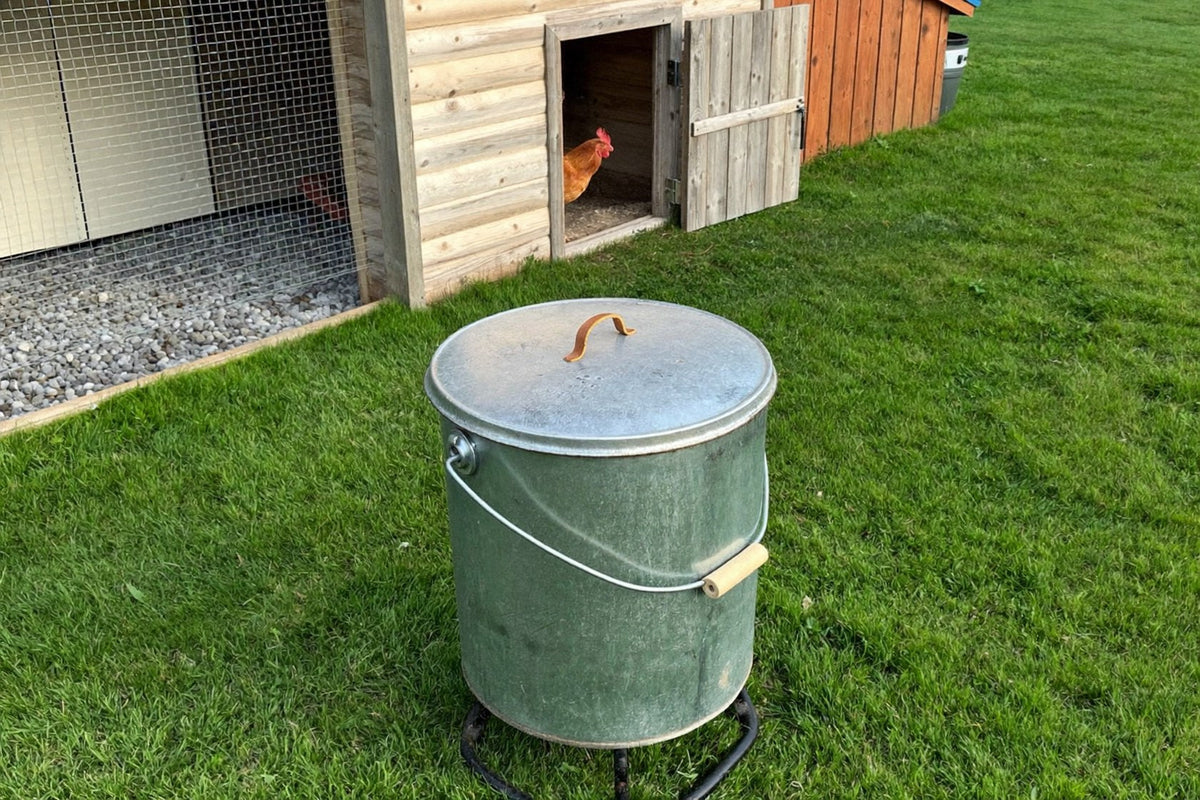
Keeping rats out of a chicken coop starts at the feed can, not the poison aisle. The extension services that write about coop pests keep landing on the same three attractants — the birds, their manure and their feed — and nearly every fix that works is a way of managing one of the three. Snakes come for the rodents your spilled feed invited. Flies come for wet manure. Mites ride in on wild birds and borrowed equipment, which is why the feeder belongs inside a coop's attached run rather than in the open yard. So this page is the pest half of coop security: rats, mice, snakes, mites and flies, each with its published counter. The structural half — latches, mesh gauge, ground aprons — has its own guide.
Pest and treatment guidance here is sourced to named extension services and linked at the bottom.
How do you keep rats out of a chicken coop?
Store feed in metal cans, clean up what the flock scatters, lock the feed away at night — then close the gaps. Penn State Extension's housing guidance puts storage first: a couple of metal cans for feed and spare shavings keep both dry and "away from rodents."
University of Minnesota Extension names the two rodents that actually show up — house mice and Norway rats — and hands you the unglamorous lever: "Cleanliness will also reduce problems with rodents." A rat that finds nothing to eat is a rat casing a different yard. Sweep the spills and pull wet feed the day it happens; dry bedding does the rest. The routine is the control.
Virginia Cooperative Extension adds the overnight rule — "Lock up or remove attractants such as feed, waste, and eggs" — and lists rats among the night visitors. A feeder that empties or locks up at dusk is worth more against them than any device sold with a picture of a rat on the box.
Hardware comes after housekeeping, and it is mostly the same hardware that stops diggers: a base that resists tunneling. Penn State's build advice — a concrete floor, with the wall started "with one or two concrete blocks" — exists because it "prevents rodents, snakes, and predators from digging under the walls and the floors." On a raised coop the equivalent is clearance: keep the space under the floor open and visible, and it stops offering the dark, undisturbed shelter rodents look for.
What attracts pests to a chicken coop in the first place?
"Birds, manure and feed can all attract pests to small flocks" — University of Minnesota Extension's full list, and the frame that organizes this whole page. Each pest keys on one attractant harder than the others, and each counter in the table below comes from a named publication.
| Pest | What draws it | The published counter |
|---|---|---|
| Rats and mice | Feed — spilled, soft-stored, or out overnight | Metal storage cans (Penn State); feed locked up at night (Virginia Cooperative Extension) |
| Snakes | The rodents first, eggs second | Rodent control, plus every opening over ¼ inch closed (Mississippi State) |
| Northern fowl mites | The birds themselves — carried in on wild birds, equipment and people | Check vents; treat while counts are under 50 mites per bird (Virginia Cooperative Extension) |
| Flies | Manure moisture | Manure at 50% moisture or below; waterers inspected daily (Penn State) |
| Raccoons and weasels | The flock — these are predators, not pests | Latches, mesh and aprons — the structural guide's territory, linked below |
No single extension publication prints the pest picture whole. Rodents live in the housing guidance, mites in a parasite bulletin, flies in a pest-management program, snakes in a wildlife page — the table is stitched from six publications across four extension services, all linked at the bottom. What it shows is the encouraging thing about pests: every row is a habit or a piece of hardware you can act on this week.
How do you keep snakes out of a chicken coop?
Control the rodents, and snakes lose their main reason to visit. Mississippi State University Extension's guidance is built on that order: "any structure or vegetation that provides a home for small rodents (mice and rats) is attractive to the snakes that prey on them." A rat problem and a snake problem are usually the same problem at different heights.
The direct attraction is the egg. Virginia Cooperative Extension is matter-of-fact: "Snakes will prey on small poultry or eggs when given the opportunity." Frequent collection shortens the opportunity — the collection cadence, and how many boxes it flows through, is in our nesting box guide.
Exclusion is a quarter-inch game. Mississippi State's rule is to close all openings larger than a quarter of an inch, with ¼-inch mesh hardware cloth as the covering standard for the gaps that must stay open. Underground, Penn State's dig-proofing — wire buried at least 12 inches along a run border, or the concrete-block base — blocks the snake and the rodent it was following with the same material.
Around the coop, the published guidance is mostly a mowing schedule: clear weedy growth, brushy fence rows and piles of boards, firewood, rock or leaves, and keep the lawn short around the perimeter. A yard with nowhere to hide is a corridor few snakes cross willingly.
Skip the repellent shelf. Mississippi State calls repellents "questionable at best," and notes that no repellent is currently registered for snake control. The same money buys a roll of quarter-inch hardware cloth, which works.
What do mites look like in a chicken coop?
Gray-to-black specks, half a millimeter to a millimeter long, that turn red after a blood meal — and mostly not in the coop at all. Northern fowl mites live on the birds; Virginia Cooperative Extension puts them "around the vent, tail, and breast."
Catching them early is the whole game. The mites are visible to the naked eye, but VCE warns that early infestations are easy to miss; populations peak after 4 to 5 weeks, by which point a single bird may host over 100,000 mites. The bill lands on the egg tray — VCE puts the production loss at 10 to 15 percent.
Treatment rewards the early. VCE's threshold: treatments work most effectively while counts are under 50 mites per bird, so a monthly vent check catches the problem inside the window where it is cheap to fix. Whatever product you use, VCE's instruction is not optional — read the label carefully, and mix and apply exactly as directed. Mite treatments are pesticides, and layers are food animals.
Where mites come from is the preventable part: transmission runs through "equipment, wild birds (sparrows and starlings), pet birds," and people. A feeder that lives inside the run sees less sparrow traffic than one in the open yard. Secondhand equipment gets washed before it crosses the threshold — and so do hands, after time around someone else's flock. The easiest inspection point is the roost after dark, when birds are calm on the bar and a vent is a flashlight check — the bar itself is covered in our chicken roost guide.
Flies and the smell problem: one number controls both
Fifty percent manure moisture. Penn State Extension's fly program turns on that single figure: fresh droppings run 75 to 80 percent moisture, flies can breed in manure anywhere between 50 and 85 percent, and drying manure to 50 or below is the whole program — dry manure, in PSU's words, "reduces the suitability" for fly egg-laying and larval growth.
"Fly control is basically a manure management strategy," Penn State's pest-management publication says, and it names the usual saboteur: leaking waterers are the major source of wet manure, so waterers get inspected daily. Manure moisture, PSU adds, is the most important factor in fly control. Not traps. Not sprays. Water discipline.
Coop odor runs on the same accumulation chain. University of Minnesota Extension: "Odor occurs when poultry manure accumulates," and "routine cleaning of the coop will prevent odor issues from arising." A small flock doesn't produce much manure — UMN again — so a smell problem is an accumulation problem, not a chicken problem.
Removal cadence is where coop hardware earns its keep. A slide-out droppings tray under the roost — look for the words slide-out, pull-out or removable on the listing — turns the wettest, freshest manure into a weekly pull-and-rinse instead of a shovel job, and dry litter handles the floor between changes. Depths, change schedules and the deep litter method's numbers are in our bedding and flooring guide.
Feed cans bought? Take 10% off a coop that moves off soiled ground. GET MY 10% CODE
Is it a pest or a predator?
Read the evidence before buying the fix, because the two problems have different playbooks. Virginia Cooperative Extension's field-sign tables draw the line: missing eggs or chicks put rats among the suspects, while lacerations near the vent point to a weasel or its relatives — with opossums and vent-pecking flockmates on the same list.
Pests come for the feed, the manure or a parasitic meal; predators come for the flock. Weasels and minks hunt at night. Raccoons famously work latches with their hands — the reason the structural guide below specs latches that need two distinct motions. Everything on this page manages attractants; none of it slows a determined digger or a latch-picker.
The structural half is its own discipline — half-inch hardware cloth, two-step latches, a ground apron under the wall line — and it has its own guide: how predator-resistant a coop really is. One thing worth knowing before you shop: a ground apron is almost never part of a coop as sold, whoever makes it — it is a groundworks job you do once, on site, and it is worth budgeting for separately. Most keepers add one from a roll of hardware cloth, and the guide shows where it goes.
Does moving the coop help with pests?
A coop that moves never lets the two slow attractants build: manure concentrating in the soil under the house, and the undisturbed ground a burrow needs. Moving is attractant management on wheels — the same chain the extension guidance describes, reset every time you move it.
The fly-and-odor logic is direct. Both follow accumulated manure, and ground that gets a fresh start every week or two never accumulates much of anything. Worth saying plainly: rotation is a pressure reducer, not a pest treatment. A rat can walk to the new spot; the point is the new spot offers nothing to move into.
Burrows are the sharper case. Rodents tunnel under stationary structures because the ground there is dark, dry and never disturbed — the exact condition Penn State's concrete-and-blocks advice exists to deny a fixed coop. A coop on wheels denies it by schedule instead: every move puts the sheltered ground back into open daylight.

The pest checks to run before you buy a coop
Four checks: where feed will live, what the floor is, whether a droppings tray is included, and what the mesh actually measures. A minute each — and the fourth is the one to slow down on, because a photograph settles the other three and cannot settle that one.
Feed storage is a floor-plan question. Penn State's metal cans need a dry corner to stand in, close enough to the coop that a February refill isn't a hike, far enough that spills don't land where the flock sleeps. A coop listing won't solve it, but the buyer who plans the can placement with the coop placement starts ahead of every rodent in the county.
The floor and the tray are the pest-relevant fittings listings do state. Floor construction — solid, tray, wire or open to grass — sets both the cleaning job and the ground pressure underneath, and a stated slide-out tray is the single fitting most worth confirming before you order, because it is the one you cannot retrofit — it is the row to look for, not the row to assume. If the listing names neither the floor construction nor a tray, that is the question to put before you pay.
Mesh is where listings go quiet. Two numbers decide what can reach, pass or tear through a mesh — the wire gauge and the aperture — and a listing that prints neither has told you nothing about exclusion, whatever adjective it puts in front of the word wire. Look for both before you order, and treat their absence as a question rather than an answer. Tell us the coop and we'll confirm the mesh spec from the manufacturer's drawing before you order; the offer stands on every coop we sell.
Sources: Penn State Extension, "Small Scale Poultry Housing" (Gregory P. Martin and Phillip Clauer, updated June 25, 2026) — accessed August 11, 2026 · Penn State Extension, "Pest Management Recommendations for Poultry" — accessed August 11, 2026 · University of Minnesota Extension, "Common concerns with backyard or urban poultry keeping" — accessed August 11, 2026 · Virginia Cooperative Extension, "Poultry Parasites: Northern Fowl Mites" (APSC-190) — accessed August 11, 2026 · Virginia Cooperative Extension, "Predators for Free-Ranging Poultry" (APSC-192) — accessed August 11, 2026 · Mississippi State University Extension, "Reducing Snake Problems Around Homes" — accessed August 11, 2026.
Frequently asked questions
How to get rid of rats in chicken coop?
Remove what feeds them before you fight them. Virginia Cooperative Extension's rule covers it: lock up or remove attractants — feed, waste and eggs. Move feed into metal cans, empty or lock the feeder overnight, sweep spills, and close the gaps the housekeeping reveals. Poison near a flock is a different decision: labels restrict where bait can go, and your county extension office can advise what's appropriate around birds.
How to keep mice out of chicken coop?
Close every opening larger than a quarter of an inch — the exclusion figure Mississippi State University Extension publishes — and give mice nothing to stay for: feed in metal cans, spills swept, bedding dry. University of Minnesota Extension's cleanliness rule names house mice directly. A raised coop with open, visible ground beneath it also removes the dark, undisturbed space mice prefer to nest in.
How to get rid of mites in chicken coop?
Treat the birds, not just the building — northern fowl mites live on the bird, around the vent, tail and breast. Virginia Cooperative Extension's numbers: treatment works best while counts are under 50 mites per bird, so check monthly and act early. Use a product labeled for poultry, mixed and applied exactly as the label directs, and wash equipment that has visited other flocks — a main transmission route.
How often should I sprinkle DE in chicken coop?
Virginia Cooperative Extension's mite publication gives an honest number instead of a schedule: in the research it cites, diatomaceous earth at 12 percent reduced but did not eliminate northern fowl mite infestations. So treat DE as a reducer, not a cure — and note that none of the services we cite publishes a coop sprinkling schedule. The mite fight is decided on the birds: check vents monthly, act while counts are under 50 per bird, and follow product labels.
How to deter raccoons from chicken coop?
Raccoons are predators, so the counter is hardware: two-step latches on every opening (the two-distinct-motions standard our predator guide details), half-inch hardware cloth instead of chicken wire, and a house door that closes every night. The full system — latches, mesh, aprons and the nightly routine — is in our guide to how predator-resistant a coop really is.