

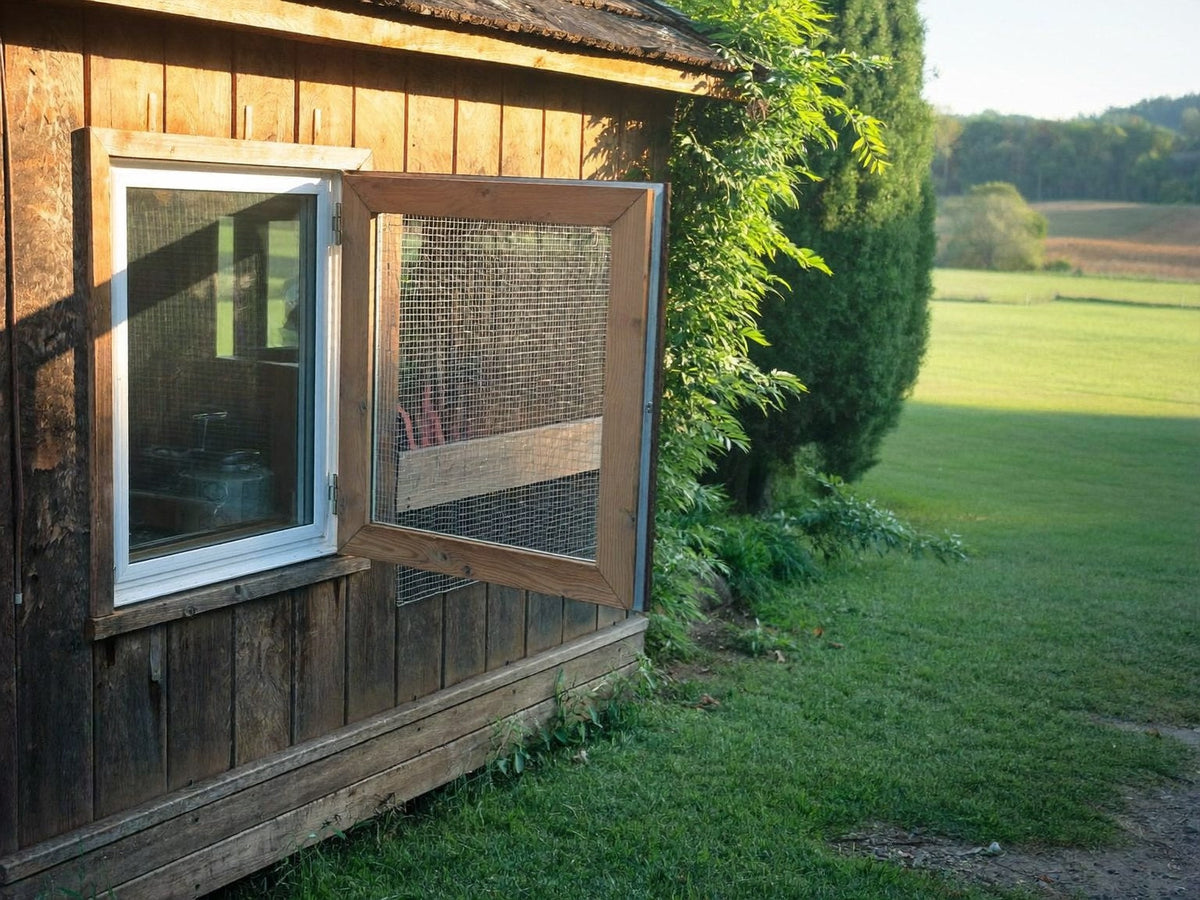
Chicken coop ventilation comes down to where the openings sit, not how many there are. Penn State Extension and Virginia Cooperative Extension publish the siting rule, the University of New Hampshire and the University of Minnesota add the south-side preference, and none of the four publishes a vent-area figure: put the openings on the side away from prevailing winds, angle the inlets upward, face the windows south or east, and keep them off the wall directly above the roost. Below: the vent words on a listing and what each one buys you, plus the ten-second check to run before you set a coop down. The walk-in coops give you the most wall to work with.
Where the vents go is quoted directly from all four services and cited at the foot. Penn State and Virginia Tech share a co-author — one voice published twice, not two agreeing.
Where should the vents go on a chicken coop?
Put them on the wall away from the prevailing wind, angled upward, and never straight above the perch. Penn State Extension states the rule in one line: "Locate openings on the side away from prevailing winds."
The second half of that instruction matters as much as the first. Penn State's next sentence: "Angle any air inlets upward to help the air to mix with the warmest (dryer) air as it enters the coop." An inlet cut level throws outside air across the coop at roughly the height the birds sleep. Angled up, the same air rises into the warmer layer under the roof and mixes before it comes back down.
Penn State rules out exactly one location, and it is the one a lot of small coops use: "However, do not allow the vents or windows to open directly over the birds perching area to prevent drafts." Height and draft interact in ways that change with the season, and our guide to whether a coop needs heating works through that relationship rather than repeating it here.
How much opening you need is a separate question, and a thinner one than the internet suggests. Penn State goes as far as: "For small coops windows or vents on one side of the house usually provide plenty of ventilation." One side of the house. Our pillar on what belongs inside a coop takes the area question apart in full — read that one for the number, and this one for the wall it goes in. Get the wall right and the area question gets a great deal smaller.
Four extension services, one siting answer, no area figure
Penn State and Virginia Cooperative Extension are not independent of each other — Phillip Clauer co-authors both, and the two ventilation passages run nearly word for word, so read them as one instruction published twice. The University of New Hampshire and the University of Minnesota reach the south-side rule separately. Not one of the four states how many square inches of vent a coop needs.
| Source | What it states about where the air goes | Vent area given? |
|---|---|---|
|
Penn State Extension Small Scale Poultry Housing |
"Locate openings on the side away from prevailing winds." "The south or east side is usually best." "Angle any air inlets upward…" | No |
|
Virginia Cooperative Extension 2902-1092 |
"Locate openings on the side away from prevailing winds. The south or eastside are usually best." "Face the front of the coop, the windows, and the outside run to the south…" | No |
|
UNH Extension Producing Your Own Eggs |
"There should be a door and at least one window, preferably on the south side of the coop." | No |
|
UMN Extension Caring for chickens in cold weather |
"Partially open a south-facing window." | No |
Virginia Cooperative Extension is the only one of the four that explains the payoff across a whole year: "Windows placed on the southside of the coop will also be a good source of light and warmth in winter and a good source of ventilation in summer." One wall, two jobs, opposite seasons. Virginia also tells you what the sun is doing for the ground: face the run south too, "this will allow the sun to warm and dry the coop and soil."
Read the table again and notice what is missing from the right-hand column. Four publications, three independent voices, one instruction — put the openings on the south or east side, away from the wind — and zero square-inch figures between them. That is not a gap in the guidance; it is the guidance. The thing they all agree on depends on your yard, your fence line and where your weather arrives from, which is why it is a decision you make in the garden with a compass rather than one you make on a product page. Go and stand where the coop will sit, note the wind, and you have already done the part that matters most.
How do you ventilate a chicken coop that can't face south?
Work the two rules that survive a bad compass: keep the openings on the leeward side, and angle whatever inlet you have upward. Penn State's small-coop guidance only asks for openings on one side of the house, not on four.
Wind beats compass when the two fight. Penn State writes the wind rule as a flat instruction and the direction as a preference — "usually best" — so a south wall that catches your prevailing weather isn't the wall to open. A north-facing opening in the lee of a fence will do more for air quality than a south-facing one taking wind head-on.
The opening you already have is the variable you actually control, and it is the one worth checking before you buy anything else. A window stated as openable or sliding is a lever. A fixed pane of transparent plastic is a light source. Both look identical in a photograph, and only one of them gives you anything to do the first time your coop smells of ammonia in August.
Your nose is the published instrument. University of Minnesota Extension: "If you smell ammonia or notice moisture collecting on objects or windows within the coop, you need to increase ventilation and clean up manure to help remove moisture." Penn State says the same thing from the other end — "Dampness and ammonia build-up is a sign that there is not enough ventilation for the number of birds in the coop." Bedding does part of this work too; depths and change schedules live in our bedding and flooring guide.

Openable, sliding or fixed: the vent words on a listing
The word a listing uses for an opening tells you more than its size does, because it tells you whether you get a lever or a fact. Here is the vocabulary, and what each term actually buys you once the coop is standing in the yard.
| The word on the listing | What it physically is | What it gives you after delivery |
|---|---|---|
| Louvered vent | A fixed slotted opening, usually set high on a wall or in a gable | Constant air exchange you cannot turn down. A good baseline, and no control at all in a cold snap |
| Ventilation door | A full panel on hinges | Normally the largest opening on the coop and the biggest single lever — shut, part open, or wide open |
| Openable or sliding window | A pane that moves within its frame | Real control over a small area. Check the stated dimensions: a sliding pane often clears only half its own width |
| "Windows", unqualified | Could be either — the word does not commit | Treat it as fixed until somebody confirms otherwise. The last section explains why that is the cheap assumption |
| Mesh, wire or fencing | The run wall, not the hen house | Nothing at all once the pop-hole shuts at dusk, which is exactly when air quality is decided |
| Nothing stated about air | Settle it from the photographs and one question, not from the spec text | Send us the coop and we will get the vent type, position and dimensions from the manufacturer before you order — start with the larger coops, where the answer matters most |
The distinction running down that last column is worth more than any single dimension: an opening a person can move is hardware you can act with, and a fixed one is hardware you can only aim. An adjustable opening is what lets you obey Penn State's rule once the coop is in the yard and the wind turns out to arrive from somewhere the photographs never showed you.
Where a listing does dimension an opening, multiply it out before you compare anything to anything. A hinged ventilation door stated at 24.4 by 18.5 inches is 451 square inches of opening. A sliding window a couple of inches deep is a small fraction of that. Both get printed under the word ventilation, and the two are not in the same business — so do the multiplication rather than counting the entries.
Then ask for what is missing. Tell us which coop you are looking at and we will put the vent and window dimensions to the manufacturer before you order, which is a message for us and a season of guessing for you.
Do chicken coops need vents, or is run mesh enough?
A meshed run isn't a ventilated house. Mesh panels sit in the run wall; the hen house is the closed box where the birds sleep, and that closed box is what Penn State's air-exchange guidance is written about.
The mechanism is an exchange, not a breeze. Penn State: "Ample air movement without a draft is essential. Fresh air brings in oxygen while excess moisture, ammonia or carbon dioxide are removed the stale air moves out of the house." University of Minnesota Extension puts the same idea in one sentence: "Air exchange within a coop is key to preventing moisture build-up and poor air quality due to ammonia." Air has to get in and out, which is why placement gets more attention in the literature than area does.
Run mesh does nothing for the house once the pop-hole shuts. Whatever a wire run contributes during the day, it stops contributing at dusk, and dusk starts the overnight hours when the birds are shut in a small volume breathing and producing moisture. The specs that decide those hours are the vent and the window, not the fencing.
UNH adds the one mechanical exception worth knowing: "If the flock is housed in a confinement situation, fans should be installed for good air circulation and ventilation in the summer." A fan is a confinement answer, not a small-coop default, and running power to a coop that moves is its own project.
Know which way your vents should face? Take 10% off a coop you can turn to match. GET MY 10% CODE
What covers the vent: aperture and gauge
The University of New Hampshire states the trade-off plainly: "The chicken coop needs to be tight enough to keep out animal predators, yet not so tight as to interfere with good ventilation." Every vent is a hole, and every hole is a hardware question.
Two numbers settle a vent opening: mesh aperture, and wire gauge. Go and see whether either one is printed anywhere on the listing. When it doesn't, a vent covered by unspecified mesh is a vent you are trusting on faith — so either ask before you order, or price a roll of hardware cloth into the purchase and cover the opening yourself. Our pest guide works through what each number does.
Latches, aprons and the rest of the structural argument have their own page: how predator-resistant a coop really is. What matters here is that the tension UNH names is real, and that you get to resolve it yourself with about ten dollars of hardware cloth and an hour. Covering an existing opening is the one job on this page that needs no permission and no spec sheet, so if a coop is right in every other way, do not let an unstated mesh figure decide it for you.
Why does a coop on wheels change the answer?
A fixed coop is aimed once, on the day it is set down. A coop on wheels gets aimed again every time you move it, which turns Penn State's prevailing-wind rule and Virginia's face-it-south rule into a repeatable decision instead of a one-time one.
Turning the coop re-aims every opening it has, fixed or openable. Nobody who pours a slab and frames a wall gets a second attempt at orientation. Move a coop on wheels and you get one every time you move it, for free, using nothing but the direction you happen to park it.
An openable vent adds the second lever. On a coop with two stated openings, you can turn the house and close the one now facing the weather, which is why an adjustable opening is worth more than a merely stated one. On a coop with one fixed window, the turn is your only control. It's a good one. It's also the only one.
The habit worth building takes ten seconds. Before you drop the wheels at a new spot, check where the wind is coming from and put the stated opening on the far side of the house. Our guide to moving a coop without wrecking the lawn covers the rest of the move; the wind check is the one step that costs nothing and is easiest to forget.
The siting check to run before you set a coop down
Four things, in this order: which way the wind comes from, which wall the openings are on, whether those openings move, and what sits directly under them inside. The whole check takes under a minute and it's free.
Wind first. Stand where the coop will go and note which way your weather arrives from. Penn State's instruction is to put the openings on the far side of that, and it outranks everything else on this list.
Then the wall. Work out which face of the coop carries the window or vent — from the spec text if it says, from the photographs if it doesn't. That an opening exists and which wall it sits on are two different facts, and here the second one is the half that matters. If neither settles it, that is precisely the question to put to the maker before you order.
Then the mechanism. Openable, sliding or fixed. A listing that says "windows" without saying which is telling you less than it appears to.
Then what is underneath. Trace an imaginary line from the opening to the floor inside. If it lands on the roost bar, turn the coop or use a different opening, because that is the one placement Penn State names and forbids.
If the listing in front of you answers none of that, send us the coop and we'll get the vent position and dimensions from the manufacturer before you commit — `sales@moveablechickencoop.com`, and it costs you one sentence. Then browse the coops built to move, where the first three items on that list stay in your hands for the life of the coop.
Which way would we face a coop, and what does being wrong cost?
South, and downwind second. If the two conflict, and a south wall catches the prevailing wind, we would take the wind rule and give up the sun, because Penn State states the wind as an instruction and the compass only as a preference.
Second stance, and it is the one that saves money: treat an unstated window as fixed until somebody confirms otherwise. Assume it opens, and you may be buying your only air control sight unseen and finding a sealed pane in the carton. Assume it is fixed, and the worst case is a pleasant surprise on delivery day. The asymmetry is obvious once you write it down, and worth writing down before you order.
What being wrong costs is slow and hard to see coming. Penn State: failure to insulate or ventilate properly "causes moisture to accumulate on the walls and ceiling in cool weather", and the published tell is dampness plus ammonia build-up. UMN gives you the same diagnosis through your nose and the condensation on the glass. Both are signals you read after the coop is in the yard and the birds are in it. That is late. The coop is heavy by then, the run is pegged down, and the fix you want is the one you could have made for free on day one by turning the coop before you set it down.
The two errors are not equal, either. An opening too far from the roost costs a little air movement over the birds. An opening straight above the roost puts moving air on them every night they sleep. Penn State spends a full sentence forbidding the second and none forbidding the first, so we would err toward the far wall every time.
What we would not do is cut a second vent on the strength of a square-inch figure from a forum thread. No source in the chain above publishes an area figure, and a number that confident with nothing published behind it is somebody's guess with a decimal point on it. Start from the opening the coop already has, read the dampness and the ammonia, and add only if the coop tells you to. Holes are much easier to cut than to close.
Buying rather than cutting sidesteps the whole problem, because the vents are already placed and you can read where they sit before you commit. Vent position is one of the fields worth checking on the listing rather than after delivery - the walk-in coops give you the most wall to work with, and the coops built to move let you turn the openings out of the wind instead of cutting new ones.
Sources: Penn State Extension, "Small Scale Poultry Housing" (Gregory P. Martin and Phillip Clauer, updated June 25, 2026) — accessed August 11, 2026 · Virginia Cooperative Extension, "Small-scale Poultry Housing" (publication 2902-1092 / APSC-186NP, Leonie Jacobs and Phillip J. Clauer, April 28, 2023) — accessed August 11, 2026 · University of New Hampshire Extension, "Producing Your Own Eggs" (no author byline; page contact Kendall Kunelius, Assistant Extension Field Specialist) — accessed August 11, 2026 · University of Minnesota Extension, "Caring for chickens in cold weather" (Colleen Carlson and Hannah Lochner, reviewed 2026) — accessed August 11, 2026. Vent and ventilation-door dimensions quoted here are manufacturers' own published figures; the square-inch totals are our multiplication of them.
Frequently asked questions
How much ventilation for chicken coop?
No extension service we cite publishes a square-inch figure. Penn State Extension goes as far as saying that for small coops, windows or vents on one side of the house usually provide plenty of ventilation, and that dampness and ammonia build-up signal there is not enough for the number of birds inside. Our guide to what goes inside a coop covers the area question in full.
How to make a vent for a chicken coop?
Cut it high on a wall away from the prevailing wind, cover it with mesh, and angle the opening upward. Penn State Extension's instruction is to angle any air inlets upward so the incoming air mixes with the warmest, driest air already in the coop. Keep it off the wall directly above the perch, which is the one placement Penn State rules out.
How to add ventilation to chicken coop?
Start with the openings you already own. A window stated as openable or sliding, or a ventilation door, gives you control that a fixed pane does not. If everything is fixed, the cheapest addition is a mesh-covered gable opening on the leeward wall, above bird height. Ask us for the opening dimensions before you cut into a coop you have just bought — modifying it yourself may affect the manufacturer's warranty.
How to prevent chicken coop from smelling?
Ammonia is the published warning light, not a smell to mask. University of Minnesota Extension's instruction is direct: if you smell ammonia or see moisture collecting on objects or windows inside the coop, increase ventilation and clean up manure to help remove moisture. Air exchange and manure removal are the two levers. Deodorizers treat the symptom and leave the moisture where it was.