

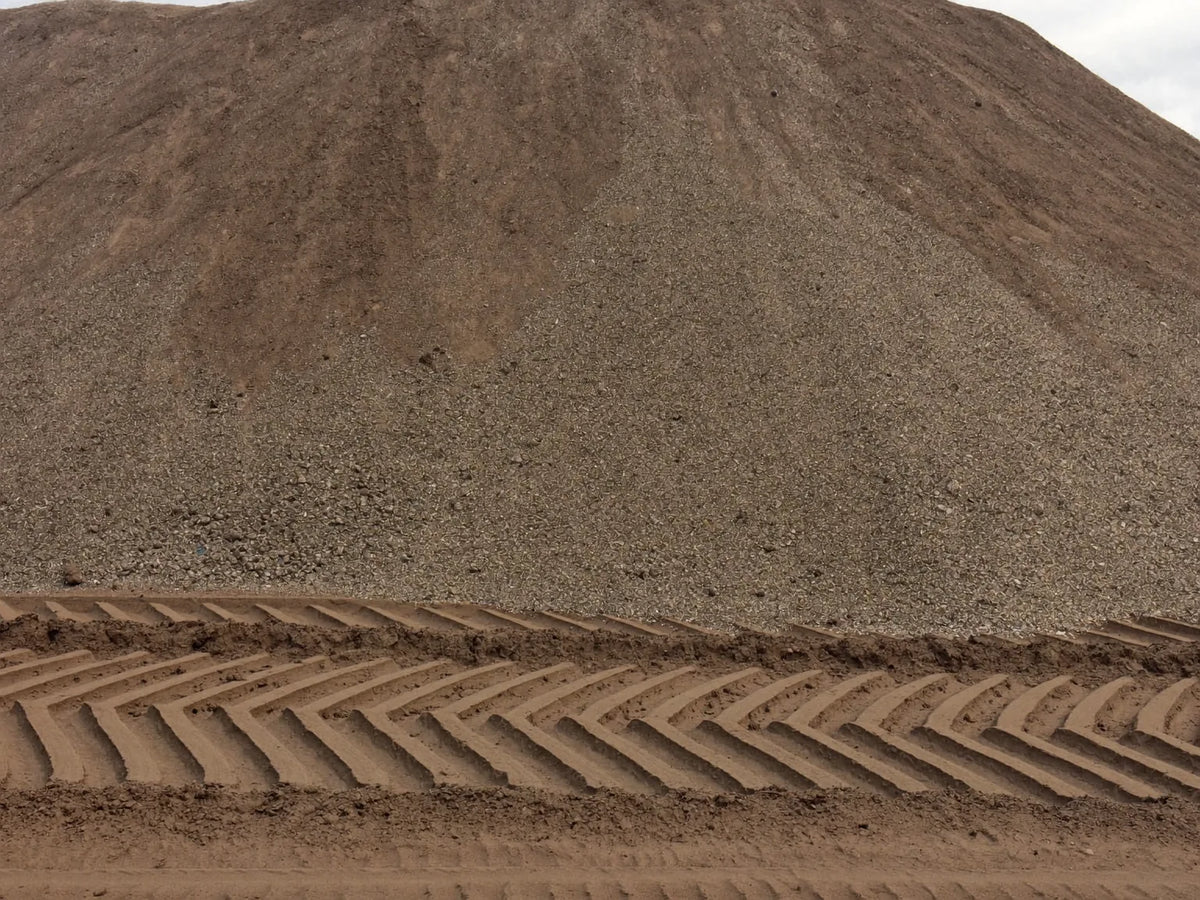
Construction sand for a chicken coop is one specific product with a specification behind it: concrete-grade fine aggregate, bought against ASTM C33. The specification matters because of what it is for. C33 is written as a purchase document, so the words on your order can be checked against something. It fixes a grain-size window, a coarseness index and a limit on the dust carried with the load. It was written for concrete, and no poultry authority grades sand at all. Sand is also the heaviest thing that will ever go into a coop you move, and it is sold by weight.
Every grain-size window, fineness-modulus band and dust cap here comes word for word from the standards bodies that publish it. The poultry services that name sand without grading it are linked at the foot, with the federal silica standard.
What is construction sand for a chicken coop?
Construction sand for a chicken coop is the builders' merchant grade of sand — concrete-grade fine aggregate — sold against ASTM C33. That standard sets a grain-size window, a coarseness index and a ceiling on the fine dust allowed in the load.
What makes it useful to a buyer is not that it is a standard. It is that the standard was written to be quoted on an order. C33's own scope says so: "This specification is for use by a contractor, concrete supplier, or other purchaser as part of the purchase document describing the material to be furnished." A purchase document is the piece of paper with your name on it.
Read the scope one line earlier and you also get the honest limit, which travels with every number below: "This specification defines the requirements for grading and quality of fine and coarse aggregate (other than lightweight or heavyweight aggregate) for use in concrete."
| What the specification controls | The published limit | What that gives a coop buyer |
|---|---|---|
| Grain-size window | Fine aggregate is the fraction passing the 4.75 mm (No. 4) sieve and predominantly retained on the No. 200 sieve — ACI E1-16 states "Coarse aggregate is that portion retained on the 4.75 mm (No. 4) sieve" | A top size and a bottom size that were agreed, rather than whatever the pit ran that week |
| How coarse, as an index | Fineness modulus 2.3 to 3.1 | The single number that separates a coarse sand from a fine one — and both ends of the band conform |
| Dust and clay in the load | Material finer than the No. 200 sieve capped at "3 percent for fine aggregates used in concrete subject to abrasion, and 5 percent for fine aggregate used in all other concrete" | The number that sits behind the word washed |
| What the grains are | "Fine aggregate shall consist of natural sand, manufactured sand, or a combination thereof" | River-rounded or crushed. The specification permits both and prefers neither |
| Cleanliness and durability | Organic-impurities, soundness and clay-lump test methods, all named in the standard | The checks that keep silt, coal, lignite and rotten grains out of what arrives |
One caveat belongs with that table. What is publicly fetchable is the standard's listing — the scope, the abstract and the list of test methods. The standard itself is paywalled and we have not read it, so every limit above is quoted from the American Concrete Institute's aggregate bulletin rather than from C33's own tables.
Turn the same table around and it sorts the sands you should walk away from, which is the question most people actually arrive with. Play sand is the clearest case: it is screened soft and fine on purpose, and soft and fine is the wrong end of a grain-size window written for concrete. Unwashed pit sand gets a different verdict entirely — it is not bad material, it is material nobody has put a number on, and it should be priced that way. Any bag offering you a name and no designation belongs in that second group too. So ask for the designation first, every time. It is one line on an order and it does all of this sorting for you.
Concrete sand, construction sand and C33: three names for one order
Concrete sand and construction sand are shop names for the same material, and the striking thing is that neither phrase appears in the specification. Searched over the raw bytes of both documents, the C33 public listing and ACI's aggregate bulletin contain zero instances of construction sand, concrete sand or play sand.
The sand nouns the specification does use are two, and they describe origin rather than grade: "Fine aggregate shall consist of natural sand, manufactured sand, or a combination thereof." ACI puts the difference plainly — "Natural sands and gravels are the product of weathering and the action of wind or water whereas manufactured crushed fine aggregate and crushed stone are produced by crushing natural stone."
So the name on the bag is retail vocabulary and the designation is the part that travels onto an order. In practice a yard will answer to concrete sand and a big-box aisle will label the same grade all-purpose. Say the designation as well as the name and the ambiguity disappears.
Washing is a process applied to either origin, not a property of one: "Screening and washing may be used to process either natural or manufactured aggregates." Which of the two you end up with depends on what is quarried near you, and no poultry publication rates one against the other.
Whether sand belongs on your coop floor in the first place is a genuinely open question with published guidance on three sides of it, and that argument lives in our sand for a chicken coop guide. Everything below assumes you have already settled it.
How coarse is coarse sand for a chicken coop, in a number?
Coarse is a comparison, not a grade. The number that carries it is the fineness modulus — one index computed from a sieve test — and ASTM C33 fine aggregate is allowed to run anywhere from 2.3 to 3.1.
ACI states the direction of the index outright: "The coarser the aggregate, the higher the fineness modulus." And the band: "For sands used in concrete, the fineness modulus generally ranges from 2.3 to 3.1 per ASTM C33/C33M." The index is computed from the percentages retained on a fixed ladder of sieves — No. 4, 8, 16, 30, 50 and 100 — so it summarises a whole gradation in one figure.
Here is the consequence the phrase hides. A sand at 2.3 and a sand at 3.1 both conform. Asking for coarse washed construction sand therefore sets a floor and not a selection, and two loads that both pass can be visibly different in the hand. If you want the coarse end, ask for the fineness modulus by name and ask for the high end of the band — which is the opposite of what a number called fineness suggests.
The band also protects a top-up. C33 constrains drift from a given source: the fineness modulus "should not vary by more than 0.20 from the value that is typical of the source (base fineness modulus)" for continuing shipments. Buy from the same supplier next spring and the material is specified to be near enough the same, which is not true of an unspecified pit sand.
What washed construction sand controls, and what it does not
Washed is a process word. The number underneath it is the limit on material finer than the No. 200 sieve, which ASTM C33 caps at "3 percent for fine aggregates used in concrete subject to abrasion, and 5 percent for fine aggregate used in all other concrete".
The fines fraction cannot be estimated by eye. It is measured by washing a sample of the aggregate over the No. 200 sieve, per the test method ASTM C117, and reporting the mass lost as a percentage. So a producer selling to the standard already knows the number for their own material, which is why asking for it is a reasonable question rather than an awkward one.
Two limits belong on that reading, in both directions. The cap was written for concrete, where excess fines raise water demand — not for a coop floor, where the reason people give for wanting fewer fines is drainage. And a percentage by mass of the minus-200 fraction is not a dust measurement. It bounds how much of the finest material is in the load; it says nothing about how much of that becomes airborne when you tip a bucket.
What it does do is worth having anyway. The washed grade is the one where somebody has measured the fine fraction and agreed a ceiling on it. The unwashed pit sand next to it in the yard may be perfectly good material, but nobody has put a number on what is riding along with it.
So buy the grade that comes with a number attached, and ask for the number by name. Where a yard cannot produce one, price that load as unmeasured material and decide with your eyes open - the ordering script for doing exactly that is two sections down.
Grade settled? The coop under it is the other half of the order. TAKE 10% OFF
How do you order coarse construction sand without guessing?
Ordering is four lines: the designation, the trade name your supplier uses, the fineness modulus you will accept, and the quantity in the unit they actually sell. Say them in that order and a yard can price the load without a conversation about chickens.
| What to say | Why that is the line that works | If they cannot answer it |
|---|---|---|
| ASTM C33 fine aggregate | The designation the standard was written to be quoted on — C33 names "a contractor, concrete supplier, or other purchaser" as its users | Ask for the gradation report. A producer selling into concrete keeps one as a matter of course |
| Concrete sand or C-33 at the counter | The trade name that maps to the designation in most yards, and the one a delivery ticket is likely to print | In a big-box aisle, read the bag's own published product data instead of the shelf label |
| What is the fineness modulus of this source? | The one number that says how coarse, inside a band that permits both ends | No figure on file means the material is not being sold to the standard, whatever the sign says |
| Washed — what is the minus-200 percentage? | Turns the process word into the number the specification actually caps, at 3 or 5 percent | Treat it as unwashed pit sand and price it as such. It is not disqualified, it is unmeasured |
| Quantity, in their unit | Bagged sand is sold by weight; loose material goes by the ton or the cubic yard, usually with a minimum load | Work the volume out before you leave the house — the cubic-feet arithmetic is in our sand guide |
Two things move the number on a ticket that has nothing to do with grade. Loose sand is sold by weight and damp sand carries water, so a wet load buys you less sand per ton than a dry one. And a yard's minimum load is usually larger than a small coop needs, which is the real reason bagged sand wins for a single hen house and loose material wins for a run.

The silica question, and the standard that names it
Respirable crystalline silica is a genuine published hazard with a federal standard attached, so it deserves that standard's own words rather than an adjective from us. OSHA regulates it as an occupational exposure, and the regulation is scoped narrowly.
The scope of 29 CFR 1926.1153 reads: "This section applies to all occupational exposures to respirable crystalline silica in construction work, except where employee exposure will remain below 25 micrograms per cubic meter of air (25 µg/m3) as an 8-hour time-weighted average (TWA) under any foreseeable conditions." The exposure limit itself: "The employer shall ensure that no employee is exposed to an airborne concentration of respirable crystalline silica in excess of 50 µg/m3, calculated as an 8-hour TWA."
OSHA also describes where the hazardous particles come from, and the description is the part that matters to somebody buying a bag: "Respirable crystalline silica – very small particles at least 100 times smaller than ordinary sand you might find on beaches and playgrounds – is created when cutting, sawing, grinding, drilling, and crushing stone, rock, concrete, brick, block, and mortar." The same agency's construction fact sheet gives the consequence rather than repeating the mechanism: those particles "can travel deep into workers' lungs and cause silicosis, an incurable and sometimes deadly lung disease".
Read that carefully and two boundaries appear, neither of which is reassurance. The exposure route OSHA names is fracturing silica-bearing material, and pouring or raking a graded sand is not one of the listed tasks. The standard also binds employers on construction sites, not a person in their own yard. Neither boundary is evidence of safety in a coop, and no publication opened for this post measures respirable silica from handling sand around a flock in either direction.
Where that leaves a buyer is with one lever and one honest gap. The lever is the grade: the washed specification is the only version of this material where the fine fraction has been measured and capped. The gap is that the minus-200 limit and the respirable fraction are different measurements — respirable particles are far smaller and sit inside that fraction, so capping the parent cannot raise the child and does not measure it. Coop-side dust, including the one cleaning instruction an extension service does publish, is handled in our sand for a chicken coop guide.
No poultry publication grades the sand it names
Poultry publications name sand as a material and then stop. Six publications were searched over their raw bytes for a grade, a sieve, a fineness modulus, an ASTM designation or the word coarse applied to sand, and not one of the six contains any of it.
The six were Penn State Extension's housing publication, Virginia Cooperative Extension 2902-1092, UNH Extension's Producing Your Own Eggs, University of Minnesota Extension's laying-hen page, UConn Extension's backyard-poultry bulletin, and the small-flock litter article by Dr. Jacquie Jacob of the University of Kentucky. Zero hits across all six for sieve, silica, ASTM, coarse, graded, micron, construction sand, concrete sand and play sand. Penn State and Virginia count as one voice rather than two, because they share a co-author, Phillip Clauer.
There is one particle-size threshold published in that set, and it is about a different material. The litter article, writing about pine bark: "when particles are larger than 1 inch, increased incidence of litter caking occurs." So the field is willing to publish a size limit when it has one. It has not published one for sand.
Say the consequence out loud rather than dressing it up. The specification you are buying to was written for concrete, and carrying it across to a coop floor rests on grain size and drainage reasoning, not on a poultry finding. Anyone who tells you an extension service recommends a sand grade is inventing the citation. What the services do publish about sand, including where they contradict each other, is set out in our sand for a chicken coop guide and in the bedding comparison.
What to check on a coop before the sand arrives
Sand is bought by weight and coops are sold by dimensions, so the figure that joins the two — what the coop weighs empty, and what it will weigh full — is the one to go looking for. Read the listing for an assembled weight before you order anything. Where it is not printed, that is a question worth asking, not a reason to stop.
The arithmetic runs perfectly well in the meantime, as long as it runs on figures somebody actually published. Take a house floor of 13 sq ft, a size stated on backyard coop listings. At 2 inches deep that is 13 × 2 ÷ 12, or 2.17 cubic feet. ACI publishes a range for the rodded bulk density of normalweight concrete aggregate — 75 to 110 lb per cubic foot — which is a compacted laboratory measure, so a loose pour sits under it and a damp one carries water on top. Even at the bottom of that band, 2.17 cubic feet is over 160 pounds of sand. At the top it is about 240.
Weight is a floor question on a coop that stays put and a design question on one that does not. A few hundred pounds of aggregate in a hen house standing on a concrete pad is a load the pad was always going to carry. The same load in a coop bought because two people can walk it onto fresh grass changes the thing you paid for, and getting it back out is a shovel job.
Which is why the spec sheet matters more than the sand here. Name the coop you are looking at, and we will take the assembled weight and the floor detail to the manufacturer and come back with what they say — the coops we carry are the place to start browsing while you wait. If sand is going in a run rather than a hen house, the roof over it is what decides how much you keep buying, and a coop with a covered run is a different arithmetic from an open pen. Run floors are their own subject in our outdoor chicken run guide.
What we would put on the order, and what we would send back
We would order ASTM C33 fine aggregate, washed, and we would ask for the fineness modulus before the load left the yard. Where nobody at the counter can produce a gradation report, we would buy the bag whose own published product data prints the designation, and pay more per pound for a number we can check.
What we would send back is narrower than you might expect. Visible clay lumps, or a silt film left on your palm after you rub a handful, is a load that did not meet the fines limit somebody agreed to. Sand sold with no designation, no report and no washing claim is not automatically bad material — it is unmeasured material, and it should be priced like it.
Being wrong in the two directions costs very different amounts, and the asymmetry is the whole argument for over-specifying. Ask for more than you need and the cost is a phone call and possibly a few dollars a ton. Ask for nothing and you can end up with an ungraded fine sand that beds down and seals, at which point the only fix is to shovel it out and buy the load you should have ordered. One mistake costs a conversation. The other costs a weekend.
The specification is the portable part of this decision. The coop is the part that is specific to you, and it is the half we can actually check on your behalf — ask us about a floor, a tray or an assembled weight and we will go to the manufacturer for it. The coops those numbers belong to are the coops built to move and the rest of the range we stock.
Sources: ASTM International, “C33 Standard Specification for Concrete Aggregates” (public listing only — the standard itself is paywalled and was not read — accessed August 21, 2026) · American Concrete Institute, “Aggregates for Concrete” ACI E1-16 (developed by ACI Committee E-701 — accessed August 21, 2026) · Occupational Safety and Health Administration, “Silica, Crystalline” (accessed August 21, 2026) · eCFR, 29 CFR 1926.1153, “Respirable crystalline silica” (accessed August 21, 2026) · OSHA FactSheet, “OSHA’s Respirable Crystalline Silica Standard for Construction” (accessed August 21, 2026) · Penn State Extension, “Small Scale Poultry Housing” (Gregory P Martin, Ph.D., PAS and Phillip Clauer — accessed August 21, 2026) · Virginia Cooperative Extension 2902-1092, “Small-scale Poultry Housing” (Leonie Jacobs and Phillip J. Clauer — accessed August 21, 2026) · University of New Hampshire Extension, “Producing Your Own Eggs” (accessed August 21, 2026) · University of Minnesota Extension, “Raising chickens for eggs” (accessed August 21, 2026) · UConn Extension, “Backyard Poultry: A Quick Look at Raising Healthy Birds” EXT 104 (Indu Upadhyaya — accessed August 21, 2026) · Small and Backyard Poultry (eXtension), “Litter Material for Small and Backyard Poultry Flocks” (Dr. Jacquie Jacob, University of Kentucky — accessed August 21, 2026) · The 13 sq ft house-floor area used in the weight arithmetic is a published manufacturer specification — a 13 sq ft main house stated by PawHut for its 59-inch wooden mobile coop, accessed August 21, 2026.
Frequently asked questions
What sand to use for chicken coop?
One grade covers every job sand does around a flock: ASTM C33 fine aggregate, washed, sold as concrete sand at most yards. What changes between the hen house, the run and the dust bath is how much you buy, not which bag you buy. Whether sand belongs on a coop floor at all is a separate argument, and the published guidance splits three ways on it.
What type of sand for chicken coop?
ASTM C33 permits two types of fine aggregate and prefers neither: natural sand, weathered by wind and water, and manufactured sand, produced by crushing stone. Your yard will know which it sells, because it depends on what is quarried nearby. No poultry publication opened for this guide rates one against the other, so choose on what your supplier can deliver washed and to a stated fineness modulus.
What sand is best for chicken coop?
The best sand for a chicken coop is the one you can specify: coarse washed construction sand meeting ASTM C33, with a fineness modulus you asked for rather than inherited. Best is a purchasing word here rather than a husbandry one. No extension service publishes a sand grade for poultry at all, so the construction specification is the only checkable answer on offer.
Where to buy construction sand for chicken coop?
Aggregate suppliers, ready-mix plants and builders' merchants sell C33 fine aggregate, usually loose by the ton or the cubic yard with a minimum load attached. Home improvement stores carry the same grade bagged, under all-purpose or concrete sand labels. Ask either one for the gradation report; a supplier selling into concrete keeps one, and a bag that prints the ASTM designation on its own product data is the retail equivalent.