

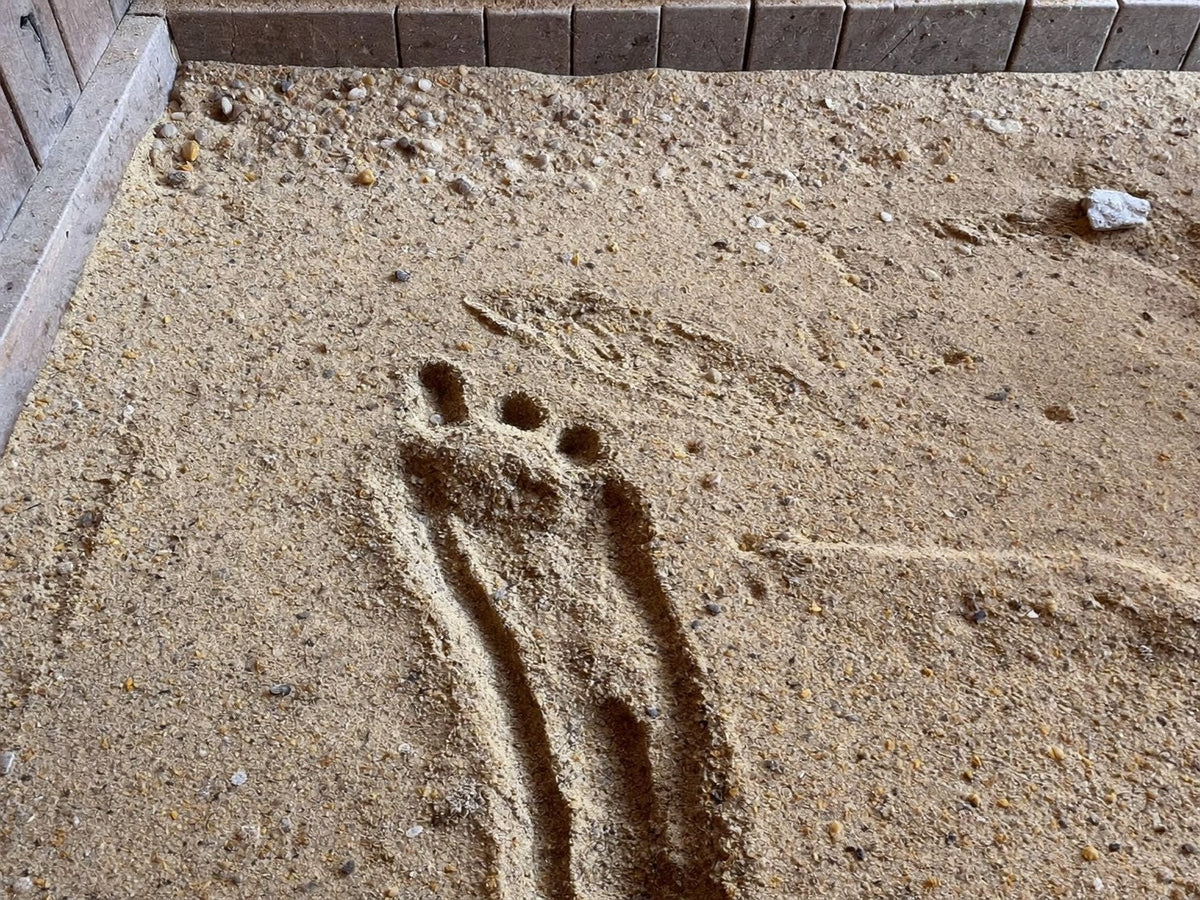
Sand for a chicken coop should be coarse, washed construction sand — the grade sold as concrete sand or ASTM C33, which one supplier states runs 0.25 to 5 mm. Not play sand, which is screened fine for sandboxes, and not bagged commercial-grade sand, which is graded to a single narrow size band. That single distinction decides almost everything people argue about: drainage, dust and how often you scoop. Sand also weighs what it weighs, which matters on a coop you move. Here is what the extension services actually publish about it, including where they disagree — and what we'd do about it.
Sand grades follow the published ASTM specification; the husbandry points are attributed to named services at the foot of the page.
What kind of sand do you use in a chicken coop?
Coarse washed construction sand — the grade the building trade calls concrete sand or C-33. QUIKRETE's product page for All-Purpose Sand, No. 1152, says the product "is a washed, properly graded coarse sand with multi-purpose uses. Meets ASTM C 33 specifications."
ASTM C33 is a real specification, which is what makes this answer checkable instead of folkloric. York Building Products describes C-33 as "a fine aggregate for concrete mixtures" and "a graded sand identified by the American Society for Testing and Materials (ASTM) as C33/C33M sand," with "particles measuring anywhere from 0.25 millimeters to 5 millimeters."
A twentyfold spread in grain size is the entire point. Big grains hold the pile open so water drains through instead of sitting on top. Uniform fine sand does the opposite: it beds down, seals and holds water.
| What the bag or the ticket says | The seller's own words | In a coop? |
|---|---|---|
| All-purpose / concrete / C-33 sand | QUIKRETE No. 1152 "is a washed, properly graded coarse sand with multi-purpose uses. Meets ASTM C 33 specifications" | Yes — this is the grade keepers mean when they say construction sand |
| River or bank-run sand | Sold loose by the cubic yard at aggregate and gravel yards; naturally mixed grain sizes | Yes, if it is washed. Ask for the C-33 gradation by name |
| Play sand | Graded and screened for sandboxes — QUIKRETE's Play Sand is described as "a specially-graded, washed sand that has been dried and screened for children's sandboxes" | No — that grade is finer and more uniform than the 0.25–5 mm C-33 range, which is the opposite of what drainage asks for |
| Bagged commercial-grade sand | QUIKRETE Nos. 1961–1963: "A consistently graded, washed and kiln dried sand used for industrial and construction applications" | No — the seller's own wording is a consistently graded, kiln dried sand for industrial and construction applications, and the line is sold in separate coarse, medium and fine grades. That is a different specification from the graded coarse sand this page is about |
Which sand is a materials question first — drainage and grain size, both of them set by the grade. You can settle that much at the store in 10 seconds: if the bag or the supplier's product data doesn't give you the words "coarse" and "ASTM C 33", put it back. What any of it does to dust is a separate question, and it has its own section below.
The published guidance splits three ways on sand
Read four extension publications on backyard coops and you get three different answers about sand. That's worth knowing before you take anyone's verdict as settled. One names sand as bedding, one names it only for dust bathing, and two never name a floor material at all.
Count those last two as one voice rather than two: Penn State's and Virginia Tech's housing publications share a co-author, Phillip Clauer, and their floor advice is the same sentence lightly reworded.
UConn Extension puts sand on the accepted list. Its 2025 backyard-poultry bulletin: "The flooring should be easy to clean and covered with bedding such as straw, pine shavings, or sand to absorb moisture and provide comfort." Sand appears in the same breath as shavings. The same bulletin qualifies it further down, listing sand among alternative materials that "have also been explored, each with varying degrees of effectiveness."
UNH Extension puts sand somewhere else entirely. Its litter instruction recommends two materials and rules out two more, and sand is not among any of them. UNH: "Fresh wood shavings or sawdust six to eight inches deep make excellent bedding or litter and are preferable to hay or straw, which is difficult to clean up once soiled." Sand shows up once in that publication, and not on the floor — hens with "daily access to loose soil, sand, or bare ground will often dust bathe."
Penn State and Virginia Cooperative Extension skip the floor-material question. Both specify a floor you can wash rather than a substance to put on it. Virginia's housing publication: "Slightly sloping the floor toward the door can help prevent puddling in the building and will make the building easier to spray out and dry between uses," and "Use building materials which will be easy to clean and disinfect." Neither names sand anywhere, and neither names a floor litter. Penn State names a material exactly once and it is not for the floor — in the nest boxes, where it says "Pine shavings are preferred."
There is a fourth position, and it is a list rather than a verdict. Dr. Jacquie Jacob's litter article for the small-flock extension program sets out what good litter should do. Her list: be nontoxic, be free of contaminants, "be very absorbent; have a reasonably short drying time; have reduced thermal conductivity; be able to be repurposed after being used as bedding material (e.g., as a land application); and be readily available and relatively inexpensive."
Run sand against that list honestly and the score is mixed by design. Sand is nontoxic, cheap, available and dries fast. It fails three criteria outright. Sand is not absorbent, and absorbency is what litter is normally bought to do. Sand conducts heat rather than resisting it, so it misses "reduced thermal conductivity" — the thermal mass keepers like is the same property the criterion counts against. And sand cannot be spread on a garden the way soiled shavings can, because sand doesn't compost. Whatever comes out of the coop is manure to deal with plus sand you keep. How the materials rank against each other, criterion by criterion, is our bedding comparison.
Does sand make a coop dusty?
No extension service we opened publishes a finding that sand raises dust in a backyard coop. The one comparison we did find points the other way, and it comes out of a commercial broiler house. The dust warning the services print is aimed elsewhere.
The comparison comes from Jacob's extension litter article, which reports Auburn University research on sand in commercial broiler houses and then a follow-up field study it does not name. After 10 consecutive flocks, houses with sand bedding "had less dust, lower levels of darkling beetles, less caking, and improved house temperatures (2ºF cooler in summer and warmer in winter)." The part the article does attribute to Auburn is the performance result: "broilers raised on sand performed as well as or better than those raised on pine wood shavings. Footpad quality also was improved." Two caveats belong with that, and we'd rather print them than bury them. Commercial broiler houses are not backyard coops, and the comparison was against pine shavings rather than against a clean slate.
University of Minnesota Extension does publish a dust warning, and it is aimed at the keeper rather than the flock. "Take safety precautions when handling dust during cleaning." "Dried chicken manure can be harmful to humans if inhaled." The instruction that follows is specific: "Wear a dust mask and mist the walls surrounding the area to control dust movement."
UMN writes that instruction for coop cleaning in general, and a sand floor's daily routine is one of the places it lands. Sand works by letting droppings dry so they can be sifted out, which means the sifting is done over dried manure. UMN doesn't rate sand against any other floor and neither will we. What it does give you is the procedure — mask on, walls misted first — and it's the same procedure on shavings.
Play sand deserves one honest paragraph of its own. QUIKRETE's own wording has it "dried and screened for children's sandboxes," which means a finer and more uniform particle than the C-33 range. No extension service we opened publishes a dust measurement for play sand in a coop, and none connects it to a disease outcome in a backyard flock — we're not going to invent either one. What we will say is that the fine bag is already the wrong bag on drainage grounds, so the question rarely needs settling.
Ventilation is the variable sitting under every dust question on this page, sand or not. UConn: "Ventilation helps reduce moisture buildup, which can lead to respiratory issues, and increase the risk of mold and bacterial growth." Penn State gives you the field test — "Dampness and ammonia build-up is a sign that there is not enough ventilation for the number of birds in the coop." Where the vents actually go is its own guide: chicken coop ventilation.
Sand decision made? Take 10% off the coop above it. GET MY 10% CODE
A sand floor is measured in cubic feet, not bags
Sand goes in by volume, and volume is where the decision gets real. Take the floor area in square feet, multiply by the depth in inches and divide by 12. That's the cubic feet you're buying — one line of arithmetic a spec table won't do for you.
Start with the caveat, because it changes how you read the grid: none of the extension publications behind this page states a depth for sand. UNH's 6 to 8 inches is written for shavings and sawdust. The 2 to 4 inches keepers use for sand is common practice, not published guidance, so the grid runs both.
| House floor area | Sand at 2 in deep | Sand at 4 in deep |
|---|---|---|
| 5 sq ft — a small raised house | 0.8 cu ft | 1.7 cu ft |
| 6 sq ft — a two-to-four-hen house | 1.0 cu ft | 2.0 cu ft |
| 13 sq ft — a mid-size house | 2.2 cu ft | 4.3 cu ft |
| 21 sq ft — one level of a larger coop | 3.5 cu ft | 7.0 cu ft |
| 34 sq ft — a larger coop, both levels | 5.7 cu ft | 11.3 cu ft |
Measure your own floor and take the nearest row, or run the arithmetic above on your exact figure — the cubic-foot columns are ours, and the working is one multiplication and one division.
Bag counting is where it stops being abstract. QUIKRETE's All-Purpose Sand comes in 50 lb and 70 lb bags, and weight is what those bags are sold by. Work the coverage out in the aisle rather than guessing at home. Shavings, straw and hemp bedding are sold by the compressed cubic foot. Sand is sold by the sack, and every one of those sacks stays in the coop afterwards. On a coop you move across the lawn, you chose the thing partly for what it weighs empty — and then filled it with the one bedding on the shelf that's sold by the pound.

Will sand fit the coop you already own?
Sand needs a floor with sides — something that holds a 2-inch column without spilling out of every joint. On most backyard coops that means the droppings tray, and the tray's depth is the number that settles it. Look for that figure on the listing before you buy a single sack.
Whatever the listing says about the tray, it puts you in one of three positions, and each has a different next move.
| What the listing tells you about the tray | What it means for a sand floor | Your next move |
|---|---|---|
| A pull-out tray, with its depth stated | Settled before you buy. Tray depths this shallow are real — a stated 1.4 in is one published example, well under the 2 in column keepers run | Hold the stated depth against 2 in. If it is under, sand goes on the coop floor around the tray rather than inside it |
| A pull-out tray, with no depth given | Undecidable from the listing alone. The number exists on the manufacturer's drawing — it just isn't in the ad | Ask for it. Tell us the coop and we'll get the tray depth and the floor lip before you order — that is what sales@moveablechickencoop.com is for |
| No tray, the house standing on open ground | Sand stops being a tray question. The ground is the floor, so drainage decides it instead of depth | Spec the ground and the roof over it — the run section below is the one to read |
Row one is where the arithmetic pays off. Set a stated 1.4 in tray against the grid earlier on this page and it settles itself: 1.4 in is less than the 2 in layer keepers use, so on a coop like that the sand goes on the floor around the tray rather than in it, and the tray keeps doing the job it was built for. That is a decision you can make in the listing rather than in the yard.
Row two is a question rather than a dead end. Don't measure a tray off a product photograph — a photograph has no scale in it. Tell us which coop you're looking at and we'll get the tray depth and the floor lip from the manufacturer's drawing before you order. The offer stands on every coop we sell.
Row three changes the subject. A walk-in metal frame standing on open ground has no tray to fill, so sand becomes a run-floor and drainage question — the ground is the floor. Which floor constructions exist and what each does to the cleaning job is covered in our bedding and flooring guide, and if sand is going outdoors, start from the coops with covered runs.
Is sand better in the run than in the coop?
Sand's best-supported job is outside the house. Every property that makes it a compromise as litter — it doesn't absorb, it doesn't compost, it drains — turns into an asset on a run floor that has to shed rain and dry out between showers.
Virginia Cooperative Extension's siting rule reads like a run specification: "Place the coop on high, well-drained areas." Sand is a drainage material by trade. York Building Products lists "drainage and filtration" among C-33 sand's applications and describes its "low absorption rate" as a working property, which is the same sentence read as a compliment instead of a complaint.
The dust bath is the second job, and it's the one two of our sources agree on outright. UNH: hens with "daily access to loose soil, sand, or bare ground will often dust bathe." University of Minnesota Extension gives the reason to provide one — "Dust baths should be available as they help control mites." Neither publication specifies a grade, so a dry, covered corner of whatever sand you already bought is about a bag's worth of following that advice. Mites are the parasite that makes it worth the trouble, and the rest of that fight is in our coop pest control guide.
A coop with a covered run changes the arithmetic again, because sand under a roof only has to handle what blows in sideways. An open run in a wet region is where sand earns its keep and also where you will buy the most of it.
What happens to a sand floor in winter?
Nothing published, which is worth saying out loud. Not one of the extension publications behind this page mentions sand freezing, sand in cold weather, or sand as a winter floor. The freezing warning keepers repeat is field experience, not guidance.
What the guidance does address is the condition underneath the warning, which is wet. Wet sand freezes and dry sand doesn't care, so the winter question is really a drainage question wearing a coat. UNH's cold-weather instruction points at the same variable from the other side: "Stir the litter frequently during the winter to keep it as loose and dry as possible and help keep the hens' feet and their eggs clean." That instruction assumes litter you can stir. A frozen slab is not stirrable.
One thermal note cuts in sand's favor, and it is sourced: Jacob's extension article reports the unnamed field study finding sand-bedded houses running "2ºF cooler in summer and warmer in winter." A 2ºF swing inside a commercial broiler house is not a promise about a backyard coop in January, and we won't dress it up as one.
The winter question collapses into where you put the coop and what the ground does under it. Parking, mud, freeze-thaw and drainage for a coop that moves are the subject of our winter coop care guide.
What we'd do with sand, and what being wrong costs
We would put sand in the run and the dust bath, and leave the coop floor on shavings. That's the choice both extension positions survive, it keeps the weight out of a coop you move, and it's the cheaper mistake to unmake.
Where we'd break our own rule: a fixed coop with a deep, sided floor, in a dry region, kept by someone who will genuinely scoop every day. Sand rewards a daily habit and punishes a monthly one, which is the reverse of how shavings behave. UNH's shavings schedule is a full change "monthly or as needed"; a sand floor run on that schedule is a litter box nobody emptied.
Being wrong costs different amounts in each direction, and the asymmetry is the argument. If we're wrong about sand indoors, you spent more on bedding than you had to and hauled shavings you didn't need. Irritating, and reversible on the next change. If we're right and you sanded a coop built to move, you added cubic feet of dead weight to the one feature you paid extra for. Getting it back out is a shovel job, one tray at a time.
Get the bag wrong and none of the rest matters. Fine screened sand packs down and holds water, which defeats the whole reason to use sand at all — so before you write sand off, check which bag you bought. Buy the coarse one, keep it dry, scoop it daily, and you're running the version the research above was actually about.
Keeping it dry is mostly a question of what the sand sits under. A covered run keeps rain off the surface you are trying to keep loose, which is why the coops with runs we stock suit sand better than an open pen does. If the coop moves instead, litter travels better than sand — those are the coops built to move.
Sources: University of New Hampshire Extension, "Producing Your Own Eggs" — accessed August 11, 2026 · University of Minnesota Extension, "Raising chickens for eggs" (Betsy Wieland and Nora Nolden; Sabrina Florentino, Extension educator; reviewed 2025) — accessed August 11, 2026 · Penn State Extension, "Small Scale Poultry Housing" (Gregory P. Martin and Phillip Clauer, updated June 25, 2026) — accessed August 11, 2026 · Virginia Cooperative Extension, "Small-scale Poultry Housing" (2902-1092 / APSC-186NP, Leonie Jacobs and Phillip J. Clauer, April 28, 2023) — accessed August 11, 2026 · Small and Backyard Poultry, "Litter Material for Small and Backyard Poultry Flocks" (Dr. Jacquie Jacob, University of Kentucky) — accessed August 11, 2026 · UConn Extension, "Backyard Poultry: A Quick Look at Raising Healthy Birds" (EXT 104, Indu Upadhyaya, March 2025) — accessed August 11, 2026. Sand grades and product wording: QUIKRETE All-Purpose Sand No. 1152, QUIKRETE Play Sand product data and QUIKRETE Commercial Grade Sand Nos. 1961–1963, with the C-33 particle range from York Building Products, "C-33 Concrete Sand" — all accessed August 11, 2026. Droppings-tray dimensions: manufacturer-stated figures on published backyard-coop listings, including trays stated at 24.4″ W × 36.4″ D × 1.4″ H by PawHut on a 59-inch wooden mobile coop — accessed August 11, 2026.
Frequently asked questions
How much sand for chicken coop?
Multiply the coop's floor area in square feet by the depth in inches, then divide by 12. A 13 sq ft floor at 2 inches deep takes 2.2 cubic feet; at 4 inches, 4.3. No extension publication we opened states a depth for sand, so treat 2 to 4 inches as common practice rather than published guidance, and work back from the bag weight, because sand is sold by weight rather than by volume.
Where to buy sand for chicken coop?
Building-supply stores and gravel yards, not the toy aisle. In bags, look for coarse construction sand — QUIKRETE's All-Purpose Sand, No. 1152, states it "Meets ASTM C 33 specifications" on its product page. Loose by the cubic yard suits a run floor: ask an aggregate supplier for washed concrete sand, C-33, or bank-run river sand, and confirm it is washed.
Can you use sand in a chicken coop?
Yes, and the published guidance is split on whether you should. UConn Extension lists sand among acceptable bedding — "straw, pine shavings, or sand to absorb moisture and provide comfort." UNH Extension names wood shavings and sawdust for litter and mentions sand only as dust-bathing material. Both positions are defensible; the deciding factors are your floor, your climate and whether you will scoop daily.
How to clean chicken coop floor?
On sand, sift daily with a fine-mesh scoop and rake the surface level; the droppings dry and lift out, and the sand stays. On shavings, stir the litter to keep it loose and dry and change it monthly or as needed, which is UNH Extension's schedule. University of Minnesota Extension adds one instruction for either floor: wear a dust mask and mist the walls before you start.