

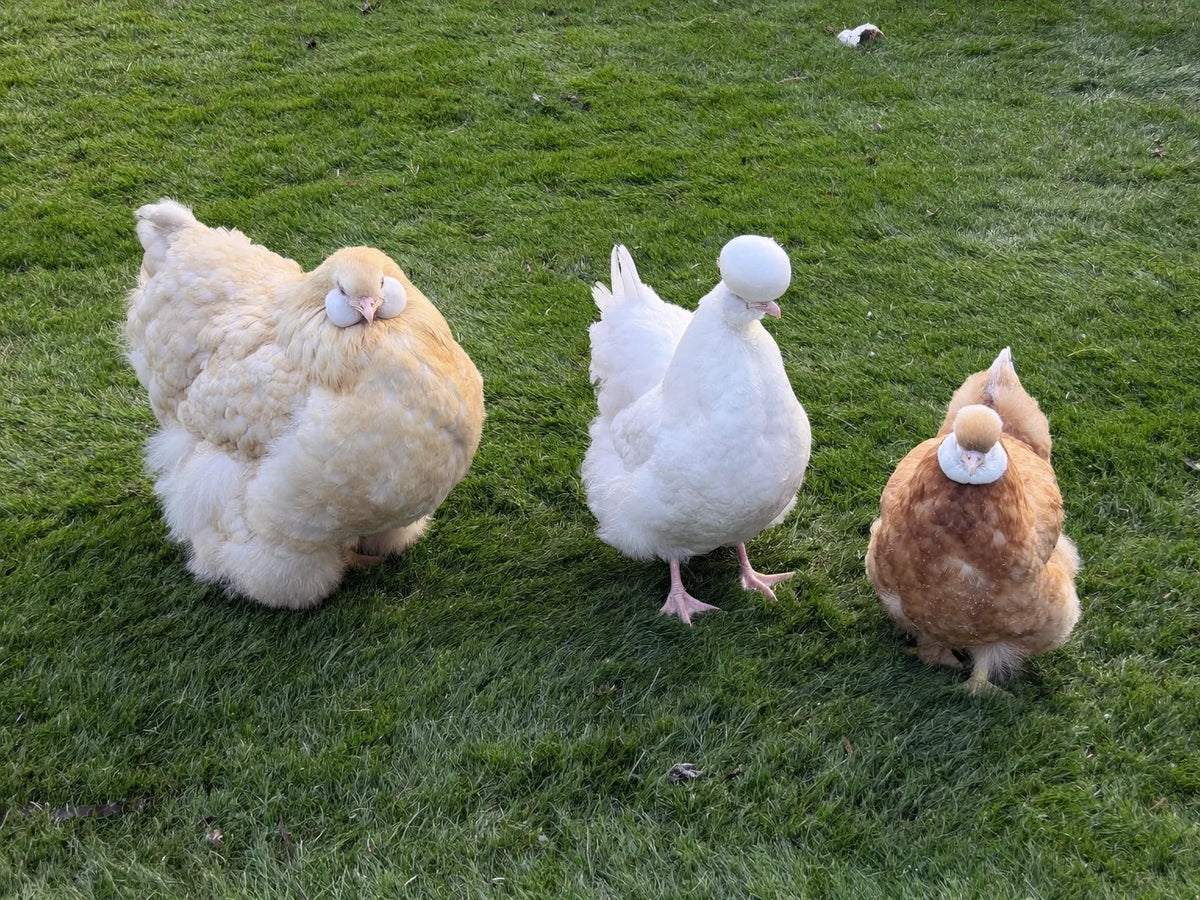
Backyard chicken breeds differ by nearly three times in body weight, and the coop is where that difference gets paid. Mississippi State Extension puts an adult Leghorn at 4.5 to 5.5 pounds and a Jersey Giant at 10 to 13. Published floor, perch and nest figures do split by bird size — but none of them says at what weight a hen stops being a laying hen and starts being a large one. So choose the bird first, then read the interior floor area rather than the hen count. Where a figure is missing from a listing, ask for it — and start from the coops we sell.
Every breed weight, temperament grouping and space figure below is quoted from the extension publication that prints it, and the eight publications opened for this page are all listed at the foot.
What are the best backyard chicken breeds for a first flock?
The best backyard chicken breeds for a first flock are the calm, hardy, brown-egg birds — Rhode Island Red, Plymouth Rock, Orpington, Wyandotte, Australorp. Mississippi State Extension is unusually direct about why temperament belongs on that shortlist at all.
Mississippi State sorts breeds into four temperament groups: good-natured, friendly, nervous or flighty, and aggressive. Rhode Island Red and Orpington sit in the good-natured row. Dominique, Araucana, Australorp, Jersey Giant, Delaware, Cornish and Java are filed as friendly. Leghorn, Ameraucana and Polish are the nervous ones — and Ameraucana appears a second time under aggressive, which is worth knowing before you buy a bird on the strength of one word.
The reason a temperament table earns its place is plain in the publication itself: "Some breeds are much more nervous, aggressive, docile, or friendly than other breeds. This can impact your selection decisions, especially if you have children who will be helping with the chickens."
Foraging is the second sorting, and on a coop that moves it matters more than temperament does. Mississippi State: "Active breeds will readily forage in the grass for bugs, tender leaves, and shoots, while the less-active breeds will wait for you to feed them every day." The same page marks Rhode Island Reds, Dominiques, Delawares and Javas as good foragers, and says of the Orpington that it is calm and docile "but they do not forage well". A coop you move onto fresh grass is worth more with a bird that will work it.
The grid below reconciles four publications on six breeds people actually buy. Weights and dispositions are Mississippi State's, the broodiness column is Kentucky's and Purdue's, and the blanks are blanks rather than guesses.
| Breed | Adult weight | Disposition, as published | Broodiness, as published | What it changes in the box |
|---|---|---|---|---|
| Leghorn (brown or white) | 4.5–5.5 lb | Nervous, flighty | Purdue files Mediterranean breeds under nonbroodiness | The floor is the easy part — what it wants is a run with a lid |
| Silver Laced Wyandotte | 5.5–8.5 lb | Relatively docile | Not addressed in these sources | Cold-hardy, poor in heat — shade and airflow, not insulation |
| Jersey Giant | 10–13 lb | Calm and docile | Not addressed in these sources | The perch question, and a nest box bigger than the published minimum |
| Buff Orpington | 7–10 lb | Calm and docile; does not forage well | Kentucky names it among the breeds with a higher tendency | Nest-box turnover, and a run it will actually use |
| Plymouth Rock | 4–7 lb | Docile; a poor forager | Good mothering instincts, per Mississippi State | Middle of the range on every published figure |
| Polish | 4.5–6 lb | Nervous and flighty; the crest blocks its vision | Rarely goes broody, per Mississippi State | Overhead cover, because it cannot see what is above it |
What your breed choice changes about the coop
Breed is usually sold as a personality decision. Five of its consequences are hardware, and each one moves a different figure on a coop listing.
| The breed trait | What it changes about the coop | What to get before you order |
|---|---|---|
| Body weight spans nearly three to one across ordinary backyard breeds, from a 4.5-pound Leghorn to a 13-pound Jersey Giant on Mississippi State's figures | Floor area per bird and perch length per bird both move with the bird; a hen count does not | The enclosed floor area in square feet and the total perch length in inches. Divide the first yourself rather than trusting the count printed above it |
| Some breeds are filed as nervous or flighty "MD" Leghorn, Ameraucana and Polish on Mississippi State's own grouping | The top of the run, and the height of the fence around it, stop being optional | Whether the run closes over the top. Start from the coop-and-run units, where the cover is part of the purchase |
| Broodiness is breed-specific, and a broody hen sits on a nest for weeks | One nest box leaves service for the duration, so the working nest count is lower than the printed one | The nest box count, read against a broody-prone flock rather than a flock on paper "MD" our nesting box guide has the ratio |
| Crested breeds such as the Polish cannot see what is above them | Overhead cover becomes a welfare item rather than a weather one | Whether the run is covered along its whole length, not just over the house end |
| Heritage breeds lay less per bird: Maine plans 1.5 layers per person on a hybrid and 2 on a heritage breed | The same eggs on the table need a third more birds, and therefore a third more floor | Size the coop from the bird count your egg target implies, not the one you started sketching with |
Square feet do not care what the bird is called, which is why floor area beats a hen count every time. Where a maker states a capacity and adds that it depends on the breed and size, that is an honest answer being handed back to you rather than a dodge "MD" and it is answerable. Send us the breed, the number of birds and the coop you are weighing up, and we will ask the manufacturer for the interior floor area, the perch length and the nest-box depth, in that order "MD" `sales@moveablechickencoop.com`. Start from the coops we sell, or the larger coops if the bird you have chosen is at the Jersey Giant end of the scale.
The space figures split by bird size, not by weight
Both housing publications that print a floor figure split it by bird size, and neither attaches a pound to any row. Penn State's table runs bantam chickens, laying hens, large chickens. Virginia's runs bantam chickens, laying hens, meat-type chickens. Nothing on either page says which is which.
The missing piece is the entry criterion. Penn State gives large chickens a third more inside space than laying hens and never defines large. Virginia does not scale between laying hens and meat-type birds at all — both get the same figure — while cutting bantams to roughly two thirds. The raw text of both pages was swept for any weight, in pounds or otherwise, and there is none. So a keeper holding Mississippi State's 7-to-10-pound Orpington has two published tables and no way to place the bird in either.
Read those two tables as one voice rather than two. Penn State's page and Virginia's publication share co-author Phillip J. Clauer, and whole sentences appear on both. Where they differ — and on bantams they differ by two to three times — that is one author disagreeing with himself across two printings, not a field converging on an answer.
The per-hen figures from four services, side by side, are in our coop size guide. That guide answers how much space a hen needs. This page is about which hen, which is the question it leaves open.
One published rule does tie the breed to the size of the flock, and through the flock to the coop. University of Maine Extension: "When using any of the breed crosses listed above for egg production, plan on 1.5 layers per person for a family flock. When using the heritage breeds, plan on 2 layers per person." A household of four is therefore six hens on a hybrid and eight on a heritage breed — a third more birds, and a third more floor, for the same eggs on the table.
What is the largest chicken breed, and where does the size go?
The largest chicken breed is the Jersey Giant. Purdue Extension's breed table records it in six words — "Massive body; largest breed of chicken" — and Mississippi State Extension puts an adult at 10 to 13 pounds, roughly double a Leghorn.
Two services, two author teams, one answer. Purdue's AS-518 is by Doug Akers, Pete Akers and Mickey A. Latour; Mississippi State's P3036 is by Jessica Wells, Tom Tabler and F. Dustan Clark. No name repeats between them, so the agreement is real corroboration rather than one text printed twice. Brahmas come next on Mississippi State's figures at 8 to 12 pounds, with feathered legs and the same slow growth.
Where the size lands first is the perch, and here the two housing publications part company. Penn State is flat: "Perches should not be used with large structured or meaty breeds of chickens to prevent leg joint damage and injuries when to jump off the perch." Virginia argues the other half — "Even meat-type chickens and turkeys are motivated to perch" — and recommends platforms instead of bars, because "their body confirmation (especially in fast-growing strains) limits their ability to perch on 'normal' perches".
The divergence is unusual and it is worth naming. The two pages agree almost everywhere else, share an author, and here they give opposite instructions for the same bird. Virginia's low-platform option and the bar-length figures are already set out in our chicken roost guide. What a big-breed buyer needs from a listing is a different number again: interior width and height, because a platform eats floor a bar does not.
Penn State adds one line about the other fitting, and it is eight words long: "Increase the nesting area space for larger birds." Penn State's own minimum box is 12 by 12 inches. No source anywhere says what a 13-pound hen needs instead, and the counting rule lives in how many nesting boxes per chicken. A flock of giants is a larger coop question from the start, not a small one you grow out of.
The brown Leghorn chicken breed, and the fence it will clear
The brown Leghorn chicken breed is a feather variety of the Leghorn rather than a separate bird, and it is the lightest thing on this page: Mississippi State puts adults at 4.5 to 5.5 pounds and files the breed under nervous and flighty. Light and nervous is a combination the run has to answer.
Mississippi State explains the naming: "Variety refers to birds within a breed that differ in feather color or pattern, or type of comb. For example, there are brown and white Leghorn varieties, based on feather color." University of Maine Extension lists the Brown Leghorn among its white-egg layers, alongside the California White, California Gray and Ancona.
Purdue's class description is the one to read before you buy fencing. Mediterranean breeds, it says, are "characterized by their active flighty dispositions, laying of white eggs, nonbroodiness, and flying expertise", and its examples are Leghorn, Ancona and Minorca. Purdue and Mississippi State both call the Leghorn flighty; Purdue and Maine both put the white-egg lines down as birds that rarely go broody, Maine's phrasing being "Females from the white-egg lines rarely want to set." Three separate author teams, no shared names, so that is corroboration checked at the byline.

Not one of them publishes a fence height. All eight publications used on this page were swept for fence, fly, flight, wing and clip. Penn State and Virginia talk about burying wire and covering the top against hawks; Maine and Kentucky return nothing at all; nowhere in the set does a service say how high a run wall has to be. So the answer a flighty bird forces is not a taller wall — it is a lid. Coops that arrive with the run already enclosed take the question off the table, and ours sit on one page. The published guidance on overhead cover is in our outdoor chicken run guide.
The comb is the other thing a Leghorn brings home. Mississippi State: "In most cases, birds with large combs do better in hotter regions, and birds with smaller combs perform better in colder areas. In general, most American breeds do better in colder climates, while Mediterranean breeds do better in hot climates." What a big comb means in a winter coop — moisture, ventilation and whether to add heat — is answered in do chickens need a heated coop, which is the post that owns the cold end of this question.
Is the silver laced Wyandotte chicken breed easy to house?
The silver laced Wyandotte chicken breed is easy to house in cold weather and awkward in hot, which is the Leghorn in reverse. Mississippi State Extension puts it plainly: "They are quite cold hardy but do not do well in the heat."
Wyandottes weigh 5.5 to 8.5 pounds as adults on Mississippi State's figures, the middle of this page, and the silver laced is the original variety, also known on Mississippi State's page as the American Sebright or the Sebright Cochin. Purdue's breed table calls Wyandottes typically docile and names silver-laced among the varieties seen most often at shows.
Heat, not cold, is the specification that follows the bird home. A hen that struggles in summer needs shade over the run, air moving through the house, and somewhere cool to stand at three in the afternoon. None of that is a heater, and none of it costs anything if the coop is right to begin with. The sourced versions are in our guides to chicken coop ventilation and summer coop prep.
One more thing a Wyandotte changes: it is a heavier bird than a Leghorn on the same bar. Our chicken roost guide collects the per-hen bar figures and the spread between the services; what none of them states is which side an 8-pound hen falls on. The size guide's rule for a mixed flock — size on the biggest bird you keep — is the right one here, and it costs a few inches of bar rather than a different coop.
Know which bird you're buying, and the coop stops being a guess. Take 10% off the one that fits it. GET MY 10% CODE
Broodiness is breed-specific, and it takes a nest box out of service
Broodiness runs by breed, and University of Kentucky Cooperative Extension names them: "Some breeds have a higher tendency for broodiness than other breeds. These include Buff Orpingtons, Cochins, Australorps, Sussex, Brahmas, and Silkies."
Two costs follow, and both are Kentucky's. "When broody, hens do not lay eggs." And: "Broody hens can also keep other hens out of the nest boxes, which may cause an increased number of floor eggs." A broody Orpington is a box out of service for as long as she sits, on top of the eggs she has stopped laying.
The other end of the range is published too. Kentucky notes that "The commercial strains of layers have been selected to reduce broodiness and the desire to incubate eggs," Maine says the same of the pure white-egg lines, and Mississippi State puts the Polish in that bracket — excellent layers, poor mothers, rarely broody.
Kentucky's remedies are worth reading as coop fittings rather than as advice. One is to lift the hen off at night and set her "on a perch with the other hens", which asks for perch length she is not currently using. The other: "You can close the nest to remove access to the nest boxes at night and after the other hens have laid their eggs." That asks for a nest box that closes, and plenty do not. Check both before you commit to a breed off Kentucky's list.
What a broody hen does to the number of boxes you need is settled in our guide to nesting box count, and whether a sloped floor helps is answered in the roll away nesting box guide — it does not stop broodiness, and that post shows why.
Are rare chicken breeds harder to keep?
Rare chicken breeds are no harder to house — they are harder to replace. The Livestock Conservancy's 2026 Conservation Priority List carries 49 chicken breeds across four risk categories, and several of them are birds an extension service would put on a beginner's shortlist anyway.
The categories are defined by counts, not by feeling. Critical means fewer than 500 breeding birds in the United States and a global population estimated under 1,000. Threatened is fewer than 1,000 in the US and under 5,000 worldwide. Watch is fewer than 5,000 in the US and under 10,000 worldwide. Recovering means a breed that has climbed above Watch numbers and is still being monitored.
Set that list beside Mississippi State's foraging notes and the overlap is hard to miss. Java is Critical, and Mississippi State calls Javas "particularly good foragers when allowed to free range". Dominique is on Watch and is described as docile, hardy and a good forager. Delaware and Jersey Giant are both Recovering, New Hampshire is Threatened, and Buckeye, Chantecler and Rhode Island White are all on Watch. The Leghorn is there too, entered as Leghorn — Non-Industrial, which is the conservancy separating the old farm strains from the commercial ones.
Why that matters to someone buying a coop is unglamorous. A rare breed eats the same, drinks the same and needs the same floor as a common one, so nothing in the housing spec changes. What changes is the cost of losing a bird, and that argues for the dull things: a run with a top, a door that latches properly, and hardware you can inspect. Our guide to coop hardware and how predators actually get in is the one to read next.
A last honest note, and it is the conservancy's own. It cannot check every breeding programme, so its list carries the warning that buyers "are encouraged to ask if birds are purebred and meet breed standards". A rare breed is a claim about a bird until somebody stands behind it — so ask the breeder that question, and size the coop from the breed's standard weight rather than from its rarity. The coops we sell get read the same way whatever the bird is called.
Which breed would we start with, and what does being wrong cost?
We would start with a Plymouth Rock or a Rhode Island Red, and we would size the coop for an Orpington. Both are docile and hardy on Mississippi State's table, both lay brown eggs well, and neither turns up on any list of fliers in these sources.
Sizing to the bird in front of you, rather than to the biggest bird you might end up keeping, is where a coop decision goes wrong. Flocks change and coops do not. Buying to Penn State's laying-hen row and then keeping large chickens is how a coop gets crowded without anyone deciding to crowd it.
Being wrong the other way has a real price too, and on a coop that moves you feel it every week. A bigger, heavier box is harder to shift, harder to park level, and slower to get onto fresh grass. That is the trade, and it deserves ten minutes rather than none.
So decide the bird, then buy the floor area it needs rather than the hen count printed above it. Tell us the breed and how many birds and we will chase whatever the page leaves out. Start from the coops we stock, or from the coops built to move if the flock will spend its days out on grass.
Sources: Mississippi State University Extension Service, “Choosing the Right Breed for Your Backyard Flock”, Publication 3036 (POD-02-26) (Jessica Wells, PhD; Tom Tabler, PhD; and F. Dustan Clark, DVM, University of Arkansas) — accessed August 21, 2026 · Purdue University Cooperative Extension Service, “Choosing a Chicken Breed: Eggs, Meat, or Exhibition”, AS-518-W (Doug Akers, Pete Akers and Dr. Mickey A. Latour) — accessed August 21, 2026 · University of Maine Cooperative Extension, “Maine Poultry Facts: Match Your Need to the Right Breed”, Bulletin #2104 (Robert Hawes with Richard Brzozowski, updated by Gary Anderson) — accessed August 21, 2026 · University of Kentucky Cooperative Extension, “Broodiness in Chickens”, ASC-247 (Jacquie Jacob and Tony Pescatore, issued August 2021) — accessed August 21, 2026 · Penn State Extension, “Small Scale Poultry Housing” (Gregory P. Martin and Phillip Clauer) — accessed August 21, 2026 · Virginia Cooperative Extension, “Small-scale Poultry Housing”, publication 2902-1092 (APSC-186NP) (Leonie Jacobs and Phillip J. Clauer) — accessed August 21, 2026 · The Livestock Conservancy, “2026 Conservation Priority Poultry Breeds” — accessed August 21, 2026 · UConn Extension, “Permitting and Regulating Backyard Chickens” — accessed August 21, 2026. Penn State and Virginia Cooperative Extension share a co-author, Phillip J. Clauer, so those two pages are one extension voice printed twice rather than two services agreeing; where they disagree, that is one author disagreeing with himself. No author name is shared between Mississippi State, Purdue, Maine and Kentucky, so agreements between those four were checked at the byline before being called corroboration.
Frequently asked questions
How big of a chicken coop do I need?
Start with the bird rather than the flock number. Penn State Extension and Virginia Cooperative Extension both publish floor figures split by bird size rather than by weight, so a Jersey Giant and a Leghorn read different rows without either page saying where the line falls. The per-hen figures sit side by side in our coop size guide. Send us the breed and the number of birds and we will confirm a model's interior floor area.
What is the best chicken coop?
There is no single best coop, only the one that fits the bird you chose. Read a listing's stated interior floor area rather than its hen count, because a hen count rarely says what size hen is being counted. Mississippi State Extension sorts breeds by temperament and by foraging drive, and a bird that forages earns its keep on a coop you move onto fresh grass. Then compare the coops we stock on floor area.
How to build a backyard chicken coop?
Settle the breed before you draw anything. Body size decides the floor area, the nest-box size and whether a perch bar suits the bird at all. On Mississippi State Extension's figures an adult Leghorn is 4.5 to 5.5 pounds and a Jersey Giant 10 to 13, so a house drawn for a generic hen is drawn for a range of nearly three to one. Our chicken coop plans guide covers what a plan should state.