

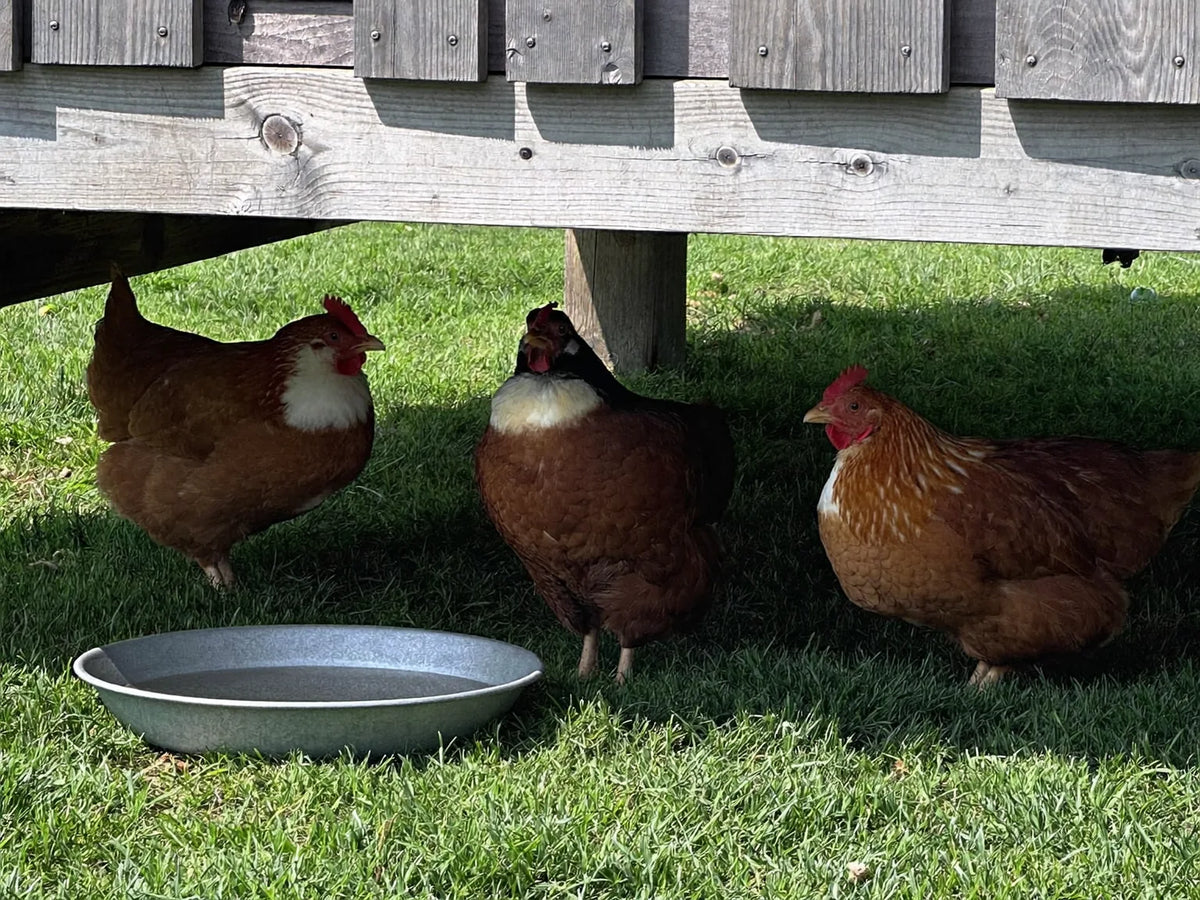
How to keep chickens cool in summer comes down to four moves in a fixed order: water, shade, moving air, and the hour you do everything else. A hen has no sweat glands. She sheds heat by panting, and Penn State Extension names the catch in the same breath — that cooling method "can also dehydrate them". So water goes first, ahead of anything you could buy. The coop matters less here than the shopping suggests, with one exception: a coop you can move is shade you can aim, and the coops built to roll are the ones you can park somewhere different at nine in the morning.
Temperature thresholds, panting signs and cooling methods all carry a named extension citation underneath — including the places where two publications draw the danger line at different numbers, which this page prints rather than splits.
What actually happens to a hen in the heat?
A hot hen is losing a race between the heat she makes and the heat she can shed. University of Minnesota Extension puts the failure plainly: "Heat stress occurs when the bird's core body temperature increases to fatal temperatures due to poor heat loss and limited coping means."
Panting is the whole cooling system, and it is a costly one. Penn State Extension explains why: "Birds cannot sweat like humans, so they use evaporative cooling in the form of panting. However, this cooling method can also dehydrate them." Humidity takes even that away, because "evaporative cooling is less effective if the air is already saturated." A muggy afternoon is harder work for a hen than a dry one at the same reading on the thermometer.
Where the heat leaves is anatomy, not effort. Penn State: "Heat dissipates more quickly from highly vascularized combs and wattles." Birds with big combs and tight, hard feathering shed it faster than soft-feathered birds carrying a layer of down close to the skin, which traps heat in July as well as it does in January. Penn State draws the practical conclusion: "Hot weather management may look different depending on the breed."
The temperature figures attached to this question describe the bird, not the building. Minnesota puts the thermoneutral zone for most poultry between 60 and 75 degrees Fahrenheit. Penn State marks the next rung: "Once temperatures reach the 80s and 90s, heat stress may occur, along with decreases in feed consumption, egg quality, and production." Neither figure is a coop rating. Our cold-climate guide works through the one published number that genuinely describes a building, and it points the other way.
How to keep chickens cool, in the order that works
Water, then shade, then moving air, then the clock. The order is ours, and it is built on what each move costs and how fast it shows, because the three services we read rank the same remedies three different ways.
Where the pages agree is on the list rather than the sequence. All three name water, shade, airflow and a change to feeding. Only one of the four is a purchase, and it is the one that gets shopped for first. How shade ranks against ventilation in the literature is settled in our shade cloth guide rather than re-argued here; what follows takes the order from the bird's side instead — what fails first, and what you can change fastest.
| The move | What it does for the bird | How fast it shows | What it costs you |
|---|---|---|---|
| More cool water, in shade, in more than one container | Replaces what panting evaporates, and cool water gets drunk when warm water does not | Same hour | A second container |
| Shade over the ground the flock actually stands on at 2pm | Takes the radiant load off before the bird has to shed it | Same afternoon | Nothing, if the coop can move |
| Air moving where the birds are, not up in the roof space | Carries heat off the bird rather than around the building | Same afternoon | A fan, and a way to power it |
| Feed early and late, none through the peak | Digestion makes heat; an empty crop at 3pm makes less of it | Next day | Nothing |
| Wetting the ground, or a mister in dry air | Evaporation happens off a surface instead of off the bird | Minutes, in dry air only | A hose |
| Electrolytes in the drinker | Replaces minerals lost during a heat episode | Over days, as support rather than rescue | A packet |
| Cool-water immersion, one bird | The treatment for a hen already in trouble, not a cooling method | Immediately | A bucket |
One line runs through those rows. The fastest moves are the cheapest ones, and the only remedy anybody sells you is the fan. Whether a coop needs one at all, and the arithmetic behind that answer, is our coop fan guide.
Why is water the first thing to change?
Because panting spends water, and a hen cannot drink her way ahead of it out of a warm bucket. Minnesota names three requirements in one sentence: "Sufficient water space, operating waterers, and cool water temperatures will encourage the birds to drink."
Warm water gets refused at the hour it is needed most, and the fixes are mechanical rather than clever. Penn State: "Consider using a drinker with insulation or refreshing water several times a day to keep it cool." Minnesota says the same about the vessel — "Flush water lines and waterers routinely to keep the water fresh and cool." Ice does the rest of the work. Penn State again: "In extreme temperatures or heat waves, adding frozen water bottles, ice cubes, or ice blocks to a water dish may help encourage poultry to drink more."
Two containers beat one big one. Ashley Wright, writing for the University of Arizona Cooperative Extension Service, puts it as a plural: "Provide multiple water sources located in shady, cool areas to encourage hens to drink and wade." The wading half is not a throwaway. "Low sided dishes or pans will allow hot chickens to wade in and cool their feet," and feet are bare skin — which, along with combs and wattles, is where a bird's heat actually leaves.
Open water in hot weather brings a second job and a second risk. Wright is direct about the risk: "It is important to change open water daily to prevent coccidiosis from spreading." Expect the droppings to change as well. Wright records that it "is not uncommon to see extremely watery droppings during periods of high heat due to increased water consumption", and names it as excretory heat loss — a way the bird raises her own cooling capacity. What else a change down there means is our droppings guide.
Electrolytes are the one place these services say different things, so take both versions. Minnesota: "You can add electrolytes to your flock's drinking water for up to three days", and "You should start providing electrolytes before the heat stress period." Wright measures the same supplement in hours: "It's best to provide the mix in the chicken's water supply for only a few hours, then remove it and replace with fresh, plain water." Days against hours, two institutions, no author in common. Neither page suggests leaving it in as a standing measure, and neither removes the plain water that has to sit beside it.
No coop arrives with a fount, so the water is your job whichever one you buy. Our accessories guide audits what listings actually include and weighs what a full drinker costs you on a coop that moves. For a heat wave, the only thing that matters is that doubling the water is the cheapest move available.
Cool water and shade cost nothing — put the budget into the coop they stand beside. Take 10% off yours. GET MY 10% CODE
Ways to keep chickens cool that cost nothing but timing
Move the feed, not the flock. Digestion makes heat, so an empty crop through the hottest hours lowers the load from the inside, and two services publish that instruction from opposite directions — one from the barn, one from the backyard.
Minnesota describes the trap first: "Birds are usually hungriest in the morning and tend to fill up, which makes them more prone to heat stress in the afternoon." Its fix carries a clock. "Withdrawing feed six hours before peak warm temperatures in the afternoon can lower the risk of heat stress", and the feed goes back "after peak temperatures have started to decline." Minnesota then fences the whole tactic: "Only use this feeding method when you expect heat stress temperatures." It is a heat-wave measure, not a routine.
Penn State arrives at the same place through the physiology. "Eating and digesting food uses energy and releases more heat, warming the body", so "Feeding birds early in the morning or late in the evening, when average temperatures are cooler, may encourage them to eat more", and "Taking feed away during the hottest portions of the day will help them stay cooler." Wright's backyard version is the same instruction in domestic clothes: layer rations early or late, and "limit treats and extras (especially scratch grains)."
Scratch is the treat to drop, for the same reason the feed moves. Penn State: "Avoid treats like scratch and corn during heat waves, as those will create more heat during digestion." What replaces it is water in disguise. Penn State calls frozen fruit or vegetables an enrichment that also helps birds stay cool, then adds the limit — "Give these in moderation, though, to avoid diluting the diet." Wright freezes chopped watermelon into a block of ice for the same three reasons: cool, occupying, and not filling.
Eggs and handling both move earlier in the day. Wright: "Most hens will lay early in the day. Picking them up as soon as possible is best." Minnesota's list of jobs to postpone opens with "Delay activity in the barn, such as moving birds or litter conditioning" — so catching, crating, worming or weighing a flock at three in the afternoon piles heat onto birds already shedding it. Whether to roll a coop into its shade at first light rather than at lunchtime is worked through in our summer prep guide.

How to keep chickens cool in 100 degree weather
One hundred degrees is an air temperature, not a hen. Minnesota's sentence deserves reading whole: "When air temperature increases towards 100 degrees Fahrenheit, the birds' core body temperatures will increase to lethal temperatures unless relief is provided."
The distinction is not pedantry, and the arithmetic shows why. A chicken's normal core sits well above 100 — Minnesota's cold-weather page states that "The average body temperature of a chicken is 106 degrees Fahrenheit" — so the popular shorthand, in which core temperatures turn lethal towards 100, describes a bird that has gone cold rather than hot. What crosses 100 is the air around her. What climbs afterwards is her core.
Minnesota attaches a qualifier the figure is usually quoted without: "These temperatures can shift depending on humidity, care and building conditions." Humidity moves it the most, and Minnesota gives the mechanism: "High humidity decreases poultry heat loss from the lungs, making the birds more prone to heat stress." Panting needs dry air to evaporate into, so the same reading on two different afternoons is not the same afternoon.
One temperature-and-humidity pairing is published in this set, and it is not about hens. Minnesota's danger-zone figures — 85 degrees with humidity above 50 percent, becoming extreme at 90 degrees and 50 percent — are stated for older turkeys. No page we opened publishes the equivalent grid for laying hens. Read those figures as proof that humidity moves the line, never as a threshold to run a laying flock against.
Misting works in dry air and can work against you in wet. Wright: "Hot, dry weather lends itself well to evaporative cooling." Minnesota puts a monitor on it: "If misting or fogging at low humidities, monitor relative humidity to prevent excess moisture in the air that can worsen heat stress conditions." Penn State's limits are practical — run misters "for short periods only or move them around at regular intervals", and expect hard water to clog them. Wetting the ground outside the coop and run does much the same job with nothing to block.
Reading the birds beats reading the forecast, and two services describe the same three-step ladder. Torey Fischer wrote Penn State's page and Ashley Wright wrote the University of Arizona's; different authors, different institutions, and neither page prints the ladder as a table. Here it is as one.
| What you see | What the sources call it | What to do about it |
|---|---|---|
| Light panting, beak open, breathing slowly, behaving normally otherwise | Penn State: light panting is "normal for short periods of time during warmer temperatures". Wright: a hen that is "simply hot" | Cool water in shade, and keep watching. No intervention needed |
| Heavier panting, wings held away from the body, crouching slightly | Wright: "light or moderate heat stress" — not in immediate danger, but a sign the whole flock needs cooling | Cool the flock now: shade, moving air, fresh cool water, feed off until the peak passes |
| Heavy panting with the wattles hitting together under the jaw, lying down, lethargy, pale comb and wattles | Penn State: "indicators of a more severe episode of heat-stress". Wright: in danger of heat exhaustion | Cool that bird immediately, then keep her somewhere cool until the signs stop |
Cooling one bird has a method, and both pages describe it closely enough to follow. Wright is the more specific: "Submerge her body up to her neck (not her head) in a bucket of cool (not icy) water and place her somewhere cool until she is completely recovered." Penn State adds what the water has to reach — "Submerge the bird's body in cool water, not too cold, and massage it into the feathers to reach the skin" — and what happens next: "Allow most of the water to drip off them before putting them back into the coop". Penn State also notes that adding electrolytes to their water "can also help with recovery".
Can the coop itself do any of this for you?
Some of it. A coop can hold shade, pass air through, and, if it rolls, go somewhere cooler than where it stood this morning. It cannot chill water, feed hens at six, or notice a bird lying down at four in the afternoon.
The nest box is the part that gets missed. It is the most enclosed space in the building, it holds heat, and a hen sits inside it for the better part of an hour. Wright covers both fixes in one instruction: put "frozen water bottles in nest boxes (change 2-3 times per day as necessary)", or block the boxes off and offer "temporary, alternative laying options (e.g. boxes, bins, or baskets) in cooler areas of the coop or run."
Air through the building is a different question with real numbers behind it, and it has its own guides. Where openings belong on a hen house is our ventilation guide. What a mesh run does and does not do in a heat wave is our outdoor run guide. Fabric over that run — what to buy, and where to fix it so it comes off again — is our shade cloth guide.
The lever a coop genuinely hands you is location. Shade at nine in the morning is not shade at three in the afternoon, and a coop on wheels follows it across a lawn for nothing: same box, different patch, twice a day if the yard allows it. On a coop that stays put, the shade has to be built, and once built it stays where you put it. Which of those two you want is worth settling while you are choosing, not in the second week of a hot spell.
Openings that actually open are the part of a coop that does something for a hen at two in the afternoon, so they are worth confirming rather than assuming. Where a listing will not say whether a run cover lifts off or a side window opens, send it over and we will get its maker to answer both before the first hot week.
What we would do first, and what being wrong costs
We would put a second drinker of cool water in the shade and take the feed away at noon, before buying anything at all. Both moves cost nothing, both work the same afternoon, and every purchase on this page is slower than either.
The reason that order holds is the speed of the failure. Heat kills across an afternoon. Cold is a slower argument about dryness and wind, which is why our cold-climate guide spends its time on the building instead of the bird. Wright puts the asymmetry in one line: "Preventing heat stress is much easier than treating it." A plan set up at breakfast beats a bucket filled at four.
Three errors are worth naming, because each one looks like help. Running a mister in humid air adds water to air that cannot take any, and Minnesota tells you to watch the humidity while you run it. Leaving electrolytes in the drinker as a permanent measure goes past what either service describes, since both write in hours or a few days with plain water alongside. Handing out scratch as a hot-weather treat does the opposite of what it looks like, because the digestion is the heat.
If you are choosing a coop with hot afternoons in mind, read the run and the openings before anything else. The coops that arrive with a run name what covers it wherever the manufacturer says so. The coops built to roll are the ones you can park under a tree at nine and bring back at dusk. Send us the model you are weighing and we will chase the cover and the openings with the manufacturer, or start from the full coop list and have the shade sorted long before it is needed.
Sources: Penn State Extension, “Summer Flock Care: Keeping Your Birds Cool and Comfortable” (Torey Fischer, M.S., Extension Educator, Poultry; updated July 31, 2026) — accessed August 21, 2026 · University of Minnesota Extension, “Preventing heat stress in poultry” (Sally Noll and Sabrina Florentino, reviewed 2026) — accessed August 21, 2026 · University of Arizona Cooperative Extension Service, “Managing Backyard Chickens During Periods of Extreme Summer Temperature” (Ashley Wright, MSc, Livestock Area Agent) — accessed August 21, 2026 · University of Minnesota Extension, “Caring for chickens in cold weather” (Colleen Carlson and Hannah Lochner, reviewed 2026) — accessed August 21, 2026
Frequently asked questions
How to keep chicken coop cool in summer?
Work on the birds before the box. Cool water in shade, feed withheld through the hottest hours and every opening left open do more than anything structural. A hen house sheds heat by exchanging air rather than by holding it out, so vents and windows do more than wall material does. Our ventilation guide covers where those openings belong.
How to keep chicken coop cool at night?
Night is an air problem rather than a shade one. A closed box that took sun all afternoon is still warm at midnight, and hens roost inside it for eight hours. Leave every opening that is safe to leave open, put fresh cool water out at dusk, and get air moving at the birds' level if the night is still. Our coop fan guide works through when a fan earns its place.
How to cool down a chicken coop?
Get the stored heat out and keep new heat off. Open everything that opens, take any solid cover off a run so air moves through the mesh, and shade the wall the sun hits hardest. Penn State Extension also suggests wetting the ground around the outside of the coop and run with a hose or garden sprinkler, which cools by evaporation without soaking the run itself.