

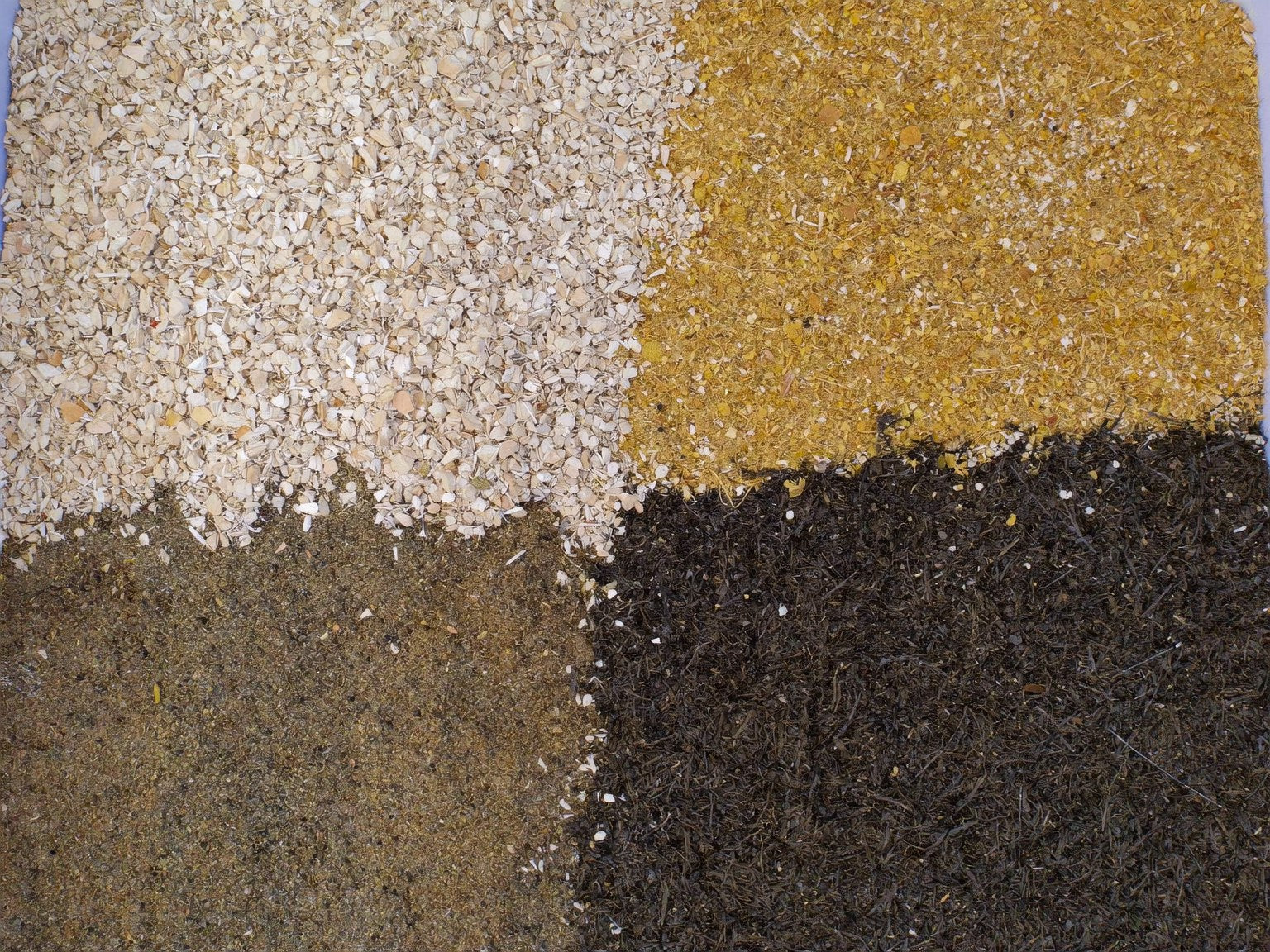
There is no single best chicken coop bedding, and a page that names one without stating its criteria is guessing. Pine shavings are the safe default — the University of Kentucky's small-flock litter guidance calls pine "the preferred option" among softwoods — but the real answer turns on your floor and your climate. So this page gives the short answer, then the 9 criteria it rests on, then all 6 materials measured against them, then the decision rule. Coop floor construction decides most of it, and it is a spec you can check on any coop you're weighing up before you buy a single bag.
The bedding criteria below are drawn from named extension and university sources, each linked where it is used.
What is the best bedding for a chicken coop?
Pine shavings, for most backyard coops with a solid floor. The University of Kentucky's small-flock litter guidance names softwood shavings first and puts pine ahead of spruce and hemlock. The word "best" only means something once you say what you measured.
Dr. Jacquie Jacob's litter page for small and backyard flocks states it plainly: "the best litter is wood shavings from a softwood, such as pine, spruce, or hemlock (with pine being the preferred option)." University of New Hampshire Extension lands in the same place from a different angle, calling fresh wood shavings or sawdust "preferable to hay or straw, which is difficult to clean up once soiled."
Neither statement is a controlled trial of every material a backyard keeper can buy. Both are the considered recommendation of an extension service writing for small flocks. That is still more than the published record offers for any other material on this page.
The recommendation stops being true in the part most pages skip. A coop with a shallow pull-out tray instead of a real floor changes the answer. A coop that moves onto fresh grass removes the question. And a wet winter climate rewards a material that gives moisture back rather than one that only takes it in.
The judging method: 7 published criteria, and 2 the publications skip
7 of the 9 criteria come from a published list. Dr. Jacquie Jacob's small-flock litter guidance sets out what good litter should be, and it is the nearest thing this topic has to a scorecard. The other 2 are ours.
Jacob's 7 published criteria, verbatim. Good litter should:
- "be nontoxic to the birds (including being free of mycotoxins that can be produced during certain fungal contaminations)"
- "be free of contaminants, such as pesticides and metals"
- "be very absorbent"
- "have a reasonably short drying time"
- "have reduced thermal conductivity"
- "be able to be repurposed after being used as bedding material (e.g., as a land application)"
- "be readily available and relatively inexpensive"
Then the 2 we add. These are ours, in our words — they are not Jacob's and not quoted from anyone:
- Produce little airborne dust
- Change your cleaning cadence as little as possible
Criteria 8 and 9 appear in the publications as observations rather than as selection criteria, and there is a reason for that: these documents are written for houses where a crew strips the litter between flocks. You are not a crew. You are one person with a scraper and a Saturday, so how much dust hangs in the air and how often the bed cakes decide whether that hour stays an hour.
Dust is a published concern even if it is not a published criterion. University of Georgia Extension warns that "litter that is too dry and dusty can also lead to problems such as dehydration of new chicks, respiratory disease and increased condemnations." Caking is the other half, and Mississippi State University Extension gives the reason to care about it early: "Once cake starts to form, it is difficult to reverse the process."
How does each bedding material score against those criteria?
No material has a published statement against all 9. Criteria 1 and 2 — nontoxic, and free of pesticides and metals — are silent for every material in this table except cedar, which is why cedar gets its own section below. The remaining 7 are where the published record actually says something: pine shavings score on availability, drying and disposal; sand scores on dust and caking but will not compost; straw absorbs well and then cakes. The table prints what the record says, and where it says nothing.
| Material | What the published record says | Strongest on | Weakest on, or unstated |
|---|---|---|---|
| Pine shavings | Jacob: softwood shavings, "with pine being the preferred option". UGA: names pine shavings and coarse pine sawdust as the bedding materials its Georgia broiler guidance is written around | Availability, drying, disposal. The benchmark every other material is measured against | Criterion 7: cost is climbing — Jacob notes shavings now go into fiberboard, paper, cardboard and horticulture. Criterion 8 unstated: no dust figure published anywhere we opened |
| Pine sawdust | Jacob: "Chickens have been shown to do well on pine sawdust, although litter consumption has been a problem" | Criterion 7: price, where a mill is close | Birds eat it — Jacob records litter consumption as a problem, and notes sawdust "contains terpenes (undesirable oils found in conifer trees)". Criterion 8 unstated: no dust figure is published for it anywhere we opened |
| Chopped straw | Jacob: "Straw is difficult to manage and is prone to caking. If straw is used, it should be chopped to one inch or less." UNH ranks shavings "preferable to hay or straw" | Criterion 7: price and availability, especially if it is already stacked on your property | Criterion 9: caking, and caked litter raises ammonia (Mississippi State). Both services we opened rank it below shavings |
| Sand | Jacob cites work in which "broilers raised on sand performed as well as or better than those raised on pine wood shavings", with footpad quality improved, plus less dust, fewer darkling beetles and less caking | Criteria 8 and 9: dust and caking, in that work. Sifts rather than changes | Criterion 6: not a compost input the way the plant beddings are — Jacob instead reports houses running 10 consecutive flocks on the same sand, so sand is a reuse-or-haul decision, not a garden one |
| Rice hulls | Jacob: "Rice hulls typically are free from excessive dust, and their size, thermal conductivity, and drying rate make them a good choice" | The only material with a published statement covering 3 criteria at once: drying time (4), thermal conductivity (5) and dust (8) | Criterion 7: regional. Away from rice country, the freight is the price |
| Hemp | Nothing. Not named in Jacob's 13-material list, and absent from the UGA, Mississippi State, Penn State and UNH publications we opened | Unestablished in the extension publications we opened | Criterion 3 unstated: no absorbency figure for hemp appears in any publication we opened, and we could not trace the four- and five-times multiples in circulation to any trial those publications cite |
The hemp row is the finding, not an oversight. Jacob's page names 13 materials — wood shavings, pine sawdust, pine bark, wood pallet pieces, pine stump chips, pine straw, paper by-products, rice hulls, peanut hulls, ground corncobs, chopped straw, sand and leaves. Hemp is in none of them, and it is in none of the other five publications we opened for this page. That doesn't make hemp bad bedding. It does mean we could not trace the confident "absorbs 4× its own weight" figures attached to it to any extension publication, and a buyer deserves to know which kind of number they are reading.
One honest limit on the whole table. Most of this evidence is broiler research: thousands of birds, concrete floors, mechanical ventilation, a 7-week cycle. Your 6 hens on a timber floor are a different problem, and none of the six publications we opened runs the backyard version. We use the commercial work because it is the only measured work there is, and we say so wherever the jump is a stretch.
Ammonia control is a moisture number, not a material
No source we opened names a bedding material that controls ammonia. In every one of them, the ammonia figure is a moisture figure. University of Georgia Extension puts the litter target at 20 to 25 percent moisture and reports that 25 ppm of ammonia already costs growth.
UGA's numbers are worth having in front of you. "Ideally, litter moisture should be maintained between 20 to 25 percent." Then: "Ammonia levels of just 25 ppm have been found to depress growth and increase feed conversion in broilers," with UGA recording worse effects again at sustained levels of 50 to 100 ppm. Those are commercial-house figures, and a coop with an open vent and 6 birds in it is a different environment. The direction of the relationship does not change with flock size.
Mississippi State draws the chain from wet to smelly in two sentences: "Too much moisture within a poultry house can cause litter to cake — it's just that simple," and "Caked litter also increases house ammonia levels." Penn State Extension reads the finished symptom in reverse, treating "dampness and ammonia build-up" as "a sign that there is not enough ventilation for the number of birds in the coop." Where the air moves is a separate decision, and it has its own guide: where the vents go on a coop.
So the material's only real lever has two parts, and absorbency is just the first. UGA: "Ideal materials will have high moisture absorption and release qualities to minimize litter caking." Absorbency alone is half the job. A material that takes water in and won't give it back is the material that cakes, which is exactly the charge Jacob levels at straw. Wet litter also drives the fly problem, which we handle in the coop pest guide.
Does your coop floor change which bedding you should buy?
Yes, more than climate does. A solid floor holds a real litter bed. A pull-out tray holds a shallow scatter. A floorless coop that you move onto fresh grass holds no bedding at all under the frame — the ground is the floor.
So settle the floor before you settle the bag. A listing tells you which of the three you are buying in one line — a solid base, a pull-out tray, or an open bottom that sits on grass — and each one buys a different material.
| What is under the hens | What the bedding job becomes | What to buy for it |
|---|---|---|
| A solid base under the whole house | A real litter bed, held at depth, stirred and changed on a schedule | Buy by the cubic foot, and buy for release as much as absorbency — the depth-to-volume arithmetic sits in our bedding and flooring guide |
| A pull-out tray under the roost | A shallow pan you empty often, with litter on the floor around it | Buy for sweep-out rather than volume: something that lifts clean and will not cake into the corners of a pan |
| No floor — the frame stands on grass and moves | No litter under the frame at all. The ground is the floor and fresh grass does the work | Buy for the sleeping box only, which is a bag rather than a budget line — start from the coops built to move |
The tray row is the one that catches people out. Where a listing does print a tray depth, the figure can be as little as 1.4 inches — and the published litter depth in our bedding and flooring guide is several times that. That is what a tray actually is: a droppings catcher you empty often, not a container for a litter bed. Material choice inside a pan that shallow is a different question from material choice on a floor. You want something that sweeps out clean and does not cake into the corners. Volume barely matters — you're refilling a pan, not a room. So check the listing for a stated tray depth before you buy a single bag, and where it isn't printed, ask for it.
A floorless coop takes the material question off the table for the run entirely; what is left is the sleeping box, and that is a much smaller bag. On a coop built to move onto fresh grass, the bedding line on your budget is set by a box you can measure in square feet, not by a floor. Climate then decides the rest. A wet region rewards the material with the better release rate. A cold one rewards the criterion nobody thinks about — Jacob's criterion 5, "reduced thermal conductivity", which is the bed's ability to sit between a hen's feet and a cold floor. Winter management is its own job, covered in our guide to keeping a coop through the cold months.

Cost per change: the cadence is the real bill
No extension publication we opened prices bedding, and the retail figures that do exist are regional and a month old. The cost that moves is how often you change, and caking is what moves it, because a caked bed is a change you did not plan.
Jacob does name the cost driver behind the shelf price, and it has nothing to do with hens. Wood shavings now compete with fiberboard, paper and cardboard manufacturing and with the horticulture trade for pots, compost and mulch. Rising cost and reduced availability are exactly why researchers went looking for alternatives in the first place, which is how sand, rice hulls and corncobs ended up in an extension publication at all.
Work the arithmetic from the other end and the picture changes. The volume you buy is set by your floor area and the depth rule — the grid for that lives in our bedding and flooring guide, and it is the same volume whichever material you pour in. What differs is how many times a year you pour it. A material that cakes at week 3 in a damp autumn costs you a full change you had not budgeted. Mississippi State's warning applies: once cake forms, you are not stirring your way out of it.
So the cheapest bedding isn't the cheapest bag. It is the cheapest material that stays loose and dry in your specific coop, and the only way to find out which one that is, is to run one material for a season and count the change-outs.
Bedding picked? Take 10% off the coop under it. TAKE 10% OFF
What happens to the bedding after you take it out?
Used bedding either composts or becomes a disposal job. Jacob's published criteria include being "able to be repurposed after being used as bedding material" — the one criterion that separates every wood and plant bedding from sand, and the one most buying guides skip.
Wood shavings, sawdust, straw, rice hulls, corncobs and leaves all leave your yard as a garden input. Sand does not: Jacob's page describes 10 consecutive flocks raised on the same sand, so sand is something you sift and keep, or eventually haul away. Neither outcome is wrong, and a keeper with a vegetable bed is running a different calculation from a keeper with a paved yard and a wheelie bin.
Composting used litter in place is a separate system with its own published numbers, and our bedding and flooring guide carries them. What belongs here is the buying consequence: criterion 6 is decided before you open the bag, and it is the criterion most likely to change your mind about sand.
What we'd recommend, what we'd avoid, and the cost of getting it wrong
Pine shavings on a solid floor, in a temperate yard, changed on a schedule you actually keep. Rice hulls if you live somewhere they are cheap. We would steer you away from cat litter and unchopped straw, and we would not fight anyone about cedar.
Cedar is the one material where criterion 1 does any work, so here is the honest version rather than the internet's version. An Ask Extension answer from Oregon State University Extension — a staff Q&A reply, not a reviewed publication — gives the mechanism: cedar "releases aromatic oils that can cause respiratory discomfort" in small animals, while adding that spread on outdoor muddy ground, it "should not cause a problem." Jacob's 13-material list does not mention cedar at all, in either direction. So criterion 1 returns a question mark for cedar and a blank for everything else. The published record is thinner than the certainty you will read online.
We would still steer you off cedar, and the reasoning is about asymmetry rather than proof. Pine does the same job, is stocked nearly everywhere, and has an actual recommendation behind it. If cedar turns out to be harmless, skipping it cost you nothing. If it does not, you spent more money to find out. That is a decision you can make without waiting for a study.
What being wrong on the whole choice costs is mostly time. The wrong material for your coop cakes, caking is difficult to reverse, caked litter lifts ammonia, and ammonia at 25 ppm already costs a bird something measurable in the commercial work. For most keepers the bill is a calendar rather than a crisis: a Saturday you did not plan to spend, twice a season, and you smell it before you see it.
When is bedding the wrong place to spend the money?
When the coop cannot move air, or when you cannot reach the corners. Penn State Extension reads dampness and ammonia build-up as a ventilation signal, not a bedding one — so a vent you can open beats an upgrade to the litter, every time.
Serviceability beats material, and our bedding and flooring guide sets out the reach test for judging it. The bedding consequence is the part that belongs here: an unreachable corner does not get a better material, it gets a worse one, because you end up buying for the part of the floor you can actually service and living with whatever the rest does.
Two specs decide more about your bedding job than the bedding does: what the floor is made of, and whether the coop moves. A bed of shavings manages manure in one place. Moving the frame stops it concentrating at all, and on a coop with no floor under the run there is no run litter to buy in the first place.
Tray size is the spec that decides your bedding job on a tray coop, so make it the number you look for. Check the listing for a stated tray depth: under two inches and you are buying a shallow pan, not a litter bed, and the bag you want changes with it. Where the listing doesn't print the figure, tell us which coop you are looking at and we will ask the manufacturer for the tray dimensions before you order — the offer stands across the full range we sell.
Sources: Poultry Extension, "Litter Material for Small and Backyard Poultry Flocks" (Dr. Jacquie Jacob, University of Kentucky) — accessed August 11, 2026 · University of Georgia Extension, "Litter Quality and Broiler Performance" (Bulletin 1267; Michael P. Lacy, Casey W. Ritz and Brian D. Fairchild; October 15, 2024) — accessed August 11, 2026 · Mississippi State University Extension, "Poultry Litter Management" (P2738; Tom Tabler and Jessica Wells) — accessed August 11, 2026 · University of New Hampshire Extension, "Producing Your Own Eggs" — accessed August 11, 2026 · Penn State Extension, "Small Scale Poultry Housing" (Gregory P. Martin and Phillip Clauer, updated June 25, 2026) — accessed August 11, 2026 · Ask Extension, "Chickens and Cedar Wood Shavings" (question submitted from Lane County, Oregon; answered by Chrissy Lucas-Woodruff, Oregon State University Extension Service, November 27, 2017) — accessed August 11, 2026. Tray dimensions: manufacturer-stated figures on published backyard-coop listings, including a 1.4-inch tray depth stated by PawHut on a 59-inch wooden mobile coop — accessed August 11, 2026.
Frequently asked questions
Can you use kitty litter in a chicken coop?
No published small-flock litter guidance names it. Dr. Jacquie Jacob's University of Kentucky list runs to 13 materials — shavings, sawdust, bark, rice hulls, peanut hulls, corncobs, straw, sand, leaves and more — and cat litter is not among them. Two practical strikes: hens eat their litter, a problem Jacob records on fine-particle sawdust, and clay will not compost. Pine shavings are the material the published guidance actually names.
Can I use cedar shavings in my chicken coop?
The published record is thinner than the internet's confidence. An Ask Extension staff answer from Oregon State University Extension gives the mechanism — cedar "releases aromatic oils that can cause respiratory discomfort" in small animals — while noting that outdoor use on muddy ground should not cause a problem. Jacob's 13-material small-flock list does not mention cedar at all. We would steer you off it inside the coop, because pine carries the published recommendation and cedar carries a question.
How often to change bedding in chicken coop?
The material sets the cadence, not the calendar. Wet litter near the waterer or feeder should be replaced, per UNH Extension, and a material that cakes forces a full change sooner — Mississippi State's warning is that once cake forms, reversing it is difficult. Our bedding and flooring guide carries UNH's published schedule and the depth it assumes.
Can you put straw in a chicken coop?
You can, and two extension services rank it below shavings. UNH Extension calls wood shavings "preferable to hay or straw, which is difficult to clean up once soiled." Jacob is blunter: straw "is difficult to manage and is prone to caking." Straw's case is price and availability — if it is already stacked on your property, it costs you nothing to try.
What kind of straw for chicken coop?
Chopped, and short. Dr. Jacquie Jacob's small-flock litter guidance gives the only published number we found: "If straw is used, it should be chopped to one inch or less." Long straw mats and cakes: Jacob adds that "Straw that is too long will mat over more quickly." Straw, not hay — UNH Extension groups the two together as harder to clean than shavings, and hay is a feed crop rather than a bedding one.