

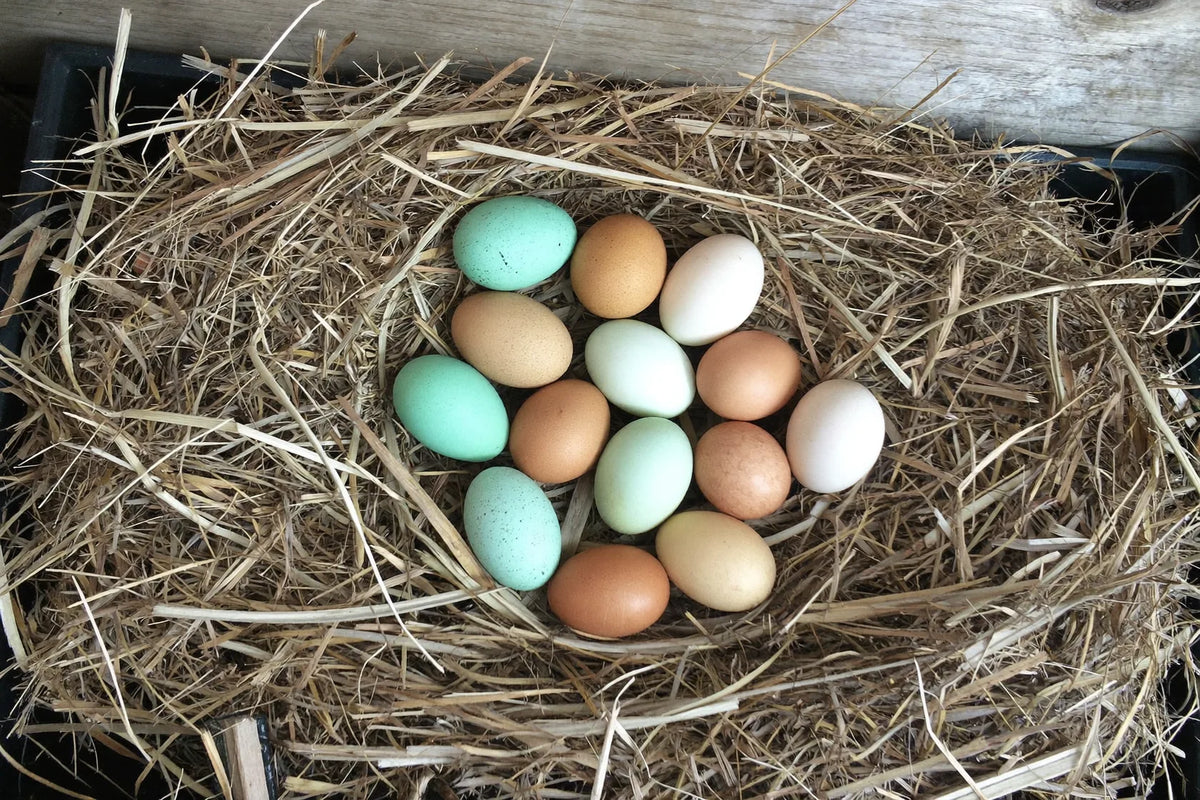
Two blue egg chicken breeds are recognised by the American Poultry Association, and its accepted list carries both: the Araucana, the South American original, and the Ameraucana, bred from it in the United States to keep the blue-shell gene. Everything else you will see under that heading is a cross or a description. The awkward part comes next, because what colour an Ameraucana actually lays is the one thing the extension services will not agree on. Shell colour changes nothing about the housing, so size the coop on the bird and start with the coops we sell.
Every shell-colour statement below was read off the publication that prints it and is quoted rather than paraphrased, because six extension voices do not agree here and a summary would hide that.
What chicken lays a blue egg, and which of these names are real breeds?
Two names pass the register test and the rest do not. The American Poultry Association's accepted list, parsed from its own page rather than from a summary of it, carries the Araucana and the Ameraucana as large fowl and again as bantams, both in the All Other Standard Breeds class. Search that same list for Easter and no chicken row comes back at all; the one match on the whole page is a waterfowl variety spelled Eastern.
Easter Egger is the name you will meet most and it is not a breed. Maine's extension service says so in a parenthesis: "the Easter Egger (not a recognized breed by American Poultry Assn)". Florida's AN239 puts the same bird in its breed table and files it as a "hybrid, not a pure breed" while listing its eggs as green, blue or light brown. Maine files Olive Egger in the same bracket, defining it as "a mix of breeds that produce olive tinted eggs" — olive being the operative word, not blue.
Cream Legbar is the third name that circulates, and it is worth saying plainly what we found: it appears on no row of the American Poultry Association list, and the word does not occur once in any of the ten extension publications we opened for this page. A bird can be real and well known and still have no published entry in the sources we can cite, and where that happens we would rather print the gap than fill it from a sales page.
Americana, with no first e, is a spelling rather than a bird. It is how the Ameraucana is sold, not how it is registered, and a search of every document opened here returns nothing under it.
The line between an Ameraucana and an Easter Egger runs through the bird's feathers, not through its eggs. Kentucky's rule turns on whether the plumage meets the show standard, so a green egg tells you nothing about which side of that line a hen sits on — the blue-egg gene is on both sides of it. Our chicken breeds chart works that identification key through properly, with the comb and the tail and the face furnishings that actually settle it.
What do blue egg laying chickens change about a coop?
Almost nothing about the structure, and one fitting a great deal. The published weights are why: Mississippi State gives the Ameraucana 4.5 to 6.5 pounds as an adult and the Araucana 4.5 to 7, both inside the ordinary dual-purpose range rather than above it — the same service puts the Plymouth Rock at 4 to 7 pounds and the Rhode Island Red at 5.5 to 8.5.
| What is different about these birds | What it changes about the coop | What to check before you order |
|---|---|---|
| Adult weight sits squarely in the dual-purpose band | Nothing about floor area or perch length. Shell colour drops out of the sizing question entirely | The enclosed floor area in square feet and the total perch length in inches, exactly as for any flock — our coop size guide has the per-hen figures |
| A mixed-colour basket is the entire reason most people keep one of these birds | The nest-box access panel earns far more attention than it would on a single-colour flock | How the nest box opens. An external lift-up lid you can see into beats reaching in through the pop door every morning of the year |
| Blue-egg birds usually arrive as one or two additions to a flock that already exists | The nest count you already own has to stretch, and a broody hen takes one out of service | The number of separate laying compartments against the new flock size — the arithmetic is in how many nesting boxes per chicken |
| Shell colour is a property of the bird rather than of the building — a hen that lays blue needs the same box as a hen that lays brown | The field that decides the purchase is the interior floor area, stated separately from the overall footprint | Whether the figure you are given is the hen house or the whole outline. They are rarely the same number |
So read a coop the way any flock reads it, and spend the extra attention on the lid. Tell us which bird you have settled on and how many, and we will go back to the maker for the floor area, the perch length and the depth of the nest box — `sales@moveablechickencoop.com`. A run-and-coop combination is where that access panel is easiest to judge before you buy. What a coop can and cannot tell you about egg output is worked through in our guide to breeds kept for eggs, and the wider question of what a listing says about the bird at all belongs to our backyard breeds guide and the chicken breeds chart.
Araucana eggs, and where the colour in the shell came from
Araucana eggs are where the whole family starts. Kentucky's ASC-190 puts it in one line: "The Araucana is a breed from South America that lays a blue egg." Purdue's table, from 2002, calls the same bird the "original blue egg laying breed". Mississippi State traces it to the Araucania region of Chile and gives adult weights of 4.5 to 7 pounds.
The blue travels, and that is the part that matters for everything below. Kentucky again, on the genetics: "the blue egg color is a dominant trait and when the Araucana is crossed with other breeds the result is a chicken that lays a colored egg". A dominant trait needs only one parent to carry it, which is why blue and green eggs turn up in flocks that contain no purebred Araucana at all.
Where the blue itself came from is stranger, and Kentucky has a whole page on it because keepers were getting the wrong answer. Coverage of the shell pigment led some readers "to believe that Araucana chickens lay blue-shelled eggs because they are sick", and others to think the birds were genetically modified organisms. Neither is right. A retrovirus inserted the sequence into the chicken genome a very long time ago, and "the genetic code left behind by the retrovirus many generations ago resulted in blue-shelled eggs". Jacquie Jacob's closing line is the one to keep: "The chickens are not spreading the virus, but rather, the virus is just a harmless part of their genetic story."
One warning about telling an Araucana by looking. Mississippi State notes that the tuftedness and the missing tail are carried on genes that kill in the double dose: "Lethal genes cause the missing tail and feather tufts on the ears. Therefore, not all birds will display these traits." A bird with a tail can still be an Araucana.
Ameraucana chicken eggs are the one thing these sources will not agree on
Ameraucana chicken eggs get a confident answer everywhere on the open web and no consistent answer in the published literature. Nine statements from six extension voices were read for this page, from the documents themselves rather than from anyone's summary of them, and they do not converge.
| Publication | Where the statement sits | What it says the bird lays |
|---|---|---|
| Purdue AS-518, dated 10/02 | Table 1, egg-colour column | Blue — and the same row says birds laying pink, green or olive are not purebred |
| Mississippi State P3036 | Egg-Laying Birds | Various shades of blue |
| UC ANR and CDFA activity book, 2021–2023 | Popular Chicken Breeds | Blue |
| Kentucky ASC-190, issued 12-2012 | Table 2, Araucana/Ameraucana row | Blue to light green |
| Kentucky ASC-190, issued 12-2012 | Body text, same document | Pink to green |
| Kentucky ASC-231, issued 1-2018 | Page 3 | Light blue, pink or green |
| Poultry Extension (Jacob, Kentucky) | Egg Production | Pink to green |
| Maine Bulletin #2104 | Filed under the heading Tinted-egg layers | Shades of brown, green and blue |
| Minnesota Extension | Ameraucana entry | Green |
Two features of that table stop it being ordinary untidiness. Kentucky's ASC-190 disagrees with itself inside one document: its Table 2 prints Blue to light green against the Araucana/Ameraucana row, and its running text a few columns away says the shell "varies from pink to green". Same publication, same two authors, same year.
Purdue goes further than differing. Its Ameraucana row states that "birds that lay pink, green, or olive eggs are not purebred Ameraucanas" — which is a direct refusal of what Kentucky, Maine and Minnesota describe purebred Ameraucanas doing. There is no averaging those two positions into a house answer, and a page that offered one would be inventing it.
Count the voices rather than the statements and the picture sharpens. Four of the nine are Jacquie Jacob, of the University of Kentucky, writing across two bulletins and one national extension page, so the disagreement is six voices wide and one of those six disagrees with itself. Jacob's national page also lists Purdue's bulletin and Maine's under its own further-reading heading, which means it was written downstream of two of the answers it does not repeat.
Age explains part of it and honesty about the register explains the rest. Purdue's row is dated 10/02 and names eight Ameraucana varieties; Mississippi State says in words that eight are recognised. The association's live list carries a ninth, Self Blue. A document can be right when it is written and quietly stop being right, which is exactly why every count on this page carries the day we read it.
Our position on that, offered as a reading of the literature and not as a finding: a blue-shelled egg is what the Araucana is described as laying by every source we opened, and an Ameraucana is a bird carrying that gene whose shell is reported anywhere from pink to blue depending on which service you ask. If a seller tells you an Ameraucana lays blue, they may well be right, and Purdue would agree with them. They are also making a claim that four other extension services do not support.
Picked the bird but not the house it lives in? Take 10% off a coop you can choose on published floor space instead of on a promised egg colour. GET MY 10% CODE
A blue egg chicken in a mixed basket, and why keepers want one
A blue egg chicken is almost never bought on its own, and the published motive is the egg box rather than the bird. Kentucky writes it into ASC-190 directly: "Some egg producers like to keep a variety of chicken breeds so they will get a wide selection of egg colors". ASC-231 says smaller operations "may prefer to produce a dozen eggs made up of a variety of different colors".
Mississippi State frames the same decision as a question to answer before anything arrives: "you can choose from white, various shades of brown, green, and blue". Maine makes the commercial version of the point about the tinted birds, that two or three of these eggs in a dozen "can make an attractive offering at farm stands".

Buying for the basket has a consequence people meet later rather than sooner. A varied basket means several breeds, several breeds usually means birds arriving at different times, and adding a bird to a settled flock is a different job from buying one more at the start. Our guide to choosing a starting flock size works through what Florida's extension service publishes about introducing new birds, and bantam chicken breeds handles the case where the new arrival is a different size from the ones already there.
Our pick of the blue egg chicken breeds, and where it can disappoint you
We would start with the Araucana if the blue egg is the point, because it is the only bird in this family every source we opened describes the same way. Kentucky, Purdue and Mississippi State each put a blue egg against its name, and Purdue calls it the original. Nothing we opened contradicts them.
The Ameraucana is the easier bird to actually buy and the harder one to promise. Buy it for the bird — a recognised breed at a manageable weight, in nine large-fowl varieties on the association's list — and treat the shell colour as a range rather than a specification. Being wrong here costs a season of mild disappointment rather than money: a hen that lays pink or green instead of blue is a perfectly good hen, and by Purdue's reading she is also not a purebred Ameraucana, which matters only if you were planning to show her.
The expensive mistake is the other one. Paying over the odds for a bird sold as an Americana, or as a guaranteed blue layer, buys a claim the American Poultry Association's list does not recognise and four extension services do not support. Ask the seller which name is on the registration, not which colour is in the photograph.
Then size the house on the bird rather than the egg. Browse the coops we stock if the flock will be housed in one spot, or a coop on wheels if you would rather walk it onto fresh ground every few days. Send us the breed either way and we will chase whatever the listing leaves out.
Sources: University of Kentucky Cooperative Extension, ASC-190 “Selecting the Right Chicken Breed” (Jacquie Jacob and Tony Pescatore, Animal and Food Sciences; issued 12-2012; the publisher flags this document as archived) · University of Kentucky Cooperative Extension, ASC-231 “Breed Selection for a Small-Scale Egg-Production Enterprise” (Jacquie Jacob and Tony Pescatore; issued 1-2018; also flagged archived) · Poultry Extension, “Selecting a Chicken Breed for Small or Backyard Poultry Flocks” (written by Dr. Jacquie Jacob, University of Kentucky — the same author as the two bulletins above, not a separate service) · Poultry Extension, “Colored Eggs and Food Safety” (Dr. Jacquie Jacob, University of Kentucky) · Purdue University Cooperative Extension, AS-518-W “Choosing a Chicken Breed: Eggs, Meat, or Exhibition” (Doug Akers, Pete Akers and Dr. Mickey A. Latour; the masthead reads NEW 10/02) · Mississippi State University Extension, P3036 “Choosing the Right Breed for Your Backyard Flock” (Jessica Wells, Tom Tabler and F. Dustan Clark) · University of Maine Cooperative Extension, Bulletin #2104 “Match Your Need to the Right Breed” (Robert Hawes with Richard Brzozowski, reviewed by H. M. Opitz, updated by Gary Anderson; the bulletin states that most figures in it were taken from material published by seasonal hatcheries) · University of Minnesota Extension, “Raising chickens for eggs” (Betsy Wieland and Nora Nolden; Sabrina Florentino, Extension educator; reviewed in 2025) · UF/IFAS Extension, AN239 “Raising Backyard Chickens for Eggs” (Mary E. Henry, Jessica M. Ryals, Alicia Halbritter and Derek L. Barber) · University of California Cooperative Extension and the California Department of Food and Agriculture, “Starting your own backyard chicken flock?” (2021–2023; an activity book for children, cited here only as a fourth printing of the blue answer) · American Poultry Association, “Accepted Breeds & Varieties” (institutional, no byline; the list itself carries no edition date) — all eleven fetched and read August 22, 2026.
Frequently asked questions
What chicken breeds lay pink eggs?
No extension publication we opened names a breed as a pink layer on its own. Pink turns up only as one end of a range given for the Ameraucana: Kentucky's ASC-231 says those hens lay a light blue, pink or green egg, and its ASC-190 body text puts the shell between pink and green. Purdue reads the same birds the other way and says a pink-laying bird is not a purebred Ameraucana.
Which chicken breeds lay green eggs?
Minnesota Extension lists green against the Ameraucana. Maine puts the same bird under a heading reading tinted-egg layers and gives brown, green and blue. Maine also names the Olive Egger, which it defines as a mix of breeds producing olive-tinted eggs rather than a recognised breed. Green is what a blue-shell gene usually looks like once it is crossed onto a brown-laying bird.
What chicken breeds lay colored eggs?
Mississippi State sets out the choice as white, various shades of brown, green, and blue. The blue and green end runs back to the Araucana, whose shell gene Kentucky describes as dominant, so it carries into crosses. Dark chocolate-brown shells come from a different set of breeds entirely. Shell colour is a surface trait and it tells you nothing about what is inside the egg.