

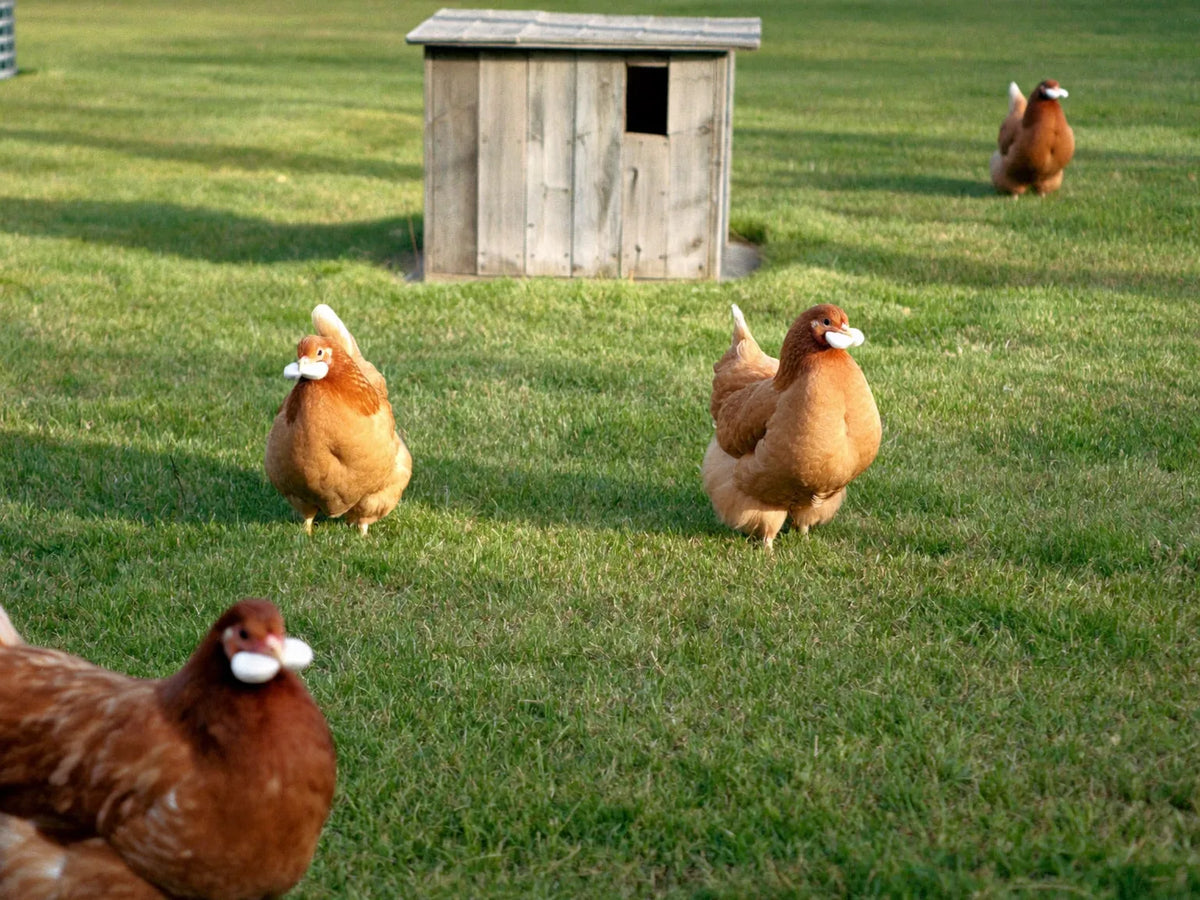
How many chickens can I have in my backyard is three questions in one: what your municipality caps, how many eggs your household actually eats, and the floor the birds set for themselves. UConn Extension names that floor, and no source we opened names a higher one — "Having just one chicken is not recommended, as chickens are social creatures that like to flock together." The egg half is arithmetic: at UF/IFAS Extension's 200 to 240 eggs a hen a year, a dozen eggs a week takes three hens rather than the two a weekly rate suggests. Settle the number first, then read it against the coops built for backyard flocks — a stated hen rating is the part you cannot revise after delivery.
Flock minimums, laying rates and the introduction problem are each traced below to the service that published them; taking the smallest of your three caps is our own method.
How many chickens can I have in my backyard?
Three limits meet on one number. A municipal ordinance sets a ceiling, the eggs your household eats sets a working figure, and the flock's own need for company sets a floor. Only the middle one is genuinely yours to move, and it is the one that tends to get settled last.
Here is the whole decision on one screen, with the direction each input pushes in. Read the last row first: it is the only input that stops being a decision once the crate arrives.
| What decides it | What it sets | Which way it moves your number | Where the figure comes from |
|---|---|---|---|
| Your municipality's rules | A hard ceiling on hens | Down, and there is nothing to negotiate | UConn Extension; UF/IFAS Extension |
| Eggs your household eats in a week | The working number | Up | UMN Extension; UF/IFAS Extension |
| The flock's need for company | A floor above a single bird | Up | UConn Extension |
| The molt and the short days | Weeks in the year with no eggs from a given hen | Up | Mississippi State Extension; UF/IFAS Extension |
| The breed you pick | The same hen count, a very different egg count | Either way | UF/IFAS Extension |
| The coop you buy | The top of the number, permanently | Freezes it | The manufacturer's stated hen rating |
How much room each of those birds then needs is a separate question with four published answers that disagree by a factor of three, and our coop size guide sets them out side by side with the working shown. This post is about the number, not the square footage.
What your town's cap actually counts
A municipal cap is a ceiling on hens, and it is the only input on the list you cannot argue with. UF/IFAS Extension names the usual three restrictions together: "Common restrictions include limiting the number of birds, establishing a setback from neighboring property for housing, and a general prohibition of male chickens, or roosters."
University of Minnesota Extension says the same thing from a different state and a different author team: "Raising chickens in the backyard may require a permit from your city; each city or town may have different requirements and restrictions," and "Some cities may also limit the number of animals you can keep." Two independent services, two plain warnings, and neither will tell you your own number.
The rooster clause matters more to a first flock than it looks. If males are prohibited where you live, "how many chickens" is really "how many hens" — and you lose nothing by it, because UF/IFAS is blunt on the biology: "Roosters are not required for hens to lay eggs."
What a cap looks like in practice, with real town figures, is set out in our 25-hen guide, which reads UConn Extension's sample of municipal rules against a large flock. Whether you need a permit before you build anything is covered in our free coop plans guide. Neither is a substitute for your own municipality's ordinance, and neither of them, and not this page, is legal advice.
How many chickens should I get for a household's eggs?
Work backwards from the eggs, and the first surprise is that the two published laying rates do not agree. University of Minnesota Extension states a weekly figure: "They will lay roughly six eggs each week." UF/IFAS Extension states an annual one: "Egg production for a small backyard flock should be about 200-240 eggs, or 17-20 dozen, per hen a year."
Six a week across a full year is 312 eggs. The published annual figure is 200 to 240. So the weekly rate over-counts by roughly 70 to 110 eggs a hen — 12 to 19 laying weeks' worth. That subtraction is ours, not either service's, and the two publications were never written to be subtracted from each other. The direction is what matters, and it is consistent: a weekly rate counts the weeks a hen is laying, an annual figure counts all fifty-two, so planning on the weekly number leaves you short of hens rather than over-supplied.
| Eggs you want in a normal week | Hens at Minnesota's six a week | Hens at Florida's 240 a year | Hens at Florida's 200 a year |
|---|---|---|---|
| 6 (half a dozen) | 1 | 2 | 2 |
| 12 (a dozen) | 2 | 3 | 4 |
| 18 | 3 | 4 | 5 |
| 24 (two dozen) | 4 | 6 | 7 |
Every figure in that table is rounded up to a whole hen, because you cannot buy two-thirds of one. The arithmetic behind the last two columns is ours: eggs wanted per week, times 52, divided by the annual rate.
Mississippi State Extension explains most of the gap. "Most hens stop producing eggs until after the molt is completed," and a molt runs "2 to 3 months" for a late molter and "as long as 4 to 6 months" for an early one. Three to four and a half months of no eggs is the right order of magnitude for the missing 70 to 110. Consistent is not the same as proven — but it is why an annual figure is the safer one to plan on.
Two more things move the same number. Daylight: UMN states that "Hens need at least 12 to 14 hours of light each day to continue laying eggs," which is why a flock's output sags every winter without a timer. And breed: UF/IFAS puts the spread starkly — "Some breeds, like the Golden Comet, produce as many as 300 eggs per year, while others may lay as few as 150 eggs annually." Pick badly and the same six hens deliver half the eggs.

Age closes the loop. UF/IFAS: "Consider that with age your hens will reduce the number of eggs laid; in which case, feed costs may exceed the financial benefit of the eggs produced." UMN puts the productive window at its widest — hens "begin laying at around six months of age and can continue for five to 10 years, with peak production occurring in the first two years." Your egg number is a number for years one and two, and it drifts downward after that.
Got your number? Take 10% off the coop that has to hold it. GET MY 10% CODE
Why one hen is not an option, and why nobody publishes a minimum
One bird is the only flock size any extension publication we opened for this post rules out. UConn Extension states it directly: "Having just one chicken is not recommended, as chickens are social creatures that like to flock together." Nothing in the same set names a minimum above one.
We looked for one. Seven publications were opened and swept for a flock-size floor — Penn State, Virginia Cooperative Extension, Minnesota, New Hampshire, UConn, UF/IFAS and Mississippi State. UConn's sentence is the only hit. The never keep fewer than three rule that circulates widely has no extension publication behind it that we could find, and we would rather say that than dress our own opinion in somebody else's letterhead.
Our position, plainly, and labelled as ours: start at three, not two. Two birds is one bad night away from the single hen UConn rules out — a fox, an illness, a hen who goes broody and stops eating with the others. Three absorbs a loss without leaving a bird on its own, and it is also the point where a pecking order has somewhere to go instead of running one bird into a corner. That is reasoning, not a published figure, and you should treat it as such.
How many chickens should I start with?
Start with the number the annual egg arithmetic gives you, add one for the bird you will eventually lose, and check the total against your municipal cap before you buy anything at all. If the cap is lower than your egg number, the cap wins and the egg number changes.
One — find the ceiling. Your municipality's ordinance, and your HOA if you have one. It is the only input that can veto everything else, and it takes an afternoon to establish.
Two — set the egg number. Take the eggs your household eats in a normal week, multiply by 52, and divide by 200 to 240. Round up. That is a working flock, not a maximum.
Three — apply the floor. Three hens minimum on our reading, for the reason above. If your egg number came out at one or two, three is where you land anyway.
Four — buy for the top of the number, not the middle. A hen is cheap to add and floor area is not, so the building should be sized for the largest number you can legally keep and would plausibly want, rather than for the flock arriving next month.
Worked through for a household that eats a dozen or two eggs a week and lives somewhere with a cap in single figures, those three limits land at three to six hens. It is not a rule and it is not published anywhere — it is what the ceiling, the arithmetic and the floor produce together. If you already know your number is four, our four-hen guide reads the listings against it; if it is a dozen, the 12-hen guide does the same.
Getting the number too low costs a second introduction
Adding a bird later is not the same job as buying one more at the start, and that asymmetry is the single best reason to think hard about the number now. UF/IFAS Extension is direct: "It is important to note that chickens do develop a pecking order and introducing new birds to an established flock may disrupt the pecking order."
It gets more specific about who suffers. "Young birds introduced to a new flock may experience bullying from older hens so it is best for new birds to be introduced slowly over a period of time to reduce the risk of injuries." The practical trick it offers is one the service itself calls common: "Introducing new birds at night is a common practice to help reduce conflict in the flock."
There is a disease cost as well as a social one. University of Minnesota Extension keeps it to one sentence: "Cleaning before introducing new birds to the area will limit the spread of disease." A new bird is one way something arrives in a flock that was previously closed.
None of that makes a later addition impossible. It makes it a project — slow introductions, a way to separate birds, and a coop with room for the arrivals before they arrive. Starting one hen short means paying that cost. Starting one hen long costs the price of a hen.
What tells you a flock has outgrown its coop?
The air tells you before anything else does. Penn State Extension puts the test in one sentence: "Dampness and ammonia build-up is a sign that there is not enough ventilation for the number of birds in the coop." Read it backwards and it is a flock-size test, because the bird count is a variable in that sentence just as much as the vent area is.
Reading it that way is ours, not Penn State's — the service is writing about ventilation, and our ventilation guide covers that half properly. What the sentence gives a flock-size decision is a symptom you can smell on a still morning, months before anything else goes wrong.
The feed line is the second tell. Penn State asks for "at least 3 inches of feeder space per bird" and explains why in the sentence before it: "The pecking order determines which birds get to eat and drink in the flock." Our four-hen guide multiplies that figure out by flock size. Above 25 birds Penn State adds a placement rule, so a backyard flock is nowhere near needing it.
Nest boxes are the third, and they scale in steps rather than smoothly — our nesting box guide works out where each step falls. Run area is the fourth, and it is usually the one that runs out first, which is why our outdoor run guide exists.
The number your coop freezes for you
A coop's hen rating is the top of your number, and it is the one input that stops being a decision the day the crate arrives. Read how the rating is written before you read the figure: a span like “2–4 chickens” is a maker handing the choice back to you, and a flat “2 chickens” is a maker who has already made it.
Both shapes are out there, and the difference matters more than the digits. "2-4 chickens", "5-8 chickens" and "6-10 hens" are all spans, and on a span you buy the top and live at the bottom. A flat "2 chickens" is a different kind of statement: two is what it means, and there is no headroom in it to grow into. So check which of the two you are looking at before you settle your number.
A span is not a promise, and testing whether these ratings hold up is a separate job from picking your number. Our capacity study does that work against stated floor areas, and our four-hen guide reads the listings that state two different hen counts in the same listing. Use them once your number is settled — not before, because a number chosen to fit a coop is a coop choosing your flock.
So pick the number, then buy the top of it. Tell us the flock number you have settled on and the model you are weighing, and we will put the hen-house floor area, the run area and any blank spec to the manufacturer before you order. The coops that arrive with a run attached save you a second purchase, the coops on wheels let you move the whole flock onto fresh grass instead of shovelling it, and the large chicken coops are the class to start in if your number runs past a small flock. If you would rather browse the lot in one place, the coops for sale are all here.
Sources: UConn Extension EXT152, “Permitting and Regulating Backyard Chickens in Connecticut: a One Health Perspective” (Sara Tomis, Renata Bertotti, David Dickson and Indu Upadhyaya, September 2025) — accessed August 21, 2026 · UF/IFAS Extension AN239, “Raising Backyard Chickens for Eggs” (Mary E. Henry, Jessica M. Ryals, Alicia Halbritter and Derek L. Barber; first published April 2010, revised November 2019 and November 2023) — accessed August 21, 2026 · University of Minnesota Extension, “Raising chickens for eggs” (Betsy Wieland and Nora Nolden; Sabrina Florentino) — accessed August 21, 2026 · Mississippi State University Extension, “Molting of laying hens” — accessed August 21, 2026 · Penn State Extension, “Small Scale Poultry Housing” (Gregory P Martin, Ph.D., PAS and Phillip Clauer, updated June 25, 2026) — accessed August 21, 2026
Frequently asked questions
Can I have a chicken coop in my backyard?
Usually yes, and the limits are local rather than national. UF/IFAS Extension notes that common restrictions cover the number of birds, a setback between the coop and neighbouring property, and roosters, adding that most ordinances “prohibit roaming poultry and are often enforced based on complaint.” Read your own municipality's zoning text and any HOA covenant before you order a coop. Nothing on this page is legal advice.
What do I need to start a chicken coop?
A number first, then a building. Settle how many hens you want from the eggs your household eats and whatever your municipality caps, because the flock size sets the floor area, the run area, the roost length and the nest-box count rather than the other way round. After that: a coop rated for the top of your number, feed, bedding, a feeder, a drinker, and somewhere to keep the birds while you assemble it.
How to start a chicken coop for eggs?
Raise chicks or buy pullets, and expect the first egg at around six months. University of Minnesota Extension puts the start of lay at “around six months of age” and peak production in the first two years. Size the flock on an annual laying rate rather than a weekly one, because the annual figure already has the molt and the short winter days inside it.
How to build a chicken coop for 3 chickens?
Three is where most first flocks land, and at that size the run usually runs out before the house does. Start from published per-bird figures rather than a drawing you like the look of. Our coop size guide sets out the four services that disagree, with the working shown. Build for more than three where your ordinance allows it, because adding floor area later is the expensive fix.