

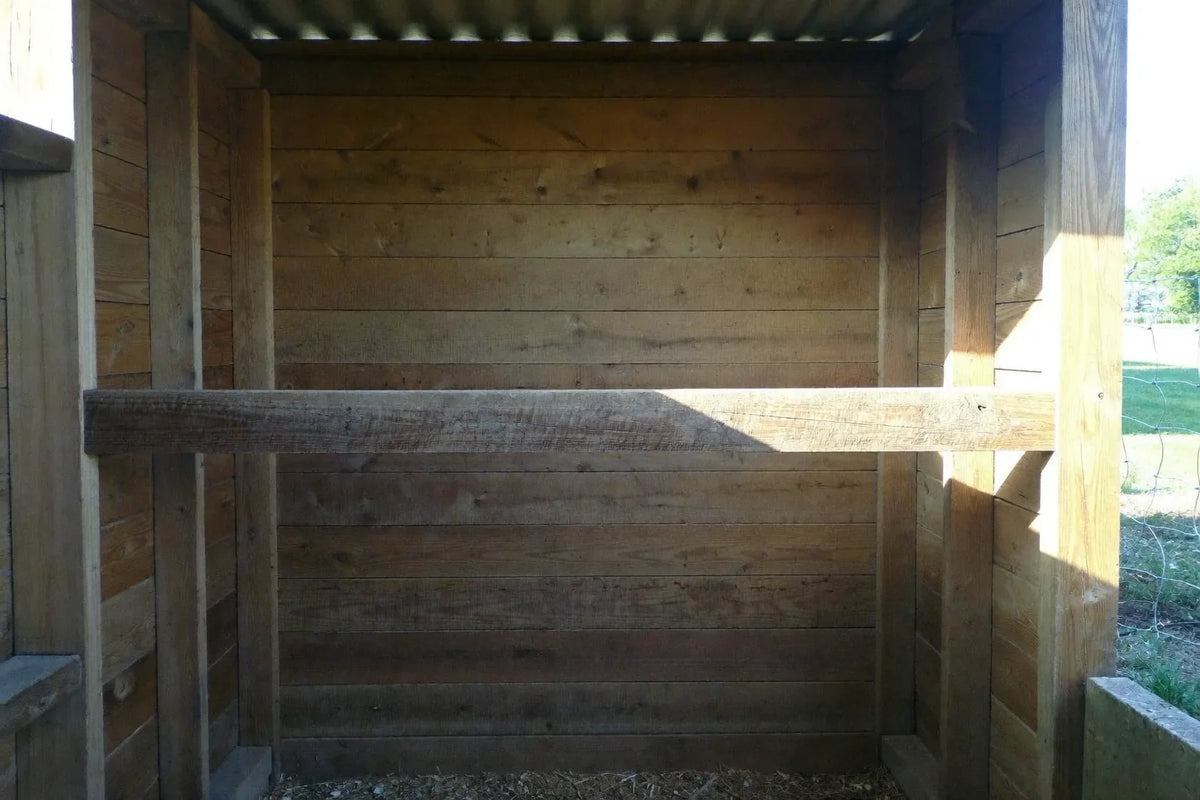
A chicken coop perch should be wood. Every extension publication that names a material at all names wood, and only one of them attaches a condition. University of Minnesota Extension is the blunt one: "Avoid using metal, plastic, or other materials that retain the cold and may cause frostbite." The harder question is the section: how wide the bar is, and whether it is square or round. Section is what decides whether a hen grips the bar or settles onto it. Tell us which coop has your attention and we will find out from its maker what the bars are cut from — browse the coops we carry while we ask.
Every material, width and shape claim here is lifted verbatim from a named extension service, all four linked at the foot. Where the board arithmetic is ours rather than theirs, the page says so in the same paragraph.
What should a chicken coop perch be made of?
Wood, on the evidence available. Three publications from three institutions name a material for the bar, and all three name wood. They arrive by three different routes: cold, grip, and how many hens actually use the thing.
University of Minnesota Extension puts it under a heading called Provide roosts, as a material rule and a size rule in two consecutive sentences: "Avoid using metal, plastic, or other materials that retain the cold and may cause frostbite. Wooden 2 by 4- or 2 by 2-inch boards work well."
University of New Hampshire Extension reaches the same material by the same route and says it more plainly: "Wood is the best material for this as metal and other materials can hold onto the cold and could result in frostbitten feet." Different institution, different author, no shared byline — so the agreement between those two is real, rather than one text printed twice under two mastheads.
The two housing publications this site cites most name no material at all. Penn State Extension's perches section and Virginia Cooperative Extension's cover per-bird space and height and stop there. Neither says what to build the bar from, which is why a reader looking for the answer has to go to the winter-care pages instead. Length, height and how far apart the bars sit are separate questions with settled published answers, and our roost guide carries all three.
Why a coop would fit a metal or plastic perch anyway
Mites. The one extension article written specifically about perches says European producers choose round iron tubes on purpose, because red mites will not live on them. The trade is paid in a different injury.
Dr. Jacquie Jacob's perch article for the national small-flock extension program sets the whole exchange out in four sentences. "Europeans typically use round iron tubes for perches to minimize infestations of red mites", she writes — and then the cost: "However, these perches are associated with a higher risk of keel deformations."
Plastic is not the escape. "Some flock owners have used plastic perches with mushroom shapes, but red mites hide during the day in the areas where these perches are connected to each other." Nor is wood immune: "Wooden perches also are very sensitive to red mites."
Read the direction of that keel finding carefully, because it is easy to take backwards. The risk is attached to round iron tubes as a pair — a material and a shape together — not to roundness on its own and not to metal on its own. The article publishes no keel figure for a round wooden bar, so there is nothing there to carry across.
The verdict is conditional, and the condition is geographic: "In Europe, the presence of red mites is a more significant problem for poultry producers than keel deformations, so European producers prefer the iron tube perches." For a backyard flock, mites are a management job before they are a materials one, and our coop pest guide covers that fight.
| Publication | Material it names | Section or width it names | The reason it gives, or what it leaves to you |
|---|---|---|---|
| UMN Extension, cold-weather care | Wood; avoid metal and plastic | “Wooden 2 by 4- or 2 by 2-inch boards” | Cold-retaining materials “may cause frostbite” |
| UNH Extension, winter care | “Wood is the best material” | “around 1-2 inches wide” | Metal “can hold onto the cold”; toes wrap the edges |
| UNH Extension, producing your own eggs | Milled lumber or a branch | 2 × 2 nominal, or a branch as thick | Fixed to the walls, in tiers |
| Small and Backyard Poultry (U Kentucky) | Wood, unless red mites dominate | Square rather than round | “more layers use perches if the perches are square” |
| Penn State Extension | None — its perches section is written about space per bird | None; it settles height off the floor instead | Material and section are both left to whoever builds the bar |
| Virginia Cooperative Extension | None, and it shares an author with Penn State, so the two count as one voice here | None; space and height again | Its nearest rule is general: remove sharp-edged objects from the coop |
Read the grid down the last column and it tells you where your own judgement has to do the work. Two of the six publications settle material, two settle a width, one settles a shape, and none of them settles all three at once. So take the material from the winter pages, the width from New Hampshire and the shape from Kentucky, and build to the overlap - a wooden bar, one to two inches across the face, square rather than round. That is the whole specification, and it costs nothing to check on a coop before you buy it.
Is a round chicken perch better than a flat one?
No published guidance prefers round. The one extension article written about perches states the opposite outright, and its reason is uptake rather than comfort: more hens choose a square bar than a round one.
The sentence is conditional and worth quoting whole. "If red mites are not a concern, wooden perches are the best option because more layers use perches if the perches are square rather than round." The evidence behind it is about how many birds use the bar, which is a different and more checkable thing than how comfortable a bar looks.
UNH Extension gets to the same shape from the bird's foot: "Make sure the roosts are around 1-2 inches wide so that your birds can wrap their toes around the edges." A round bar has no edges to wrap around. It has a circumference. Two publications, two reasons with nothing in common, one answer — which is the kind of agreement worth more than two services printing the same sentence.
Square is not the same as sharp. Jacob's article, describing the United Kingdom's welfare rules, notes that "the perches cannot have sharp edges". The same passage adds that "it is not mandatory in the United States to include perches in poultry housing" at all, so no equivalent rule binds anyone here. Virginia Cooperative Extension gives the general version as a coop rule: "Remove any loose or ragged wire, nails, or other sharp-edged objects from the coop."
Our own reading, and it is ours rather than a published instruction: leave the section square, then ease the top two edges with a sanding block until they are smooth under a thumb. The bird keeps an edge to grip, and the raw sawn arris goes. No extension publication we opened states an edge radius, so a number here would be one we invented.
Which makes this a five-minute job with a sanding block and no shopping list at all. Do it before the bar goes in, run a thumb along the top two edges, and stop when it stops catching. If the bar came with the coop and you would rather not take a block to somebody else's timber, ask us first and we will find out what the manufacturer says about it.
How wide should the bar be under a hen's foot?
One to two inches, on the only published width we could find. UNH Extension states it with the failure mode at both ends: "Too narrow and it will be difficult for them to balance, too wide and flat, they won't have anything to grab onto."
The full instruction is a width and a purpose in one line: "Make sure the roosts are around 1-2 inches wide so that your birds can wrap their toes around the edges." The same service's egg-production page reaches for a stock size instead, calling for "perches of 2" x 2" lumber or equally thick branches attached to the walls" — the same width said a different way. Two pages, one institution, so it counts as one voice saying it twice and not as two sources agreeing.
Minnesota's sentence is where this gets interesting, because it names a board and never a face: "Wooden 2 by 4- or 2 by 2-inch boards work well." Dressed dry, a nominal 2 × 4 measures 1½ by 3½ inches. That size table is in our DIY mobile coop guide, which uses it to total a frame in pounds, and the nominal-versus-actual trap is set out in our coop plans guide.
So the arithmetic that follows is ours. Stand that 2 × 4 on edge and the hen meets 1½ inches, inside New Hampshire's band. Lay it flat and she meets 3½ inches, which is one and three-quarter times the top of that band. Minnesota never says which way up, and New Hampshire never mentions a 2 × 4. The two published rules coincide on a 2 × 2, or on a 2 × 4 turned on edge, and nowhere else.
Hold the direction of that carefully, because it runs one way only. New Hampshire's band is advice rather than a measured limit. A wider face therefore sits outside their recommendation rather than proven unusable. And a stated width only ever proves that a bar that size works. It never proves it is the narrowest that would.
Go and measure the bar you already have, then, because that is the one number this whole section turns on. A tape across the face the birds actually stand on settles it in ten seconds - and if the coop is not in your garden yet, ask for the figure before it is.
Know the face width you want under the flock now? Take 10% off the coop the bar has to fit inside. GET MY 10% CODE
Perch material and the frostbite argument
Frostbite is why both winter publications name a material at all. Minnesota's mechanism is contact: metal and plastic "retain the cold", and the bar is the surface a bird's feet are in contact with for longer than any other in the coop.
Minnesota also describes what a roosting hen does with her feet, and it is the sentence the whole argument turns on: "While roosting, chickens can comfortably lay on their feet to warm them." The same paragraph gives the bar its second job — "Roosts offer an elevated space for chickens to rest overnight, which keeps them off the cold floor" — and its third: "Roosts should provide enough space for the chickens to fluff their feathers and lay together for warmth without overcrowding."
Set that beside New Hampshire's width rule and the bar is doing two things at once. It has to be narrow enough for toes to reach the edges, and steady enough that a bird can settle down onto her own feet. The one-to-two-inch band is the only published range that answers both, and Minnesota's 2 × 2 sits inside it.
Minnesota's warning is written under a roosts heading, so it is about the bar rather than about the building it is fixed inside. Our cold-climate coop guide is where we first drew that line. The same New Hampshire page that says metal siding is fine on a coop says metal is the wrong thing to put under a hen at night. One page, two building parts, two different answers.
Minnesota publishes the hedge that keeps all of it usable, too: "The exact height and dimension of the roost will depend on the size of your coop." A bar is fitted to a house, and the house sets what will fit. The rest of the winter build — bedding depth, drafts, moisture — is in our winterizing guide.
Chicken coop perch spacing changes with the bar, not the flock
Every published spacing figure is written per bird or bar-to-bar, and not one of them moves when you change the material. What moves is the clear air left between two bars, because the bar's own face is inside the gap you set.
The horizontal and per-hen figures are settled and we publish them next door: our roost guide carries the spread across three services and the tiered ladder that comes out of it. What that page does not carry is the wall.
Jacob's perch article does, by way of the United Kingdom's welfare rules, which require "20 centimeters (about 8 inches) between a perch and the wall". Read it for exactly what it is: a legislative minimum in another country, described rather than recommended. The same page says plainly that perches are not mandatory in the United States. No US extension publication we opened states a perch-to-wall dimension of any kind.
The vertical has a stated failure mode, and it is not the fall you would expect. "If the vertical distance between perches is too large, it is more likely that the chickens will misjudge their landings and collide with perches, thereby injuring their keels." Jacob adds the floor half of it: "chickens find it difficult to land safely on perches when jumping down, so ensure that there is sufficient floor space to allow the chickens to land safely when leaving the higher perches."
Our part in this is small and worth saying anyway. Whatever gap you set between two parallel bars, the section of the bar itself is spending some of it. A 3½-inch face and a 1½-inch face fixed on the same centres leave two different amounts of clear air for a bird to turn round in. Section is a spacing decision as much as a comfort one.
So set the centres from the clear air you want, not from the bar. Decide the gap a hen needs to turn round in, add the face width of whatever you are fixing, and mark the centres off that total - it is one addition, and it is the difference between a second bar that gets used and one that does not.
Chicken coop perch ideas that use what the yard already has
A branch is a published option, not a compromise. UNH Extension names it in the same breath as milled lumber: "perches of 2" x 2" lumber or equally thick branches attached to the walls".

Chicken coop perches do not have to arrive with the coop, and a branch is the cheapest bar there is. Thickness is the whole test on one, and "equally thick" is the phrase doing the work — it points straight back at the same one-to-two-inch face. A branch also has to be fixed so it cannot roll under a bird landing hard on it, which is the one thing a squared bar gives you for nothing.
Most of the ideas circulating for this fitting can be settled against that same band in a sentence each, so here they are with the verdict attached:
- A 2 × 4 on edge. The face is 1½ inches, inside the published band, and it is the orientation Minnesota's sentence never specifies. Our pick.
- A 2 × 4 laid flat. 3½ inches, one and three-quarter times the top of the band. Popular in winter advice because a hen can cover her feet; outside the only published width there is.
- A 2 × 2. Named by two of the four publications and inside the band on every face. The safest thing to buy.
- A branch. Published option, not a compromise — but choose one about as thick as a 2 × 2, and fix both ends so it cannot roll.
- A broom handle or a dowel. Round, and usually well under an inch. Fails the narrow end of the band, which New Hampshire names as a balance problem.
- A stepladder or a sawhorse. Fine as a frame, but the rung is the bar — measure the rung, not the ladder.
- A galvanized pipe. Round, cold and named by both winter publications as the thing to avoid.
- A pallet section. The deck boards are usually inside the band, but pallet timber carries its own question about what it previously held.
Removability is the idea worth taking from the research side. Jacob is explicit about it: "the roosts should be removable to allow you to clean out the manure that accumulates under them." Nothing about timber makes that hard — two open-topped brackets and a bar that lifts straight out beats a bar screwed through from the outside, every single cleaning day. Where the droppings land is its own design question, covered in our poop shelf guide and our easy-clean interior guide.
One more from the same article, and it is about timing rather than timber: "Rearing chickens without early access to perches has been shown to impair their ability to use the perches as adults." Birds raised with a bar use a bar. If you are adding one to a flock that has never had it, expect the habit to take a while to arrive.
Whichever idea you take from that list, fit it on open-topped brackets rather than screwing it through from outside. It costs nothing extra, it lifts straight out on cleaning day, and it means you can swap the face width later if the flock votes against your first choice.
What chicken coop plans with material lists leave out
A cut list names a nominal size and stops there. Our own plan sheets carry one: a dimensioned elevation, a plan view and a cut list in nominal lumber sizes. A nominal size is where the perch question starts rather than where it ends.
Look at what a materials list actually settles. Our free plan sheets specify framing lumber as nominal 2 × 2 and 2 × 4, the same pair Minnesota names. Our DIY coop guide prints that line item as a row of its own. So the sheet answers Minnesota. It does not answer New Hampshire, because a nominal size never says which face you present to the bird.
It says nothing about the species either. Fir and pine are trade names before they are trees. What a grade would add on top of that is a separate argument again, and our wooden coop guide takes it apart properly. For a perch it matters less than it does for a wall, because the bar is carrying a few pounds of hen rather than the weather.
So a plan with a material list does about half the job on this one fitting. Read the cut list for the stock size, then decide the face and the edge yourself — the sheet hands you the stock, never the orientation.
Two pencil marks finish the job. Write the orientation on the drawing next to the bar, and write eased next to the top two edges, and the sheet is then complete for anyone who builds from it later. Our free plan sheets are the ones to mark up.
Chicken perch ideas we would skip, and what getting it wrong costs
Three we would not build: a galvanized pipe, a moulded plastic bar, and a ladder of thin dowels. Each one fails a published rule, and each one fails it in the same direction — the flock declines to use the bar.
A bare metal pipe is named by both winter publications as the thing to avoid, and the single reason to accept one is a European production problem rather than a backyard one. If mites are your fight, fight them with management and bedding, not with a colder bar.
Plastic gets named alongside metal by Minnesota, and Jacob supplies the detail that settles it: on mushroom-shaped plastic perches, red mites "hide during the day in the areas where these perches are connected to each other". Plastic solves neither of the two problems it is usually bought to solve. On a moulded coop the bar is sometimes part of the shell, which is a different problem entirely, and our plastic coop guide is where that one gets put to a maker.
A ladder of thin dowels is the one we would argue with hardest. No extension publication we opened recommends a dowel. New Hampshire's failure mode names the risk without needing a second source: "Too narrow and it will be difficult for them to balance".
Getting this wrong is cheap to fix and tedious to live with. A bar the flock declines is a fitting you paid for and a habit you then have to break. What happens when birds settle in the nest boxes instead — contaminated boxes, dirty eggs, broken ones — is set out in our roost guide and our nesting box guide.
The perch spec worth asking us for
Three fields decide whether a coop's bar is the right bar, and they are the three a product description is least likely to carry: what the bar is cut from, how wide the face is, and whether it lifts out for cleaning. Read any listing for those three before you order, in that order.
Our roost guide covers the bar's other three fields — count, length, and height off the floor. This page is about the two fields that guide was not looking for.
The first is the edge. Sanded, eased, chamfered and rounded are the words to search a listing for, and the ones worth asking about when they are not there, because the difference between a raw sawn arris and an eased one is a thumb test you cannot run through a screen.
The second is whether the bar comes out. Removable gets used freely in coop descriptions — of trays, of nest-box dividers, of run covers — so check which part the word is actually attached to before you assume it means the perch. Jacob's cleaning instruction stands or falls on that one word landing in the right place. Our plastic coop guide puts the same question to the maker of a moulded shell, where the bar can be part of the mould.
And notice what a materials list will happily be precise about: a square steel tube frame, iron supports, fir panels, a leak-proof metal tray. Four materials named to the letter, and then nothing about the one part the birds are in contact with all night. Read that as a description-writing habit rather than a quality signal — it is the kind of gap a manufacturer will close if somebody asks them to.
So ask. Send the model and your flock size to sales@moveablechickencoop.com and we will put all three questions to the manufacturer while the answers are still easy to act on. If you are still choosing, the coops with a run attached are the ones to compare when the flock is out all day, the larger coops are where a full-length bar has somewhere to go, and the full range of coops is on one page.
Sources: University of Minnesota Extension, “Caring for chickens in cold weather” (Colleen Carlson and Hannah Lochner, reviewed 2026) — accessed August 21, 2026 · University of New Hampshire Extension, “How Should I Take Care of Backyard Chickens in the Winter?” (Sean O’Brien, February 15, 2024) — accessed August 21, 2026 · University of New Hampshire Extension, “Producing Your Own Eggs” (Kendall Kunelius) — accessed August 21, 2026 · Small and Backyard Poultry, “Perches in Housing for Small and Backyard Poultry Flocks” (Dr. Jacquie Jacob, University of Kentucky; a national Cooperative Extension resource) — accessed August 21, 2026 · Penn State Extension, “Small Scale Poultry Housing” (Gregory P. Martin and Phillip Clauer) — accessed August 21, 2026 · Virginia Cooperative Extension, “Small-scale Poultry Housing” (2902-1092 / APSC-186NP, Leonie Jacobs and Phillip J. Clauer — Clauer co-authors the Penn State page above, so the two are one lineage rather than two independent sources) — accessed August 21, 2026.
Frequently asked questions
How to build a chicken coop perch?
Cut it from wood and present a one-to-two-inch face, which is UNH Extension's band, and a nominal 2 × 2 lands inside it. Ease the top two edges with a sanding block. Fix it so it cannot roll or shift, and mount it in brackets it can lift out of — the national small-flock extension article asks for roosts that are removable so you can clean under them.
How to build a chicken coop roost?
Same bar, and the material is the part to settle first. University of Minnesota Extension names wooden 2 by 4- or 2 by 2-inch boards and warns off metal and plastic, which "retain the cold and may cause frostbite". A straight branch works too: UNH Extension accepts "equally thick branches" alongside milled lumber. How long the bar needs to be, and how high it goes, are in our roost guide.
Where to put perches in a chicken coop?
Where the daily work is not, is the first rule. The national small-flock extension article says it plainly: "Locate perches in an area of the house where they will not interfere with the daily care of the birds, including feeding, watering, and egg gathering." A bar you reach past to fill a drinker is one you will resent by February. Published heights and the distance from the nest boxes are in our roost guide.