

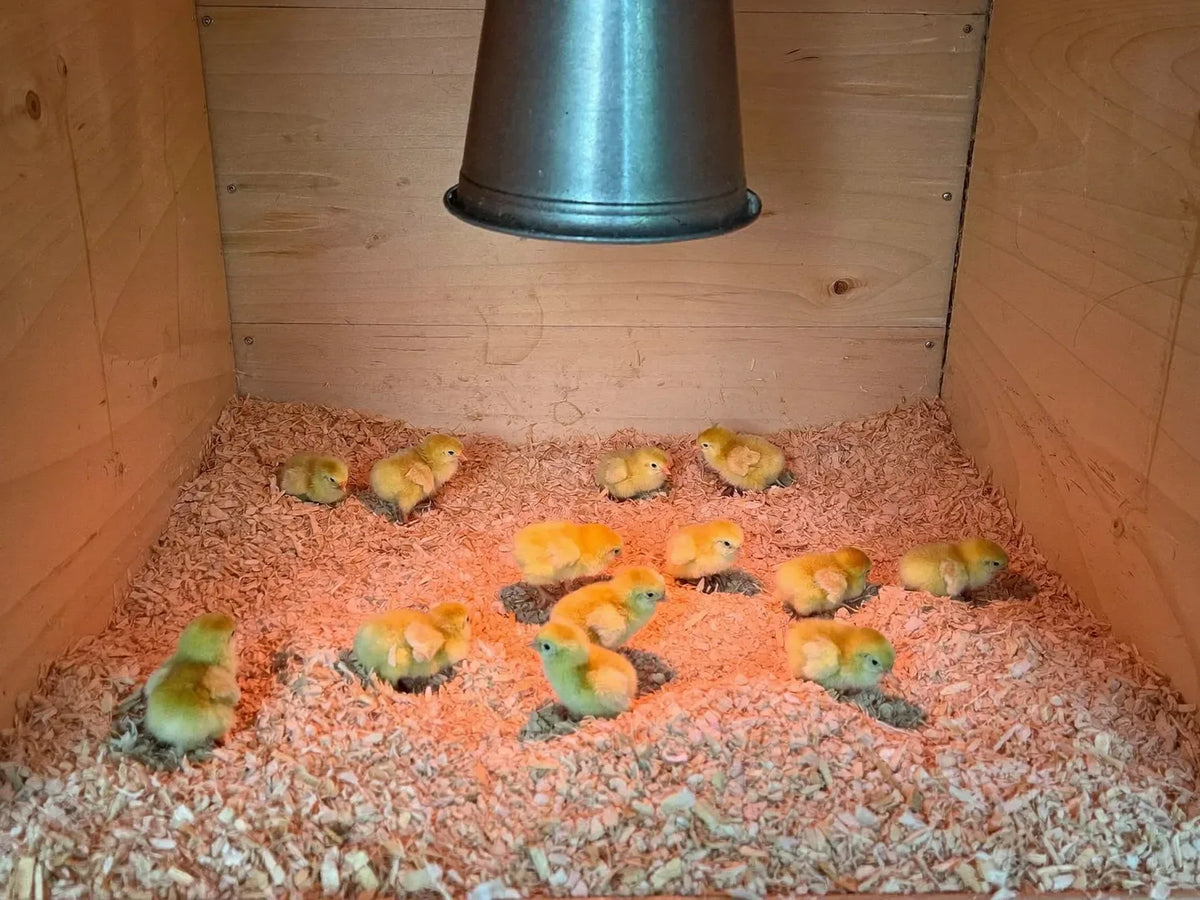
A chicken coop heat lamp is a brooding tool, and brooding is the only job published guidance gives it. Penn State Extension holds day-old chicks at 95°F at chick level for the first week, then steps down 5°F a week. Warming grown hens is a different job, and University of New Hampshire Extension advises against it: "the risk of a heat source causing a fire is too high with combustible bedding materials present." Rutgers names heat lamps the leading heating equipment in barn fires. Penn State asks for 20 inches between a lamp and anything flammable; a hen house has litter below and a roof panel above, so the strict reading wants over 40 inches of clear interior height. Measure yours before buying the lamp — and if the box is what you are choosing, start with the coops we stock.
Clearance distances and brooding temperatures here are taken from named extension publications, linked at the point of use.
What is a chicken coop heat lamp for?
A heat lamp is an infrared bulb in a reflector, hung above a brooder to hold newly hatched chicks at a set temperature. It exists for one reason: a chick cannot yet hold its own body heat, and a grown hen can.
University of New Hampshire Extension puts the biology plainly — "Newly hatched chicks cannot control their body temperature in the first few weeks of life," so "It is essential that they have a source of heat." That window closes. Missouri Extension dates it: "The normal brooding period, when heat is required, is from the time chicks hatch until they are about six weeks old."
Two jobs get confused because one device gets sold for both. Job one is brooding, which has a published temperature schedule and an end date. Job two is warming adult birds in a coop in January, which has neither. The device is the same; the case for it is not. Whether the second job needs doing at all is argued out in our guide to heated coops, and the short version there is that for most flocks it does not.
Nearly every argument about heat lamps in coops is really an argument about which job you are doing, so settle that before you read another word about wattage. Chicks: the schedule below is what you need. Grown hens in January: the money does more good in bedding, working vents and a drier box, and the coops built to move are the ones you can park out of the wind.
Heat lamp for chicks: the brooding temperatures, week by week
Start at 95°F measured at chick level, then drop the target 5°F every week. Penn State, UNH and Missouri Extension all publish that same weekly step, and their starting figures sit within five degrees of each other.
Where you measure decides whether the number means anything. Penn State is exact: "Always measure the temperature at the chick's level, directly under the heat source." UNH gives the height — "Measure the temperature 2.5 inches from the top of the litter directly below the hood." A thermometer stuck on the brooder wall reads the room, not the birds.
The column below is arithmetic: 95°F in week one, minus 5°F for every week after. Each source's own wording sits beside it.
| Week | Target at chick level | What the publications actually say |
|---|---|---|
| 1 | 95°F | Penn State: "Supply 95°F at chick level under the heat source for the first week." UNH gives 90–95°F. Missouri asks for "about 95 degrees Fahrenheit in winter and 90 degrees the rest of the year" |
| 2 | 90°F | Penn State: "Decrease the heat by 5°F per week". UNH: "Each week you should decrease the temperature by 5 degrees" |
| 3 | 85°F | Same step, all three |
| 4 | 80°F | Same step, all three |
| 5 | 75°F | Missouri stops stepping here: "drop the temperature 5 degrees each week until the chicks are five weeks old; then maintain the temperature at 70 degrees" |
| 6 | 70°F | Missouri's end of the brooding period. Penn State keeps stepping down "until the normal daily temperature is reached (62-65 degrees F)" |
| Lamp out | 65–70°F | UNH: the brooder comes out "after the temperature under the brooder is in the 65 to 70 degree range, or when the brooder and outside temperature match" |
Three publications, one schedule, and the split only comes at the bottom. They are separate texts — Penn State's is by Gregory Martin and Phillip Clauer, Missouri's by Jesse Lyons, and UNH's page names no author — and by week six they land within five degrees of each other. Penn State reaches 70°F exactly. Missouri holds there by its own rule. UNH's week-one range of 90–95°F puts it at 65 to 70, which is also where UNH pulls the brooder. Where they part is how far below that to keep going. UNH's version is the only one that needs no calendar at all: pull the lamp when the brooder and the outside air read the same.
Chick behaviour is the better instrument anyway. Penn State reads it in four states: "Comfortable chicks are spread evenly through the brooding areas," "Cold chicks will huddle under the heat source," "Chicks that are too warm will be seen as far from the heat that is possible," and "Chicks in a drafty brooding area will huddle away from the source of the draft." Missouri adds the overheating tell — chicks "pant and gasp (often at the outer edge near the chick guard ring) when overheated."
On a hanging lamp, height is how you hit the number. UNH says the weekly step "can be easily accomplished by raising the height of the lamp." Missouri, in its brooding section: "During normal weather, infrared heat lamps placed 1 to 1.5 feet above the chicks will usually provide enough heat to start with," then "Adjust the height of the lamp to adjust the temperature. Raising the lamp a few inches a week should be about right." Work down the column with a thermometer at chick level and the lamp comes out on the birds' schedule rather than the calendar's.
Why do heat lamps start fires?
Four links make the chain, and they fail in order: the mount lets go, the hot bulb lands on bedding, the bedding is dry, and nobody is in the building. Most of the published rules below break one of the first two. Nothing published breaks the last two — dry litter and an empty yard at three in the morning are conditions, not equipment — and the table adds a fifth way in that skips the chain entirely: the cord.
Rutgers NJAES puts the ranking on record: "Heating equipment is the leading cause of fires in barns with heat lamps as the leading heating equipment involved in these fires," and "Improperly utilized heat lamps are a major source of barn fires." Read the scope honestly — that ranking covers barns, not backyard coops, and we could not find a published count for backyard coops anywhere. What transfers is the mechanism, not the statistic: Rutgers says lamps "are often placed too close to hay and bedding which may ignite quite easily from the heat," and a coop is a smaller box full of the same materials.
UNH names the part nobody designs around: "the tendency of chickens to knock things over." A brooder holds chicks confined by a guard ring. A coop holds adult birds that roost, flap and land on things.

| What fails | The published rule | Who says it |
|---|---|---|
| The suspension | "Never hang a heat lamp by the cord." · "Do not hang the lamp by the cord, a chain will provide strong and safe suspension" | UMN · UNH |
| The bulb after a fall | "Lamps with a cage around the bulb can help prevent the bulb from contacting the bedding if the lamp were to fall." | UMN |
| Distance to anything that burns | "As a rule, heat lamps should be at least 20 inches from any flammable material." · "Secure all heat sources so they cannot be moved or slip too close to flammable materials." | Penn State |
| Water meeting a hot bulb | "Protect the bulb from splashing water (water splashed on the hot bulb will shatter it)" | UNH |
| The power path | "Never use extension cords with heat lamps." · "Only use extension cords short term." · "Do not use them to run power to your coop." · "Always work with a professional electrician when installing electricity in your coop." · "Keep all wires away from poultry, water, and flammable litter to prevent damage, shocks or fires." | Rutgers · UMN |
| The birds | "the tendency of chickens to knock things over" | UNH |
Read the power-path row against what a moveable coop is. A coop earns its keep by being somewhere new every few days, which means it is rarely near a fixed outlet — and the cord that closes that gap is the one thing Rutgers rules out outright. Neither publication is writing about coops that roll, so neither draws the conclusion. We will: on a coop you move, a heat lamp asks for exactly the cord Rutgers rules out and UMN addresses head-on: "Only use extension cords short term. Do not use them to run power to your coop."
Pace that distance before you price a lamp. Walk from your nearest permanent outdoor outlet to the patch the coop will actually stand on, and if a proper supply cannot reach it, the lamp is decided against already and the budget goes to bedding, vents and a dry box instead.
How much interior height does a heat lamp need?
More than 40 inches of clear interior height on the strict reading, plus the depth of the fixture itself. Penn State's rule of thumb is at least 20 inches between a heat lamp and any flammable material; in a hen house the litter below is flammable and so is the roof panel above, which makes two clearances rather than one. Measure from the top of the litter to the underside of the roof panel before you buy anything, and Penn State's own mounting instruction — "Use a chain or cable to suspend heating equipment in the brooding area" — puts the anchor in that roof.
Add it up, and say which part is published and which part is ours. Twenty inches of air under the bulb is Penn State's, stated. Applying the same 20 inches to the roof panel is our reading of "any flammable material" — Penn State does not print it, and nothing in the rule exempts a ceiling either. Take the strict reading and the hen house wants more than 40 inches of clear interior height. Take the loosest reading that still respects the litter, and it wants 20 plus the depth of the reflector. Overall coop height does not count, because most of it is legs, run and roof pitch. The figure that matters is the inside of the hen house, so read the listing for it and get a tape into the box if you already own one.
Real published figures make the point. Interior hen-house heights of 31 inches, 39.2 inches and 42.1 inches are all printed on backyard-coop listings, and on the strict reading the first two do not clear the two clearances at all, while the third leaves about two inches before the fixture is counted. Find your own number and read it off the table.
| What your tape says inside the hen house | What the strict reading leaves | What that means for what you do |
|---|---|---|
| Under 40 inches | Nothing — the two clearances alone do not fit, before any fixture | The lamp is not going in this house. Brood the chicks in a garage, shed or spare room, and keep the coop for grown birds |
| 40 to 44 inches | An inch or two, before the fixture is counted | Measure the reflector's depth and the chain drop before you buy. A margin this thin is a margin one knocked lamp uses up |
| Over 44 inches | Room for a fixture, if the anchor above it is rated to carry one | Ask whether any part of the frame is rated to hold a hung fixture, and mount to that rather than to a roof panel |
| Ridge or eaves? | Two different numbers on the same building | Measure at the lowest point the lamp could hang over, because that is the one the clearance has to survive |
None of that is a fault in the coops. A hen house is a small box on purpose — quicker to warm with bodies, easier to keep dry, and light enough to move. A clearance rule simply does not shrink because the building did.
Where a listing prints no interior height, the figure is not missing so much as unpublished: the factory that cut those panels worked to it. Name the coop in an email to sales@moveablechickencoop.com and we will come back with the interior height, the roof-panel material, and whether any part of the frame is rated to carry a fixture.
Is a heat lamp for chickens ever the right call in winter?
For grown birds, the published answer is mostly no, and two named services disagree about the edge case. UNH advises against supplemental heat "in most circumstances." University of Minnesota Extension sets a threshold instead: "Provide supplemental heat when coop temperatures fall below 35 degrees Fahrenheit."
Read UMN's own ordering carefully, because it is doing work. The list of what to use runs "brooder plates, panels, and hanging heaters" — radiant sources that "heat the birds but not the surrounding air space" — and the heat lamp arrives after them as "Another option is an approved heat lamp with a heat bulb." Placement is specified too: "at the height of the nest boxes or lower rung of the roost." Not overhead, above the bedding.
The disagreement between them is real, and it is narrower than it looks. UMN's conditions are that the product be "approved for use around chickens and livestock" and that you "Always read fire risk warnings and follow installation instructions." UNH's position is that in a box with combustible bedding and birds that knock things over, the risk is not worth taking. Neither one recommends the clamp lamp hung over the litter, which is the exact object most people mean by the question.
What the published guidance keeps coming back to is dry air moving over dry bedding — the reasoning is worked through in coop ventilation and the routine in winter coop care. If you have already decided you want a heated device, the watts, the thermostats and the mounting belong to our chicken coop heater guide, which covers hardware this post deliberately does not.
Ruling the lamp out? Take 10% off the coop you keep the flock dry in instead. GET MY 10% CODE
"Chicken lamp" means three different devices
"Chicken lamp" is a shopping phrase rather than a product category, and it returns three devices with three different jobs. Sorting them takes one question: are you adding heat, adding warmth without a hot bulb, or adding daylight?
A heat lamp is an infrared bulb in a reflector, and its job is brooding. A radiant panel or brooder plate warms the bird instead of the air — UMN groups "brooder plates, panels, and hanging heaters" together for exactly that reason. A coop light is not a heater at all; it runs on a timer to extend day length, and UNH's warning about it is short: "Make sure to use a lamp that won't generate too much heat, as this can be a fire hazard."
Wattage is where the confusion turns expensive. Missouri Extension provisions "one 250-watt lamp for each 50 to 75 chicks." Penn State's stated small-flock option is a wooden brooder box using incandescent light bulbs, where "Two 40-watt bulbs will usually produce enough heat." Both are current, both are published, and they are sized for very different boxes. The target in both is a temperature at chick level — never a wattage on a carton. Buy the thermometer before the bulb, and put it where the chicks actually stand.
What we'd use instead, and what getting it wrong costs
For chicks, we would brood indoors with a radiant plate and keep the lamp as the backup, not the plan. For grown hens in a coop, we would spend the money on dry bedding, working vents and unfrozen water, and skip the heat entirely.
Being straight about the limits: none of that is a promise about a bird. Nobody can sell you certainty about a cold snap. The clearance arithmetic, the mounting rules and the temperature schedule are what the published guidance supports, and they are the claims we will make.
The cost of getting it wrong is not symmetrical, and that asymmetry is the whole argument. Leaving the lamp out is the course UNH already advises in most circumstances, and the visible result is a coop that looks exactly like it did yesterday. Hanging one badly is the other kind of mistake, and the mechanism Rutgers describes — a lamp too close to bedding that "may ignite quite easily from the heat" — does not care whether the box is a barn or a coop: three in the morning, a wooden box, dry litter on the floor. One of those is recoverable. The other takes the coop and everything in it.
What we can help with is the box. A raised floor keeps litter out of the wet, pull-out trays get the damp manure out in January, and a coop you can move onto drier ground is how you get dry litter without adding a heat source at all. If the run is where your birds lose their footing in bad weather, the coops with covered runs are the ones to look at first — and tell us the model, because we will chase the interior height and the panel material before you order.
Sources: Penn State Extension, "Brooding of Domestic Fowl" (Gregory P. Martin and Phillip Clauer, updated June 25, 2026) — accessed August 20, 2026 · University of Minnesota Extension, "Caring for chickens in cold weather" (Colleen Carlson and Hannah Lochner, reviewed 2026) — accessed August 20, 2026 · University of New Hampshire Extension, "Brooding and Caring for Chicks" — accessed August 20, 2026 · University of New Hampshire Extension, "How Should I Take Care of Backyard Chickens in the Winter?" (Sean O'Brien, February 15, 2024) — accessed August 20, 2026 · University of Missouri Extension G8351, "Small Flock Series: Brooding and Growing Chicks" (Jesse J. Lyons, June 1999, revised September 2017) — accessed August 20, 2026 via the publisher; the server has since begun refusing automated requests, so the quotations remain checkable against the Internet Archive capture of February 9, 2026 · Rutgers NJAES FS608, "Fire Prevention and Safety Measures Around the Farm" (Margie Margentino, Karyn Malinowski and Sara Malone, June 2019) — accessed August 20, 2026. Interior hen-house heights quoted in the body are manufacturers' own stated figures, read from published listing spec tables on August 20, 2026: 31 inches on PawHut's 96.5-inch wooden mobile chicken coop with run, 39.2 inches on PawHut's 59-inch wooden mobile coop, and 42.1 inches on a 43-inch wooden chicken coop on wheels.
Frequently asked questions
When to put heat lamp in chicken coop?
For grown hens, there is no month on the calendar that puts one in. University of New Hampshire Extension advises against supplemental heat in most circumstances, and University of Minnesota Extension's own threshold — supplemental heat below 35 degrees Fahrenheit — is met with radiant panels and plates before a lamp appears on its list. The season that genuinely calls for a lamp is chick season, in a brooder, indoors.
Where to put heat lamp in chicken coop?
Over one part of a brooder, never the whole of it, so chicks can walk away from the heat. In a hen house there is rarely a spot that works: Penn State asks for 20 inches minimum from any flammable material, and the litter below and roof panel above both qualify, so the strict reading needs over 40 inches of clear interior height plus the fixture. Measure yours; mounting is in our coop heater guide.
When should I put a heat lamp in my chicken coop?
Think in life stages rather than weather. Chicks need a heat source from day one, at 95 degrees Fahrenheit measured at chick level, dropping 5 degrees a week. Missouri Extension puts the end of that period at about six weeks old, and UNH pulls the brooder once it reads 65 to 70 degrees or matches the outside air. After that the lamp comes out and stays out.
How to install a heat lamp in a chicken coop?
Start with the power path, because that is where the published rules are hardest. Rutgers NJAES states plainly: "Never use extension cords with heat lamps." University of Minnesota Extension goes further for coops: "Only use extension cords short term. Do not use them to run power to your coop." A coop that gets moved onto fresh grass has no fixed outlet at the new patch, which is the problem in one sentence.