

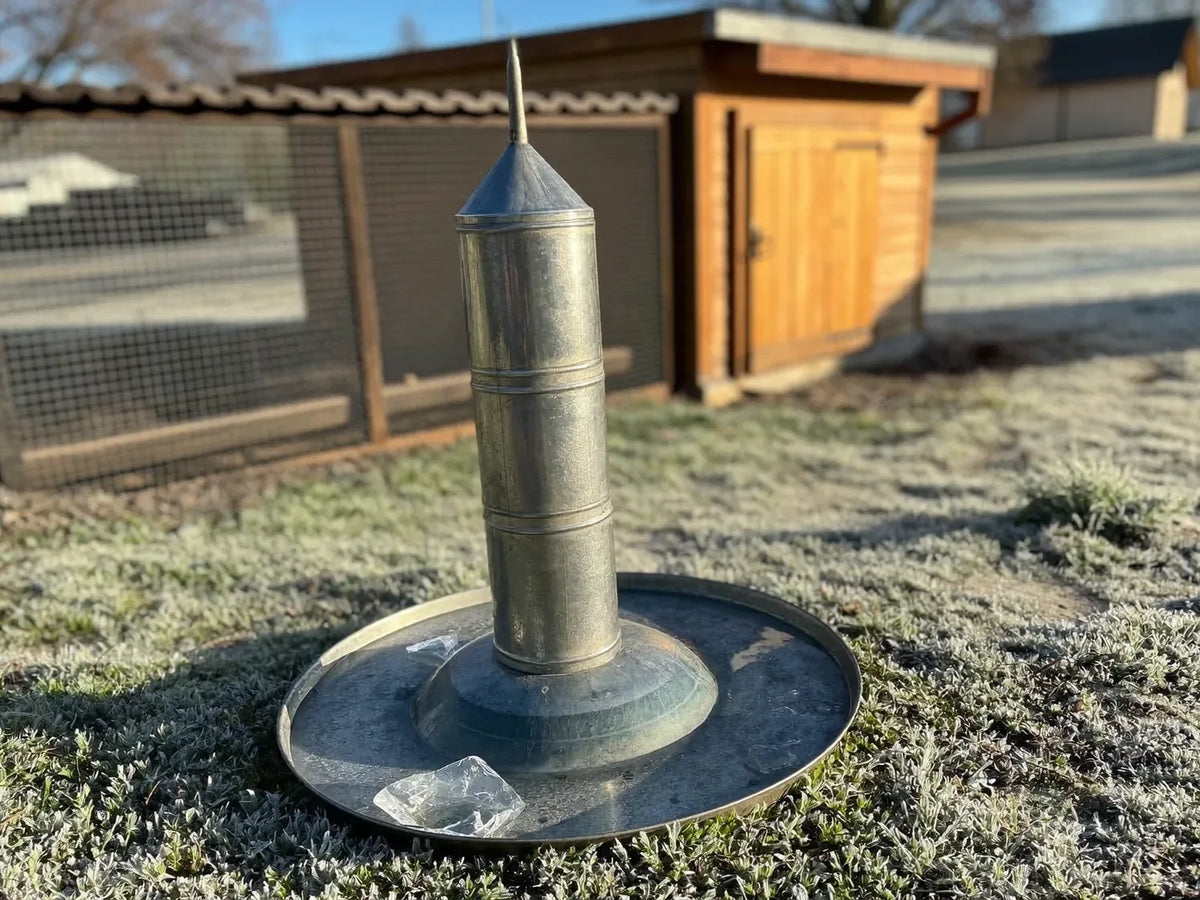
A chicken coop water heater is usually one of four things: a heated base a metal fount stands on, a plastic heated fount that plugs in, a heated dog dish, or a submersible bucket de-icer. University of Minnesota Extension names the first three. All four need the same thing — a cord run safely to wherever the coop is standing — and a live element standing in water inside a wooden building decides the rest, so GFCI protection is the first purchase, not the last. Check the listing for an outlet or a cable pass-through, and price the supply in separately where it names neither. Point at whichever of the coops built to move is on your list and we'll put the outlet question to its manufacturer.
Freeze-protection and electrical-safety guidance is attributed to named services below, with the rate the running-cost sum uses.
What is a chicken water heater, and which type does a coop need?
A chicken water heater is any device that keeps drinking water liquid below freezing. University of Minnesota Extension lists three of them for a backyard flock: "Plastic, heated founts that plug into an outlet", "Heated bases that you can place a metal fount on", and "Heated dog dishes".
The fourth comes from the livestock side of the same problem. Ohio State University Extension's Seneca County office puts it plainly for tanks and buckets: "If electricity is available, use a submersible electric tank or bucket heater." A submersible heater sits in the water rather than under it, which is why the guidance names it for tanks and buckets rather than for a poultry fount.
Then there is the option with no cord at all, and it is not a joke. Carrying warm water out twice a day installs nothing, costs nothing, and fails only on the mornings you oversleep. The carry-versus-heat decision itself, and what the published guidance says about each side of it, is worked through in our winter coop care guide. What follows here is the hardware.
Size the vessel for how often you want to walk out, not for the flock's thirst. The Alabama Cooperative Extension System publishes the figure: "Providing a gallon of water each day is enough to sustain the water consumption of roughly 16 laying hens." Six hens get through well under half a gallon a day at that rate. A bigger fount buys fewer trips in bad weather, not better water — the same guidance still asks you to "provide fresh water daily (more often in the summer) and keep drinkers free of slime and mildew".
| The option | What it needs where the coop stands | What the published guidance says about it |
|---|---|---|
| Heated base, metal fount on top | A cord, a flat rigid surface, and a fount made of metal | UMN pairs the base with a metal fount — "Heated bases that you can place a metal fount on" — and asks you to keep "the heating element away from the bedding" |
| Plastic heated fount that plugs in | A cord and an outlet; nothing goes underneath it | UMN lists it as its own class: "Plastic, heated founts that plug into an outlet" |
| Heated dog dish | A cord, a partial cover, and a spot where open water will not fill with bedding | UMN lists it and gives it one instruction of its own: "These dishes should be partially covered to prevent birds from stepping into the dish or drowning" |
| Submersible tank or bucket heater | A cord, and a container the heater is rated for | Ohio State's county guidance names it as the electric option. Iowa State's Livestock Project names the failure modes: tank heaters "can sometimes cause fires, cause animals to get shocked when drinking, and even cause fatal electrocution" |
| No power at all — carry it out | A routine, and a spare vessel | UMN: "It's a good idea to have a second waterer on hand in case one freezes or stops working" |
Pick the row that matches the cord you can honestly run, rather than the row you would prefer. The electrical rules below decide whether that cord exists at all, and they are worth reading before you spend anything on a vessel.
Heated bases are paired with a metal fount, and that decides the rest
A chicken water heater base is a flat electric plate the waterer stands on, and University of Minnesota Extension describes it in one line: "Heated bases that you can place a metal fount on." Metal is the fount UMN pairs with a plate. Whether a particular base will take a plastic one is the base manufacturer's instruction to give, not UMN's, so read the plate's own paperwork before you stand anything on it.
Two jobs get done by one instruction, and UMN writes them as a single sentence: "Place your water source on a stand to keep birds from scratching manure and bedding into it while keeping the heating element away from the bedding." Clean water is the first job. The second is that a heating element and a heap of dry shavings are not supposed to be in contact.
Bedding is the fuel in that sentence, and how much of it ends up airborne and banked against the base depends on which material you run. The comparison lives in our guide to what goes on the floor.
Flat and rigid is the other half of it. A base wants a surface that will not tilt when a hen lands on the fount's rim, and a wooden coop floor under four inches of litter is not that surface. Read the coop's own siting instructions for the same reason. Where they call for timber pads or paving slabs beneath the legs, it is because soft lawn settles unevenly under a load, and the plate under a fount wants that same level footing even though it weighs a fraction as much. Lay a slab where the fount will stand while the ground is still soft enough to dig, and if you want a coop's own siting instructions before you order, name it and we will fetch them.

What does a chicken coop water system need before you plug it in?
Power, and every rule that comes with power near water. Ohio State University Extension's farm-safety fact sheet draws the boundary in one sentence: "GFCI protection should always be used when operating electrical devices outside and in wet or damp locations." A coop in winter is both at once.
A GFCI is a speed device rather than a fuse. Ohio State: "GFCIs quickly (1/40th of a second) shut off the power in the event of an electrical short or ground fault." The same sheet says you do not need a rewire to get one — "GFCI protection can be obtained by using special breakers, hard-wired receptacles and portable models, which can be plugged into any electrical outlet."
Extension cords are where this usually goes wrong. University of Minnesota Extension gives three instructions in a row and none of them is soft: "Only use extension cords short term." "Do not use them to run power to your coop." "Always work with a professional electrician when installing electricity in your coop."
Iowa State University's Livestock Project repeats the cord rule for exactly this class of hardware — "When using a tank heater or de-icer, avoid using extension cords" — and names the hazard in the same passage without softening it: "These tank heaters can sometimes cause fires, cause animals to get shocked when drinking, and even cause fatal electrocution." Its other line belongs in your diary: "It is important to check often to make sure it is working properly."
Cords at bird height are a separate problem from cords in the wet. UMN: "Keep all wires away from poultry, water, and flammable litter to prevent damage, shocks or fires." Ohio State's Seneca County office says the same thing from the livestock side, asking you to "secure electric cords away from teeth, feet, and legs", and adds the two specs to check on the cord itself — labelled for outdoor use, and every heater properly grounded. The Seneca County page and the GFCI fact sheet quoted earlier are both Ohio State University Extension, so read those two as one service saying it twice; Minnesota is a genuinely separate voice.
Worked out where the cord has to reach? Take 10% off the coop you'll park at the end of it. GET MY 10% CODE
There is one check worth running that the hardware will never prompt you to do. Writing for the University of Delaware's extension animal science blog, Katie Ockert of Michigan State University Extension recommends testing heated buckets and tank heaters with a voltmeter — one lead in the water, the other to ground — because "Any electrical current will deter animals from drinking from the water tank or bucket". A flock drinking less in January looks like cold weather and can be a fault in the hardware. Run that test in the first week the water freezes, before you conclude anything about the birds.
Where the power comes from, and what to measure before you buy
From an outlet that already exists, or from one an electrician puts in for you. A coop is a timber or steel box with a roof on it, and the supply is a separate job with a budget of its own — so read the listing for an outlet, a cord port or a cable pass-through, and for a hook or bracket to hang a drinker from. Where it names none of them, plan the supply and the fixings yourself and price them in before you order.
Geometry is the part that does get printed, and geometry is what decides whether a heated vessel fits where you want to put it. Four measurements settle the job.
| What has to work | The measurement that decides it | What to do about it |
|---|---|---|
| A heated base standing under cover | Clear headroom of the sheltered ground space beneath a raised house | One published figure for that space is 12.25 inches, which is shorter than a great many founts. Measure the fount first, and ask for the headroom where the listing does not print it |
| Carrying the fount in and out | The aperture you carry it through, width and height | There are two of them and they are different sizes: one published outdoor run door measures 24 inches wide by 28.3 high, while the living-area door on the same coop is 11 by 12.25. Measure against the one you will actually use |
| A cord that reaches safely | Distance from a GFCI-protected outlet to the winter parking spot | Pace it out before you buy anything. It has to be a proper supply rather than a lead across the lawn, for the reasons in the section above |
| Something level for the plate | The ground the coop and the fount stand on | Paving slabs or timber pads where the lawn is soft. A plate that tilts when a hen lands on the fount's rim is a plate that ends up in the bedding |
Twelve and a quarter inches is the figure worth carrying around in your head, because it is the height a fount has to fit under to stand out of the weather, and a two-gallon plastic fount standing on a heated plate is often taller than that. Measure the vessel you already own against it tonight. Where it does not clear, the fount goes inside the house instead and the binding aperture becomes the living-area door.
If the spot a heated base would stand on is your deciding factor on a particular coop, tell us which one at sales@moveablechickencoop.com. We'll get the interior floor dimensions and the headroom under the house from the manufacturer before you order.
Which is the best chicken water heater for a coop that moves?
The heated base, on a coop with somewhere flat and sheltered for it to stand. One small plate, a metal fount you can carry indoors to thaw, and no electrics sealed inside the vessel — that is the shortest list of things that can go wrong, which is why we'd start there rather than with a fount that is all one unit.
The awkward part is the cord, not the heater. UMN's instruction — do not use an extension cord to run power to your coop — is written for a building that stays where it was built. A coop that moves has no fixed supply at all, so the honest version of the rule for this category is that the winter parking spot gets chosen partly by where a proper supply can reach it, and it gets chosen in October. Our fall winterizing checklist sequences that against the other jobs, and the rest of what makes a good winter spot — drainage, wind, the path you'll walk in the dark — is in our winter coop care guide.
Two shapes of coop come out of the same decision. The coops built to move let you choose that spot late in the season, and the coops with a run already attached give the fount somewhere out of the weather to stand once you get there.
Keep a spare either way. UMN again: "It's a good idea to have a second waterer on hand in case one freezes or stops working." A spare turns a failed element from an emergency into an errand, and it is the cheapest insurance in this whole post.
Running cost is the next question, and it is three multiplications you can do standing at the feed bin. Take the wattage off the label — call it 100 watts for the arithmetic — multiply by the hours your night actually sits below freezing, say fourteen, and you have 1.4 kilowatt-hours. Priced at 18.44 cents per kilowatt-hour, the US residential average, that is about 26 cents a night. Put your own wattage, your own freezing hours and the rate off your own bill through the same three steps and the answer belongs to you rather than to us. Our coop heater guide runs it on heat, where the wattages are two orders of magnitude higher and the conclusion changes, and if mains power cannot reach the parking spot at all, the off-grid route is in our solar coop heater guide. Tell us where the coop will stand and we will help you work out what can reach it.
What we'd check first, and what getting it wrong costs
Check the supply before you check the heater. The order that saves money is: where a GFCI-protected outlet can safely reach, then what the vessel will stand on when it gets there, then which heated vessel fits under the cover you actually have.
Get it backwards and the failure is predictable. You buy a heated base in November, discover in December that the nearest outlet is sixty feet away, and spend the winter running a cord across a lawn — the one thing the poultry guidance and the livestock guidance both tell you not to do. Then it rains, and the GFCI you skipped turns out to have been the cheap part of the job.
Being honest about the limits: none of this is a promise about a bird. Named guidance covers the hardware, the cord and where the vessel stands, and that is the claim we'll make. Whether your flock needs heated air as well as liquid water is a different question, argued from the same extension sources in the heated coop guide.
Where we can help is picking the coops that make the January version of this job easier: a sheltered patch of ground the fount can stand on, a house that sits clear of the wet, and the freedom to park where a proper supply can reach you. The coops built to move give you that last one, and the full coop list is where to start on the other two. Send us the coop you have shortlisted, and its headroom, floor dimensions and siting instructions come back from the manufacturer before you order.
Sources: University of Minnesota Extension, "Caring for chickens in cold weather" (Colleen Carlson and Hannah Lochner, reviewed 2026) — accessed August 20, 2026 · Ohio State University Extension, "Grounding and GFCI Protection" (Ohioline AEX-79021, S. Dee Jepsen and Jeffery Suchy, November 19, 2015) — accessed August 20, 2026 · Ohio State University Extension, Seneca County Agriculture and Natural Resources, "Battling Frozen Water for Your Livestock?" (Pressley Buurma, December 25, 2025) — accessed August 20, 2026. The two Ohio State pages above are one extension service, so the sentences they share are one finding stated twice rather than two services agreeing · Iowa State University Center for Food Security and Public Health, The Livestock Project, "Planning for Winter: Livestock" (November 30, 2022) — accessed August 20, 2026 · Alabama Cooperative Extension System, "Feeding the Laying Hen" (Wilmer Pacheco, Joseph Gulizia and Kevin Downs, August 2022) — accessed August 20, 2026 · University of Delaware Cooperative Extension, "Tips to Keeping Livestock Healthy During Winter Months" (Katie Ockert, Michigan State University Extension, January 2, 2019) — accessed August 20, 2026. · US Energy Information Administration, Electric Power Monthly, Table 5.3 — accessed August 20, 2026; most recent month shown is May 2026 at 18.44 cents per kilowatt-hour, the rate used in the running-cost illustration. Coop dimensions: the 12.25-inch under-house headroom, the 24 by 28.3-inch outdoor run door and the 11 by 12.25-inch living-area door are PawHut's own stated figures for its 96.5-inch wooden mobile chicken coop with run, and the paving-slab-and-timber-pad siting instruction is a manufacturer's own; both were read from published listing spec tables on August 20, 2026.
Frequently asked questions
Should I put food and water in my chicken coop?
Water, yes, once it freezes, but only where a cord can reach it safely. University of Minnesota Extension asks you to keep all wires away from poultry, water and flammable litter, and not to run power to a coop on an extension cord. The sheltered ground under a raised house is often the spot that works. For where feed and water sit the rest of the year, see our coop layout guide.
How to hang water in chicken coop?
Hanging suits an unheated fount and stops bedding being scratched into it. A heated base cannot hang, because it is a plate the fount stands on. University of Minnesota Extension asks you to put the water source on a stand instead, which keeps the bedding out of the water and the heating element away from the bedding. So the winter version of hanging is a low, solid, level stand with the cord routed well away from the birds.
How to put water in chicken coop rust?
Rust starts where water sits on bare metal, and a heated base makes metal unavoidable: University of Minnesota Extension pairs the base with metal rather than plastic. Empty and dry the fount when you swap in the spare instead of topping it up, and keep the plate underneath dry. Alabama Cooperative Extension gives the same instruction for any drinker, asking you to provide fresh water daily and keep drinkers free of slime and mildew.
How to keep water clean in chicken coop?
Raise it, and refresh it on a schedule. University of Minnesota Extension asks you to place the water source on a stand, which keeps birds from scratching manure and bedding into it while keeping the heating element away from the bedding. Alabama Cooperative Extension gives the routine for any drinker: provide fresh water daily, more often in summer, and keep drinkers free of slime and mildew. The schedule matters more than the vessel.