

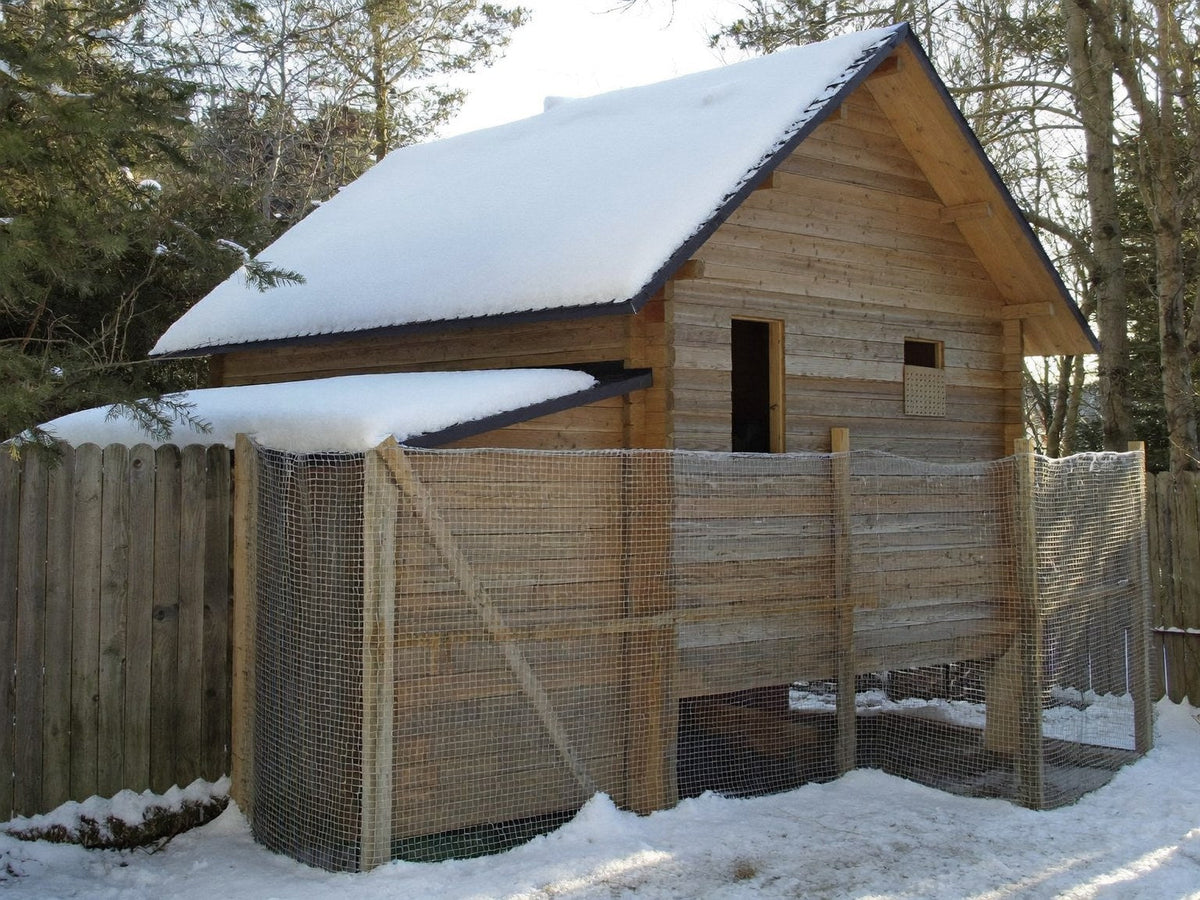
Winter does not attack a chicken coop with cold. It attacks with water. Chicken manure is 70 percent water, says University of Minnesota Extension, which calls manure management the key to controlling coop moisture — and the ground underneath goes soft, then solid. So a winter chicken coop forces four decisions on you: air, insulation, water and site. Only the last one carries a hard deadline — once the ground freezes, you're not moving that coop until spring, which is why the coops built to move need their winter spot chosen in October rather than December.
Moisture, frostbite, insulation and winter water are quoted here from the University of Minnesota, Penn State, Virginia Tech and the University of New Hampshire, each linked at the foot. Two of those four are really one: a shared co-author and shared text run through the Penn State and Virginia Tech pages, and this guide flags that at every point it leans on either.
What does winter actually do to a chicken coop?
Winter loads a coop with water and takes away your options. Moisture builds up inside faster than it leaves, and the ground underneath goes soft, then frozen, which is the half of the problem nobody warns you about.
Penn State Extension states the condition that matters more than the thermometer: "Poultry can handle cold very well if they are dry. However, cool and humid conditions can create many health problems." Virginia Cooperative Extension — which shares a co-author with the Penn State page and reprints much of its text — carries the same sentence with one addition, dry and fully feathered, and both publications state the housing rule identically: "Poultry require a dry, draft-free house."
University of Minnesota Extension names the mechanism plainly. "The main causes of frostbite are high moisture and cold temperatures." You control exactly one of those two ingredients. That's why every job below is a moisture job wearing a different hat.
Birds are a separate question with a separate answer. Breeds, thresholds, whether a heater earns its place — all of that lives in our guide to whether chickens need a heated coop. The page you're reading is about the building and the ground under it.
The four winter decisions a coop forces on you
Four decisions, and they aren't independent. Insulating changes what your vents have to do. The vents change how fast moisture leaves, moisture sets how much bedding work you have — and the parking spot quietly decides all three.
| The decision | The question underneath it | What actually decides it |
|---|---|---|
| Air | Is the coop shedding moisture faster than the flock makes it? | Vent placement and area, not vent count — covered in our ventilation guide |
| Insulation | Will insulating trap the moisture the vents exist to remove? | Whether the vents stay open. Penn State pairs insulation with a vapor barrier, never with a sealed house |
| Water | Will the waterer still be liquid at 6am? | Power at the coop, or a twice-daily swap on foot |
| Site | Will the coop be somewhere you still want it in March? | Drainage, wind shelter, and how soon your ground freezes |
Only one row has a date attached. Air, insulation and water stay adjustable all winter. Add a vent in January. Seal a crack in February. Buy a heated waterer the morning after you find ice. The site closes. Once the ground goes hard, the coop is where it is.
Where does the water in a winter coop come from?
Mostly from the flock. Chicken manure is 70 percent water, according to University of Minnesota Extension, "which makes manure management key to controlling moisture in your coop." Snow and rain tracked in through the pop-hole finish the job.
Manure is the share you can physically carry out, which makes it the one worth attacking. UMN gives two routes: "One option is to routinely pick up manure and remove soiled bedding throughout the winter. Another option is to deeply bed the coop …" Depths, change intervals and the deep litter method are in our bedding and flooring guide. Pick a route there and run it harder in December than you do in June.
UMN also hands you a free diagnostic that takes about four seconds. "If you smell ammonia or notice moisture collecting on objects or windows within the coop, you need to increase ventilation and clean up manure to help remove moisture." Your nose and your eyes, no instruments. Do it on the coldest morning of the week, when the contrast between inside and outside is at its widest.
The other half of the answer is airflow, and airflow is a placement problem rather than a quantity problem. Where the vents go, and why one wall beats another, is in our guide to chicken coop ventilation.

Insulated chicken coops: is insulation worth it, and can you buy one?
Insulate only if you can keep the vents open at the same time. Penn State Extension pairs the two in one sentence: "Well-ventilated houses must also have plenty of insulation and a good vapor barrier."
Virginia Cooperative Extension prints that sentence word for word — the two publications share a co-author, so read them as one source rather than two.
Insulation is a partner to ventilation, never a substitute for it, and both extension pages name the failure mode without softening it. "Failure to insulate or ventilate properly causes moisture to accumulate on the walls and ceiling in cool weather." A sealed, insulated, under-vented coop is a condensation chamber, and it costs money to build.
UMN's own advice is narrower than the search term suggests: "If your coop is unfinished, consider insulating the interior to help retain heat." Unfinished. A coop with a lined interior, or a small coop whose birds fill it, is a different case from a bare-stud shed.
Sealing is the cheaper cousin, and it's the job we'd do first. UMN: "Inspect your coop for holes and cracks that may allow air to flow freely into the coop. Sealing these spots will prevent cold drafts…" Sealing gaps at bird height isn't the same thing as closing the vents above them. The difference between those two moves is the whole argument in the heated coop guide.
Now the part a shopping search won't tell you. "Insulated chicken coop" is a query with real volume, and the word does a lot less work on a listing than it does in the search box. Check whether the listing states an R-value or a vapor barrier rather than the adjective on its own, because those two are what Penn State's sentence is actually about. Where it states neither, ask before you order — tell us which coop you're weighing up and we'll put it to the manufacturer. And if a genuinely insulated, vapor-barriered house is a requirement rather than a preference, that is a build rather than a purchase at this price band, and the free plans below are the better starting point.
Ground clearance, floors and the freeze-thaw problem
The winter spec that decides the most is the one listings are quietest about: how far the floor sits above the ground. Published clearances do exist — 7.5 inches is one — and the number is worth going and finding, because it decides whether the coop rides above the mud or sits down in it.
It often appears under "height to the floor" rather than under ground clearance, which is part of why it gets missed. So here is the winter spec sheet as a reading order: what to look for, why it matters in January specifically, and what to do when the listing is silent.
| What to look for | Why it matters in January and not in July | If the listing doesn't say |
|---|---|---|
| Ground clearance, as a figure in inches | Freeze-thaw lifts and drops wet ground several times a week. Clearance is the gap that keeps the floor out of it | Ask for it. It is often filed as "height to the floor", so ask by description rather than by field name |
| A cover or tarp stated as sitting over the run | A roof keeps the hen house dry; only a run cover keeps the birds somewhere to stand on the short wet days | Assume the run is open. A tarp and four bungees is a cheap retrofit, so don't let this decide the coop |
| A pull-out or slide-out droppings tray | Manure is the water you can physically carry out. A tray makes that a weekly pull instead of opening the coop up in the cold | Check the photographs for a handle or a lip at floor level, then ask |
| Vents you can open and close without tools | A vent you can adjust is a vent you can run one way in January and another in July | Treat it as fixed until confirmed. That assumption costs nothing if you're wrong and a season if you're not |
| Insulation, an R-value or a vapor barrier | Penn State pairs insulation with a vapor barrier and open vents. Any one of the three alone is not the thing | Look for the R-value and the vapor barrier, not the adjective. A build, rather than a purchase, is the honest answer if you need all three |
Read the table in that order, because it runs from what you cannot retrofit to what you can. Clearance is set the day the coop is built. A run cover is an afternoon and a tarp. That is the whole reason ground clearance goes first, and roofing — which does the same job in January that it did in July — does not.
The ground's winter trick is freeze-thaw. Wet ground swells as it freezes and drops as it thaws, and it can run that cycle several times in a week. A coop with a solid floor rides on top of it. A coop with an open floor, or one sitting low on short legs, sits in the mud while it's soft and in the ruts once it sets. Ground clearance is what buys you the gap.
Extension guidance points at the same variable from the drainage side. Penn State Extension: "Build the coop on high, well-drained areas. This prevents prolonged dampness and water saturation of the floor of the coop and outside runs." Virginia Cooperative Extension prints the same passage with one word changed — "Place the coop on high, well-drained areas."
Winter parking spot picked? Take 10% off the coop that'll sit in it. TAKE 10% OFF
How do you keep water from freezing in a chicken coop?
Two published options, and one of them needs an outlet. University of New Hampshire Extension puts the choice in a single line: "In cold weather use a water heater or empty it at night and refill in the morning."
Everything else on the shelf is a variation on one of those two. UNH adds the detail that costs people a waterer every year: "Bear in mind, plastic waterers may crack or become brittle during cold months if they are allowed to ice over." Ice doesn't just block the water. It splits the container.
UMN's fallback when you find the waterer solid: "If it is frozen, you may need to bring it into a heated area such as a garage or porch to allow it to thaw." Once is fine. Twice a day all winter is a different proposition, and it's worth deciding which one you're signing up for before November rather than during it.
Power is the real fork in the road. Virginia Cooperative Extension names the fitting, though it has heat lamps and lighting in mind rather than waterers: "A nearby or in-coop electrical outlet may be useful to provide additional heat in the coop during cold months (for instance by using a poultry heat lamp) and additional light if egg laying rates are lower than preferred." A fixed coop gets wired once. A coop on wheels doesn't, so you're choosing between a cord run to wherever the coop is parked, or a routine you carry out on foot with a jug in each hand.
One more UNH line worth knowing before you assume winter birds drink less: "Animals, including birds, drink more water in winter if it is 50° F." Warm water gets used. Ice does not.
Winter parking: pick the spot before the ground freezes
The single winter decision with a deadline is where the coop stands when the ground hardens. Virginia Cooperative Extension's siting rule leads with drainage: "Place the coop on high, well-drained areas."
A fixed coop gets sited once, at build time, and lives with it. A coop that moves gets re-sited every week or two — which sounds like an advantage until the week the ground stops cooperating. From that point the winter spot is the only spot, and it inherits every siting decision a fixed-coop owner made deliberately in year one.
Choose the winter spot deliberately, then. High ground over low, because low ground collects the runoff twice: once as rain in November and again as meltwater in March. Something solid at your back for wind. A path you can walk in boots carrying water, because you'll be walking it in the dark at both ends of the day. And enough slope away from the coop that thaw water leaves rather than pools. Virginia Cooperative Extension applies the same logic indoors, noting that "slightly sloping the floor toward the door can help prevent puddling in the building and will make the building easier to spray out and dry between uses."
Orientation matters too, and it is a bigger topic than one paragraph deserves. The sun and prevailing-wind side of the decision is worked through in our ventilation guide, and the mechanics of the move itself are in how to move a chicken coop.
The mud is the part people underestimate. A run that gets a fresh patch every week in summer stays put for months in winter, and the ground under it takes the whole season's traffic in one place. A stated cover over the run earns its keep in exactly this window — so if you are choosing now, choose for that, and put the coop where the thaw water runs away from you.
What we'd do, and what getting it wrong costs
We'd spend nothing on insulation and all of the effort on the parking spot. Insulation is the decision with the least published support at this price band, and the site is the one with a deadline and no undo.
Our order of work: air first, because it's the constraint UMN and Penn State both keep returning to. Manure removal second, since it's the largest water source you can lift and carry. Water third, decided by whether power reaches the coop. Site last in the list and first in the calendar, because it's the only one that expires.
Being wrong on insulation costs you money and a wet ceiling. Penn State Extension already named it: moisture accumulating on walls and ceiling in cool weather is the published result of insulating without ventilating. You buy rigid board, you staple it up, you seal the house tight, and you've built the high-moisture condition that page warns about.
Being wrong on the site costs you the whole season. A winter of walking water across churned ground to a coop you can't move, with a run that never gets a fresh patch, isn't a hardware problem you can fix in January. It's a decision you made in October without noticing you were making it.
Water is the cheap one to get wrong — a split waterer and a bad morning. It belongs on the list anyway, because it's the one job with no version you can skip.
None of this is a promise about birds. Extension services publish conditions and causes, not guarantees, and neither do we. What we can tell you is which of these decisions is reversible in February and which one is not.
Which winter specs should you check before you buy?
Four specs set how much winter work a coop makes: the roof and any cover over the run, the droppings tray, how far the floor sits off the ground, and whether the vents can be adjusted without tools.
Roof material is the easy one to find; a cover over the run is the one worth hunting for, and the two are not the same claim. A run cover matters more in a wet winter, because a run that stays usable gives the flock somewhere else to be during the daylight hours you have left.
The droppings tray is the winter tool disguised as a cleaning convenience. Look for the words pull-out or slide-out, and for whether the tray runs the full width — a full-width, hose-rinsable tray is the version that actually saves you the job. A tray turns the 70-percent-water problem into a weekly pull instead of a shovel job in a coop you're trying not to open.
Ground clearance is where listings go quiet. Phrases like "raised clear of the ground" or "raised on support legs" are descriptions rather than measurements, and in a freeze-thaw winter the measurement is the part that matters. Tell us which coop you're looking at and we'll get the clearance from the manufacturer's drawing before you order — the offer stands on every coop we sell.
Adjustable ventilation is the fourth, and it's the one worth reading a spec table twice for. A vent you can open and close is a vent you can run differently in January than in July. The placement side of that decision is in our ventilation guide.
If your flock will be shut in for more of the day than usual, floor area is the spec to compare rather than overall length. Working out what a stated footprint really holds is covered in our coop size guide — and once you have the number you need, start from the larger coops and walk-ins.
Sources: University of Minnesota Extension, "Caring for chickens in cold weather" (Colleen Carlson and Hannah Lochner, reviewed 2026) — accessed August 11, 2026 · Penn State Extension, "Small Scale Poultry Housing" (Phillip Clauer; reviewed by Gregory Martin; updated June 25, 2026) — accessed August 11, 2026 · Virginia Cooperative Extension, "Small-scale Poultry Housing" (2902-1092 / APSC-186NP, Leonie Jacobs and Phillip J. Clauer, April 28, 2023 — shares co-author Phillip Clauer, and much of its text, with the Penn State page above; the two are one source, not two) — accessed August 11, 2026 · University of New Hampshire Extension, "Producing Your Own Eggs" — accessed August 11, 2026.
Frequently asked questions
How to keep chicken coop warm in winter?
Mostly you don't heat it, you dry it and stop the drafts at bird level. University of Minnesota Extension's winter jobs are the unglamorous ones: inspect the coop for holes and cracks, seal them, and remove manure so the moisture leaves with it. Penn State is blunt about the trade: poultry handle cold very well if they are dry. If you're weighing an actual heater, our heater guide covers that choice.
How to keep eggs from freezing in chicken coop?
Collect early and collect often. University of Minnesota Extension puts it plainly: freshly laid eggs are 109 degrees Fahrenheit, they are largely made of water, and they are prone to freezing. Most hens finish laying before noon, so a midday pickup catches nearly the whole day's lay. UMN also says to inspect eggs as you collect them and discard any with cracked shells.
How to keep chicken coop dry in winter?
Take the water out rather than trying to stop it arriving. Chicken manure is 70 percent water, says University of Minnesota Extension, so a droppings tray pulled and rinsed on a schedule removes the largest source you can physically carry. UMN's warning sign is easy to check: if you smell ammonia or see moisture collecting on objects or windows, increase ventilation and clean up manure.
How cold is too cold for a chicken coop?
Nothing in the spec tables we publish answers that with a number — tell us the coop and we'll ask the manufacturer what they state. The published thresholds are about the birds rather than the building, and Penn State's condition matters more than any number: poultry handle cold very well if they are dry. The bird-side temperature question, breed by breed, is answered in our guide to whether chickens need a heated coop.