

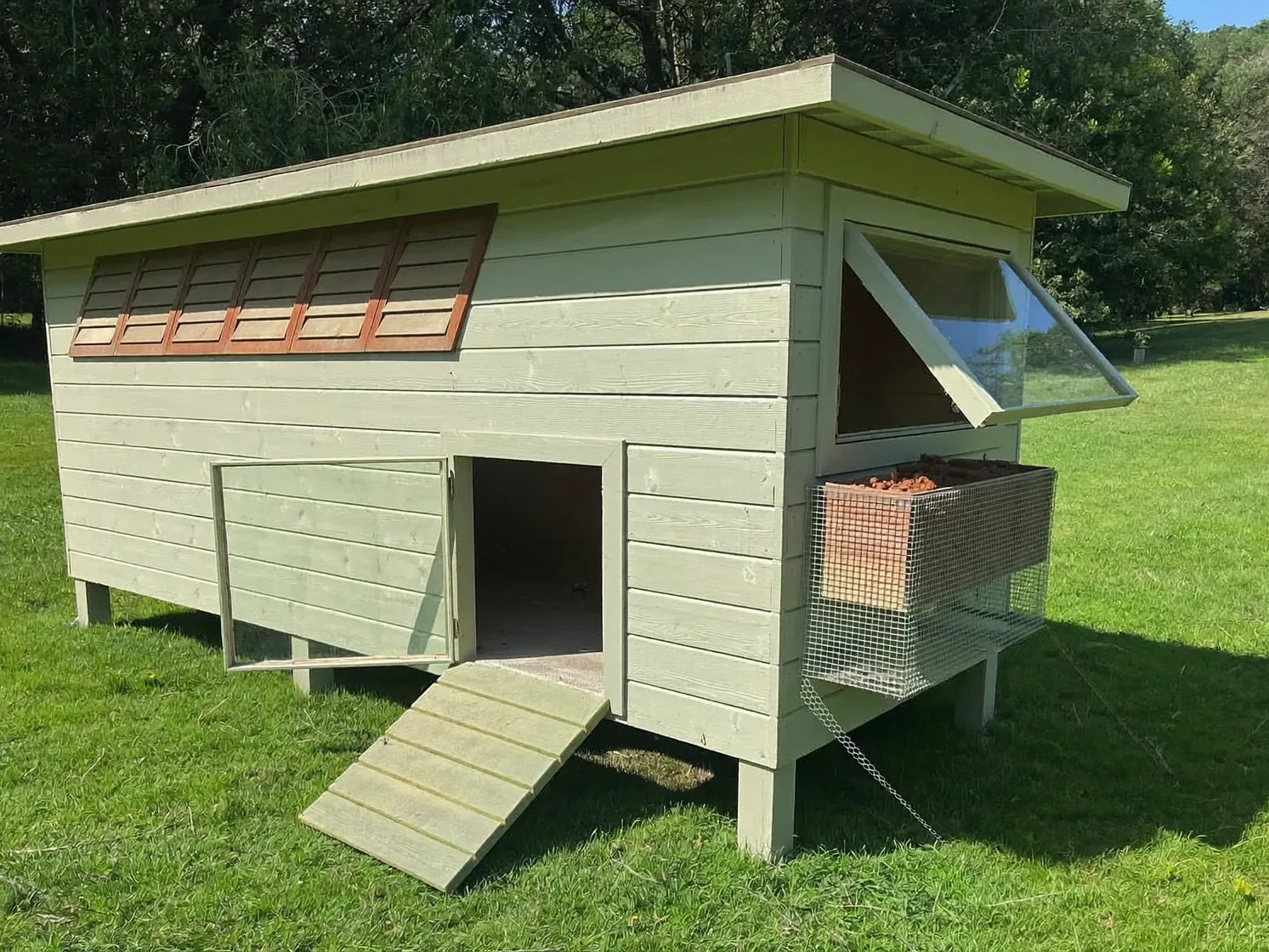
Most backyard flocks do not need a chicken coop exhaust fan, and the reason is not the one you would expect. Mississippi State Extension's rule for a mechanically ventilated house is enough fans to exchange the air in the house at least once a minute. Run that rule on a hen house measuring 53.9 by 37.4 by 39.2 inches inside — 45.7 cubic feet — and you get 46 cubic feet per minute. That is under ten watts at the worst fan efficiency Mississippi State publishes. Electricity was never the obstacle here. A cord run to a coop built to move is one, and the draft a fan puts over a roost is the other.
Airflow figures come from published poultry-housing guidance, named where used, with the fan sums laid out so you can substitute your own numbers.
Do you need a chicken coop exhaust fan?
Probably not. Our chicken coop ventilation guide works through what four extension services publish about openings, and none of them reaches for a motor to do the job. The University of New Hampshire Extension prints the one exception the housing guidance makes, and the wording repays a slow read: "If the flock is housed in a confinement situation, fans should be installed for good air circulation and ventilation in the summer." Confinement is the operative word. It describes birds shut inside a building they cannot leave, not four hens with a pop-hole onto grass.
Order of operations matters more than hardware here. Openings first, then bedding, then headcount, and only then a fan. If you are still choosing the box, put the money into openings rather than into a motor and start with the full coop list.
What a chicken coop fan can and can't fix
A fan moves air. It does not remove water, and most problems people buy a chicken coop fan to solve are water problems — wet litter, a dripping waterer, a roof leak over bedding, or too many birds in a small box.
Penn State Extension frames ventilation as an exchange rather than a breeze: fresh air in, moisture and ammonia out. A fan does that, and so does an open window on the leeward wall.
| What sends people looking for a fan | What the published guidance says is going on | Does a fan fix it? |
|---|---|---|
| Ammonia in the morning | Penn State: dampness and ammonia build-up is a sign that there is not enough ventilation for the number of birds in the coop | Partly. It is an exchange problem, and an opening exchanges air too |
| Condensation on the window | Penn State: failure to insulate or ventilate properly causes moisture to accumulate on the walls and ceiling in cool weather | No. In cold weather a fan trades condensation for a draft |
| Wet, packed litter | Penn State: poultry can handle cold very well if they are dry | No. The water is in the bedding, not in the air |
| Birds panting in August | Minnesota: airflow at the birds' level is key to removing bird heat | Yes. This is the job a fan is actually for |
| Air that feels damp, with no number on it | Alabama Extension: it is general practice to maintain house relative humidity between 50 and 70 percent during cold weather | Maybe. Put a hygrometer in there before you buy anything |
Only one row in that table is a clean yes, and it is the row about heat. Everything above it is a moisture problem wearing a fan-shaped disguise. The honest first move is a bag of dry bedding and a look at the roofline, not a trip to the hardware store.

How many CFM does a chicken coop need?
Nobody publishes a figure for a backyard coop. The one rule in print comes from Mississippi State Extension, written for a commercial house: "There must be enough fans to exchange the air in the house at least once per minute." To use it you need a volume, and a volume needs an interior height.
The one extension page written specifically about small-flock ventilation — Dr. Jacquie Jacob's, for the University of Kentucky — names no fan and no number at all, only "the laws of physics to generate air movement."
Check the listing for the inside height of the hen house, not just the outside footprint or a floor area. Height is the number that turns a floor into a volume, and where it is not printed you can take it with a tape or ask for it before you order. Once you have it, the sizing is one multiplication and one division.
| Inside the hen house, in inches | Interior volume | Air changed once a minute | Fan draw at 5 cfm/W |
|---|---|---|---|
| 38 × 22 × 42.1 — a small raised house | 20.4 cu ft | 20 CFM | about 4 watts |
| 53.9 × 37.4 × 39.2 — a bigger raised house | 45.7 cu ft | 46 CFM | about 9 watts |
| 72 × 48 × 72 — walk-in height | 144 cu ft | 144 CFM | about 29 watts |
| Yours: width × depth × height | divide by 1,728 for cubic feet | the same figure again, in CFM | divide by 5 for watts |
The working, so you can redo it on whatever coop you own: 38 × 22 × 42.1 inches is 35,196 cubic inches, and 35,196 divided by 1,728 gives 20.4 cubic feet. Once a minute makes that 20 CFM. Where a listing gives you both a floor area and inner dimensions, use the dimensions: an area has already been rounded, and you need three numbers rather than one. Mississippi State puts fan efficiency at "about 5 cfm/W to 25 cfm/W" and reports tested 50-inch fans landing between 14.3 and 24.5. That band was measured on large agricultural fans, so a small one is not guaranteed to sit inside it. Even at the published floor of 5 cfm/W, the draw is single figures in watts.
Running cost follows a number that small. Nine watts around the clock is 0.22 kilowatt-hours a day. At the US residential average price of electricity, 18.44 cents per kilowatt-hour, that is roughly four cents a day. Put the rate off your own bill in its place and the sum takes ten seconds. Our coop heater guide runs the same arithmetic on heat, where the wattages are two orders of magnitude higher and the answer changes.
Rather choose a coop by its openings than wire one for a fan? Take 10% off. TAKE 10% OFF
Chicken coop vent fan vs. the vent you open by hand
A chicken coop vent fan is a vent with a motor behind it. It gives you airflow on a still night, when a passive opening gives you nothing. It also gives up the one advantage a plain vent has: a plain vent cannot blow on a sleeping hen.
Carrying the commercial rule across is where this goes wrong, and the trouble is in the units. Mississippi State's worked example is a house 50 feet wide by 500 feet long with a 10-foot ceiling, running fifteen 50-inch fans. "Fifteen times 27,000 is a total fan capacity of 405,000 cfm." Then "the cross-sectional area of your house is 500 feet (10 ft x 50 ft)", and "If you divide 405,000 by 500, you will get 810 feet per minute." The 500 in that division is the slice of building the air crosses, not the distance it travels down the house.
Copy the air speed and there is nothing to copy. The 810 is not a second rule competing with the first — it is the first rule measured along the building, and Mississippi State says so before it does any arithmetic: "If you have a 500-foot-long house, your air velocity needs to be 500 feet per minute to exchange the air in your house in 1 minute." One change a minute means the air walks the length of the building in a minute, whatever that length happens to be. Five hundred feet a minute in a 500-foot house is the same instruction as about three feet a minute in a hen house 37.4 inches deep. The figure that sounds like a specification is the one carrying a 500-foot building inside it.
The two jobs behind those numbers are still different. Exchange rate answers moisture and ammonia; air movement at bird level is what lifts heat off a hen, and that is true in any building. It is the 810 that belongs to a 500-foot house, not the principle.
Placement inherits a rule from the passive case and tightens it. Penn State forbids exactly one location: "do not allow the vents or windows to open directly over the birds perching area to prevent drafts." A fan makes that stricter rather than looser, because a fan runs on the still nights when an open window would have moved nothing.
Dust is the other thing the commercial literature warns about and backyard keepers underrate. Mississippi State reports that "Dirty shutters are a common problem in many poultry houses, and they can reduce air delivery by as much as 40 percent." A coop is a dustier box per cubic foot than a poultry house, and nobody cleans a coop fan monthly.
Four things about the coop decide which fan can go on it, and none of them is CFM: the opening the fan has to fit, the wall or panel it screws to, where its power comes from, and whether you can shut it off completely in January. Settle those four before you shop, and if the coop you are weighing does not print its vent dimensions, send the model to sales@moveablechickencoop.com and the vent dimensions come back to you from the manufacturer.
Does a chicken fan actually cool hens in a heat wave?
Yes, and this is the one job the published guidance backs without hedging. University of Minnesota Extension puts it in two flat sentences: "Airflow at the birds' level is key to removing bird heat" and "Increasing ventilation to remove heat from the birds should be your first priority."
Minnesota wrote that for barns, and the barn numbers do not travel. The bird does. A hen's thermoneutral zone is a property of the hen, given by Minnesota as "between 60 and 75 degrees Fahrenheit" for most poultry, and it does not widen because the building got smaller. Heat guidance carries across where ventilation-rate guidance does not. That asymmetry is why a chicken fan is a summer tool rather than a fixture.
The escalation is worth knowing before July arrives. Minnesota describes birds cutting feed intake "towards 85 degrees Fahrenheit", and core body temperatures reaching lethal levels once the air goes "towards 100 degrees Fahrenheit" without relief. It names the failure mode too: "Naturally ventilated barns are at risk of heat stress if the air is calm and supplemental fans are not present."
Air on the birds in July is the same air Penn State forbids over a roost in January, and both instructions are right. Winter wants exchange above their heads with nothing moving at perch level. Our guide to whether a coop needs heating works through that height difference.
Shade and water come first even so. Minnesota's summary names "Access to cool, fresh water, ventilation, and adjusted feed schedules", and its last word on the subject is "Provide shade for pastured poultry." Rolling a coop under a tree at nine in the morning takes thirty seconds and no cable, and it removes the sun before the fan has to remove the heat. That trick is most of the case for a coop you can move.
Powering a chicken house fan when the coop moves
You supply it, and you supply the hole it passes through. Fitting a chicken house fan means providing the feed and the cable entry yourself, so check the listing for an outlet, a cord route or a cable gland before you plan either one — and a coop that moves every few days makes both harder than they look on a diagram.
A load that small opens every option: a mains lead, a battery pack or a small solar panel will each carry single-digit watts. Supply was never the constraint.
The cord is the constraint, and Minnesota rules out the obvious workaround. University of Minnesota Extension is flat about extension leads: "Only use extension cords short term" and "Do not use them to run power to your coop." For anything permanent the instruction is "Always work with a professional electrician when installing electricity in your coop", with the reason attached: "Keep all wires away from poultry, water, and flammable litter to prevent damage, shocks or fires."
A coop that moves and a permanent circuit are close to a contradiction. Moving is the whole point of this kind of coop — our guide to moving one without wrecking the lawn is about exactly that — and a fixed feed to a fixed point undoes it. A battery or panel keeps the coop untethered, at the cost of one more thing to charge. Our solar coop heater guide sizes a panel against a load hundreds of times bigger.
Then there is the hole. The University of New Hampshire states the tension every coop opening sits inside: "The chicken coop needs to be tight enough to keep out animal predators, yet not so tight as to interfere with good ventilation." A cable entry is one more gap in that wall. Tell us which coop you are looking at and we will ask the manufacturer whether there is anywhere a cable can pass without opening a gap that matters.
Would we fit one, and what does being wrong cost?
No, on a backyard coop, with two exceptions — and only one of them is in the literature. We would keep a portable fan and a lead where we could find them in a July heat wave. We would fit a permanent one only to genuine confinement housing — birds shut in for weeks — which is the case the University of New Hampshire actually describes.
The two errors are not the same shape, and that is what settles it. Fit a fan you did not need and you get moving air over a roost on cold nights, a cable entry in a wall, a moving part in a dusty box, and a quiet belief that the moisture is handled while the litter is still wet. All of that is chronic, cheap and reversible.
Skip a fan you did need and the failure is acute. Minnesota's description of untreated heat stress ends with the bird dying, and it runs across an afternoon rather than a season. An asymmetry like that does not argue for buying a fan. It argues for owning one and leaving it unplugged eleven months of the year.
What we would not do is cut a permanent opening because a forum thread quoted a CFM figure. The only published fan numbers are commercial-house numbers, and the air-speed half of them carries the length of a 500-foot building inside it. A number that confident, with a broiler house behind it, is a specification for a different problem.
The cheaper move is to buy the openings instead of fitting the motor. A coop on wheels lets you turn those openings out of the weather and park the whole box in shade in August, which is the half of the job you can do with no power at all.
Vent dimensions are worth reading on the listing rather than discovering on delivery day. The coops built to move give you the shade trick and the turn, the walk-in coops are where louvered vents and opening side windows turn up, and the larger coops are where headcount makes ventilation matter most. If the one you like says nothing about air, send us the link and we will get the numbers from the manufacturer. The rest of the range is on the full coop list.
Sources: Mississippi State University Extension Service, "Fan Selection for Poultry Housing" (publication P2998, Tom Tabler, PhD and Jessica Wells, PhD, copyright 2019) — accessed August 20, 2026 · Penn State Extension, "Small Scale Poultry Housing" (Gregory P. Martin, PhD, PAS and Phillip Clauer, updated June 25, 2026) — accessed August 20, 2026 · University of Minnesota Extension, "Preventing heat stress in poultry" (Sally Noll and Sabrina Florentino, reviewed 2026) — accessed August 20, 2026 · University of New Hampshire Extension, "Producing Your Own Eggs" (no byline stated; page contact Kendall Kunelius) — accessed August 20, 2026 · "Ventilation in Small and Backyard Poultry Flock Housing" (Dr. Jacquie Jacob, University of Kentucky; no date shown) — read September 4, 2026 · University of Minnesota Extension, "Caring for chickens in cold weather" (Colleen Carlson and Hannah Lochner, reviewed 2026) — accessed August 20, 2026 · Alabama Cooperative Extension System, "Cold Weather Ventilation & Moisture Control of Poultry Houses" (Campbell, Davis, Linhoss, Griggs, Smith, Edge and Rueda, January 24, 2022) — accessed August 20, 2026 · US Energy Information Administration, Electric Power Monthly, Table 5.3 — accessed August 20, 2026; most recent month shown is May 2026 at 18.44 cents per kilowatt-hour. Interior dimensions quoted in the body are manufacturers' own stated figures, read from published listing spec tables on August 20, 2026: 38 by 22 by 42.1 inches on a 43-inch wooden chicken coop on wheels, and 53.9 by 37.4 by 39.2 inches on PawHut's 59-inch wooden mobile coop.
Frequently asked questions
How to make a chicken coop?
Build the openings in rather than planning to add air movement afterwards. Penn State Extension's guidance for a small coop is that windows or vents on one side of the house usually provide plenty of ventilation, so a wall you can open beats a motor you have to power and clean. Frame those openings above roost height, back them with hardware cloth, and settle the size of the house before you cut anything using our guide to reading coop plans.
How much space in chicken coop for 9 chickens?
Nine hens is roughly where ventilation stops being optional, because Penn State Extension ties the need to headcount rather than floor area: dampness and ammonia build-up is a sign that there is not enough ventilation for the number of birds in the coop. Penn State Extension publishes 1.5 sq ft per laying hen, and the published figures run as high as 5, so run the numbers with our coop size guide, which sets three extension services side by side.
How to insulate a chicken coop?
Insulate and ventilate in the same job, or the insulation makes things worse. Penn State Extension states both halves: well-ventilated houses must also have plenty of insulation and a good vapor barrier, and failure to insulate or ventilate properly causes moisture to accumulate on the walls and ceiling in cool weather. Cover any foam where hens can peck it, keep the high openings open, and read whether a coop needs heating for the winter sequence.
Where to put fan in chicken coop?
It depends on the month: the two jobs want opposite answers. In winter, high on the wall: Penn State Extension is explicit, do not allow the vents or windows to open directly over the birds perching area to prevent drafts. In a heat wave University of Minnesota Extension wants the opposite, airflow at the birds' level is key to removing bird heat, so reach for a portable fan, not a fitted one. Passive placement is in our ventilation guide.