

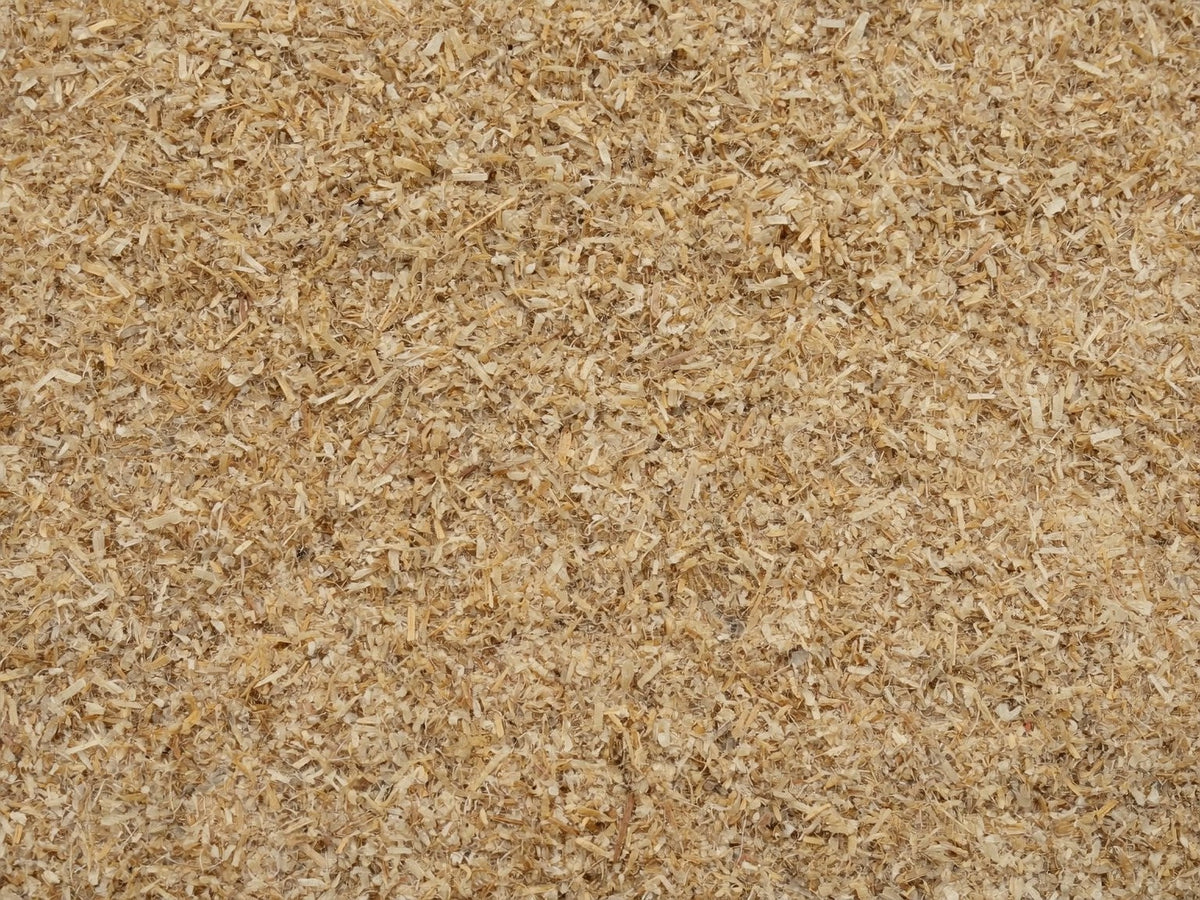
Hemp bedding for a chicken coop is milled hemp hurd, the woody core left after the stalk's fiber is stripped out. The one published measurement we could open puts its water absorption at 251.9% of its own weight — and the published figures for wood shavings run from 200% to 460%, which puts hemp inside that range rather than above it. Not four or five times more absorbent, and not clearly more absorbent at all. Hemp's one real published edge is ammonia. The rest of the label — low dust, fewer mites, faster composting — is untested by any extension service we could find. Depth still beats material, on every coop floor including the coops built to move.
Absorbency and ammonia figures here come from published trials, named and linked where each one is quoted.
What is hemp bedding for a chicken coop?
Hemp bedding is the milled woody core of the industrial hemp stalk, sold as short chopped chips. Penn State Extension calls that core the hurds, the "short inner fibers," and lists animal bedding among the crop's farm uses.
The hurd is what is left after the valuable part is taken. Penn State describes the split during retting, which "helps to break the bonds between the two types of fibers in the hemp plant, the bast (long outer fibers) and the hurds (short inner fibers)." Bast fiber goes to textiles and composites. The hurd used to go nowhere. The 2023 characterization study in the journal Animals is blunt about it: hemp hurds "are a poorly appreciated part of the plant that typically represents waste."
Bag labels use three words for the same material — hurd, shive, and hemp bedding. You will also see "chopped hemp stalk." All of it is that same pith; Arango and colleagues use "hurds" and "shives" interchangeably for it throughout the paper.
Penn State's uses table runs to five categories — fibers, leaves, hemp oil, seeds, and buds and leaves — and animal bedding appears in exactly one line of it, filed under leaves: "Farm and landscaping: mulch, composting, and animal bedding." A land-grant university naming the use, filed under a different part of the plant from the hurd, with no figure printed alongside it. That turns out to be the pattern for this whole topic.
Does hemp absorb more water than pine shavings?
Not on the published record. Hemp hurd measured 251.9% of its own weight in water, and the wood-shavings figures in print run from 200% to 460% — hemp sits near the bottom of that range, not above it.
Getting to that answer means fixing the thing every hemp page gets wrong, which is the basis. Absorbency reaches print two ways: as a percentage of the bedding's own weight, and as pounds of water per pound of bedding. They are the same measurement, so 251.9% is 2.52 lb per lb — but a ratio between two of them only means something if both came off comparable protocols, and mostly they did not. Here are the two published sets, kept apart, each with its own source.
The first set is the one Arango and colleagues built: their own hemp result, plus every bedding figure they collected from earlier work to compare themselves against. One paper, one comparison, all on percent of own weight.
| Material | Water absorbed, % of own weight | Where the figure comes from |
|---|---|---|
| Hemp hurd, average of 10 varieties | 251.9% | Measured by Arango et al., Animals, 2023 |
| Hemp hurd, range across those varieties | 211.4–317.9% | Measured by Arango et al. — no significant difference between varieties |
| Hemp shives, the only earlier published value | 325.0% | Earlier literature, quoted in Arango's discussion |
| Fine wood shavings | 266% | Earlier literature, quoted in Arango's discussion |
| Wood shavings | 315.9% and 460% | Earlier literature, quoted in Arango's discussion |
| Sawdust | 483% | Earlier literature, quoted in Arango's discussion |
| Cereal straw, wheat straw, straw | 305%, 320.8%, 330% | Earlier literature, quoted in Arango's discussion |
| Recycled paper, paper cuttings | 382%, 392.3% | Earlier literature, quoted in Arango's discussion |
| Rice husks | 462% | Earlier literature, quoted in Arango's discussion |
The second set is Rutgers, which publishes in pounds of water per pound of bedding and covers the materials a horse owner actually shops for. Multiply any of these by 100 and you have the same basis as the table above — 2.0 lb/lb is 200% — though Rutgers prints its table without citing where the figures came from or what protocol produced them.
| Material | Water absorbed, lb per lb of bedding | Same figure as a percentage |
|---|---|---|
| Pine shavings | 2.0 | 200% |
| Pine sawdust | 2.5 | 250% |
| Pine chips | 3.0 | 300% |
| Wheat straw | 2.2 | 220% |
| Ground corncobs | 2.1 | 210% |
| Shredded newspaper | 1.6 | 160% |
| Peat moss | 9.0–10.0 | 900–1000% |
Set the two tables next to each other and the real finding falls out, and it is not about hemp. Rutgers puts pine shavings at 200%. The wood-shavings figures Arango's own discussion collects are 266%, 315.9% and 460%. Same material, published values spanning a factor of 2.3. The disagreement inside wood shavings is larger than any hemp-versus-pine gap anybody is selling — which means the multiple you get depends entirely on which shavings number you reach for, and a page that picks the lowest one is not measuring hemp, it is picking a number.
Hemp at 251.9% lands inside that spread, near the bottom of it, and below every wood-shavings value in the set its own paper assembled. Arango reads that as parity rather than defeat: the sentence immediately after the list says hemp shives "may have a similar water absorption capacity to fine wood shavings which are known for their good moisture absorption," and the authors are careful that "it was difficult to make direct comparisons with previous reports due to the different methods used and the nature of the sample." Their hemp also came in under the only prior hemp figure on record, 325.0%. Similar, with wide error bars. Not better by a multiple, and not better at all in a way you could put on a bag.
Variety is the other thing the marketing gets backwards. The 10 varieties spread from "the highest value (317.9%; Felina 32)" to "the lowest value (211.4%; Eletta Campana)," which reads like a shopping guide until you read the clause attached to it: "No statistical differences (p > 0.05) were observed among varieties." Treat that range as measurement noise, not as a reason to hunt for a cultivar. Variety did matter for ammonia, where the differences were significant — but not here.
No poultry study we could open has put hemp and pine shavings on the same bench on the same day, which is why the honest answer to the headline question is "no measurable advantage" rather than a number with a decimal point in it.
Pine chips beat average hemp in the Rutgers table, and peat moss beats everything at 9 to 10 lb per pound. Neither took over the coop-bedding aisle, because litter is judged on seven or eight things at once and absorbency is one of them. The full material decision — cost per change, dust, availability, what it does to your cleaning cadence — sits in our guide to choosing between bedding materials.
Does hemp bedding reduce ammonia in a coop?
Bench tests say yes, coop tests do not exist. Arango measured 50.0% ammonia absorption across 10 hemp varieties, and the earlier work its discussion cites put hemp at 60% relative ammonia absorption against 44% for wood shavings.
Read that comparison in the original, because it is the one place hemp has a published edge over the material it is sold to replace. Arango's discussion: "Our results were close to those of Airaksinen et al., who reported that the relative ammonia absorption of hemp was 60%, and stated that hemp had a better ammonia absorption capacity than wood shavings (44%), and straw (4%)." Hemp beating shavings by roughly a third, straw by fifteen-fold, and Arango's own 50.0% sitting close enough to 60% to corroborate rather than contradict it.
Two caveats travel with that number and neither cancels it. The 60-versus-44 pairing is Arango quoting Airaksinen, not Arango measuring both materials itself, so it inherits whatever protocol Airaksinen used. And every figure here comes off a bench with a bedding sample on it, not out of a coop with birds in it — nobody has published what 60% against 44% does to the air a hen breathes at three in the morning in February. Still, it is a real measurement, from a source we opened, pointing the same way twice.
Variety does the interesting work here rather than on water. Ammonia absorption "ranged from 45.0% (Fibranova) to 55.5% (Ferimon)," and the authors report those differences between varieties as statistically significant — the opposite of what they found for water. We have not found a bag that names its variety.
What the extension services publish about coop ammonia is a building story, not a bedding story. Penn State Extension: "Dampness and ammonia build-up is a sign that there is not enough ventilation for the number of birds in the coop." Mississippi State's litter publication names the two levers as "adequate ventilation and use of litter amendments," then adds a detail no bedding label mentions: "Litter pH affects ammonia release and should be below 7 to reduce volatilization." We could not find a published pH for any hemp bedding product.
So if a coop smells, the first fix is air, not material. Where the vents go is a decision of its own, and we gave it a separate guide to coop ventilation. The second fix is dryness, which is depth and change cadence rather than brand. Hemp's ammonia figure is worth something on top of those, and worth nothing instead of them.
Hemp chicken coop bedding: the claims nobody has measured
Four claims ride along with most of the hemp labels we have read: low dust, less ammonia, fewer mites, faster composting. Ammonia has bench numbers behind it, as the section above sets out. We opened the extension literature on backyard poultry litter looking for tests of the other three, found none of them, and found hemp itself never named.
The clearest case is the one article written specifically to compare litter materials. Dr. Jacquie Jacob's "Litter Material for Small and Backyard Poultry Flocks," published through the University of Kentucky, works through thirteen named materials — wood, paper, hull, cob, straw, sand and leaf litters, listed out in full in our bedding comparison. Hemp is not one of them.
The same article sets out what a good litter has to do: "be nontoxic to the birds ...; be free of contaminants, such as pesticides and metals; be very absorbent; have a reasonably short drying time; have reduced thermal conductivity; be able to be repurposed after being used as bedding material (e.g., as a land application); and be readily available and relatively inexpensive." Seven requirements. Hemp has a published number against exactly one of them — absorbency — and that number does not put it ahead of wood shavings.
Dust deserves the sharpest flag, because dust is what people buy hemp on. Both of the dust findings in that article belong to other materials: "Rice hulls typically are free from excessive dust, and their size, thermal conductivity, and drying rate make them a good choice for bedding," and, of the sand trials it describes, that "the houses with the sand bedding had less dust, lower levels of darkling beetles, less caking, and improved house temperatures." No dust measurement for hemp bedding in a coop has been published anywhere we could reach.
Hens eat their litter, too. Jacob notes that chickens "have been shown to do well on pine sawdust, although litter consumption has been a problem." No source we opened tests hemp on that question either.
None of this makes the four claims false. An untested claim is untested, not disproved, and hemp may well be quieter in the lungs than a bag of fines. It does mean that money spent on hemp buys one published edge — ammonia, measured on a bench rather than in a coop — plus three assumptions, and you should know which is which before you spend it.
Trying hemp? Take 10% off the coop first. GET MY 10% CODE
How much can hemp cost before it stops paying?
On water absorption alone, the same or less than pine shavings. The closest same-basis comparison in the literature puts hemp at 251.9% against fine wood shavings at 266% — a ratio of 0.95, so any hemp price gap buys you nothing.
The arithmetic is a single division, and running it against all four published shavings figures rather than the convenient one is what turns this from marketing into a decision. Divide hemp's 251.9% by each shavings value on the same percent-of-own-weight basis. Anything above 1.0 is headroom to pay more. Anything below 1.0 says hemp has to be the cheaper bag.
| Shavings figure used | On the percent-of-own-weight basis | Hemp at 251.9% is | What hemp may cost per pound |
|---|---|---|---|
| Pine shavings, Rutgers FS537 | 200% | 1.26× | up to 26% more |
| Fine wood shavings, quoted in Arango | 266% | 0.95× | about 5% less |
| Wood shavings, lower value quoted in Arango | 315.9% | 0.80× | about 20% less |
| Wood shavings, higher value quoted in Arango | 460% | 0.55× | about 45% less |
Three of those four rows say hemp has to be cheaper than shavings to win on water. One says you can pay a quarter more — and it is the row that reaches across two different labs, two different decades and two protocols nobody published side by side. Every "hemp absorbs 26% more" figure in circulation is that top row, quoted on its own. Printing the other three is the whole point of this page.
Run it on the bag in front of you if you want to check a specific pairing. Bag price divided by (bag weight in pounds × the multiple) gives dollars per pound of water absorbed, and the lower number wins on absorbency alone. What you should not do is treat any single multiple as the answer, because the published inputs disagree by more than the decision does.
One trap hides in the units. Every figure above is per pound of bedding, and bedding is sold by the cubic foot. Do the division on the stated bag weight, not on the volume printed in large type on the front, and if a bag states volume only, it cannot be compared on this basis at all. Worth knowing before you carry it to the register.
Bedding prices move by region, by season and by how far the nearest mill is, so the only figures worth trusting are the two on the shelf in front of you. Run the division on those, buy the cheaper answer, and put what you save into depth — depth is the variable with published guidance behind it, and the one that decides whether either bag performs. If the coop itself is still undecided, the house floor area is what sets every sum on this page, and the coops built to move keep that number small by design.

Hemp in the nesting boxes
Penn State Extension's nesting guidance names one material: "Pine shavings are preferred," with 2 inches of clean, dry nesting material in the boxes at all times. No extension source we opened puts hemp in a nest box or rules it out.
The nest job is not the floor job. A nest liner has to cushion an egg and stay put, which is why Penn State also specs "a three to four inch lip in the front of the nests to keep nesting material in the box." Absorbency barely enters it, because a nest box never catches a night's manure the way the floor under the roost does. In our own handling, fine-particle bedding of any kind kicks out of a shallow box faster than a coarse one — an observation, not a published finding.
UNH Extension's warning is the one that costs money: "Don't let the nest boxes run out of shavings either — bare nesting box floors result in broken, dirty eggs." How many boxes a flock needs, and where they belong, is its own guide.
Does hemp bedding suit a coop that moves?
On a floorless coop it doesn't apply: the ground is the floor and there is no litter to buy. On a mover with an enclosed house, the littered area is small, which is the one place a costlier bedding is easy to justify.
University of Minnesota Extension states the mobility case plainly — "Moveable shelters are a valuable tool for pasturing chickens and reducing cleaning time" — and the second half of that sentence is the bedding argument in miniature. Fewer full change-outs means the annual bedding bill is set by the size of the sleeping box, not by the footprint of the whole structure.
So find the floor area the manufacturer labels as the house or the living area, not the total footprint — the footprint includes a run you will never bed. That house figure is the one your bedding bill is set by. Across a year, the gap between hemp and shavings on a house of around 5 sq ft is a couple of bags; on a walk-in floor it becomes a line item worth arguing about. The depth-to-volume arithmetic for whatever figure you find already sits in our bedding and flooring guide.
Moisture is the other reason a mover changes the sum. UMN puts 85 percent of chicken droppings, by weight, at water, and wet litter is what feeds the fly and odor chain in our coop pest guide. Manure that would concentrate under a fixed house gets left behind instead — which is the argument for a coop you roll to fresh ground, whatever you end up pouring inside it.
Where we land, and what being wrong costs
We'd buy on price and put the difference into depth and cadence. A deep fill changed on schedule beats a better material laid thin, and on water absorption the published record does not show hemp is the better material — it shows hemp landing inside the range wood shavings already occupies, at the low end of it.
Where hemp does earn a price gap is ammonia. Sixty percent against 44% for wood shavings is a real published figure, out of the same discussion section that knocks the absorbency claim down, and it points at the one problem backyard keepers actually complain about. If your coop smells and the venting is already right, hemp is a defensible thing to try. If you are buying it because a bag said "absorbs four times its weight," you are paying for a number nobody has measured.
Both sides of this argument talk past the evidence. Sellers quote absorbency multiples the only published characterization never reaches, and manufacture the ones they do quote by comparing across incompatible protocols. Skeptics call hemp a gimmick with no test to point at either, and miss the ammonia figure sitting in plain sight. The published record says hemp has "a similar water absorption capacity to fine wood shavings" and a better one on ammonia, which is a narrow, real, unexciting case for a material sold on excitement.
Here is what being wrong costs, in both directions. If we are wrong, and hemp really is meaningfully lower in dust and slower to cake, our advice costs you a few dollars a bag and a floor that wants stirring a little more often. If the bags are wrong, the cost is a season of paying double on the strength of a trial nobody ran. Neither is a disaster, which is precisely why the trial has never been funded and why this page has to hedge.
The study's authors say it themselves: "other parameters and on-farm trials will be required to make a full assessment of hemp." Publish that trial and we will rewrite this page the week it lands.
Which coop floors even take bedding?
Check the floor before you check the bag. Whether the house has a pull-out or slide-out droppings tray under the roost decides how much moisture the litter around it ever has to handle, and it is a line you can read off a listing in seconds.
The tray is the fitting that decides the job. It sits under the roost, catches the heaviest overnight load, and pulls out for emptying, so a plain solid floor is working far harder than a trayed one at the same depth. A floorless mover takes no litter inside the run at all. The four floor constructions and what each does to the cleaning work are laid out in our guide to coop floors.
Don't wait for a listing to pick the bedding for you or to tell you how many bags the floor takes — a spec table gives you dimensions, and the bag decision is yours to make from them in one line of arithmetic. Where a listing doesn't state the house floor area, tell us which coop and we'll get it from the manufacturer's drawing before you order — the offer stands on every coop we sell.
Sources: Arango, S., Greco, R., Guzzo, N., Raffrenato, E., Montanari, M., Bailoni, L., "Physical Characterization of Ten Hemp Varieties to Use as Animal Bedding Material", Animals 13(2):284, 2023 — accessed August 11, 2026 · Penn State Extension, "Industrial Hemp Production" — accessed August 11, 2026 · Penn State Extension, "Small Scale Poultry Housing" (Gregory P. Martin and Phillip Clauer, updated June 25, 2026) — accessed August 11, 2026 · University of New Hampshire Extension, "Producing Your Own Eggs" — accessed August 11, 2026 · University of Minnesota Extension, "Raising chickens for eggs" (Betsy Wieland, Nora Nolden and Sabrina Florentino; reviewed 2025) — accessed August 11, 2026 · Jacquie Jacob, University of Kentucky, "Litter Material for Small and Backyard Poultry Flocks" — accessed August 11, 2026 · Rutgers NJAES Cooperative Extension FS537, "Horse Manure Management: Bedding Use" (Michael Westendorf and Uta Krogmann, September 2013) — accessed August 11, 2026 · Mississippi State University Extension, "Poultry Litter Management" (P2738, Tom Tabler and Jessica Wells) — accessed August 11, 2026. Coop floor areas quoted as examples are manufacturer-stated house or living-area figures from published backyard-coop listings — accessed August 11, 2026.
Frequently asked questions
How much hemp bedding for chicken coop?
Work it out from the floor, not the bag. Multiply your enclosed-house floor area by the depth you want, then divide by 12 for cubic feet — the full grid sits in our bedding and flooring guide. Bales often print an expanded volume as well as a weight: use the volume to work out how many bags fill the floor, and the weight for any cost-per-pound comparison. Buy the first fill and one change together.
How long does hemp bedding last in a chicken coop?
Nobody publishes a hemp-specific figure. The schedule in print covers litter generally: UNH Extension says that if managed properly, cleaning out and changing the litter only needs to happen monthly or as needed, that very wet litter near the water or feed should be replaced, and that litter should be stirred frequently during the winter to keep it loose and dry. Claims of two or three times the life of pine shavings have no test behind them.
How to clean hemp bedding in chicken coop?
Same routine as any litter: pull the droppings tray under the roost, lift the wet spots daily, stir the rest to keep it loose and dry — UNH Extension specifies frequent stirring during the winter — and change it out monthly. UNH also says very wet litter near the water or feed should be replaced. Watch for caking, which Mississippi State Extension describes as litter clumping together once it starts holding moisture.
How to compost chicken coop bedding?
Compost it away from the coop and turn it. University of Minnesota Extension puts 85 percent of chicken droppings, by weight, at water, so what you carry out is wet and heavy, and it needs air to break down rather than sit. Claims that hemp composts faster than wood shavings appear on bags and in no extension source we opened — treat compost speed as an open question, not a reason to pay more.