

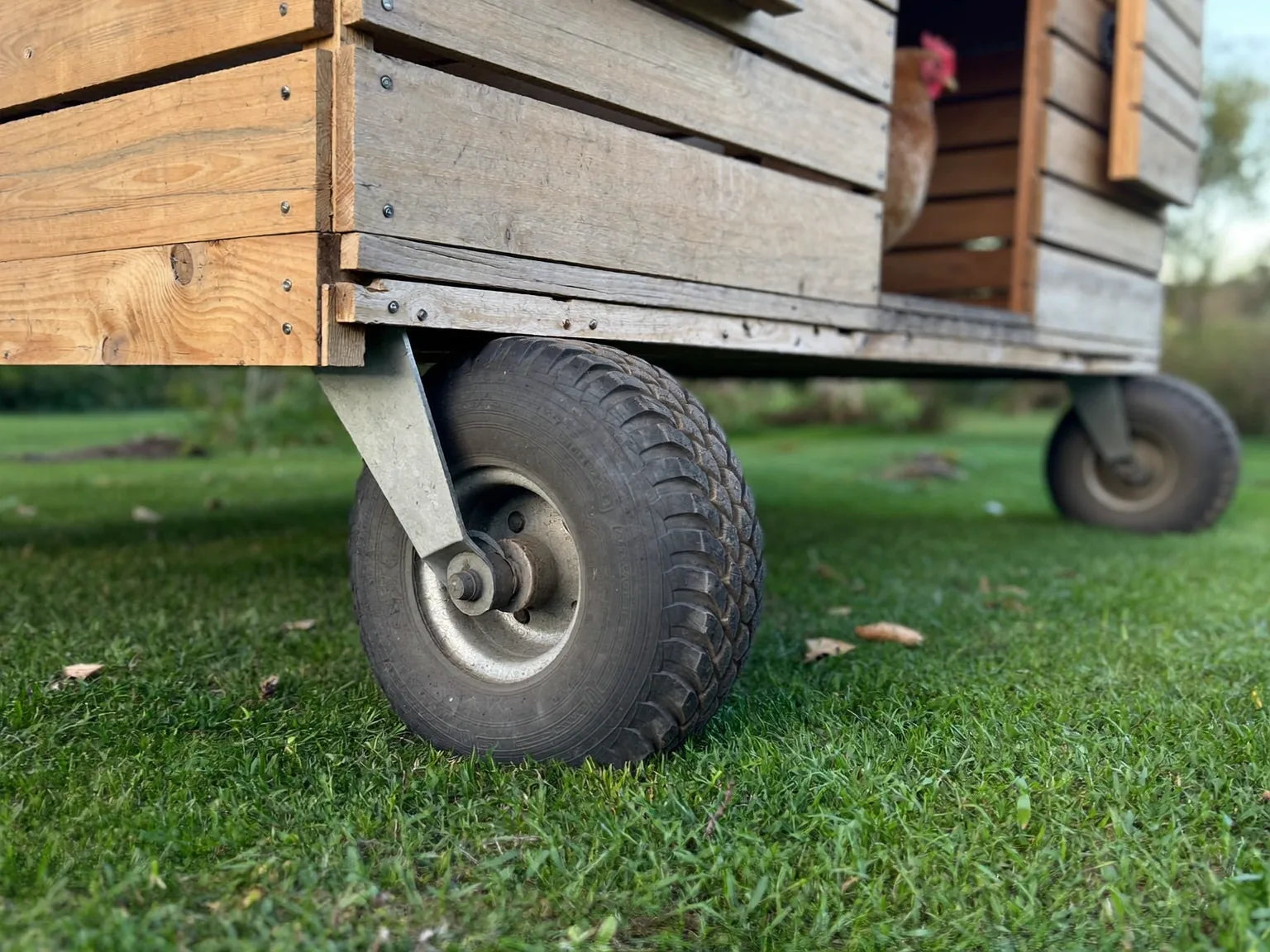
Chicken coops on wheels are solid-floored coops you roll to fresh ground instead of carrying them. The wheels are the part the spec tables say least about, and diameter is the field that decides where one will actually roll. The rule that makes one usable: a wheel turns on an axle half its own height off the ground, so a stated 3.9-inch wheel rides on an axle 1.95 inches up, and a two-inch root stands exactly axle-high. Call that a lawn wheel — mown grass, a packed path, a gentle slope. So the question worth asking isn't whether a coop rolls. It's whether it rolls on your ground. Start with the coops built to move.
The wheel arithmetic here is one division you can redo in your own yard; the siting instructions come from Penn State and University of Minnesota extension publications, linked at the foot.
What counts as a chicken coop on wheels?
A chicken coop on wheels is a coop with a solid floor and wheels fitted at one end or one side. The floor is what separates it from a chicken tractor; the wheels are what separate it from a coop you carry.
Floor construction is the definitional half, and it decides your whole cleaning routine rather than your moving routine — we took that apart in what a chicken tractor is. The wheels are the half that gets far less scrutiny — odd, because they're the part you interact with every time.
Rolling and carrying fail in different ways. A carried coop is limited by what your back can hold; a wheeled coop is limited by what its smallest wheel can climb. The technique itself — cadence, surface, whether one person is enough — belongs to how to move a chicken coop, and the wider trade against a fixed building is in mobile versus walk-in coops.
One consequence follows from the definition and is worth naming early. Wheels commit the design to a solid floor, and a solid floor commits you to a tray: with a panel under the roost the ground never gets to do that part of the cleaning, so the tray inherits it. Read the floor line before you read anything about the wheels, because it sets where your cleaning happens for the life of the coop — then shortlist on that basis from the coops built to move.
The wheel words, translated
Wheel descriptions come in three registers, and they are not equally useful: a measurement, a count, or an adjective. A measurement you can act on. A count tells you how the load travels. An adjective — "built-in", "heavy-duty", "large" — is a word about wheels, not a wheel specification.
A measurement, written as something like "2 × 3.9″", is the register that answers the question you actually have. Two numbers: how the load travels, and a diameter that halves into the obstacle height the coop can climb.
"4 universal (swivel) wheels" commits the manufacturer to a behaviour rather than a size. Universal means they steer. Useful on a patio, unhelpful on turf, and silent on diameter.
"2 metal" and "large aluminum wheels" give you the material. Material tells you something real about rust and wear, and nothing at all about what the wheel climbs. "Large" is a comparison with nothing on the other side of it.
"Built-in wheels fitted" and "integrated heavy-duty wheels" describe attachment, not specification. Both mean the wheels arrive on the coop instead of in a separate box, which is worth knowing and isn't what you asked.
"Fitted to one side" is a positional statement, and position changes how a coop behaves more than most buyers expect — wheels down one side make the coop pivot around the other rather than tow in a line.
An adjective is not a lie. It is a gap, and the gap is fillable: the number exists on the drawing the wheel was ordered from, it just isn't in the ad. Send us the listing you are weighing up and we will ask for the measurement behind the adjective — `sales@moveablechickencoop.com`.

What does wheel diameter actually decide?
Diameter decides what a wheel climbs and what stops it. A 3.9-inch wheel turns on an axle 1.95 inches above the ground, so a two-inch root, rut or frost heave is an obstacle as tall as the axle that has to ride over it.
Halving a stated diameter is arithmetic anyone can do, and it is the whole argument for reading the field. Anything shorter than that axle — mown grass, a packed path, a gentle slope — is comfortable going. Anything standing near 1.95 inches — long grass laid flat, gravel, molehills, the lip where lawn meets a paving slab — is a climb. Run the same division on whatever diameter a listing hands you, and a number you cannot picture becomes a height you can stand in the garden and look at.
Soft ground is where a small wheel runs out of road first. A narrow wheel carries the load on very little contact area, so wet turf gives way under it while a wider, taller wheel would ride across. Penn State Extension's siting advice happens to point at the same ground for a different reason: "Build the coop on high, well-drained areas." The service explains why in the next line — "This prevents prolonged dampness and water saturation of the floor of the coop and outside runs." Dry, high ground is kinder to the hens and kinder to a small wheel, which is a rare case of two problems having one answer.
Two more fields would settle the ground question outright: a terrain rating, and whether one adult can move it alone. Treat both as things to ask for rather than things to look for. Tell us the coop and the roughest stretch of your route and we will put those questions to the manufacturer before you order — start that message from the coops built to move.
Sold on wheels? Take 10% off the coop under them. GET MY 10% CODE
Do four wheels beat two on a chicken coop with wheels?
Four wheels is a different machine, not an upgrade. Two at one end make a lever: you lift the far end and tow. Four carry all of the weight, all the time — easier on paving, harder on turf.
Swivel is the sharpest example. Where a listing says "4 universal (swivel) wheels", universal means each wheel steers. On a hard floor that is a genuine convenience. On grass it is the opposite of one — you want the coop to hold a line, and a wheel built to steer has no opinion about lines. The failure has a shape you will recognise the first time: the coop crabs sideways into the fence while you push it straight.
"4 heavy-duty" is a load word rather than a size word. Heavy-duty says the wheel is built to carry; it does not say how far off the ground the axle sits.
Here is the part that runs opposite to intuition. With four wheels down permanently, diameter matters more, not less, because your arms are carrying none of the weight and the wheels are carrying all of it — every obstacle has to be climbed rather than lifted over. So when the ground is rough and a listing quotes four wheels and no diameter, buy for weight instead and start with the lighter portable coops. If you are drawing your own frame rather than buying one, the fields a plan should state are in our chicken tractor plans guide.
Will a coop's wheels work on your ground?
It is the one wheel question with a decision at the end of it, and your own yard answers it faster than any spec table can. Walk the path you would push or tow the coop along, stop at the roughest stretch on it, and match that stretch to a row below.
| The roughest stretch of your route | What the wheels are being asked to do | What that settles about the purchase |
|---|---|---|
| Mown grass, close to level | Roll, and nothing else | Wheels are not the spec deciding this purchase. Choose on covered floor area and henhouse layout instead — a fitted wheel of any size copes with a lawn |
| Paving, a packed path or a gravel drive | Roll, and clear a lip at every joint | Where four wheels pay for themselves, and where swivel stops being a nuisance and starts being a convenience |
| Rutted turf, surface roots, molehills | Climb something as tall as the axle | Diameter settles it and nothing else does. Get the figure before you order — ask, and we will chase it |
| A step, kerb or raised gate lip on the route | Be carried over, not rolled over | Weight is your spec, not wheels. The lighter portable coops are the answer however good the wheels look |
The third row is where the arithmetic pays. Halve the stated diameter, then go and measure the tallest root or rut on the path: if the ground wins, the coop stops there on every single move, and no quantity of "heavy-duty" alters it. Two numbers settle what a page of adjectives cannot.
A count and a diameter are not the same kind of fact, which is the whole reason one of them is harder to find. A count is something anyone writing a description can see by looking at the coop; a diameter belongs to the engineering paperwork the part was bought against, one department further back. So where a listing hands you the first and not the second, nobody is withholding anything — the number simply never made the trip into the advert. Which is why asking works.
So ask. Send us the coop you are looking at and a sentence describing the roughest stretch of your route, and we will get the diameter, the wheel material and the wheel position before you order — `sales@moveablechickencoop.com`. The shortlist lives at coops built to move.
When handles beat wheels
Handles beat wheels whenever the ground is worse than the wheel. Gravel, a rutted paddock, a step at the gate — by the axle arithmetic above, all three are trouble for a small wheel, and two people lifting are quicker than one person fighting a wheel that will not climb.
A stated handle tells you the manufacturer expects hands on the coop rather than just a push, and the wording is informative. "Long tow handle" means you walk in front and pull. "Side handles" and "one handle" imply a lift, which is a two-person job on anything but the smallest coop. "Handles fitted" printed alongside a wheel spec means the design assumes both.
University of Minnesota Extension's trigger for moveable housing is condition-based rather than scheduled: "Simply move the location of the house when manure begins to build up." Read that as a hardware requirement. The wheel has to work on the day the ground says move — which, in most yards, is a day or two after rain, on the softest ground of the month.
Here is our stance. If the only level ground you own is gravel, paving or hard-packed dirt with a lip at every edge, buy for weight rather than for wheels and start with the lighter portable coops. If your lawn is mown and roughly flat, a small wheel is genuinely fine and the whole debate is academic — in which case go straight to the coops built to move.
What the wheels don't decide
Wheels are one field of several, and three more decide how a coop on wheels behaves once it has stopped rolling. Take them in the order they bite.
Weather. A coop that moves gets parked in whatever the weather is doing, so pitch, overhang and covering matter more than they would on a coop that lives in the lee of a shed — the specs worth checking are in what a coop roof has to do.
Hardware. A coop that moves cannot rely on buried wire, because nothing under it stays buried, so latches, mesh and the base rail carry the whole job. The fittings are covered in how predator-resistant a coop really is.
Assembled footprint. The outline you have to steer through a gate is the run outline, not the henhouse. Measure your narrowest gate before you shortlist anything, and size the flock against the covered area with our coop size guide.
None of the three changes the wheel arithmetic; all three change which coop you end up wanting. Work through them with the coops built to move open in the next tab.
What to ask before you order a coop on wheels
Three questions, one message: what diameter are the wheels, what are they made of, and where on the frame do they sit? Ask us about any coop you are considering and we will put all three to the manufacturer. Most people don't need to wait for the answer — if your ground is mown and roughly flat, a small wheel is genuinely fine and the coops built to move are ready to order today.
Diameter, in inches. It is the single field that predicts whether the coop rolls on your ground. Ask for the number rather than for a reassurance: a number halves into an obstacle height you can go and measure, and a reassurance doesn't.
Material. Solid rubber, hard plastic and pneumatic wheels behave differently on wet grass and age differently outdoors. A material answer also tells you whether the wheel can be swapped later, which matters if your yard is rougher than your lawn suggests.
Where they sit. Wheels at one end mean lift-and-tow. Wheels at four corners mean push. One side means the coop pivots around the other. Any of the three can be right; not knowing which you bought is what leaves a coop parked.
So pick the ground first, then the coop. The reasons to move a coop at all hold whichever one you pick. Mown and roughly flat: any of the coops built to move will do the job, and the wheel debate is academic. Rough, gravelled or stepped: buy for weight instead and start with the lighter portable coops you can lift rather than roll.
Sources: Penn State Extension, "Small Scale Poultry Housing" (Gregory P. Martin and Phillip Clauer) — accessed August 11, 2026 · University of Minnesota Extension, "Raising chickens for eggs" — accessed August 11, 2026. Wheel, handle and clearance strings quoted above are phrasings observed on published backyard-coop listings, including a 3.9-inch wheel diameter and a 7.5-inch height to the floor stated by PawHut on wooden mobile coops — accessed August 11, 2026.
Frequently asked questions
How to build a mobile chicken coop?
Decide the floor before you cut anything. A solid floor with a droppings tray makes a coop on wheels; an open base makes a chicken tractor, and the two clean differently. Next comes weight, because a mobile coop you can't shift is a shed. Leave the wheel mounting until the frame is loaded, since a bare frame balances nothing like a finished one. The fields a plan must state are in our chicken tractor plans guide.
How to build a chicken coop on wheels?
Build the coop first, then buy the wheels for your worst ground rather than your best. A coop on wheels has a solid floor, so plan the droppings tray into the frame from the start — the tray is where the cleaning moves to once the birds stop standing on grass. Size the wheel by the tallest thing it has to climb in your yard, then check the lowest frame rail clears that too.
How to make a movable chicken coop?
Movable doesn't have to mean wheeled. Skids, handles or a two-person lift move a light coop perfectly well, and a coop light enough to lift needs no axle at all. Start from the weight one person can manage, then let the ground decide: wheels on smooth, firm going; skids or handles where it's rough, graveled or stepped. Weigh the finished build before you call it movable.