

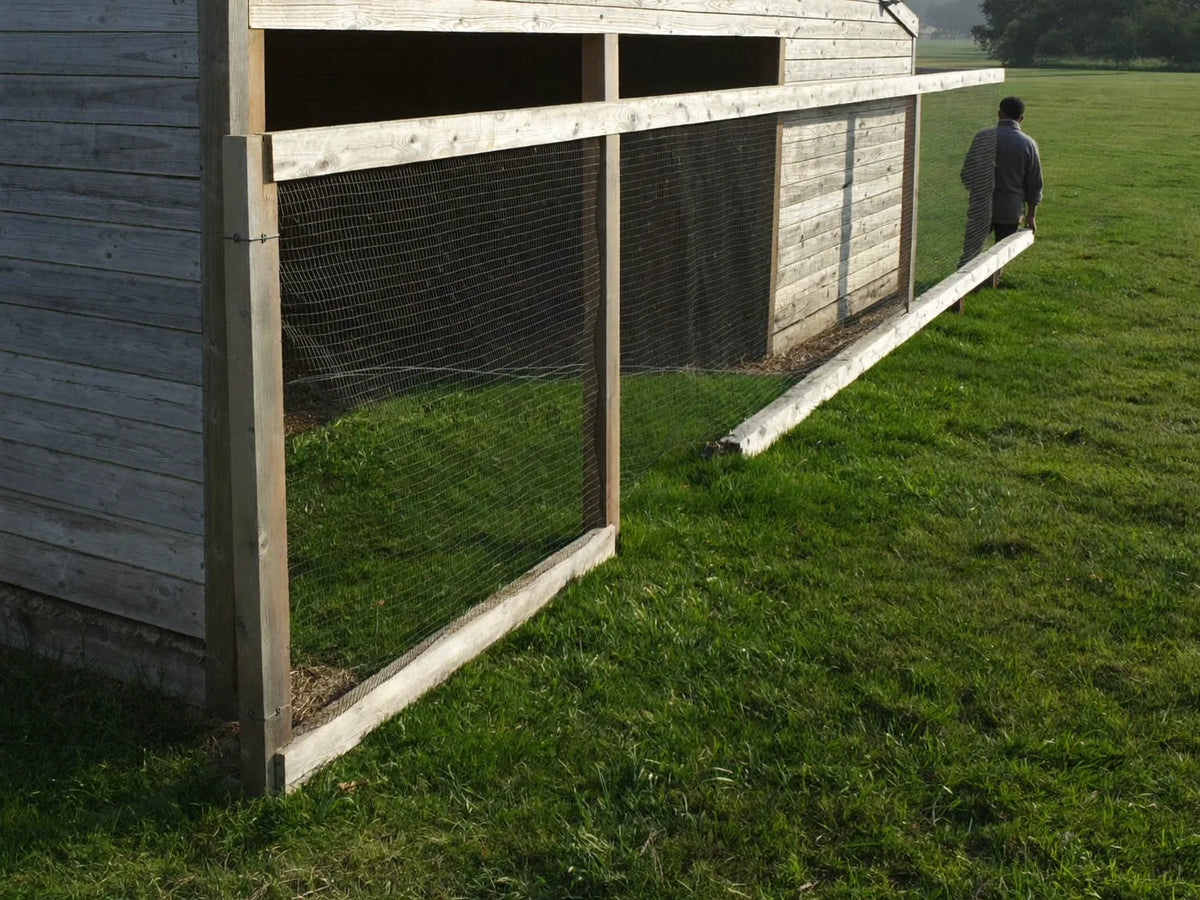
Six specifications decide what a chicken coop costs, and only four of them appear on the listing. They are how much material the coop encloses, what that material is and how thick, the wire, the moving and access hardware, whether a run comes attached, and how much of the build is left to you. What a coop costs does not travel — prices move and catalogues change — but the drivers do, so this guide prices those instead, with dated third-party figures you can recheck. Test it against the coops we sell and against anything else you are looking at.
Every dollar figure on this page belongs to somebody else and carries their name and the week they published it, so you can re-read the index rather than trust a total. The six cost drivers, and the board-foot arithmetic laid over the lumber composite, are ours.
What actually decides what a chicken coop costs?
Six things, and they pull in different directions. A coop's price tracks the material it encloses, the thickness of that material, the wire, the hardware that lets it move and open, whether a run is attached, and how far along the parts arrive.
Everything else on a listing is downstream of those six, including the hen rating, which is the figure a listing puts furthest forward.
| Cost driver | Why it moves the number |
|---|---|
| Enclosed material area | You buy the skin, not the floor. The material bill is walls, roof and mesh, and those do not track floor area one for one — the same footprint with taller walls or a second storey is more material and no more ground. |
| Panel material and thickness | Twice the thickness is twice the timber in the same wall, and it changes nothing else on the listing — not the footprint, not the hen rating, not the photograph. |
| Wire aperture and gauge | Halving the mesh aperture roughly doubles the length of wire in the same panel, and a thicker wire is more metal in every foot of it. |
| Moving and access hardware | Wheels, axles, handles, ramps, pull-out trays, hinged nest lids and latches are parts. Every one is bought, packed and fitted. |
| Whether a run is attached | The run is usually the largest single area on the object, and it is mesh and frame over all of it. Both are bought by the foot. |
| How much build is left to you | Pre-drilling, labelling, painting and bolt-together fittings are work done before the coop reaches you, or work you do on a Saturday. |
Hen capacity is the number a title leads with and the one that carries least. Penn State Extension's Table 1 gives a laying hen 1.5 sq ft inside, and Virginia Cooperative Extension's gives 3 to 4. Virginia's own page says why the two can sit that far apart: "There is very little research on space requirements for small-scale poultry housing." Published figures that far apart — two to nearly three times, depending which end of Virginia's range you take — mean a hen rating is not a unit of size, so it cannot be a unit of price either. Our coop size guide tables the published figures and shows how far a stated capacity usually is from the arithmetic.
The number in the title is a length, not a size
The number a coop listing leads with is a length in inches, and it is the least comparable figure on the page. A pair of coops can sit within an inch of each other on stated length and differ by more than double in enclosed area.
Here is that case, in manufacturers' own published numbers. One wooden mobile coop with a run states an overall length of 96.5 inches, then states its enclosed upper storey separately at 28.25 by 31 inches, which it converts to 6.1 sq ft. A portable coop with a run states 95.3 inches long and gives its raised storey as 13.2 sq ft. An inch and a bit apart on the number in the title; a little over twice the enclosed floor on one as on the other.
The labels are part of the problem. One maker calls that storey a "living area" and the other calls it a "second level", and neither phrase is a standard. Where both a length and a width are stated you can at least multiply them yourself and get a footprint; where only a length is published, the figure in the title is doing no work at all.
Cost follows the enclosed area much more closely than the length, because the enclosed area is where the walls, roof and hardware are. When two listings look close on the headline number and far apart on price, read the per-level figures before you conclude anything.
How much of the price is the run?
More than the photograph suggests. A run is mesh, frame and often a cover over the largest area of the whole object, and where a manufacturer dimensions the run separately, the split is plain in its own figures.
Some listings dimension the run as a box of its own, and that is where the split becomes plain. The same wooden mobile coop above states an outdoor run 54 inches long, against a stated overall length of 96.5 inches. More than half the length you are paying for is run rather than hen house. That is not a fault. It is what you want if the flock spends its day outside, and it is why the pair in the section above are not one product with different numbers on it.
A run also changes what the coop is for. Coops that arrive with a run attached give a stationary flock somewhere to be; a coop with no run assumes you will build or buy the outdoor half separately, which moves the money rather than removing it. Our outdoor run guide works through the area side of that same listing and what the published per-bird run figures do to it. If the birds will be out all day, start from the coops built to move and put the money into the run rather than the shell.
Worked out which cost drivers you are actually paying for? Take 10% off whichever coop carries them. TAKE 10% OFF
Cost to build a chicken coop: the one input you can price exactly
Softwood framing is a commodity with a published weekly price, so timber is the one part of the cost to build a chicken coop anyone can price exactly. On 14 August 2026 the framing lumber composite stood at just over $536 per 1,000 board feet.
The NAHB publishes that composite and credits the figure to Madison's Lumber Price Index, on a page dated 17 August 2026. Anybody can go and read this week's number, which is the point of quoting an index instead of a total.
An index price only becomes useful once you know what a board foot is. Ohio State University Extension's fact sheet on measuring standing trees gives both the definition and the formula. "In the United States, the most common measure of lumber volume is the board foot, defined as a piece of wood containing 144 cubic inches." Then the working: "The board-foot content of any board may be determined by multiplying the length by the width by the thickness, all expressed in inches, and dividing by 144 cubic inches."
Divide that index by a thousand and you get about 54 cents a board foot. Then the awkward part, and it is the reason a price per board foot is not a price per stick: the answer for one stick depends on whether you measure it by the name on the label or by the wood in your hand.
| Which measure | Board feet in an 8-ft 2x4 | Commodity wood in one stick |
|---|---|---|
| Nominal — 2 in by 4 in by 96 in | 2 x 4 x 96 / 144 = 5.33 | a little under three dollars |
| Dressed dry — 1.5 in by 3.5 in by 96 in | 1.5 x 3.5 x 96 / 144 = 3.5 | a little under two dollars |
The dressed sizes in that table are not our invention: the USDA Forest Products Laboratory's Wood Handbook tables them as American Standard Lumber sizes, where a nominal 2 finishes at 1½ in and a nominal 4 at 3½ in dry. The same chapter, in its purchasing notes, tells you why the gap matters before you multiply anything: "Consider that the board measure depends on the thickness and width nomenclature used and that the interpretation of these must be clearly delineated. In other words, such features as nominal or actual dimensions and pattern size must be considered." Nominal measure is about half as much again as dressed measure for the same stick, so a price per board foot means nothing until somebody says which one it is quoted on. Neither the index nor the handbook states that for you, and we are not going to guess it — take the range as the honest answer.
Now the conclusion worth carrying into a listing. On that same 14 August 2026 reading the composite was "Unchanged year over year". A commodity that has not moved across a year cannot explain why one coop costs several times another. The gap between two coops is a specification gap — thickness, wire, hardware, run, assembly — and not a lumber gap. Pricing the timber is one input, not a verdict on whether to build. For the whole cost to build a chicken coop, our DIY coop guide sets out the seven line items and explains why it deliberately prints no total; the mobile-build post uses the same handbook to work out what a frame weighs.
How much is a chicken coop, and what makes one cheaper?
Ask how much a chicken coop is and the answer is a specification list, not a figure. Cost comes out of a coop in a predictable order: the run goes first, then the moving hardware, then the finish, then the thickness of whatever is left.
The first three are visible on the page before you pay. The fourth is the one to plan around: a panel, board or sheet thickness is a figure you should expect to ask for rather than read. The closest a listing usually comes is calling a steel coop "thickened", which is an adjective with no number behind it; our cold-climate guide takes apart what that leaves a buyer with. Treat the wire the same way — ask for the gauge and the mesh aperture by name, and the pest-control guide sets out what those two numbers tell you once you have them.
Both are askable. A thickness and a gauge are exactly the kind of thing a maker will answer for one specific coop, even when the page does not carry them — so send the listing across, say which of the two would decide it for you, and that figure is ours to fetch before you order.
None of that makes a cheaper coop a bad coop. It makes it a coop with a shorter specification, and a short specification is the right buy for a small flock on a sheltered site. Our guide to the budget end of the market works through what you give up at each step down, which is a different question from what sets the number in the first place.
Flat-pack, kit or built: what you are actually paying for
Coops in this category arrive as parts, so the real question is how far along the parts are. Pre-drilled labelled panels, a bolt-together steel frame and a sack of loose fittings are three different amounts of your Saturday.
A listing usually tells you which of the three you are getting, and none of the three arrives built. Where a build time is stated at all it can be unusually specific — one wooden coop with a run gives "two adults, approx. 40 minutes" and says the panels are pre-drilled. Everywhere else the honest instruction is to assume assembly and plan for two people, which is the safe default across the flat-pack coops.
A coop built to your own dimensions by a local carpenter sits in a different world, and it is priced in hours rather than in materials. That is why a one-off build and a flat-pack of the same size are not comparable purchases: one of them is buying somebody's week. The timber in both is the same commodity at the same published price.
Assembly is the one driver where the cost does not disappear when the number goes down. It moves onto you. Budget the afternoon, read the used-coop inspection guide if you are weighing a second-hand one against a new flat-pack, and treat "some assembly required" as a sentence that has told you nothing.
Which cost drivers can you check before you pay?
Four of the six, on most listings. The table below splits one driver in two, because a coop's material is always named and its thickness never is, and it gives you something to do about the two that go unpublished.
| Cost driver | Where the figure lives | What to do |
|---|---|---|
| Enclosed area | In the title as a length; in the spec table as a length and a width; sometimes broken out as a floor area level by level | Multiply the stated length by the stated width yourself, and read any per-level figure before the headline one |
| Run | In the title as a word. In the spec table as a box of its own only where a maker chose to dimension it | Ask for the run's own length and width — it is the largest area you are buying |
| Frame and cladding material | Named in the material row: fir, steel, iron, mesh, asphalt | Read it as a material, not a grade. "Fir" is a trade word covering several species |
| Moving and access hardware | Named as parts — wheels, trays, ramps, latches. The sizes sit on the drawing the part was ordered from | Ask for the wheel diameter and the tray dimensions if you plan to move it or clean it weekly |
| Panel thickness | An adjective at best — "thickened", "solid". It sits on the factory drawing rather than in the advert | Ask us; it goes to the maker before you order |
| Wire aperture and gauge | The mesh gets named; the two numbers that decide what it keeps out sit with the wire supplier | Ask us; both go to the maker before you order |
| Assembly | An assembly row, where there is one: pre-drilling, package contents, occasionally a build time | Assume assembly, assume two people, and plan the afternoon |

Assembled weight belongs on that list and is the field you are least likely to find on it. A weight tells you what the moving hardware is working against, which is the whole question if the coop is going to be shifted across a lawn every week. Name the coop and the figure gets fetched from its maker rather than estimated off a photograph — and the coops built to move are the place to start if that is the job.
Where we would spend more, and where we would not
We would spend on the run and on the hardware, and we would not spend on size for its own sake. Both of those are visible before you pay, which is the whole argument for putting your money there.
A run has the clearest link to how the birds actually live, and the moving and access hardware decides whether the coop is a weekly chore or a monthly one.
We would not pay a step up for a larger stated length without a stated width or a stated floor area behind it. That is the one place a coop's headline number can be generous with nothing underneath it, and the section above shows how far apart two coops of the same length can be. Getting this wrong is not catastrophic — it is a coop that fits three hens instead of the five you planned for, and you find that out when the flock grows into it rather than on the day it arrives.
The thing we would genuinely rather have than any of it is the panel thickness. Of everything on this page it is the figure we would most want before spending, and it is the one to ask for by name. Ask us for it on whichever coop is in front of you and the chase starts — and if the answer changes your mind, that is the answer doing its job. Start from the coops we sell, pick two, and send us the pair.
Start from the drivers rather than the number. Filter the coops we sell by whether a run is attached and by how far the moving hardware goes, then read the stated dimensions level by level rather than the length in the title. If the flock needs fresh ground more than it needs floor area, the coops built to move put the money into wheels and a handle instead of into square footage you have to mow around.
Sources: NAHB, “Framing Lumber Prices” (page published August 17, 2026; figures credited to Madison’s Lumber Price Index for the week ending August 14, 2026) · Ohio State University Extension, “Measuring Standing Trees”, fact sheet F-35 (Randall B. Heiligmann, written May 20, 2016; revised by Kathy Smith; page dated March 11, 2024) · USDA Forest Products Laboratory, “Wood Handbook”, FPL-GTR-282 (2021), Chapter 6 (C. Adam Senalik and Benjamin Farber) · Penn State Extension, “Small Scale Poultry Housing” (Gregory P. Martin and Phillip J. Clauer) · Virginia Cooperative Extension 2902-1092, “Small-scale Poultry Housing” (Phillip J. Clauer) — all five opened and read August 21, 2026. Penn State’s and Virginia’s housing pages share an author, so they are one literature published twice rather than two independent sources. The spec-table figures quoted in the body are each manufacturer’s own published wording, read from backyard-coop listings on August 21, 2026 — the 96.5″ overall length, 28.25″ × 31″ upper storey, 6.1 sq ft living area and 54″ outdoor run from a PawHut wooden mobile coop with run; the 95.3″ length and 13.2 sq ft raised storey from a portable coop with run; and the “two adults, approx. 40 minutes” build time from a 95″ wooden coop with run.
Frequently asked questions
How much does a durable wooden chicken coop cost?
Durability is bought as three specifications rather than as a price band: the species and thickness of the timber, the finish over it, and whether the frame is kept clear of wet ground. Check whether the listing gives a board thickness as well as a species. Where it names the species and stops there, thickness is the number to ask for — name the coop and that figure comes out of the manufacturer before you order.
How much does it cost to set up a chicken coop?
Setting up costs ground and hours rather than parts. You need a level, drained patch, two people for a flat-pack build, and any fittings you want to add while the panels are still open, such as extra perch length or a latch you prefer. Coops in this class arrive as parts rather than built, so budget the afternoon whichever one you pick.
How much does it cost to maintain a chicken coop?
Maintenance is bedding, a periodic strip-out and the occasional fastener, and two specifications decide how expensive it gets. How completely the coop opens comes first, because a coop you can reach into is cleaned in minutes rather than a morning. Where the timber meets the ground comes second, because that is the joint you want to be able to see and get a brush to.