

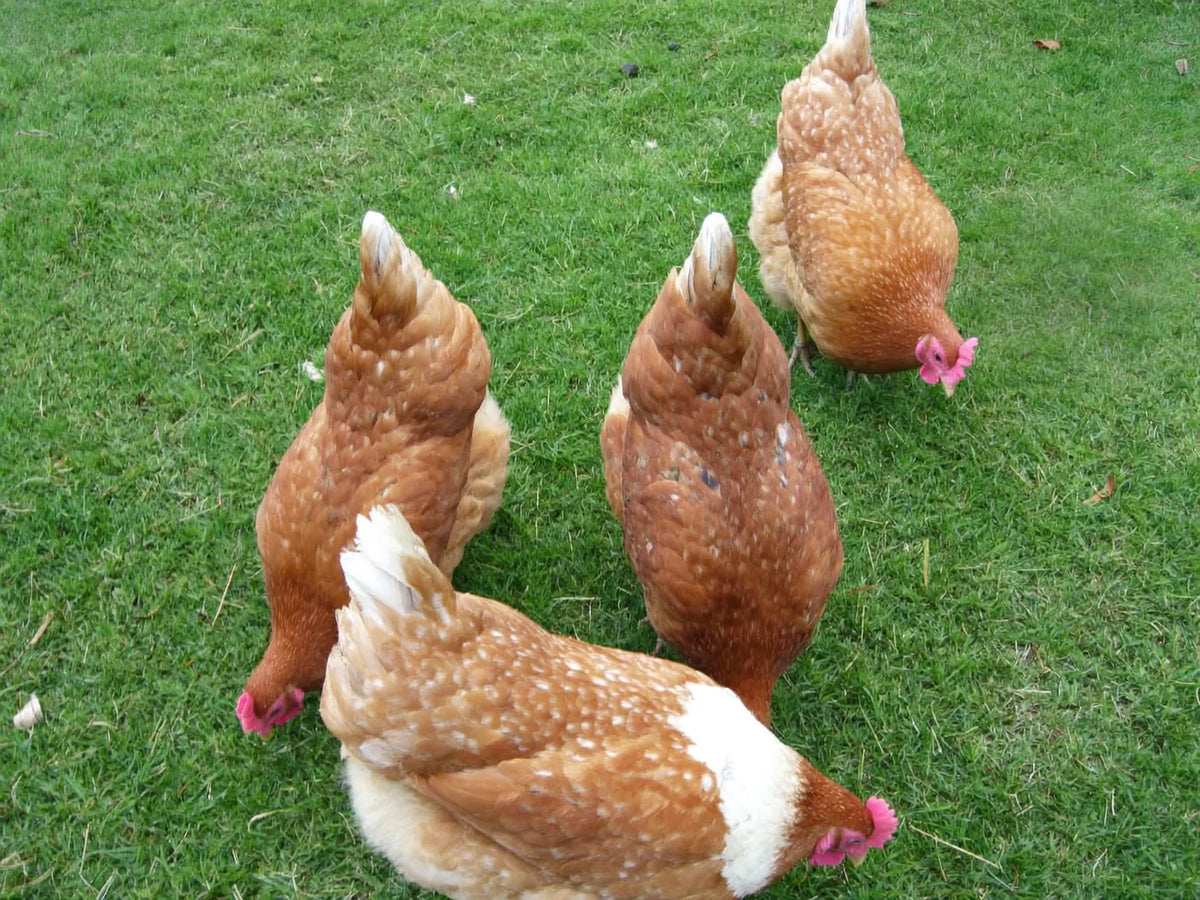
How many eggs does a chicken lay per year? About 200 to 240, or 17 to 20 dozen, is what UF/IFAS Extension publishes for a small backyard flock — and every one of those eggs is paid for in feed, bedding, water and, if you light the coop through winter, a little electricity. The quantities behind those lines are published and they hold. The prices are not, so every price here carries the day it was true and the publisher who set it. If the housing is still to buy, start with the coops we sell; this page is everything that comes after it.
Quantities and prices are kept apart on this page on purpose. Pounds of feed, cubic feet of shavings and kilowatt-hours come from named extension services; every dollar figure belongs to a named publisher and carries the month it was true, so you can re-price the year yourself rather than trust a total.
How many eggs does a chicken lay per year?
Between 200 and 240 eggs a hen a year — 17 to 20 dozen — on UF/IFAS Extension's published figure for a small backyard flock. Plan on the annual number rather than on a good week, because the annual number already counts the weeks a hen lays nothing.
UNH Extension arrives near the same place by a different route: "each hen should produce 20 dozen eggs or more" across 13 months of production. Two services, two framings, one usable planning figure.
The weeks with no eggs in them are not a failure. UNH describes what happens without a winter light: "by October 31st the days will be short enough to cause the flock to stop laying eggs and lose their feathers. In about 6 weeks a much-needed new set will have grown." Six weeks of moult, plus the short days either side of it, is most of the gap between a good week and a yearly total.
Year two is where a cost page has to be blunt. UNH puts the fresh rate at "about nine eggs per day" for ten hens, then says the same flock "will ease off to six to seven eggs per day after 13 months of production." That is roughly a fifth to a third fewer eggs a day — our subtraction, not UNH's — with the feed bill unchanged. Breed moves the number as well, in both directions; that side of it belongs to our guide to backyard chicken breeds, and how many birds you need is worked through in how many chickens to start with.
The cost of chickens, line by line
The cost of chickens, once the coop is bought, is four recurring lines and one slow one: feed, bedding, water, winter electricity, and replacing the hen. Feed dominates. UF/IFAS states the split outright — "An estimated 70% of the cost of raising chickens can be attributed to feed."
Here is the year as a bill of quantities rather than a bill of money. The quantities come from named services. The prices sit in the last column with their dates attached, because those are the half that decays.
| What recurs | How much, per hen, per year | Where the quantity is published | What it cost, and when |
|---|---|---|---|
| Layer feed | 90–100 lb across 13 months of laying, or 156 lb if you take the weekly feeding rate straight across 52 weeks | UNH Extension; Alabama Extension; UMN Extension | 26 cents a pound in Penn State's sample layer budget, page updated July 6, 2023 |
| Bedding | 18–24 cu ft, at 3 sq ft of floor a bird, 6 to 8 inches deep, changed monthly | UNH Extension, then our arithmetic | No national published price. Count the volume, then price your own bale |
| Water | About 23 gallons | Alabama Extension, then our arithmetic | Mains water — too small and too local to be worth a figure |
| Winter light | Up to 85 kilowatt-hours, and that is for the whole coop rather than for each bird | UNH Extension, then our arithmetic | 18.44 cents a kilowatt-hour, the EIA figure for May 2026 |
| The hen herself | One replacement every year or two, if you want the first-year egg rate back | UNH Extension | Local, and nobody publishes a national figure |
Our position, and it is why this page looks different from the rest of the results: the pounds and the gallons are the durable half of a cost answer, and the money is the half that rots. A dozen large eggs on the shelf fell by more than a third in twelve months on the government's own series. A single number for the cost of a hen is a number that will be wrong by spring.
How much does a chicken cost to keep for a year?
Feed is the answer to how much does a chicken cost to run, and three of the extension services we opened publish a rate for it. Two land within a pound of each other. The third lands at nearly twice that, and knowing which is which is worth more than any single figure.
Alabama Cooperative Extension states it per day: "if laying hens consume 0.25 pounds of feed per day, they will consume 0.5 pounds of water per day." Across 365 days that is 91 pounds a hen — our multiplication, not Alabama's. UNH Extension states it per hen per production cycle: "each hen should produce 20 dozen eggs or more and eat 90-100 pounds of feed during the same time." Different states, different authors, different units, and the same answer. We checked the bylines before saying so: Alabama's page is Wilmer Pacheco, Joseph Gulizia and Kevin Downs; UNH's is Kendall Kunelius. No name appears twice and neither page cites the other.
University of Minnesota Extension states it per week instead: "A 6-pound hen will eat roughly 3 pounds of feed each week." Multiplied across 52 weeks that is 156 pounds, about 70 per cent more than those two annual figures. Our reading, offered as a reading rather than a finding: the unit is not what separates them. Read the three sentences again and only one of them names a bird — Minnesota's is stated for a six-pound hen, and neither of the others says what size of bird it is describing. UNH qualifies a second figure on the same page in the same way, giving a daily volume and then making it depend on the size of the hen. A rate with a bird attached to it and a rate without one are not the same kind of number, which is the reason to carry both ends rather than average them. Minnesota's sentence does a different job in our accessories guide, where it sizes a sack and a storage bin.
Now the money, dated. Penn State Extension's sample budget for a 50-hen brown-egg flock prices layer feed at 26 cents a pound, on a page updated July 6, 2023. At that rate, 90 pounds of feed is about $23 a hen for the year and 100 pounds is about $26, in 2023 money. Feed at the Minnesota rate instead — 156 pounds — comes to about $41 at that same 2023 price.
One honesty note on that budget, because it matters to anyone who opens it. We use Penn State's price and not its quantity. The same 50-hen worksheet books 652 pounds of layer feed against 1,083 dozen eggs, which is about 13 pounds of feed a bird for nearly 22 dozen eggs a bird — and no published feed rate gets 22 dozen eggs out of 13 pounds. The 100-hen version repeats the ratio. A price per pound is a market figure and stands on its own; that quantity is not one we would hand a reader.
Feed has moved since 2023, and it will move again. Take the price off the sack in your own shed, multiply it by 90 to 156 pounds, and the number is yours rather than ours. That is the whole reason the working is on the page.
Now you know what a hen eats in a year, the coop is the only line you pay once. Take 10% off it. GET MY 10% CODE
Sq ft per chicken is a bedding bill, not a one-off
Sq ft per chicken reads like a one-time decision made at the checkout, and it is not. UNH Extension puts the floor at "at least three square feet of floor space per bird," and every one of those square feet gets bedded, stripped and re-bedded for as long as you keep hens.
The published space figures differ by service, and the full per-hen comparison lives in our coop size guide, with the cross-catalogue version in the capacity study. The figure this page needs is the one that turns into volume. UNH also sets the depth — "Fresh wood shavings or sawdust six to eight inches deep" — and the cadence: "If managed properly, cleaning out and changing the litter only needs to happen monthly or as needed."
Put those three together and one hen's three square feet is 1.5 to 2 cubic feet of shavings per change, which makes 18 to 24 cubic feet a hen a year. That multiplication is ours. The per-change grid by floor area is already published in our bedding and flooring guide; what is new here is the annual column, and the fact that it scales with the coop rather than with the flock.
Which is why the hen-house floor area is a recurring cost you can read off a listing before you buy. Find the stated area in the left-hand column and read your bedding bill straight across.
| Hen-house floor a listing states | Bedding per change at 6 to 8 inches | A year of monthly changes |
|---|---|---|
| 4 sq ft | 2.0–2.7 cu ft | 24–32 cu ft |
| 6 sq ft | 3.0–4.0 cu ft | 36–48 cu ft |
| 8 sq ft | 4.0–5.3 cu ft | 48–64 cu ft |
| 10 sq ft | 5.0–6.7 cu ft | 60–80 cu ft |
| 13 sq ft | 6.5–8.7 cu ft | 78–104 cu ft |
| 16 sq ft | 8.0–10.7 cu ft | 96–128 cu ft |
Two things that table is not saying. Run area is ground rather than litter, so it stays out of the column entirely — a page offering 34 square feet of "total space" over a 13 square foot raised house is billing you for the 13. And more space a bird is better for the birds and worse for this line: the two goods pull against each other, so a listing that hands you a generous house is also handing you a bigger bedding bill. That is a trade to make on purpose rather than a rule to follow.

The one arrangement that changes the arithmetic is a floor that opens onto grass. A coop you move has no litter bed under the run at all, because the run floor is the yard and you shift it onto a fresh patch instead of stripping it. That is the honest case for coops built to move on a page about running costs — not that they are cheaper to buy, but that one recurring line gets smaller. Where a listing does not state its hen-house area — the one figure this whole bedding line is computed from — send it across and we will have its maker put a number on the house itself.
What does a coop light cost to run over a winter?
It is the cheapest line on this page by a wide margin. UNH Extension specifies both the fitting and the season: "at least 14 hours of total light daily from September 1 to May 1 with a 25-watt electric light bulb." That window is 242 days, and it is the only line here that can be priced exactly.
The arithmetic, so it can be redone at your own rate. Watts times hours divided by 1,000 gives kilowatt-hours: 25 watts for 14 hours is 0.35 kilowatt-hours a day, and 242 days of that is 84.7 kilowatt-hours. The EIA put the US residential electricity rate at 18.44 cents a kilowatt-hour for May 2026, which makes the whole eight-month window about $16 — for the coop, not for each bird.
Read that as a ceiling rather than an estimate, because the direction matters. A winter light tops daylight up to 14 hours; it does not replace daylight. On a September evening the bulb runs an hour or two, not fourteen, so the real figure sits well below the one above and can never sit above it.
Heat is the line that would change the picture, and it is a separate decision with a separate answer. What a panel or a lamp actually draws is worked through in our coop heater guide, and the winter water problem — usually the bigger draw of the two — in the coop water heater guide. Water itself barely registers: Alabama Extension's rate of "a gallon of water each day" for roughly 16 laying hens works out at about 23 gallons a hen a year, which is a rounding error on a municipal bill.
Backyard eggs against store eggs: do the hens pay for themselves?
No, backyard eggs do not reliably save you money, and the arithmetic is close enough that it is worth doing rather than asserting. Which of the published feed rates you believe is what decides the answer.
Take the converged rate first. Ninety pounds of feed against 17 to 20 dozen eggs is 4.5 to 5.3 pounds of feed a dozen, or 117 to 138 cents at Penn State's 2023 price. Note which end goes with which: the cheapest dozen pairs with the most eggs, because feed per dozen falls as output rises. Take the Minnesota feeding rate instead, at 156 pounds, and the same dozen carries 7.8 to 9.2 pounds of feed, or 203 to 239 cents at that same 2023 price.
Now the shelf. The Bureau of Labor Statistics priced a dozen large Grade A eggs, US city average, at 219 cents in July 2026. In July 2025 the same series read 360 cents. So the feed in a backyard dozen might be half the shelf price or a little more — and the shelf price itself moved by more than a third inside a year.
Feed is also not the whole bill. It is roughly 70 per cent of it on UF/IFAS's own split, which leaves bedding, water, power, the coop and the bird. UNH is specific about the part the per-dozen figures leave out: "you need to plan on a five-month growing period before you see any eggs." Five months of feed with nothing coming back sits in none of those figures, and it lands in year one, the year people run this arithmetic.
Keep hens for eggs you can date, for the birds, for the manure, for the kids. Those are real reasons and they need no spreadsheet to defend them. Keeping hens to beat 219 cents a dozen is a bet you will probably lose, and we would rather say so here than let you discover it after a year of feed bills.
What would we budget for, and what would we skip?
Budget for feed and bedding as the two lines that never stop, and treat the rest as noise. On the figures above, one hen is roughly 90 to 156 pounds of feed and 18 to 24 cubic feet of shavings a year. Nothing else here comes close to either.
What we would skip first: pricing the coop as though it belonged in the annual bill. It does not — it is the one thing here you buy once, and it is the only line where paying more can shrink a recurring cost for years afterwards. What a coop costs to buy, and what a budget gives up, is answered in our guide to the cheapest coops.
What we would skip second: heating the coop by default. The light above is cheap, heat is not, and the case for heating at all is the weakest argument on this page.
So the sequence that costs least over five years is dull, and it works. Settle the flock number, read the hen-house floor area off the listing before you order, and choose the coop whose floor you can strip in ten minutes. Run that test across the coops we carry; the flat-packed kits are the quickest place to hold a house area up against a hen rating. Give us the model and your flock number and we will come back with the figure the maker will actually stand behind — before the first bag of feed, not after.
Sources: UF/IFAS Extension, AN239 “Raising Backyard Chickens for Eggs” (original April 2010, revised November 2023) — accessed August 21, 2026 · University of New Hampshire Extension, “Producing Your Own Eggs” (Kendall Kunelius, no date shown) — accessed August 21, 2026 · University of Minnesota Extension, “Raising chickens for eggs” (Betsy Wieland and Nora Nolden; Sabrina Florentino, reviewed 2025) — accessed August 21, 2026 · Alabama Cooperative Extension System, “Feeding the Laying Hen” (Wilmer Pacheco, Joseph Gulizia and Kevin Downs, September 7, 2022) — accessed August 21, 2026 · Penn State Extension, “Enterprise Budgeting for Small Poultry Flocks” (Jodi Gauker and Russell Phenicie, updated July 6, 2023), with its interactive 50-hen brown-egg budget — accessed August 21, 2026 · US Energy Information Administration, Electric Power Monthly, Table 5.3 (May 2026 figure, released July 23, 2026) — accessed August 21, 2026 · US Bureau of Labor Statistics, CPI Average Price Data, series APU0000708111, “Eggs, grade A, large, per doz.” (US city average) — read from the BLS public API August 21, 2026
Frequently asked questions
How many square feet per chicken in a coop?
UNH Extension puts it at “at least three square feet of floor space per bird” inside the house, and the published figures differ between services rather than settling on one number. Our coop size guide sets them side by side with the run figures. Whichever you use, treat it as recurring rather than settled: every square foot of house floor gets bedded, stripped and bedded again roughly once a month.
How much pine shavings for chicken coop?
Multiply the hen-house floor area by the depth, then divide by 12 for cubic feet. UNH Extension calls for shavings six to eight inches deep, so three square feet of floor takes 1.5 to 2 cubic feet at each change, and a five-square-foot house takes 2.5 to 3.3. The full grid by floor area sits in our bedding and flooring guide.
How much does it cost to start a chicken coop?
Two bills, not one. The coop, the fencing, the feeder and the birds are bought once. Feed, bedding, water and winter power repeat every year, and this page prices the repeating half. Prices are the part of a cost answer that goes stale fastest, so every figure here is dated. For the buying half, our guide to the cheapest coops covers what a budget gets you.