

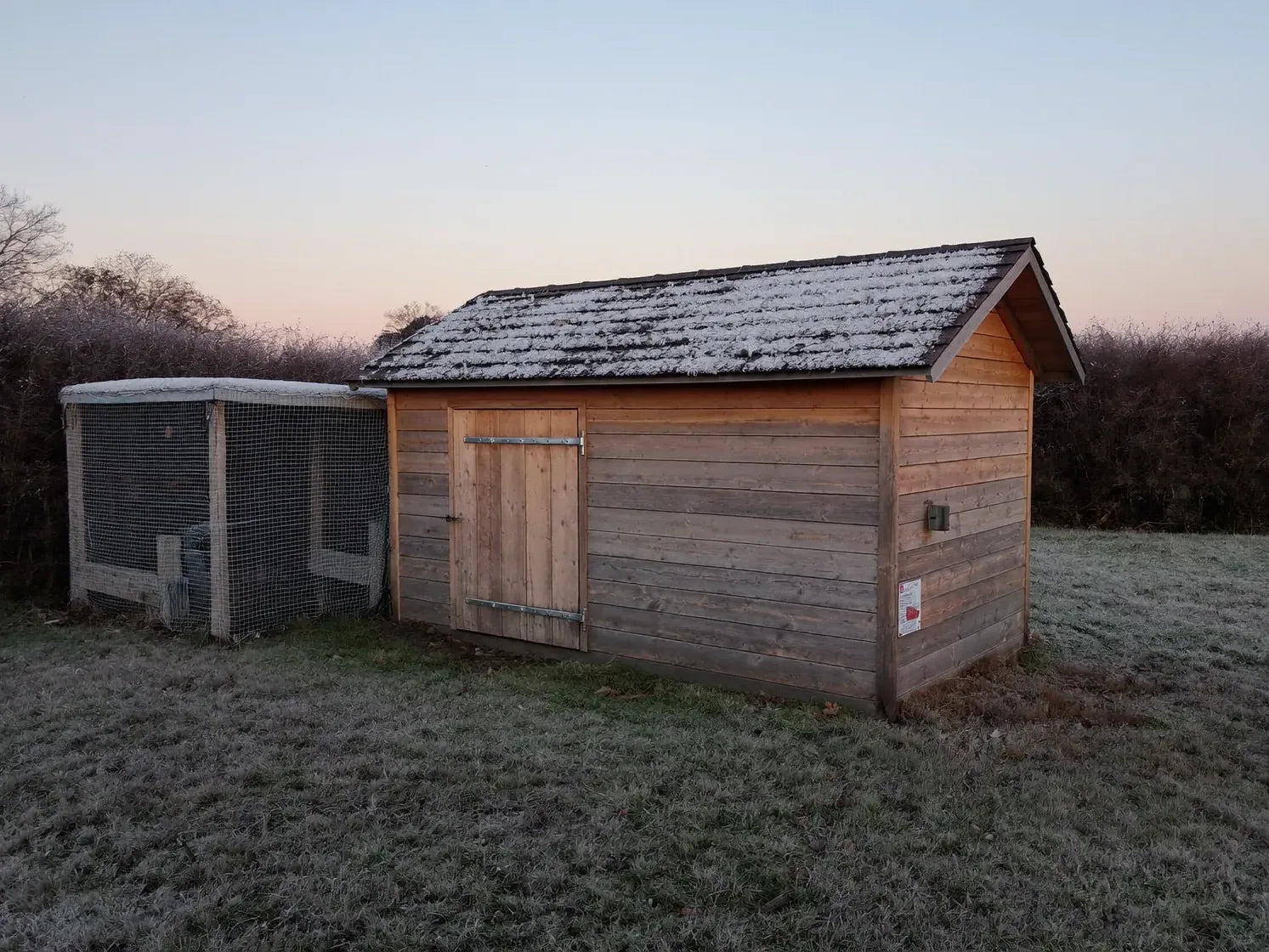
A cold weather chicken coop is one that stays dry and blocks wind at the birds' level, not one that stays warm. Penn State Extension puts the standard in a sentence: "Poultry can handle cold very well if they are dry." Most published temperature figures describe the birds. The one written about a coop is University of Minnesota Extension's 35 degrees Fahrenheit, and UMN's own words for it are "coop temperatures" — an indoor reading, with the thermometer height named. That turns the purchase into a short checklist you can run on the page in front of you, and one item on it decides the rest. Work down the list below, then start from the full range of coops.
Every temperature threshold, thermometer position and frostbite instruction here comes from an extension service we name; the first-freeze windows are NOAA's. Every one is cited below, because these services openly disagree about supplemental heat.
How cold can chickens tolerate, and what does that number describe?
No extension publication we opened states a lowest survivable temperature for a chicken. University of Minnesota Extension publishes a comfort band instead: "Most poultry can maintain their body temperatures when the environmental temperature is between 60 and 75 degrees Fahrenheit."
Below that band the bird is spending energy rather than crossing a line. UMN gives the mechanism in one sentence: "A chicken's body temperature lowers when it loses more heat than it can produce." The average body temperature it is defending is 106 degrees Fahrenheit. So the published answer is about a rate, and UMN names where the rate ends up if it runs long enough: "Prolonged cold stress can reduce performance and lead to death."
Check the direction of that number before you spend anything on it. A tolerance figure describes a healthy, dry, acclimated adult bird of a particular breed. It says nothing about a building, and it cannot be read backwards into one. Do not go hunting for a temperature rating on a coop either — what a coop page gives you is a material, some openings and a roof, and those are the things that decide whether the bird's own tolerance ever gets tested.
The birds will tell you before a thermometer does, and two services with no author in common name the same three signals. UMN: "Huddling together, holding a foot up to their breast, or puffing their feathers are all signs that your chickens may be cold." University of New Hampshire Extension lists huddling, a lifted foot and fluffed feathers as the cues to go and look at the coop. Which breeds cope and which struggle is the bird-side question, and our guide on whether chickens need a heated coop answers it breed by breed. Learn those three signals before you buy anything at all, though: they cost nothing, they work in any coop, and they send you to look before a thermometer would.
What temperature is too cold for chickens at night?
Overnight the coop is the entire environment, so the number that matters is an indoor one. University of Minnesota Extension sets its action point at 35 degrees Fahrenheit and, unusually, says exactly where to read it.
UMN states the trigger twice. Its summary line: "Provide supplemental heat when coop temperatures fall below 35 degrees Fahrenheit." Its body adds the heights: "When temperatures fall below 35 degrees Fahrenheit, provide supplemental heat at the height of the nest boxes or lower rung of the roost." Both of those sentences are already carried in our coop heater guide, which owns the buying decision they lead to. The one that rarely travels with the figure is the third: "Placing a thermometer on the wall at each of these heights can help you track coop temperatures."
A thermometer on the wall is the part of the instruction that turns a number into a measurement. The heights do double duty — they are where UMN puts the heat, and they are where UMN puts the instrument. "Coop temperatures" is UMN's own phrase for what that instrument reads, so a weather app showing 35 degrees outside is not the reading UMN describes, and the gap between the two depends on the box, the bedding and how many birds are in it.
The same figure turns up attached to a different instruction. North Carolina Cooperative Extension's Lee County office writes: "The first reminder is to make sure you have a heat lamp on to keep your birds warm when the temperature gets below 35 degrees Fahrenheit." No measuring location is named there. So one publication tells you where to hold the thermometer and the other does not, which is the whole difference between a number you can act on and a number you can only repeat.
The services also disagree about the action itself, and it is worth saying so plainly rather than picking a side. University of New Hampshire Extension: "In most circumstances, we advise against adding supplemental heat to your chicken coop." Its reason is fire, not temperature: "The risk of a heat source causing a fire is too high with combustible bedding materials present and given the tendency of chickens to knock things over." The hardware side of that argument is worked through in our heat lamp guide.

All three instructions are about the same place, whatever they tell you to do there: the closed box the birds sleep in overnight. So settle that box before you settle anything about heat — which means the first thing to check on a coop you are considering is not its heating at all, and the category name will not tell you.
Does the coop even have an enclosed hen house?
Some of what the category sells as a coop is a covered run with no sleeping box inside it. In a climate that freezes, that is the first fork in the decision, and it is settled in about fifteen seconds if you know which two fields to read.
Read the nesting boxes and the roost. A walk-in frame that states neither is an enclosure with a roof on it, however coop-like the photograph looks — and that is a genuinely useful thing to own, just not the thing that gets a flock through January. The wall materials give you the same answer a second way: steel pipe, powder-coated mesh and coated fabric are the materials of a shelter, not of a hen house.
Mesh and fabric do not stop wind, and wind is the thing the published guidance keeps naming. UNH: "A cold wind entering the coop takes away the birds' natural ability to keep themselves warm." Penn State Extension states the requirement as a pair of adjectives: "Poultry require a dry, draft-free house."
So a walk-in enclosure in a cold climate is the run, and it wants a closed hen house standing inside it. That is a perfectly good way to buy — it is exactly how the walk-in coops and runs are worth reading, as the outer half of a two-part purchase. Whether run mesh does any ventilating work for the house is a separate question with its own page, our ventilation guide. Check those two fields before you order, and where a page is silent on both, name the coop and both questions go straight to its manufacturer under our signature.
Settled on the coop your hens will actually sleep in? Take 10% off that one. GET MY 10% CODE
Wood, metal or fabric: how cold can chickens handle each one?
The published material warning is about the perch, not the wall, and reading the two as one rule is the easiest mistake to make here, because the two sentences sit under different headings in different publications. UMN warns off metal for roosts. UNH says metal siding is fine on a coop, with a condition attached.
UMN, under its roosts heading: "Avoid using metal, plastic, or other materials that retain the cold and may cause frostbite. Wooden 2 by 4- or 2 by 2-inch boards work well." A roost is the surface a bird's feet rest on for hours at a stretch, in direct contact, with its body weight on top. Bar sizing and height have their own page, our roost guide.
UNH, under its coop-structure heading, is describing a different part of the same building: "Siding materials other than wood such as corrugated metal will work if it is solid enough to prevent moisture and wind from entering." Different authors, different institutions, different building parts. No contradiction between them, and no corroboration either.
Insulation sits behind both of those, and UNH puts it in its place: "Some people choose to insulate their coops. This helps the space inside stay warmer but isn't an absolute necessity as protecting your birds from wind is the bigger consideration." Whether an insulated coop is a thing you can buy at all is settled in our winter coop guide.
Fabric earns a narrower job. A coated cover over a run keeps rain off the ground the birds use in daylight, and it is a poor wall for a sleeping box because it flexes and it seals. Sealing without venting is the failure mode Penn State names: "Failure to insulate or ventilate properly causes moisture to accumulate on the walls and ceiling in cool weather."
So the material question resolves into two decisions you can make from a photograph: a solid panel or sheet for the sleeping box, and whatever you like for the run around it. Pick the box first, then browse the larger coops and walk-ins for the run to put around it.
The cold weather chicken coop checklist: six things to read before you order
Six fields decide whether a coop holds a line in January. Every one of them can be settled from the page you are already looking at, or asked for in a single email before you commit — and the order below is the order they matter in, not the order they appear on a spec table.
| What to read | What it decides for you | What to do when the page doesn't say |
|---|---|---|
| Nesting boxes and a roost | Everything below it. A frame with neither has no inside to keep dry, so nothing else on this list applies to it | Ask, and ask before anything else. Silence on both fields is usually the answer, but it is worth one email to be sure |
| Wall material of the sleeping box | Whether the wall is a continuous barrier — which is UNH's actual test, not thickness | A photograph settles it on its own: a solid panel or sheet passes, mesh and fabric do not. Where the words are vague, ask which one it is |
| Panel or wall thickness | How many winters the wall survives, not how cold it gets inside on any one night | Ask us. A manufacturer knows its own panel, and this is the first question we would put to them for you |
| Openings you can set from outside | Whether you are still adjusting ventilation in February, or gave up in December | Count the vents, louvers and windows in the photographs, then ask which of them actually open. A vent you reach by opening the coop is a vent you stop using |
| Roof covering and overhang | Where the water goes before it reaches the wall — the wall's real enemy | Read whatever roof line the page does give you, then ask for the covering and the pitch. Both are on the drawing the roof was cut from |
| Floor height off the ground | Whether the floor spends February sitting in a freeze–thaw puddle | Look for a stated ground clearance; failing that, measure the leg off the dimensions drawing |
Row two is the one people get backwards, so it is worth being exact. UNH's test is not a thickness figure at all — the clause that defines "solid enough" sits inside UNH's own sentence, "to prevent moisture and wind from entering". Continuity, in other words. That is a question a photograph answers, which is why it sits above thickness on the list rather than below it.
Watch the adjectives, because a weather claim usually lives in one. Rainproof. Windproof. Weather-resistant. Thickened. Adjectives carry no units, so two coops described in identical words can be built completely differently and there is no way to tell them apart from a page. Thickened compared to what is a fair question and a manufacturer can answer it in one line.
So make them. Say which coop is on your shortlist and we will ask for the panel thickness and the wall build, then put the answer on the product page for the next person — `sales@moveablechickencoop.com`. The roof gets a guide of its own, our coop roof guide, and once the six rows above are answered the full range is where to start.
How do you know it's too cold in there?
You hang two thermometers and read them at first light. That is the whole method, and it is the part of Minnesota's instruction that almost never travels with the number.
Put one at the height of the nest boxes and one at the lower rung of the roost, both fixed to the wall — the same two heights Minnesota names for the heat itself, because those are the heights the birds occupy overnight. Read them before you open the door. A coop that has been standing open for an hour is reading the yard, not the coop, which is exactly the error a weather app makes for you at a distance.
Then decide how long the coop has to keep doing it, because that is the real difference between a Minneapolis purchase and a Georgia one. NOAA defines a first freeze as surface air at 32 degrees Fahrenheit or below over a widespread area, and NCEI's summary of the 1991–2020 U.S. Climate Normals gives a median date by region. The median is worth reading carefully: it is the date where "a freeze is expected to have happened on or before the listed date in five out of the 10 years recorded", so it is a coin toss, not a deadline.
| Region | NOAA's window for the first fall freeze | What that asks of the coop |
|---|---|---|
| Midwest | Mid-September to early October — the coldest contiguous stretch NOAA names | The longest run on this list. Openings you can set from outside stop being a nicety, because you will be adjusting them in the dark |
| Northeast | Mid-September to early October, or early September farther north | The same. Buy the enclosed sleeping box first and argue about supplemental heat afterwards |
| Northwest | Anywhere from the beginning of September to November, with wide local variation | Check your own elevation before you use a regional figure at all. A valley and a ridge in the same county are different purchases |
| Southwest | September to November inland and at altitude; not until at least December across most of California and southern Arizona | A dry, draft-free box still matters — there are simply fewer nights when it does. Spend the difference on shade and airflow instead |
| South | Early October in Virginia, trickling down to December further south; parts of Florida might not see a freeze every year | The roof is doing more work than the wall. Buy for rain and ventilation, and treat cold as the smaller problem it is here |
Note what the table is not: NOAA's maps are, in its own words, "a generalization and not absolute", and elevation, water and even how built-up your area is all move the date. Use it to size the decision, then use your own two thermometers to make it. If you want the openings on a specific coop checked against the row you land in, point us at that coop and the manufacturer's own opening detail comes back to you, or open the full range and point at the two you cannot choose between.
Frostbite: what it looks like, and what to do about it
Frostbite is the injury the whole of this page is really about, and it is the one thing here you can diagnose with your eyes on a Saturday morning.
Look at three places. University of Minnesota Extension: "Most cases of frostbite affect a chicken's comb, wattles and feet. These areas may become black or gray and feel brittle." Check while the birds are still on the roost at first light, when a foot is within reach without a chase around the run.
Prevention is a coop job before it is a bird job, and UMN says which one: "So controlling moisture through airflow and manure management during the winter is critical." That is the same sentence as the ventilation instruction earlier on this page, arriving from the other end. There is a bird-side measure too, and it is worth knowing precisely what it does and does not do — "You can apply petroleum jelly to chicken combs and wattles to help insulate them and prevent frostbite damage. Petroleum jelly does not treat frostbite."
Treatment is not a home job. UMN is unambiguous: "Consult a veterinarian if you have a chicken with frostbite or infection. If left untreated, severe frostbite can lead to loss of the comb, wattle, or foot." One more instruction goes with it, and it is the one people miss because it is about the flock rather than the bird: "If a bird with frostbite gets pecked on by others in the flock, move them to a separate space to allow time for recovery." A second, smaller enclosure is worth having before you need it, which is one of the quieter arguments for a coop you can move rather than a shed you cannot.
So the buying consequence is short. Ventilation you can adjust without opening the coop is the thing that keeps moisture off a comb, and it is a spec you choose once at purchase and live with for years. If you cannot tell from the page whether a coop's openings adjust, ask us — we will get it from the manufacturer — and the coops built to move are where a second, separate space is easiest to arrange.
Buy for dryness, not for warmth: what we would spend on first
We would spend the budget on a closable hen house with a tight roof and adjustable openings, and nothing at all on making a coop warm. Penn State's condition is the one that keeps coming back: poultry handle cold very well if they are dry.
Our order of work, for a coop bought new for a cold climate. A real enclosed sleeping box first, because it is the only item on the list you cannot add later. Walls and roof with no gaps at bird height second. Openings you can set from outside third, because a vent you can only reach by opening the coop is a vent you will stop adjusting in February. The parking spot last on the list and first in the calendar, which our winterizing guide dates properly.
Getting the box wrong costs a second purchase in the worst month to make one. Getting the warmth question backwards costs more than money. Seal a coop tight to hold heat and Penn State's sentence describes what you built: moisture accumulating on the walls and ceiling in cool weather. UMN names the injury at the end of that chain: "High moisture in a coop, combined with cold temperatures can lead to condensation, which can cause frostbite." Warm and damp is the losing combination, and it is the one that feels like care while you are doing it.
Anywhere in the continental US that freezes at all, the shell of the coop is doing that work, not a heater — which is why the six rows of the checklist are worth more of your attention than any wattage.
If the coop has to move as well as shut, the coops on wheels are where those two requirements meet. For a flock that will spend more of the short days indoors, the larger coops and walk-ins buy the floor area to spread out on. Ask us for the panel thickness on whichever one is in front of you and we will chase the manufacturer while you decide.
Sources: Penn State Extension, "Small Scale Poultry Housing" (Gregory P. Martin and Phillip Clauer, updated June 25, 2026) — accessed August 20, 2026 · University of Minnesota Extension, "Caring for chickens in cold weather" (Colleen Carlson and Hannah Lochner, reviewed 2026) — accessed August 20, 2026 · University of New Hampshire Extension, "How Should I Take Care of Backyard Chickens in the Winter?" (Sean O'Brien, February 15, 2024) — accessed August 20, 2026 · North Carolina Cooperative Extension, Lee County, "Backyard Poultry Winter Care" (Jared Butler, January 17, 2024) — accessed August 20, 2026 · NOAA National Centers for Environmental Information, "When to Expect the First Fall Freeze" (October 23, 2023) — accessed August 20, 2026
Frequently asked questions
How cold can a chicken coop get?
No publication we opened states a figure, which is why University of Minnesota Extension says to measure it: put a thermometer on the wall at nest-box height and at the lower roost rung. Read the coop, not the forecast. UMN notes that deep bedding stirred through winter "will provide some natural heat as the manure decomposes", one of few heat sources an unheated coop has. What winter does to the building is in our winter coop guide.
What temp should a chicken coop be in the winter?
University of Minnesota Extension gives the only action figure we found: below 35 degrees Fahrenheit, provide supplemental heat, measured at the height of the nest boxes or the lower rung of the roost. That is an indoor reading, not a forecast. University of New Hampshire Extension advises against supplemental heat in most circumstances on fire-risk grounds, so treat 35 degrees as a decision point rather than a temperature the coop has to hold.
How to winterize a metal chicken coop?
Treat the walls and the perch as separate problems. University of New Hampshire Extension says corrugated metal siding works if it is solid enough to prevent moisture and wind from entering, so seal seams and gaps rather than covering the panels. University of Minnesota Extension's warning about metal is aimed at roosts, where it says metal retains cold and may cause frostbite, and names wooden boards instead. The job order lives in our winterizing guide.
How to build a chicken coop for cold weather?
Build to two published conditions rather than to a temperature. Penn State Extension asks for a dry, draft-free house with windows or doors that can be opened for ventilation when necessary. University of New Hampshire Extension describes the common build as plywood walls on a wooden frame, sealed against wind, rain, snow and rodents, under a roof that is solid and leak-proof. Dimensioned drawings sit in our free coop plans.