

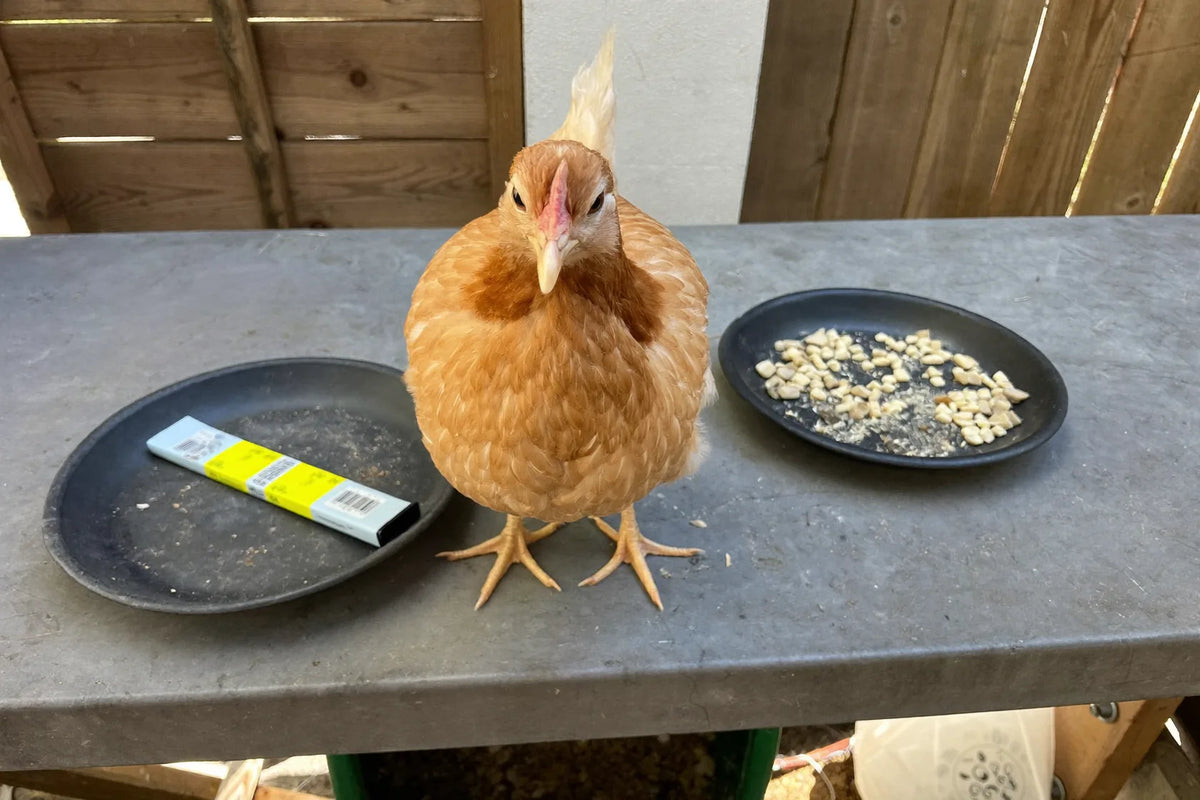
Chicken layer feed is a complete ration for hens that are already laying, and the one thing separating it from every other bag is calcium. Oregon State Extension puts a layer feed at "about 16% protein and extra calcium (3-4%)"; Kentucky puts a bird still growing at 1.2 per cent calcium, and warns what happens if you get that backwards. Four extension services publish how much a hen eats and they disagree by about two to one, so this page prints all four rather than picking. Housing first, because the flock size is the input the feed arithmetic runs on — settle it against the coops we sell before you buy a single bag.
Four extension services publish a different daily feed rate and this page prints all four rather than averaging them, each quoted from the publication that states it and normalised to the same unit so the disagreement is visible.
What is chicken layer feed?
Chicken layer feed is a ration formulated for hens in production, carrying more calcium than a growing bird's diet because a hen puts calcium into a shell every day she lays. Alabama Cooperative Extension gives the reason: "The eggshell is composed of around 96 percent calcium carbonate."
The switch is triggered by the bird, not the calendar. Oregon State Extension's laying-hen guide gives the rule as "Start feeding layer feeds at about 18-20 weeks of age or when the first egg is laid, whichever occurs first." Read the last three words carefully — they mean the week number is a fallback, not a floor. A pullet that lays at 17 weeks has already overtaken it.
Getting the switch early is worse than getting it late. Kentucky's small-flock feeding guidance is blunt about the mechanism: "Laying mashes typically contain 2.5% to 3.5% calcium. Growing chickens require only 1.2% calcium in their feed. If you feed high-calcium diets to growing chickens, kidney damage can result."
Alabama sets the other end of the window from the bird's side, noting that "Generally, most pullets will lay their first egg at 20 to 25 weeks." Between those two publications the honest answer to when is a window of about eight weeks with an override in it, and the override is an egg.
What the coop decides about the feed bill
Three things about the feed bill are settled by the building rather than by the bag, and one of them is the biggest lever you have. A coop that moves adds a fourth wrinkle — it puts the flock on grass, which is the one a mobile-coop site has an interest in getting wrong.
| What the coop decides | Why it decides it | What to settle first |
|---|---|---|
| How many birds you feed | Flock size is the biggest single lever on the bill, and a coop capacity is usually offered as a range rather than a number | Settle the flock size against a stated floor area in our coop size guide, then buy feed to that figure rather than to the top of the range |
| How far you carry the sack | A store stays put while a mobile coop does not, so every move lengthens the walk to the feeder | Site the feed container by where the coop parks, not by where it grazes |
| Whether grit is on your list | Hens eating pasture are Kentucky's pasture-raised case, and grit is the instruction that applies to them | If the flock is on grass, budget grit. If it lives on a complete ration indoors, that instruction is not aimed at you |
Oregon State states the ceiling directly: "While pasturing can be a beneficial supplement to a feed ration, it is not a substitute for the various feeds noted above." It goes further on the calendar — "the greatest feed value is during the spring and summer when the insect activity and seed production is highest", and "During the late fall and winter, there is little feed value in the pasture for chickens." Fresh ground is a real supplement in the warm half of the year and close to nothing in the cold half, and no publication we opened for this page puts a figure on the size of the saving. Budget as though the grass were not there. If it helps, that is upside. Our guide to free-range coops works through what daily outdoor access does and does not change.
Grass does change the grit answer, and that is the honest version of the mobility argument. A flock in a chicken tractor is Kentucky's pasture-raised case by definition — hens eating grass that no mill has ground. Kentucky's instruction to supply grit to pasture-raised birds is the one that applies there, not Alabama's line about a flock living on commercial feed alone.
One tension inside the guidance gets sharper on a coop that moves. Alabama says that with a complete layer feed you should "provide feed for your hens at all times", and in the next breath that "It is okay to feed your flock meals once or twice daily to avoid having excess feed sitting in your feeder, which may attract rodents and insects." Both sentences are Alabama's, in the same section. A coop parked in one spot every night settles that argument once. A coop that sleeps somewhere new every few days makes the decision again each time, and what is left in the feeder at dusk is the part you control. Site the feed container by where the coop parks rather than by where it grazes, and accept that every move lengthens the carry.
Then the flock size, because it decides the arithmetic — and a coop capacity is usually offered as a range rather than a single number, which is the second place the multiplication bites. Take a coop offered for four to six hens: at the lowest of the four published rates set out further down this page, four birds eat about 0.9 pounds of feed a day, and at Minnesota's rate six birds eat about 2.6. Close to three to one on one building, because the flock range and the rate disagreement multiply. Our multiplication, not theirs.
Feed storage is a separate building problem and it is worth planning as one: coop area and run area are figures you can get for a coop, and where the sack lives is a question about your shed, your garage or your porch. Our bulk feed guide has the published storage instructions. If it is the coop's own enclosed volume you need in order to plan around it, ask us and we will get it from the maker — `sales@moveablechickencoop.com`.
Complete layer feed for chickens: what the word promises
A complete layer feed for chickens is one designed to be the entire diet, not a base to build on. Alabama puts it in a sentence: "Complete feeds (along with clean water) are designed to be the sole source of nutrients."
Kentucky says the same thing as a recommendation rather than a definition — "The simplest way to feed a small flock of chickens is to purchase a complete feed from a feed store" — and the consequence is the part people skip. Alabama's own advice is to "avoid mixing scratch grains with your complete feed. This only dilutes the nutrients your birds need." Anything you add is subtracted from somewhere.
There is a trap sitting next to the word, and Oregon State names it. All-purpose feeds are sold as a single ration for a whole flock of mixed ages, and PNW 477 says of them that "Laying chickens that are fed all-purpose feed will generally not receive enough calcium for proper eggshell formation", and that oyster shell then has to make up the difference. A feed can be complete for a flock and still be short for a hen in lay. The label is the only place that distinction shows up.
How do you tell a good layer feed from a bad one?
Read the tag, and read it for two minerals rather than one. Alabama Cooperative Extension's instruction is specific: "The label or tag on a layer feed should display the amount of analyzed calcium and phosphorus in the feed."
Phosphorus is the one nobody looks at. Alabama gives 2 parts calcium to 1 part phosphorus as the general rule of thumb for most animals, then says that "for laying hens, this should be much higher" — its stated range runs from 4:1 up to possibly as high as 7:1.
Then stop chasing a protein number, because the published ones do not agree. Here they are side by side.
| Publication | Crude protein | Calcium | What it is written for |
|---|---|---|---|
| Alabama Coop. Extension, ANR-2913 — body text | "around 18 percent crude protein" | — | Small backyard laying flocks |
| Alabama Coop. Extension, ANR-2913 — Table 1 | 16% or more | 3% to 4% | The same publication, three sections later |
| UNH Extension, Producing Your Own Eggs | "about 16-18% crude protein" | 4% | A first small flock |
| Kentucky, Feeding Chickens for Egg Production | "at least 14% protein", with 16% "more common" | 2.5% to 3.5% | Small and backyard flocks |
| Oregon State, PNW 477 | "about 16% protein" | 3-4% | Laying hens, peer reviewed |
The published band is 14 to 18 per cent protein and 2.5 to 4 per cent calcium, and one publication prints two different protein figures in the same document. That is not a reason to distrust any of them — a range is what an honest recommendation looks like when birds differ. It is a reason to stop reading a single number on a bag as a score.
Two ingredient warnings are worth more than the protein number anyway. Alabama says to "avoid any layer feeds that might contain fish meal or cottonseed meal", because fish meal can carry into the flavour of the egg and cottonseed meal can turn the white green. Oregon State's version of the same instruction is four words long: "However, read the label carefully."
The hen range on a listing is what sizes your feed order — so take 10% off the coop that sets it. GET MY 10% CODE
Poultry feed for layers: four published rates, and they do not agree
Four extension services publish how much poultry feed for layers a hen gets through, in four different units, and converting them all to one unit puts the lowest and the highest about two to one apart. Every conversion below is ours; every quoted figure is theirs.
| Source | As published | Pounds a hen a week (our conversion) | What it is stated against |
|---|---|---|---|
| Alabama Coop. Extension (Pacheco, Gulizia, Downs) | "A laying hen will consume between 100 and 150 grams of feed per day or roughly 0.25 pounds." | 1.5 to 2.3 | No bird weight given |
| UNH Extension (Kunelius) | 90-100 lb across 13 months of production | 1.6 to 1.8 | No bird weight; volume figure hedged "depending on size" |
| Kentucky (Jacob), layer row of the feed-requirement table | 18-24 lb per 10 birds per week, from 20 weeks on | 1.8 to 2.4 | Commercially raised replacement pullets |
| UMN Extension (Wieland, Nolden; Florentino) | "A 6-pound hen will eat roughly 3 pounds of feed each week." | 3.0 | A 6-pound hen, stated |
Three of those four bands overlap. Minnesota's single figure sits about a quarter above the top of the highest of the other three, and about twice the bottom of the lowest. We checked the bylines before saying anything about agreement: Alabama is Pacheco, Gulizia and Downs; New Hampshire is Kunelius; Kentucky is Jacob; Minnesota is Wieland and Nolden with Florentino. Four institutions, no shared name, no shared sentence.
Our reading, and it is a reading rather than a finding. The obvious explanation is that a weekly rate describes what goes into the feeder while a daily one describes what goes into the bird — and it does not survive this table, because Kentucky's figure is weekly too and lands with the daily ones. What does survive is what the publications say about themselves. Minnesota's rate is the only one attached to a bird weight at all; the other three name no bird. Kentucky names two more variables outright: "As the energy content of a diet increases, feed intake decreases, and vice versa", and "During hot weather, feed intake decreases." Minnesota's own diet page says the same about the calendar — feed consumption may rise in winter and fall in summer. Our winter coop guide carries Minnesota's quantified cold-weather figure.
So the number moves with the bird, the feed and the weather, and a single answer would be a worse answer.
What we are deliberately not doing is giving you a second answer to how long a sack lasts. Our accessories guide already sizes a feed bin on Minnesota's rate, and our guide to what chickens cost per year already prices a year at both ends of the same disagreement. Two pages on one site should not hold three sack figures between them.
The measurement that beats all four is yours. Alabama notes that "The purchased feed should have the manufacture date on the bag" and to ask the retailer if it does not. Write your own two dates next to it — the day you opened it and the day it ran out — and after two sacks you have a rate for your birds, your feed and your weather that no extension service can publish for you.
Layer crumble chicken feed, or pellets?
Layer crumble chicken feed and layer pellets are the same formulation in two physical forms, and Alabama leaves the choice to you: "Whether you choose to feed layer crumbles or pellets is your decision." The differences it does state run in opposite directions.
Crumbles exist for small beaks. Alabama: "Crumbles are broken up pellets designed to help chicks eat, and many layer diets come in crumble form." Pellets have the process argument — "Pelleting of feed has several advantages, including improved digestion and consistent intake of all ingredients and nutrients in the feed."
The cost of crumbles is waste. Alabama's finding is that "Adult chickens eating crumbles tend to waste more feed", and that a crumble leaves powder in the bottom of the feeder that birds pick around rather than eat. Pellets do not do that, which is why the argument tends to settle on pellets once the birds are grown. What the form does to a feeder mechanism is a different question and a different post.

Organic chicken layer feed: two services, and where they part company
Organic chicken layer feed costs more, and the two publications that discuss it agree about the money and disagree about the nutrition. Both are named here because neither should be reported as the settled answer.
Alabama's position is that the difference is mostly price: "The composition of organic diets is not much different than conventional, but the cost of organic poultry feeds is considerably higher." Oregon State's is harder. PNW 477 records that under organic rules "organic feeds are more difficult to formulate and often contain ingredients that are imported from other parts of the world, which can significantly increase the feed cost while providing less than optimal nutrition for laying chickens", and notes the synthetic amino acid methionine is allowed only under a variance that may change.
Two institutions, two authors, no shared wording, and a real disagreement about whether an organic bag is nutritionally equal. Neither of us is a nutritionist and we are not going to break the tie for you. Alabama's practical note is the one worth acting on: if the reason you are considering organic feed is that you intend to sell eggs as organic, feed is only one component of that, and the requirements are worth researching before the feed decision rather than after it. If you want the money side dated and sourced, that is in our guide to what chickens cost per year.
Do laying hens need oyster shell and grit as well?
Three published positions exist on oyster shell, and they are only two independent voices — which is more useful to know than any one of the three answers.
Minnesota states it as part of the diet: a laying hen diet "should also contain crushed oyster shell for egg production and grit for digestion." Alabama disagrees directly — with a good complete layer diet, "supplementing a layer flock with oyster shell is probably unnecessary" — while adding that it is cheap and does no harm.
The third position is a method rather than a verdict, and it appears twice under two names. Kentucky: "Some high-producing laying hens may require the extra calcium that the oyster shell provides." Oregon State: "Some high-producing laying birds may require the extra calcium provided by oyster shell even though the prepared diet is a complete feed." Those two sentences are near-identical, and Kentucky's page lists Oregon State's publication under further reading. Treat them as one line of work printed twice, not as two services agreeing. Both give the same test — "You can determine the need to feed oyster shell by examining shell quality" — and Oregon State adds the mechanism: offer it in a separate feeder, free choice, so the hen decides.
Grit splits the same way and for a reason that matters on this site. Alabama says a backyard flock eating commercial feed does not need supplementary grit at all, because the feed is already ground. Kentucky agrees for birds on bare ground — they "can typically find enough grit in the form for small rocks or pebbles" — and then names the exception: "Grit should also be provided to pasture-raised chickens", because "Grit is important for breaking down the grass chickens consume."
The one thing every publication agrees on is a substitution mistake: "Oyster shell should not be used as grit since it is too soft and does not aid in grinding." They are two different products doing two different jobs. Which of these your flock needs is a question for an extension poultry educator or a vet who has seen your birds and your eggs — it is not a question a coop shop should answer for you.
Three published shelf lives, and the clocks start in different places
Layer feed does not keep indefinitely, and four publications set a limit on it. They do not measure the same thing: three start the clock when you put the sack into a container, and one starts it at the mill.
| Publication | The limit it states | When the clock starts |
|---|---|---|
| Penn State Extension, small laying flock | "Store feed in a dry, dark metal container for up to 4 weeks." | When you store it |
| Kentucky (Jacob) | "Feed should not be stored for more than two months." | When you store it |
| Oregon State, PNW 477 | "Store feed for a maximum of two months and keep it in a cool, dry place." | When you store it |
| Alabama Coop. Extension, under Age of feed | "As a good rule of thumb, the feed should be no older than 3 months." | At the mill |
Alabama's three months and Penn State's four weeks are not competing answers, because they start in different places — a bag can be eight weeks old on the shelf and still be on day one of your four weeks. Whichever expires first is the one that governs, which in practice is always the tighter one. Kentucky and Oregon State both say two months, and Kentucky's page lists Oregon State's under further reading, so count that as one figure rather than two. Our accessories guide turns Penn State's limit into a bin-sizing rule, and that rule holds whichever of these numbers you believe, because it works from the tightest.
The container is described the same way everywhere. Alabama asks that feed be kept in a "rodent- and insect-free container or area" and never in direct sun or a hot store; Oregon State asks for "enclosed solid containers, such as a covered trash can, to reduce its availability to rodents that can eat a great deal of feed and potentially spread disease." None of that describes a coop. It describes a shed. Everything else about rodents around a coop is in our pest control guide, which is built on the same published lines.
What we would put in the feeder, and what we would skip
One complete layer feed, in pellets, chosen off the calcium and phosphorus line on the tag rather than the protein headline, in the smallest bag we would finish inside four weeks. That is the whole decision, and everything above is why.
What we would skip: buying on the protein number alone, when the published range across four services is 14 to 18 per cent and one document prints two of them. Buying oyster shell before seeing a thin shell, when the two publications that address the question both say to judge it by the shells. And budgeting any feed saving against a run on fresh grass, because Oregon State calls pasture a supplement and not a substitute and says it is worth little in winter, and no page we opened for this guide puts a number on the saving.
Where we would spend more is the coop, not the feed. A ration is a decision you can revise next month for the price of one bag; a coop sized to the wrong end of a hen range is a decision you live with for years, and the number of birds it holds is the single biggest lever on what you spend on feed after it. Work the sizing out first in our coop size guide, then pick from the mobile coops we carry or the coops with runs — and tell us the flock size you have landed on, so we can check the run area against it before you order.
Sources: Alabama Cooperative Extension System, “Backyard & Small Poultry Flock Management Series: Feeding the Laying Hen” (ANR-2913) (Wilmer Pacheco, Joseph Gulizia and Kevin Downs, September 7, 2022) — accessed August 22, 2026 · poultry.extension.org, “Feeding Chickens for Egg Production in Small and Backyard Flocks” (Dr. Jacquie Jacob, University of Kentucky; no date shown) — accessed August 22, 2026 · Oregon State University Extension Service, “How to feed your laying hens” (PNW 477) (James Hermes; published August 2016, reviewed 2024; peer reviewed) — accessed August 22, 2026 · University of New Hampshire Extension, “Producing Your Own Eggs” (Kendall Kunelius) — accessed August 22, 2026 · University of Minnesota Extension, “Raising chickens for eggs” (Betsy Wieland and Nora Nolden; reviewed by Sabrina Florentino) — accessed August 22, 2026 · Penn State Extension, “Successfully Raising a Small Flock of Laying Chickens” — accessed August 22, 2026
Frequently asked questions
What to plant near chicken coop?
Nothing you plant will replace layer feed. Oregon State Extension puts the limit plainly: pasturing is a supplement to a feed ration and not a substitute for it, and the feed value peaks in spring and summer. Kentucky adds the one real warning worth acting on, which is not to feed grass clippings from a lawn that has had pesticide on it recently. Plant for shade and shelter, and leave the ration alone.
How to keep squirrels out of chicken coop?
Start with the sack rather than the structure, because the feed is the draw. Alabama Extension asks that feed be kept in a rodent- and insect-free container, and Oregon State asks for enclosed solid containers such as a covered trash can. Then stop leaving feed standing in the feeder overnight, which is the reason Alabama offers meal feeding at all. The hardware half of the job is in our pest control guide.
How to get a chicken back in the coop?
Feed at a fixed time and let the coop be the place it happens. Alabama Extension's meal-feeding option is once or twice a day, with enough put down for the hens to clean up in 30 minutes to an hour, and a routine like that is something you can call on. Alabama also warns against mixing scratch grains into a complete feed, so the lure is the ration itself rather than something extra.