

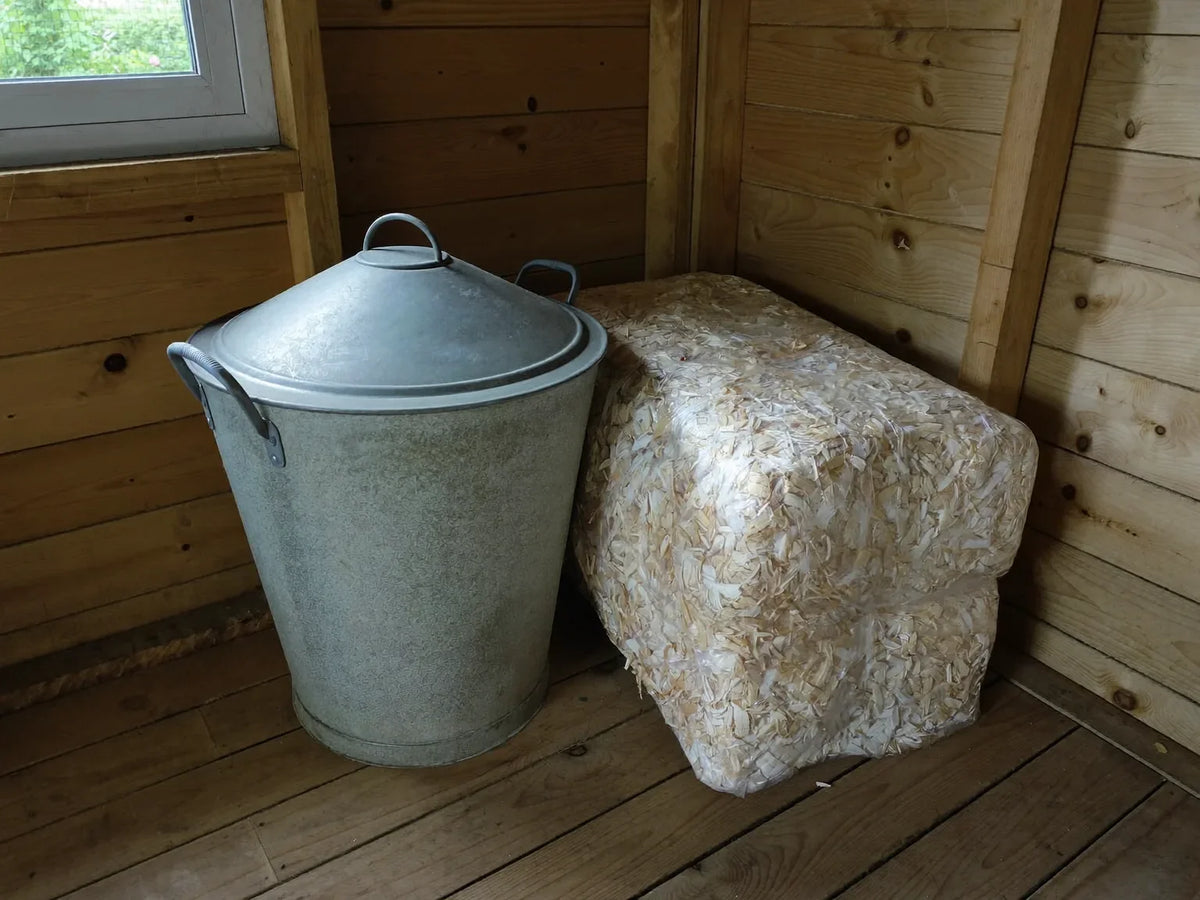
Chicken coop accessories split into two piles: the ones a coop arrives with, and the ones you buy afterwards. Feed and water sit firmly in the second pile — assume the feeder, the drinker and the feed bin are yours to buy whichever coop you pick, and assume the tray, the latch and the ramp are the coop's job. The order that saves money is coop first, extras second: pick from the coops we sell on flock size and mobility, then buy the few things the coop genuinely leaves to you.
Nothing is on this list because it sells well. The feed rate, the one-month storage window and the weight of a gallon of water are all quoted from named public sources, cited in full at the foot of the page; the move-day arithmetic is ours.
What chicken coop accessories actually matter?
Three things, for most backyard flocks: something to hold feed, something to hold water, and somewhere dry to keep the sack. Everything else on the usual accessory list is either fitted to the coop already or genuinely optional.
The list gets long because two different questions get answered as one. What belongs inside a coop is a housing question — a roost, nest boxes, litter, ventilation. Our guide to what belongs inside a chicken coop sets out all six fittings with the extension figures behind each. What you buy separately is the other question, and the answer depends entirely on which coop you picked.
Accessories, in the sense this page uses the word, are the things that are not part of the building. A feeder is an accessory. A nest box is a fitting, because it arrives bolted to the coop or it does not arrive at all. The distinction decides when you spend: fittings are chosen when you choose the coop, accessories are chosen afterwards, and only one of those two decisions is reversible. So settle the fittings first — that is a decision made on the coops we sell rather than in the accessory aisle.
What comes fitted, and what you buy yourself
Most of the accessory list is a coop feature rather than a purchase, and the split is stable enough to shop from. Here is the usual aisle sorted by who supplies each item, and by the moment you actually decide it.
| What you are shopping for | Fitting or accessory? | What to do about it, and when |
|---|---|---|
| Droppings tray | Fitting — it arrives bolted in or it does not arrive | Check the spec row before you order. A coop that already has one does not want a second |
| Latch or lock | Fitting, though a better latch is a five-minute upgrade | Buy the coop on the door, not on the latch. Cold hands decide this one |
| Ramp or fold-down door | Fitting — it is cut into a panel | Settle it at purchase; a ramp added later means a hole in something you bought |
| Run cover or tarp | Fitting where a run is attached, an accessory where it is not | Read the run row first, then buy fabric only if it is silent |
| Perch | Fitting, and usually given as a count rather than a length | Ask for the bar length before you order — a count answers nothing |
| Feeder | Accessory. Budget for it on every coop | Buy after the coop, sized to the flock rather than to the hen house |
| Waterer, drinker or fount | Accessory. Budget for it on every coop | Buy one you can lift full if the coop moves — see the weight below |
| Feed bin or storage | Accessory, and it lives outside the coop | One bin, one sack. The sizing rule is below |
| Dust bath | Accessory | A shallow tray on a coop that moves; a scratched hollow only on one that does not |
| Grit or oyster-shell hopper | Accessory | Wait a month. Buy it when the flock's routine has shown you it is needed |
| Thermometer | Accessory, and the cheapest thing here | Buy it with the coop and hang it at bird height |
Feed and water hardware is on every shopping list, because it is not part of the building on any coop. The lower half of the table above is that list, and it is shorter than the accessory aisle suggests. The upper half is money you do not need to spend twice — a tray that came bolted into the coop does not want a second tray beside it.
Do not expect a listing to itemise the carton, and where it does, expect it to say one coop and one manual. Read a coop listing as a description of a building, with everything that goes inside the building left to you. Where a manufacturer has not said what is in the carton, we would rather ask than guess: name the coop and the carton question goes straight to whoever packed it.

How much feed and water does a small flock get through?
About 3 pounds of feed a week for a 6-pound hen, and fresh water every day. University of Minnesota Extension publishes both figures, and between them they size the two accessories every flock needs, whatever coop it lives in.
Minnesota's diet guidance states the feed rate plainly: "A 6-pound hen will eat roughly 3 pounds of feed each week." Six hens of that size work out at about 18 pounds a week, so a 50-pound sack is a little under three weeks of feed. The same page gives the daily job: "Feed chickens and change their water daily."
Penn State Extension sets the deadline that sack has to beat. Poultry feed "can be stored for up to a month" in a dry, cool, non-sunny place, because sunlight and heat damage the vitamins in it and moisture makes it mould. Three weeks of feed inside a one-month window is the whole sizing rule for a feed bin: one sack, one bin. A container that swallows three sacks keeps two of them past their month, and a smaller flock makes that worse rather than better. Where the bin stands and what it is made of is a rodent question, answered with Penn State's own line in our coop pest control guide.
Water is the accessory with a weight problem. The U.S. Geological Survey puts a gallon of tap water at 70°F at 8.329 pounds, so a 3-gallon fount holds about 25 pounds once it is full, and a 5-gallon bucket about 42. On a coop that stays put, that number never comes up. On a coop you roll onto fresh grass every few days, it is the heaviest loose object in the setup. It moves twice on every shift — off the old patch, onto the new one — unless you carry it empty and fill it where it lands.
Sizing the vessel for winter, when the walk out matters more than the weight, is a separate trade and our coop water heater guide works through it.
The feeder and the fount are yours to buy whichever coop you pick — so take 10% off the coop they stand in. GET MY 10% CODE
Which chicken run accessories earn their place?
The ones that lift out in one hand. A run attached to a coop that rolls travels every few days, so every object standing in it is either carried to the new patch or left behind on the old one.
Count the loose items before you buy them. A feeder, a fount and a dust tray is three lifts out and three lifts back on every move, on top of the coop itself. Two of the three are unavoidable. The third is a choice, and it is the one no accessory list ever prices. The ones you resent carrying stop getting carried.
Dust bathing is the job a run does better than a coop, and Minnesota's sanitation guidance is the reason to provide for it at all — our sand guide carries that line and the material question with it. In a run that travels, a shallow tray you can lift beats a hollow scratched into the ground, because the hollow does not come with you.
Shade and cover are run accessories too, and each has its own page. What a cover does to the air in summer is in our shade guide; what a tarp fixes and what it breaks is in our tarp guide. Check whether the listing already names a run cover before you buy fabric for one, and ask before you order where it says nothing either way. The run itself — how big it should be, and what happens to the ground under it — is the subject of our outdoor run guide.
Chicken pen accessories: the ones that only work when nothing moves
A pen that stays in one place can take hardware a travelling run cannot: anything pegged, buried, planted or plumbed. The trade is the ground underneath, which stops recovering the day the pen stops moving.
Pegged and buried hardware is the clearest case. A skirt of wire pinned flat to the soil around a static pen is hardware you can check, and what it is made of belongs to our guide to the security hardware itself. Drag the same pen to fresh grass and the skirt has to be lifted, re-laid and re-pinned every time, which is how a good measure quietly falls out of use.
Plumbed water is where a static pen wins outright. A hose bib and a float valve turn a daily job into a weekly one, and neither travels. The same goes for a feed station on a paving slab, a planted shade line, and anything wired to a socket.
Nothing here argues against a static pen. The accessory list simply follows a decision you already made — which is why coops built to move and walk-in enclosures end up with different kit inside them, and why buying the kit first is the wrong order.
Chicken coop accessories ideas, sorted by what move day does to them
Sorting accessory ideas by weight and by what they are fixed to beats sorting them by price. The table runs from the ones that travel for free to the ones that have to be undone every single time the coop shifts.
| Idea | What it is for | What move day does to it |
|---|---|---|
| Droppings tray | The weekly clean-out | Nothing. It travels bolted in — check the spec row before you buy a second |
| Egg basket or collecting tub | Carrying eggs indoors unbroken | Nothing. The cheapest useful thing on this list |
| Thermometer at bird height | Telling you what the birds are actually in | Nothing — it travels in a pocket. Assume you are buying it; where to hang one is the part that matters |
| Dust tray | Dust bathing | One lift each way. A scratched hollow scores worse: it stays behind |
| Standing fount | Daily water | About 25 lb at 3 gallons. Carry it empty, fill it on the new patch |
| Hanging feeder | Keeping feed off the floor | Down and up again, and it needs something to hang from |
| Shade cloth | Summer shade over the run | Off the frame and back on — or move the coop into the shade instead |
| Lidded feed bin | One sack, dry and out of the sun | Stays put. Site it by where the coop is parked, not by where it grazes |
| Wire skirt or apron | Ground-level hardware on a static pen | Lifted and re-pinned at every new spot, which is why it suits a pen |
A hanging feeder and a shade cloth both need a fixing, and a fixing means a hole. Drill a bought coop for a hook and the hole stays drilled, so read the manufacturer's warranty terms first. What a bracket can actually bite into is the other thing a listing will not tell you, so say which coop, and we will get the panel backing and the maker's position on a fixing in the same reply, before you buy either. Our solar accessories guide works the same problem through for panels.
What about the powered accessories?
Every powered accessory asks the same question before you choose a model: where the power comes from when the coop is not standing next to a wall. Four of them come up often enough to have guides of their own, and each answers it differently.
An automatic pop-hole door has to open at dawn whether or not you are up, and sizing and mechanism are covered in our automatic coop door guide. A fan is a summer load, and whether a coop needs one at all is settled in our coop fan guide. A light or a small panel is the subject of our solar accessories guide. A heated waterer is a different scale of load entirely, and our coop water heater guide prices it.
What we'd buy first, and what we'd skip
We would buy three things and stop: a feeder, a fount light enough to lift full, and a lidded bin that holds one sack. Everything else is worth deciding a month in, when the flock has shown you what the routine actually is.
The skip list is longer than the buy list. We would not buy a second feeder for a flock of six, or nest-box liners before seeing whether the boxes need them, or anything that has to be unbolted on move day. We would not buy an accessory to fix a coop that is the wrong size either — no accessory has ever solved that, and our coop size guide is the cheaper place to solve it.
Where we would spend more is one step up in the coop, not one step up in the kit. A tray that pulls out cleanly, a latch you can work with cold hands and a run you can actually reach into are worth real money, and they are decided once. A feeder is decided again whenever you feel like it.
The accessories are the cheap, reversible half of this. The coop is the half you live with for years, so put the budget there and let the extras follow it. Coops built to move suit a flock you want on fresh grass every few days; coops that arrive with a run suit birds that spend their days in one enclosure.
Give us the coop you have settled on and the packing list comes back from its maker, itemised. If you are still narrowing it down, the full range sorted by flock size is the place to start.
Sources: University of Minnesota Extension, “Raising chickens for eggs” (Betsy Wieland and Nora Nolden; Sabrina Florentino, Extension educator; reviewed 2025) — accessed August 21, 2026 · Penn State Extension, “Small Scale Poultry Housing” (Gregory P Martin, Ph.D., PAS and Phillip Clauer, updated June 25, 2026) — accessed August 21, 2026 · U.S. Geological Survey, Water Science School, “Water Density” (no author or date shown on the page) — accessed August 21, 2026
Frequently asked questions
What are the parts of a chicken coop?
A coop is a hen house plus its fittings: a roost to sleep on, nest boxes to lay in, a droppings tray or a floor beneath them, ventilation above head height, a door, and often an attached run. Feeders and waterers are not parts of the building. They are bought separately, so budget for both whichever coop you choose. Each fitting gets its own section in the coop interior guide.
How to store chicken feed in coop?
Store it out of the coop if you can. Penn State Extension says poultry feed keeps for up to a month in a dry, cool, non-sunny place, and a hen house is humid, dusty and full of birds that will help themselves. Use one lidded container that holds a single sack, and keep the rodent side of feed storage in mind when you site it.
Where to put feeder in chicken coop?
Hang it where the birds can feed without standing in it, clear of the roost so droppings do not fall in, and high enough that bedding is not scratched up into the tray. Our interior layout guide sets out what else competes for that wall.