

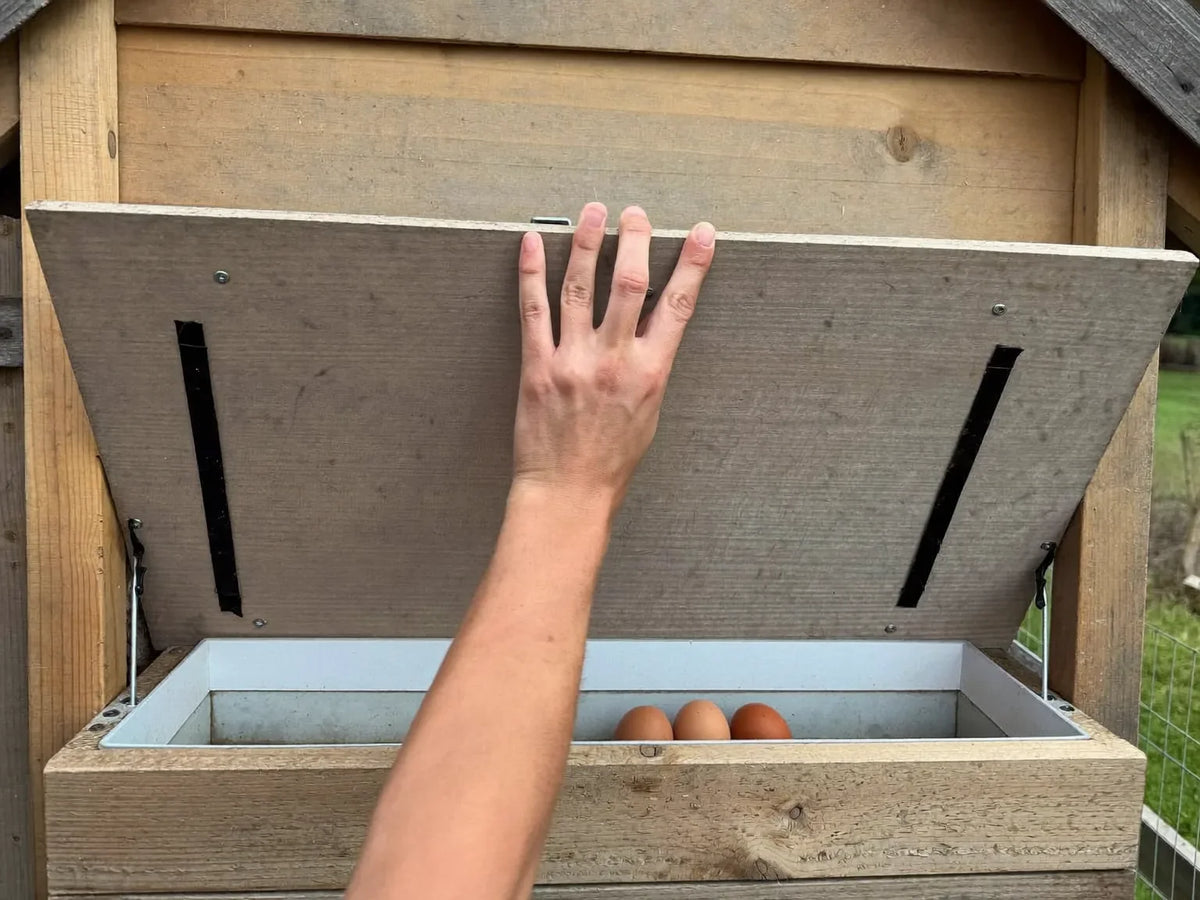
A roll away nesting box has a sloped floor, so the egg leaves the nest within seconds of being laid and settles in a covered tray the hen cannot reach. Cleaner eggs are the visible result. The real target is breakage, because Penn State Extension calls egg eating a habit that is "extremely difficult, if not impossible, to break". Treat it as a fitting rather than a feature — a nest-floor slope is something you check for, not something a spec table volunteers — and the decision at the point of buying becomes which nest box will take one. Point us at the coop and its box dimensions come back from the maker's own drawing. Start from the coops for sale.
Egg-eating, broodiness and nest-padding claims on this page each carry a named extension publication, cited below. The slope-to-angle arithmetic is ours and it is shown in full.
How does a roll away nesting box work?
A roll away nesting box works in one movement. The hen lays onto a floor that slopes away from her, the egg rolls off under its own weight, and a lip at the bottom edge stops her following it into the tray where it lands.
Four parts have to agree for that to happen. The floor has to fall in one direction. The surface has to be smooth enough that an egg crosses it, which rules out loose bedding piled deep. The exit gap has to be tall enough for an egg and low enough that a hen's foot does not go through it. And the tray has to be shaded, because an egg sitting in the open is an egg in view.
Only the first of those is a number, and it is the one nobody publishes. The rest are things you can see are right or wrong on the first morning you use it — which means the only thing to settle before you buy is the box the mechanism has to go into. Start with the nest boxes on the coops with a run attached, because a coop that stays put is where a roll-away pays best.
Is a roll out nest box the same thing?
Roll out nest box, roll-away nest, rollaway nest — three names, one mechanism, which is a nest floor that does not hold the egg. What genuinely varies between designs is which edge the egg leaves by, and whether the tray it lands in can be reached without opening the coop.
Front-roll designs put the tray on the wall you already walk up to. Rear-roll designs put it behind the box, which is tidier inside and worse if the back of the coop faces a fence. Neither is better in the abstract; the one that suits you is the one whose tray is on the side you can stand on.
Outside access is worth searching the description for, and it is the phrase rather than the feature name you have to read. "Both boxes open from outside", "two-part hinged top" and "openable nesting box lids" are three different ways of saying the same useful thing: a lid you can lift without going in — which is the same lid a catch tray would sit under. Scan the description for any of the three before you decide a coop can't take a roll-away.
How many boxes you need and where they belong are separate questions with their own answers — the ratio the extension services publish and where a box fits inside a small coop.
How steep does a nesting box floor have to be?
Not one extension page we opened carries a slope figure for a nest box floor. The only slope Penn State Extension and Virginia Cooperative Extension put in a small-flock coop is a drainage slope on the coop floor, and the quantity they give is the word "slightly".
Penn State's wording is "Slightly slope the floor toward the door to prevent puddling in the building and make the building easier to spray out and dry between uses." Virginia's is the same instruction in near-identical words. The two pages share co-author Phillip J. Clauer, so that is one instruction printed twice and not two services arriving at it separately.
So any degree figure you find for a nest floor is somebody's build, not a published standard. What we can give you honestly is the arithmetic, which is ours and which you can redo. A nest floor's angle is the arctangent of the drop divided by the depth of the box. So the box's inside depth is the number to hunt for on a listing — and when it isn't printed, ask for it before you order, because nothing else substitutes for it. Assume the shallow end while you wait: 12 and 12.8 inches are both real published nest-box depths, and the table runs on those two.
| What you measure, back edge to front edge | Angle over a 12 in nest floor | Angle over a 12.8 in nest floor |
|---|---|---|
| A drop of 0.5 in | 2.4° | 2.2° |
| A drop of 1 in | 4.8° | 4.5° |
| A drop of 1.5 in | 7.1° | 6.7° |
| A drop of 2 in | 9.5° | 8.9° |
| A drop of 2.5 in | 11.8° | 11.0° |
| A drop of 3 in | 14.0° | 13.2° |
The table converts and it does not prescribe. It turns a drop you can measure with a ruler into an angle, and an angle somebody quotes into a drop you can check. It says nothing about which row moves an egg across a nest liner, and nothing about which row a hen will still sit on. Anyone who tells you the number is telling you about their own box.
Check the maker's own arithmetic while you are in there, because it does not always survive a calculator. A nest box stated as 38 by 12.8 inches and called 3 sq ft is neither figure: 38 by 12.8 is 3.4. Multiply the two dimensions yourself before you trust the area, and if they disagree, say so: we will have the box figures confirmed by the manufacturer.
Why do chicken nesting boxes end up with dirty or eaten eggs?
Two things happen to an egg that stays in the nest: it gets stood on, and it gets sat on by the next hen in. University of Georgia Extension puts the consequence plainly — "prolonged stays in the nest can result in eggs being soiled or broken".
Breakage is where the expensive version starts. Penn State Extension's egg-eating page opens on it: "Egg breakage is a major reason why hens start eating eggs." The habit that follows is the part you cannot undo, and Penn State is blunt about that too — "Egg eating by hens is a habit which is extremely difficult, if not impossible, to break. It is important you manage your facilities so the hens never taste a broken egg."
Penn State's own answer is a schedule, not a device. "Prevention is the only proven treatment. Collect eggs often and early in the day. Most hens will lay before 10:00 a.m. each morning. The longer the eggs are in the barn, the better the chance they will break or be eaten." Nowhere on that page is a roll-away mentioned. The whole case for the mechanism is that it performs the instruction on mornings when you cannot.
Be careful about counting sources here. The eXtension write-up on egg eating, by Dr. Jacquie Jacob of the University of Kentucky, lists Phillip Clauer's Virginia Tech piece under its own further reading, and Penn State's page carries Clauer as author. The two extension texts on egg eating we opened for this post are one lineage. Georgia's circular, written by Claudia Dunkley, is a genuinely separate voice, and it is the only one of them that attaches a per-day figure to collection: "eggs should be frequently collected, at least four times daily, and should not be left overnight in the nests" — written about hatching eggs bound for an incubator. For table eggs the same circular gives no number at all. The published collection rule for table eggs sits with the nest-box guide.
Worked out what you want the nest floor to do? Take 10% off the coop you fit it into. GET MY 10% CODE
Do chicken laying nest boxes stop a broody hen?
No, and the claim that they do is the one worth checking hardest. A roll-away takes away one trigger for broodiness, not the state itself. University of Kentucky Cooperative Extension is explicit that some hens "may not even need eggs to become broody. That is, they may brood in a nest with no eggs."

Kentucky's ASC-247 does back the mechanism halfway. Its instruction is "To discourage broodiness, collect all eggs as frequently as possible", which is exactly what a sloped floor does all day. But the same publication hedges the trigger itself: "Leaving eggs in a nest may trigger a hen to become broody, but that is not always the case." Discouraging is not preventing, and a serial brooder will sit on an empty nest.
The cost runs the other way too. Kentucky notes that a broody hen "can serve as a natural incubator for any fertile eggs you might want to hatch", and Georgia's circular starts its collection advice with the exemption: "If you intend to allow the hens to hatch their eggs, egg collection is not necessary." A nest that removes every egg within seconds is a nest you cannot hatch in. If chicks under a hen are ever on your list, one box stays flat or the slope has to be blockable.
Bedding is the second cost, and it is a real collision rather than a preference. Penn State asks you to "Keep 2 inches of clean, dry nesting material in the nests at all times" as protective padding against cracking. A floor holding two inches of loose shavings is a floor an egg will not cross. The roll-away trades that padding for a much shorter stay in the nest, and the thin liner it needs instead is a different job from what goes in a conventional box.
Can you build DIY chicken nesting boxes that roll?
Building one is mostly subtraction. A nest box you already own becomes a roll-away when its floor is replaced by a sloping panel, its front edge gains a lip, and the egg lands somewhere covered. Three measurements decide whether that is possible in the box you have.
| What to measure | Why a roll-away needs it | How to get it when the listing doesn't print it |
|---|---|---|
| Inside depth of the box | The run the egg has to cross. A shorter run needs less drop for the same angle | Ask for the inner depth, not the box's outside dimension. Published depths of 12 in are real, so plan for the shallow end until you have the figure |
| Whether the dividers come out | A one-piece sloping floor cannot be fitted around a fixed divider | Some descriptions say "removable dividers" outright. Where it is silent, it is a one-line question — and a photograph will not settle it |
| Lid access from outside | A tray you can only reach by going in has moved the chore, not removed it | Start in the description rather than the spec table — search it for "outside", "hinged top" or "lid" before you ask anyone anything |
| Whether a sloped floor or egg tray is already fitted | Would save you the whole conversion | Ask rather than infer — a photograph will not show you a two-degree fall. Give us the model and the maker can answer it in writing |
The tray has to live somewhere, and that is the constraint the drawing hides. Adding a catch tray to the front pushes the box outward by its own depth. On a coop that has to go through a side gate, outward is width you may not have, and the alternative — taking the depth out of the nest instead — makes the box shallower than the box you measured.
Retro-fitting a box to a coop you bought puts screws through a wall that cannot give them back. Send the listing over and say where the box would go, and we will press its maker for a yes or no on modifications before anything goes through a wall. Building the whole coop instead is its own decision, and it changes the answer, because a box you designed can carry the slope from the start.
What a coop that moves does to the slope
A nest floor's angle is measured against the horizon, not against the coop, so where you park changes it. A ground fall of one inch per foot works out at 4.8 degrees — the same angle as a one-inch drop across a 12-inch nest floor. The slope you built and the slope you parked on are the same size.
The two slopes add or cancel, depending on which way round the coop sits. Park with the fall running the way the egg rolls and the nest is twice as steep as you built it. Turn the coop end for end on the same ground and the floor is flat. Park across the fall and the egg goes sideways into the box wall instead of forward into the tray, which is the version that looks like a broken mechanism and is not.
The addition only holds while the fall runs along the roll axis. A coop parked at an angle to the slope splits the difference, and no simple addition covers it — which is the honest reason the fix here is a check rather than a specification.
The check takes two seconds and it is the only one we would insist on. After each move, set one egg on the empty nest floor and watch what it does. None of the publications opened for this post says anything about a nest box in a structure that gets moved, so the arithmetic above is ours and the test is the part that settles it. If a fixed nest position matters more to you than fresh ground, the coops that stay put with a run attached are a different trade worth making.
Would we fit one?
Yes on a coop that stays where it is, with a flock big enough that nobody is at the box by mid-morning. No on a two-hen tractor you move every day, where the move already puts you at the nest before the eggs have been there an hour.
The failure we would expect from a badly judged slope is not a broken egg. It is a hen that stops using the box — Penn State already tells keepers to discourage floor nesting, and a nest that feels wrong underfoot gives her a reason to look elsewhere. That expectation is ours, not a published finding, which is exactly why the egg-on-the-floor test beats a number copied off a forum.
Being wrong is cheap to correct and annoying to live with. A slope too shallow leaves the egg in a nest you have already stripped of padding, which is the worst of both arrangements. A slope too steep is a ramp with a hen standing on it.
So pick the box first and the fitting second. Name the coop and your flock size, and the nest-box depth, the lid style and the divider detail come back from the manufacturer — ask first or order first, whichever suits. If the flock is going out on grass, start with the coops that move; if the boxes need to sit still in one place, look at the coops that come with a run. Everything we carry is on one page.
Sources: Penn State Extension, "Prevention of Egg Eating in Chickens" (Phillip Clauer; reviewed by Dr. Paul Patterson; updated October 4, 2023) — accessed August 21, 2026 · University of Georgia Extension, "Maintaining Good Egg Quality: A Guide for Small Producers", Circular 1230 (Claudia Dunkley, published with full review July 28, 2026) — accessed August 21, 2026 · University of Kentucky Cooperative Extension, "Broodiness in Chickens", ASC-247 (Jacquie Jacob and Tony Pescatore, issued August 2021) — accessed August 21, 2026 · Penn State Extension, "Small Scale Poultry Housing" (Gregory P. Martin and Phillip Clauer) and Virginia Cooperative Extension, "Small-scale Poultry Housing", 2902-1092 (Leonie Jacobs and Phillip J. Clauer) — accessed August 21, 2026; those two pages share co-author Phillip J. Clauer and are one voice published twice, and Penn State's egg-eating page carries the same author, so the eXtension article that cites it is the same lineage rather than a second opinion. Nest-box depths (12 in and 12.8 in inner), the 38″ × 12.8″ box stated as 3 sq ft, the removable-divider description and the outside-opening lid wordings ("both boxes open from outside", "two-part hinged top", "openable nesting box lids") are each a manufacturer’s own published wording, including PawHut.
Frequently asked questions
Where to buy chicken coop with nesting boxes?
Buy the coop for its nest box rather than for the box count. Three things decide what you can fit later: the inside depth of the box, whether the lid opens from outside, and whether the dividers pull out. Our range sits on one page, coops for sale. We will get the box dimensions from the manufacturer where the listing does not carry them.
When to put nesting boxes in chicken coop?
Before the first egg. Dr. Jacquie Jacob's eXtension article on egg eating treats it as a training step: transfer pullets to the layer house and train them to use the nests before they begin laying, with roosts provided during the growing period to encourage nest use. With a roll-away, run it empty for a week first. A floor that will not move an egg is much easier to fix before there are eggs on it.
How to add a nesting box to a chicken coop?
Measure first. You need the inside depth of the space it will sit in, the height of the opening it hangs off, and a wall that can carry the box loaded. An external box bolted through a coop wall wants the care of a window: sealed along the top edge and pitched to shed water. On a bought coop, name it and we will check what its warranty says about drilling.