

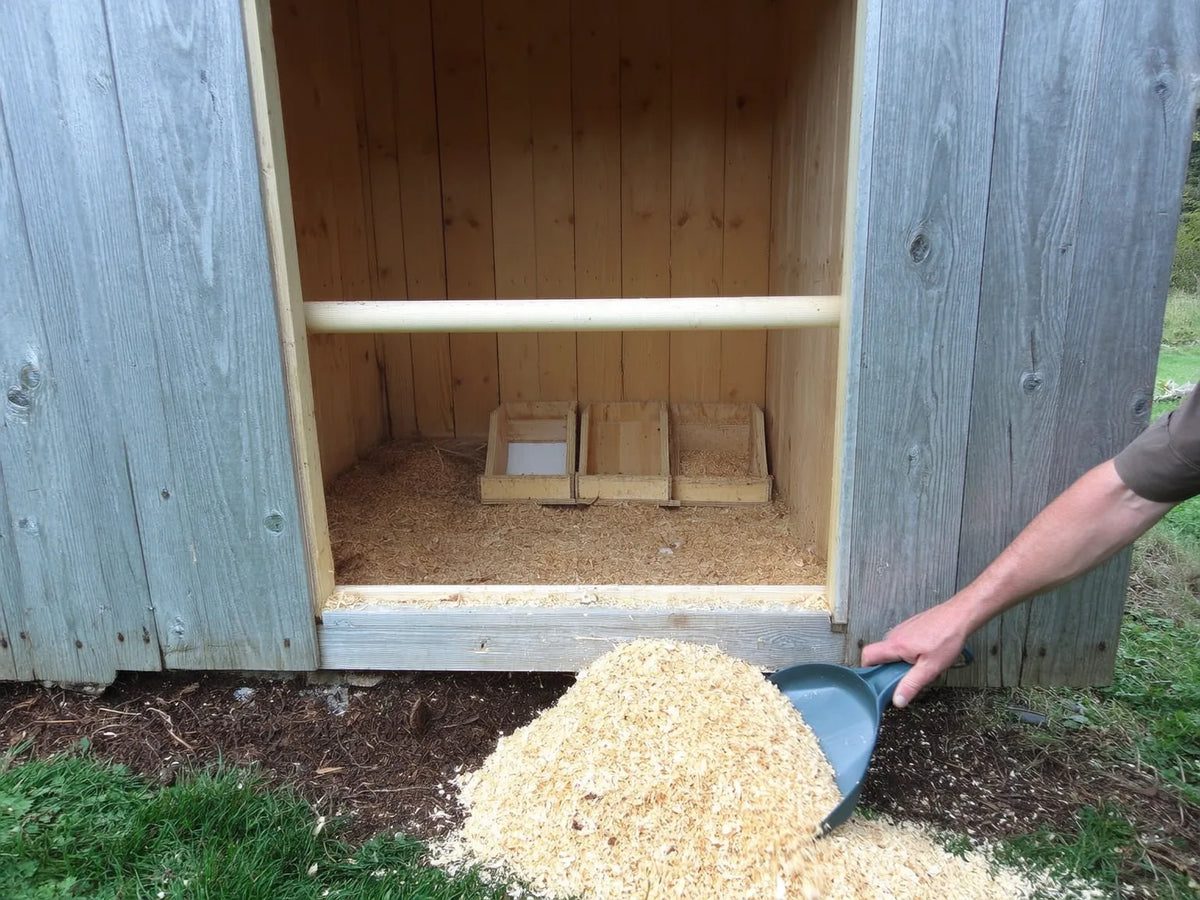
An easy to clean chicken coop interior is one where every surface a hen soils can be reached, lifted out or washed. The pull-out droppings tray is the cleaning feature this market sells, and it is a real saving: pull it, empty it, slide it back. It is also the feature a listing leads on, so it is the one to look past. The perch bars, the nest interiors and the corners are surfaces a tray never touches, and they decide how long the job takes. This is the pre-purchase version of the question: four surfaces, and the answer to get on each before you order. Name the coop you are choosing between and we will chase whichever interior spec is missing. Start from the coops for sale.
Disinfection order, bleach dilution and the warning about nest pads all come from the extension publications cited below. The pre-purchase questions built on top of them are ours.
What makes a chicken coop interior easy to clean?
An interior is easy to clean when every soiled surface can be reached, lifted out or washed down. That is a materials question before it is a layout question, and one published sentence puts it exactly that way.
Virginia Cooperative Extension's housing publication gives the instruction plainly: "Use building materials which will be easy to clean and disinfect." Penn State Extension's housing page carries that sentence word for word. Read it as one author appearing twice, not as two services independently agreeing — Phillip J. Clauer co-authors both documents, and identical wording is evidence of a shared author, not of independent support.
The instruction is about the building, not about a routine. It asks you to judge the box before the birds go in it, which is a question a listing can answer and a photograph cannot.
University of Minnesota Extension names the surfaces that have to take that treatment. Its annual clean-out instruction: "Disinfect the inside of the coop, including troughs, perches and nests." Three surfaces, and a droppings tray reaches none of them. Minnesota also publishes the dilution, which is rare in print at all: "To disinfect, use one tablespoon of chlorine bleach in one gallon of boiling water."
Where those fittings sit relative to each other is a separate question, and our guide to what fits inside a small coop works through the distances. This page is about the surfaces themselves.
Chicken coop interior design: the four surfaces that hold muck
Four surfaces inside a coop collect droppings, and each one wants a different tool. The floor under the roost takes the overnight load. The bars take what dries onto them. The nests take mud, bedding and the occasional broken egg. The corners take dust.
| Surface | What lands on it | What actually shifts it | What to settle before you order |
|---|---|---|---|
| Floor under the roost | The overnight load — the heaviest single deposit in the coop | Pull the tray, or strip and replace the litter | Whether the tray draws all the way out, on the side you will be standing on, and how deep it is |
| Perch bars | Droppings that dry onto the top face and stay there | Scrape along the bar, then wash — Minnesota names perches in its disinfect list | Whether the bars lift out. A removable bar turns a scraping job into a rinsing job, and it is worth asking about by name |
| Nest interiors | Bedding, mud off feet, broken egg | Lift the material out whole and replace it; wash the box | Whether the lid lifts from outside the coop, and whether a shallow tub will drop into the box |
| Walls and corners | Dust, feather down, cobwebs | Brush down before anything wet goes near it | Which faces are finished. A sealed wall wipes; bare timber soaks and keeps what soaked in |
The order matters more than the tools. Minnesota's own sequence starts by emptying the building — "All feeders should be removed and bedding completely cleared out" — then "Remove dust and cobwebs from the corners of the coop", and only then the wet work. Wash first and the dust turns to paste. Leave any of the four for long enough and it stops being a cleaning question, which is the subject of our guide to what a dirty coop attracts.

What the coop is standing on changes the last step, because a coop you can move onto fresh grass leaves part of the problem behind instead of carrying it.
Does a pull-out tray do the cleaning for you?
No. A pull-out tray moves the overnight load from under the roost onto a tray you still have to carry, empty and rinse. It takes the worst of the four surfaces off your hands, and it takes exactly that one.
Coops in this category carry the idea that they look after themselves. Nothing in the category does, and the tray is where that idea comes from. It is worth having — it is the difference between kneeling in a box with a scraper and standing outside it with a bin — but it is a collection device, not a cleaning method.
Read the tray's reach honestly and the point makes itself. Minnesota's disinfect list is troughs, perches and nests. A tray sits under the roost. It never meets a nest box, it never meets a bar, and it never meets a wall. How much lands on it in the first place is a question of flock size and appetite, worked out in our guide to how often chickens actually go.
If the listing dimensions the tray, our layout guide runs the arithmetic that matters — how much of the floor it covers, and how its depth stacks up against a published litter depth — in how the tray and the litter compete. What goes on top of it is a bedding decision, and that lives in our guide to coop bedding and flooring.
Judging a coop on how it cleans rather than how it photographs? Take 10% off the one you land on. TAKE 10% OFF
What to settle about the tray and the finish before you order
A tray row on a spec table can be one word or it can be four facts, and the difference is most of your Saturday. Four things decide whether that tray shortens the job. Read the row, find which of the four it gave you, and chase the rest.
| What the tray row has to tell you | Why it decides the job | What to do when the row is silent |
|---|---|---|
| Whether it can be washed | A tray you can rinse is a two-minute job. A tray you have to scrape dry is a fifteen-minute one, in the same clothes you were wearing | "Hose-rinsable" is the phrase a maker writes when it is true, so search the description for it. Failing that, line the tray with something washable and the answer stops mattering |
| What it is made of | Metal takes a hose, a scraper and a full load without flexing. A "leak-proof pull-out metal tray" or a galvanized one is telling you it will survive being emptied weekly for years | Ask for the material outright. A photograph will not show you gauge, and a full tray is heavier than an empty one looks |
| How far it draws out, and which side | A tray that clears only half its own length has to be lifted over the frame with both hands full. One that comes out of the side facing your fence is worse | Ask for the draw direction, then go and stand where you would stand and check you have the room to swing it |
| How deep it is | Depth decides whether a week of droppings and litter sits inside the lip or spills down the frame on the way out | Ask, and plan on the shallow end until you hear back. Our layout guide runs the tray-against-litter arithmetic wherever a depth is published — see how the tray and the litter compete |
Some shapes have no tray at all, and that is a different cleaning model rather than a missing feature. An open walk-in shell sold without a hen house has nothing underneath the birds: the floor is whatever ground you stood it on, and the clean-out is a move rather than an empty. If that suits your yard, the walk-in coops are the shape to look at — standing height is the single biggest thing that shortens a clean-out, because every surface is already within arm's reach.
The finish is the bigger silence, and it decides whether a wall can ever be washed at all. Read the coating claim carefully when you find one: "weather-resistant paint" is a promise about the outside of the coop in the rain, and it says nothing about which faces the coating goes on. A sealed wall wipes; a wall of bare fir soaks and keeps what soaked in. Our guide to painted and white coops works through what a coating claim covers, and whether to add a coat yourself is answered in what should be inside a coop. On the coop as it arrives, ask us: we will read the maker's own documentation back to you on which faces are finished.
Roosts are the last question and the easiest to forget, because a bar you can lift out is rinsed in a sink instead of scraped in a crouch. Ask whether the perches are removable, by that word. Our chicken roost guide covers what a bar's length, height and section change about everything else.
Which chicken coop interior ideas actually shorten the clean-out?
Chicken coop interior ideas that shorten a clean-out all do one thing: they turn a surface you have to scrape into a surface you can lift. Anything else added to the inside of a coop is one more object to wipe around.
Line the tray rather than scrape it. A sheet of something washable, cut to the tray and sitting loose in it, means the tray itself stays clean and the weekly job becomes lift, tip, drop a new one in. It costs nothing, it comes out with the tray, and it does not touch the coop.
Make the nest material liftable in one piece. Penn State Extension is blunt about the obvious alternative: some producers cut carpet pads for the bottom of the nests to stop breakage, but "these can easily become contaminated with bacteria and harbor mites" unless they come out and get cleaned or replaced often. A handful of bedding you can lift out whole does the same job and leaves nothing behind.
Give the tools a home on the coop. Penn State again, and it is the least glamorous line in the whole publication: "Also have a location to hang your cleaning tools so they are easy to access when they are needed." A scraper you have to go and find is a clean-out you put off.
Park it with the tray facing open ground. This one is ours rather than published, and it costs nothing to get right. A tray needs its own length of clear space to draw out, so a coop reversed against a fence means moving the coop before you can move the tray. It is the same reasoning our guide to what an access door has to clear applies to the opening you reach through.
Easy made chicken coops: what you can add without cutting anything
Easy made chicken coops are sold on how fast they go together, not on how fast they come clean — but the two meet in the same place, which is how much of the interior comes apart again. Most of what helps can be added without a tool.
Things that sit in rather than fix on are the whole list: a cut-to-size tray liner, a loose board laid on the floor under the bars, a shallow tub inside the nest box that lifts out with the bedding in it, a hook over a rail for the scraper. Nothing there is fastened to the coop, and each one takes a surface off the scraping list.
Anything that fixes on is a different decision. A fixing driven into painted fir on a coop you bought lets water reach the end grain, and the hole is permanent, so read the manufacturer's terms first — then say which coop it is and the fixing question goes to its maker while you are still deciding.
Which easy chicken coop ideas would we skip?
We would skip three of the easy chicken coop ideas that look like savings. A carpet pad in the nest box, a bare timber floor you plan to hose out, and any coop judged on how many access doors it has rather than how big they are.
The carpet pad is the one with published guidance against it. Penn State Extension warns that pads cut for the bottom of a nest "can easily become contaminated with bacteria and harbor mites" unless they are removed and cleaned or replaced frequently. The whole appeal of a pad was that it saved a job, and it does not.
A bare timber floor and a hose is the one we would argue hardest against. Water goes into unsealed fir and stays there, and the coop is then a wet building with a dry-looking floor. Penn State and Virginia Tech write their shared instruction about building materials rather than about mops for exactly this reason. Dry methods on unsealed timber, wet methods on metal and sealed surfaces, and let the finish decide which you are running.
Access-door counts read like a cleaning spec and are not one. A count of doors tells you nothing about whether your shoulders fit through any of them, and the arithmetic that does answer it — how far into a coop you can reach from a stated opening — is worked through in our door size guide. One dimensioned opening beats a listing full of undimensioned ones.
The three surfaces to settle before you order
Three answers decide the weekly job, and the coop's overall length is not one of them. Whether the tray draws all the way out on the side you will be standing on. Whether the nest material lifts out in one piece. And whether the interior is finished or is bare timber.
Ask them in that order, because each one closes a door on the next. A tray that clears its own frame takes the heaviest surface out of the building before you touch anything else. Nest material that lifts out whole removes the second surface without a scraper. And the finish decides whether the walls and corners can ever take water, which is the difference between a coop you wash and a coop you brush.
Where a listing answers none of the three, that is not a reason to wait — it is a question with an address. Give us the model and the answers come back off the maker's own paperwork while you are still choosing. Start from the coops on wheels, which take the whole floor problem onto fresh ground between cleans, or from the walk-in coops, where you stand inside and every surface is already within arm's reach.
Sources: Penn State Extension, “Small Scale Poultry Housing” (Gregory P. Martin, Ph.D., PAS and Phillip Clauer; updated June 25, 2026) — accessed August 21, 2026 · Virginia Cooperative Extension, “Small-scale Poultry Housing”, publication 2902-1092 (APSC-186NP) (Leonie Jacobs and Phillip J. Clauer, April 28, 2023) — accessed August 21, 2026. The Penn State and Virginia Tech pages share co-author Phillip J. Clauer and print the materials instruction quoted above in identical words, so they are one voice published twice rather than two services agreeing · University of Minnesota Extension, “Raising chickens for eggs” (Betsy Wieland and Nora Nolden; Sabrina Florentino, Extension educator; reviewed 2025) — accessed August 21, 2026, and independent of both. The tray and finish wordings quoted in this guide — “hose-rinsable”, “leak-proof pull-out metal tray”, a galvanized pull-out tray, and “weather-resistant paint” on fir — are each a manufacturer’s own published wording, including PawHut.
Frequently asked questions
How to clean chicken eggs from coop?
Neither extension page opened for this guide publishes a washing method, and both put the effort earlier than the sink. University of Minnesota Extension's daily list says to pick up eggs twice a day, which is the biggest single reduction in dirty eggs. Penn State Extension asks for clean, dry nesting material kept topped up at all times. Rules for washing and storing eggs you intend to sell are set by your state department of agriculture.
How to keep chicken coop clean?
Between clean-outs, keep it dry and keep the load off the floor. Pull the droppings tray on its own rhythm instead of waiting for the full job. Brush the corners before dust turns into cobwebs, which University of Minnesota Extension lists as a step of its own. Top up nest bedding rather than letting it pack down, and keep the water source outside the house wherever the design allows it.
How to build an easy to clean chicken coop?
Choose materials before fittings. Virginia Cooperative Extension's housing instruction is to use building materials that are easy to clean and disinfect, and that one decision outranks everything added later. Then build the surfaces so they come apart: a tray that clears its own frame on the side you stand, nest material that lifts out whole, and nothing fixed down where a scraper has to reach past it.