

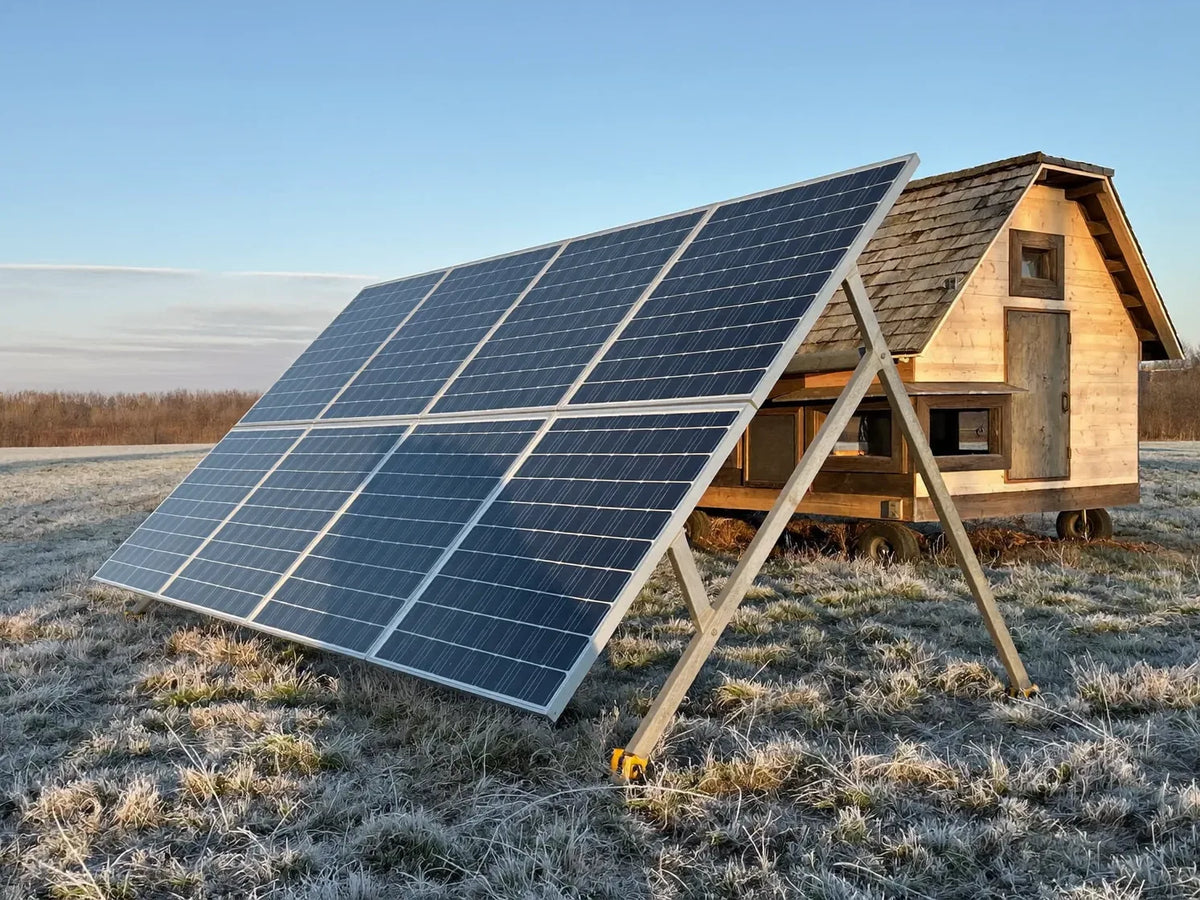
A solar chicken coop heater is a low-watt radiant panel run off a solar-charged battery, not a device that turns sunlight straight into warmth. The problem is the calendar. At Minneapolis, a horizontal panel collects about 1.33 kilowatt-hours per square metre on an average December day and 6.02 in June, so the thinnest sun of the year lands in the month the heater works hardest. Tilt the same panel steeply south and December roughly doubles. Even then, a twelve-hour northern load needs a panel several times the heater's own rating, which makes this a cord decision before it is a panel decision. Start from the coops that roll, because the array follows wherever the coop parks.
The insolation figures are NASA's, the panel arithmetic is ours and shown in full so you can rerun it for your own latitude.
What is a solar chicken coop heater?
Two different things get sold under that name. One is an electric radiant panel powered by a photovoltaic panel, a charge controller and a battery. The other is passive: sun through glass, warming the coop while it shines. Only the first makes heat at four in the morning.
The passive version is real, and the extension literature backs it. Virginia Cooperative Extension tells you to "Face the front of the coop, the windows, and the outside run to the south, this will allow the sun to warm and dry the coop and soil." The same page names the payoff: "Windows placed on the southside of the coop will also be a good source of light and warmth in winter and a good source of ventilation in summer."
Timing is what passive gain cannot fix. The gain arrives at midday, and the coldest hour inside comes half a day later, just before dawn. Storing that warmth takes mass, and a fir coop with a shingle roof has close to none of it.
The electric version is a small off-grid power system with a heater on the end. Every question that follows is an energy question, not a heating question. Whether your flock needs the heat at all is a separate argument, and the heated-coop guide makes it properly.
University of Minnesota Extension sets the trigger this post assumes you have already crossed: "Provide supplemental heat when coop temperatures fall below 35 degrees Fahrenheit," positioned "at the height of the nest boxes or lower rung of the roost." Not every flock gets there, and it is a reading taken inside the coop rather than outside it, so hang a thermometer at roost height and read it on a cold morning before you price anything.
Is a radiant heater for a chicken coop the same thing as a solar one?
No, and the two words describe different halves of one machine. "Radiant" names how the heat reaches the birds. "Solar" names where the electricity came from. A radiant heater for a chicken coop is what almost every solar setup ends up running.
Minnesota Extension is precise about the delivery half: "Radiant heat sources heat the birds but not the surrounding air space," and "Radiant heaters include brooder plates, panels, and hanging heaters." Which of those is safe, how it mounts and what it costs on mains power are all answered in our coop heater buying guide.
Radiant matters more on solar than on mains, for one reason. A healthy coop pushes its air out through vents by design, so watts spent warming that air leave the building with it. On a grid circuit you pay for the waste in cents. On a battery you pay for it in panel area, and panel area in December is the scarcest thing you have.
Voltage is the other half of the label to read. A battery is direct current; most coop panels sold for houses run on 120-volt alternating current and need an inverter, which takes a cut of every watt-hour on the way through. Some units state a low-voltage DC input and can be fed from the battery directly. Where a listing states neither, assume 120-volt AC and budget an inverter into the losses — or ask us to confirm the input voltage with the manufacturer before you order, at sales@moveablechickencoop.com.
How much sun does a December day actually deliver?
Less than most sizing advice assumes, and least where the heat is wanted. Solar people count a day in peak sun hours. University of Maryland Extension defines the unit: modules "are rated under these standard test conditions which specify a solar irradiance of 1,000 watts per square meter," and one peak sun hour is an hour's worth of energy delivered at that intensity.
Maryland puts the same idea the other way round. Peak sun hours are "the number of hours in a day that the sun would need to shine at its 'peak intensity' (i.e., 1 kW/m²) to provide the actual daily amount of solar insolation." So a December day worth 2.6 kilowatt-hours per square metre runs a panel at its nameplate rating for 2.6 hours, and gives you nothing for the other twenty-one.
Here is what December pays out, from NASA's twenty-year monthly climatology, sorted worst first by what a flat panel collects.
| Where | Flat, December | Tilted for December | That tilt | Flat, June |
|---|---|---|---|---|
| Seattle, WA | 0.87 h | 1.77 h | 66.5 degrees | 5.78 h |
| Burlington, VT | 1.13 h | 1.99 h | 63.5 degrees | 5.57 h |
| Bismarck, ND | 1.32 h | 2.75 h | 71.0 degrees | 6.51 h |
| Minneapolis, MN | 1.33 h | 2.62 h | 68.0 degrees | 6.02 h |
| Nashville, TN | 1.95 h | 3.19 h | 58.5 degrees | 6.17 h |
| Denver, CO | 2.35 h | 4.55 h | 65.5 degrees | 7.27 h |
| Phoenix, AZ | 3.05 h | 5.35 h | 60.0 degrees | 8.47 h |
A flat panel loses between 64 and 85 percent of its June yield by December across those seven places. Seattle is the extreme: 0.87 peak sun hours, which is under a sixth of its June figure. Angle is the cheapest fix on the list, and it is free. Tilting for December lifts the harvest by roughly two-thirds at Nashville and by slightly more than double at Bismarck.
The angle that does it is steeper than the rule you will be given. Maryland's published guidance is that "To maximize year-round energy generation, a solar panel should be tilted at, or slightly less than, the local latitude." NASA's December-best angle for these same places runs from 58.5 to 71.0 degrees, which is 19 to 27 degrees steeper than each city's latitude. Year-round advice optimises the year. A heater array only has to win one month.
Read the table as a description of a typical day and nothing more. A twenty-year average sets no floor under the worst week of any given winter, and Maryland flags the reason: "The solar resource may be reduced in the winter, for instance, due to shorter days and widespread cloudiness across the state for longer periods of time." Storage is what carries a cloudy run, and the average cannot tell you how long the run will be. Your own address is one query away on the same method: NASA POWER's climatology tool returns a December irradiance in watts per square metre for any latitude and longitude, and multiplying by 24 then dividing by 1,000 turns it into the peak sun hours the next table divides by.
Worked out your December sun hours? Take 10% off the coop that has to get through them. TAKE 10% OFF
Where does the panel go on a coop that moves?
Somewhere you choose, because the array is something you site rather than something a coop comes with. Read the listing for an outlet, a grommet, a cord pass-through or a rated electrical draw before you plan a cable route; where none of those words appear, plan on adding the panel, the controller and the battery as separate purchases and getting the cable in through a vent rather than a new hole.
The coop roof is the obvious mount and the worst one. Our roof guide traced the covering minimums through the 2021 residential code and found the shingle floor at 2:12, about 9.5 degrees. December wants 58.5 to 71.0 degrees, so a panel screwed flat to a coop roof is aimed well short of the angle that month rewards. Measure your own roof's rise over one foot of run before you assume it does better.
Where the coop arrived assembled instead of being built in your own yard, read its warranty terms before anything goes through the roof covering: a fastener into a shingle is a hole you cannot un-drive, and drilling one can change what the maker still owes you. Name the coop and the mount you are picturing, and the terms arrive in writing, chased by us.

An adjustable ground frame beside the coop solves the angle and creates a second object to move. Maryland's warning applies with force in winter: "Solar panels are also sensitive to shading." A December array is aimed at a low sun, and a low sun throws long shadows, so the fence that shades nothing at midsummer can shade the whole panel at midwinter.
Moving the coop re-opens the question every time. Our coop door guide makes that point for a door motor, which sips a watt or two and forgives a bad week. A heater array does not forgive one, so choose the winter parking spot before the ground hardens and keep it clear of the fence line. The coops that roll are the ones you can pull back out of a shadow that only exists in December.
How big a panel does a solar powered heater for a chicken coop need?
Bigger than the heater, by a lot. The arithmetic for a solar powered heater for a chicken coop is two steps: watts times hours gives watt-hours per night, then watt-hours divided by peak sun hours gives the panel wattage that would replace them.
| Heater draw | Energy per night | Horizontal, Minneapolis | Tilted, Minneapolis | Tilted, Phoenix |
|---|---|---|---|---|
| 100 W panel | 1,200 Wh | 900 W | 460 W | 220 W |
| 150 W panel | 1,800 Wh | 1,350 W | 690 W | 340 W |
| 200 W panel | 2,400 Wh | 1,800 W | 920 W | 450 W |
Two things move those figures, in opposite directions. A thermostat is the one that helps: our heater guide treats one as standard fit, and a heater that only fires below Minnesota's line does not burn twelve hours. Everything else pushes the other way, and Maryland lists where the energy goes: "shading, snow cover, wiring, connections, light induced degradation, nameplate rating, system age, and operational availability among other factors." Size on the hours the heater actually runs, then add the losses on top.
The battery is the half people forget. That 1,800-watt-hour night is 150 amp-hours out of a 12-volt bank, and one night's capacity is not a design, because cloudy runs come in threes and fours. Maryland is blunt about which systems this bites: "Detailed estimates of each electrical load are particularly important for off-grid and battery-integrated PV systems to ensure that sufficient power is available when needed."
Two inputs decide the answer: your address and the number printed on the heater's label. Our heater buying guide prices the same nights on mains electricity at a dated national rate, which is the comparison most people want before they commit to an array. Give us those two and we will run the array arithmetic beside you, then confirm with the maker what your chosen coop can carry on its roof or beside it.
When is a solar power heater for a chicken coop worth the trouble?
When there is no honest way to run a cord, and only then. A solar power heater for a chicken coop does not save money on a load this small; grid electricity for a radiant panel is measured in cents a night. What the array buys is reach.
Minnesota Extension closes the easy shortcut. "Only use extension cords short term." "Do not use them to run power to your coop." "Always work with a professional electrician when installing electricity in your coop." A permanent circuit and a coop that moves are a contradiction, because the circuit is fixed and the coop is not.
Our order of operations, and we would defend every step. Get the house dry and draft-free first, which the ventilation guide and the winter guide cover between them. Then water that does not freeze. Then heat, only for the birds that genuinely qualify under Minnesota's 35-degree line. Then solar, only where the coop stands out of reach of a cord.
Getting it wrong is expensive in a specific way. An array sized on an annual average, or worse on a summer figure, works beautifully for eight months and fails on the first hard night, which is the night it was bought for. Build it in September and run it through a full overcast week while the failure is cheap. A flock that has come to depend on heat has a much harder night when the battery quits, and our heater guide explains why acclimation makes that worse.
If you are still choosing the coop itself, the parking spot is a power decision as much as a grass decision — and the coops that roll are the ones you can move back out of a shadow line that only exists in December. Work that list in order and the array is the last decision, not the first.
Getting a cable into a coop, and mounting anything to it, is a question we will put to the manufacturer for you. Send the model you are weighing and the town you keep hens in to sales@moveablechickencoop.com; back comes whatever the manufacturer states about cable entry and mounting, plus the December sun hours for your own address. The full range of coops is there to browse by flock size in the meantime.
Sources: University of Minnesota Extension, "Caring for chickens in cold weather" (Colleen Carlson and Hannah Lochner, reviewed 2026) — accessed August 20, 2026 · Virginia Cooperative Extension, "Small-scale Poultry Housing" (publication 2902-1092, Leonie Jacobs and Phillip J. Clauer, April 28, 2023) — accessed August 20, 2026 · University of Maryland Extension, "Working on Solar: Panels and Power Output" FS-2022-0646 (Drew Schiavone, updated June 28, 2023) — accessed August 20, 2026 · University of Maryland Extension, "Working on Solar: Design and System Sizing" FS-2023-0655 (Drew Schiavone, updated June 24, 2024) — accessed August 20, 2026 · NASA POWER Project, NASA Langley Research Center, Climatology API v2.9.7, parameter SI_EF_TILTED_SURFACE, 20-year monthly climatology January 2001 to December 2020 — queried August 20, 2026. Irradiance values were returned in watts per square metre and converted to peak sun hours as W/m2 x 24 / 1000; the panel-size table divides each night's watt-hours by those peak sun hours.
Frequently asked questions
When should I put a heater in my chicken coop?
Fit and test it in early autumn, not during the first cold snap. Minnesota Extension's trigger is a coop temperature below 35 degrees Fahrenheit, measured at nest-box height, so the thermostat setting matters more than the calendar date. A solar setup needs longer lead time than a mains one, because the only honest test is a full overcast week with the battery carrying the load.
How to heat a chicken coop with solar?
Size the battery to the night, then size the panel to December rather than to the year. Multiply the heater's watts by the hours it runs to get watt-hours, then divide by your December peak sun hours to get the panel wattage. Aim the panel steeply south, steeper than 60 degrees at northern US latitudes, and treat the result as a floor because every real loss makes the array bigger.
What type of heater for a chicken coop?
A radiant type, on any power source. Minnesota Extension notes that radiant heat sources warm the birds rather than the air, which is what you want in a building designed to exchange its air. On solar that stops being a preference and becomes arithmetic, because watts spent warming air that leaves through the vents cost you panel area you do not have in December.
How to run electricity to chicken coop?
Properly or not at all. Minnesota Extension's guidance is direct: only use extension cords short term, do not use them to run power to your coop, and always work with a professional electrician when installing electricity in a coop. A buried circuit is the right answer for a coop that stays put. For one that moves, that circuit is exactly what solar exists to replace.