

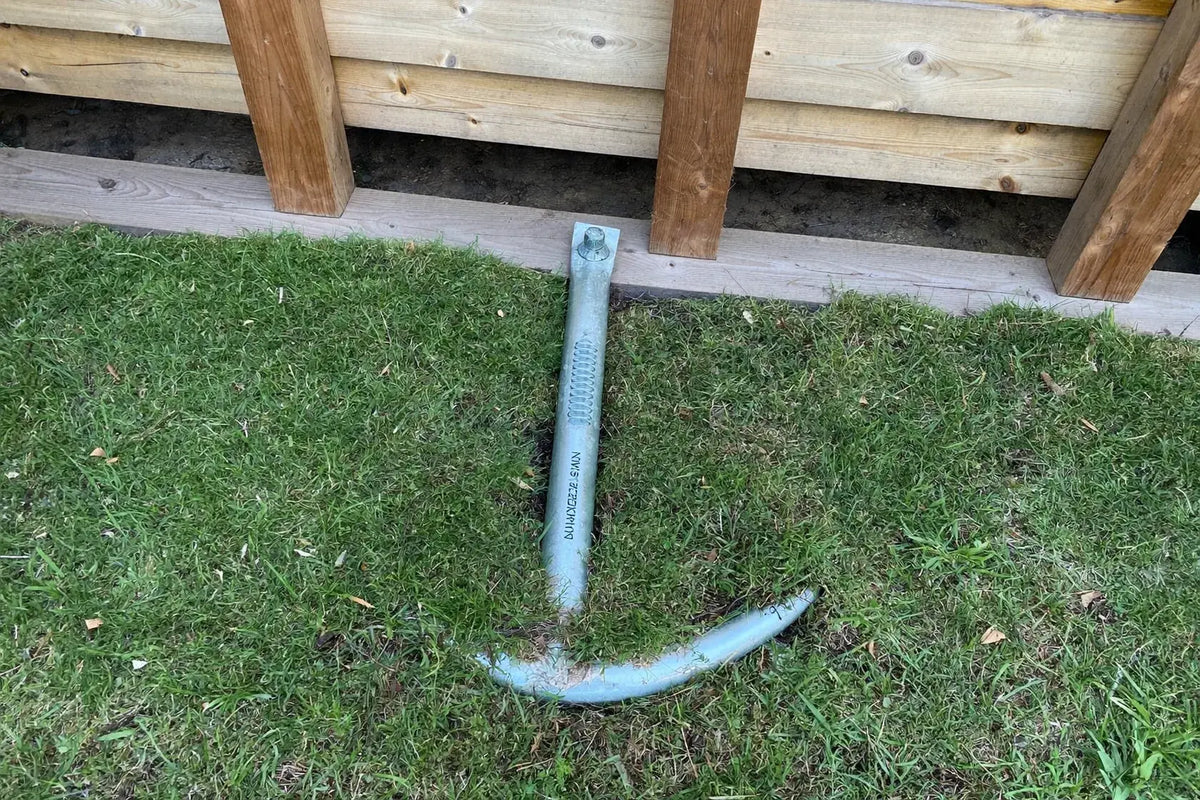
Chicken coop anchoring is the one part of siting that arrives with no hardware and no instructions. A coop light enough for one person to move is, by the same physics, a coop the wind can move — so what a moveable coop needs is a hold-down strategy rather than a permanent foundation. Two things resist wind on any light structure: the weight of the thing, and whatever grips the soil under it. So look for the assembled weight on the listing in front of you — it is half of that sum, and if it is not printed, ask for it before you order. The coops built to move are where this question actually lives.
Anchoring methods, post depths and wind thresholds come from named engineering publications, cited underneath with the structure each was written about — high tunnels, not hen houses. Where a figure will not scale down to a coop, this page says so.
The coop you can move is the coop the wind can move
Lightness is one property with two consequences. The mass that lets you shift a coop across the lawn on your own is the same mass a gust has to overcome, and no wheel, handle or clever hinge changes that arithmetic in your favour.
Lightness is not an argument against a coop that moves. It is the reason the answer has to be a different shape. A house bolted to a slab solves the problem once, permanently, and gives up the ability to be anywhere else. A coop that lands on new ground every few days has to solve it again at every stop, which means whatever you use has to be quick to fit, quick to remove, and worth doing at seven in the morning in the rain.
Reversibility is the thing you actually paid for, and every hold-down method spends some of it. That is the trade this page is about: not whether to hold a coop down, but how much of the move you are willing to give up to do it.
Why a coop moves at all already gives the short version of this question in its FAQ — anchors, augers or slabs for a coop that stays, and weight for one that does not. What follows is the long version of the second half. What the coop stands on — the load path, the levelling, what goes under a leg — is a separate decision with its own guide, and this page starts where that one stops.
What actually resists the wind on a coop that moves
Two terms carry the whole problem, and one published sentence names both. UConn Extension's high-tunnel engineering sheet writes the resisting side as "the weight of the building and the withdrawal resistance of the posts have to withstand about 300 lbs/post." Mass, plus grip. Nothing else is holding anything anywhere.
Read the figure at the right distance. UConn's 300 lbs/post belongs to a worked example that is a 30-foot by 72-foot tunnel, and it does not scale down to a hen house by eye. What transfers is the shape of the sum — mass plus grip, set against lift — not the size of any number inside it.
The pushing side of that sum is published and computable, and it has already been worked out on this site. What wind does to a stretched cover runs the pressure arithmetic from a cited extension figure, at speeds you can look up in a forecast, and it is not repeated here.
Our side of the sum is the one that goes missing. Search the listing for an assembled weight in pounds or kilograms before anything else, and when it is not there, do not read the silence as lightness. An unstated weight tells you nothing about the coop and everything about the listing — it is a blank field, not evidence that the thing is light, and it is the single most useful figure to ask a manufacturer for. What a rolling coop actually arrives with hits the same blank from the wheel side.
The face the wind pushes on, oddly, is the half you can measure yourself. A coop is longer than it is wide, so its long side is its biggest vertical surface — take the overall length and the overall height off the listing and multiply them. A coop stated at 43 inches long and 51 inches high puts roughly 15 square feet side-on to any wind crossing the garden, and you can run that multiplication on any listing in under a minute. The sail is computable from the dimensions already on the page. The weight that resists it is the field you will have to ask for.
One caution before anyone measures a run the same way. Where most of a coop's side is wire, air goes through it, and mesh is not a sail. The parts that behave like one are the solid hen house, the roof, and anything you have draped over the frame.
The hold-down options, and what each one costs at every move
Five answers exist and they are not interchangeable: mass you add, a stake driven straight into the ground, a screw-in earth anchor, a buried deadman, and a line to something already fixed. Each buys a different kind of resistance and charges for it in move time.
| Hold-down | What it actually resists | What it costs at every move | What to settle before you rely on it |
|---|---|---|---|
| Ballast in the base — slabs, sandbags, a heavier bottom rail | Lift, by supplying the term the listing left blank | Nothing, if it is fixed in and travels with the frame; a two-handed job if it is not | Whether it is fixed in. Mass that travels with the frame is hold-down; mass you carry back and forth is a chore you will stop doing |
| Stake or peg, driven beside or through a rail | Sliding, and lifting only as far as the soil holds the stake | Out at one end of the move, in again at the other, every time | Your soil. Push one in by hand where the coop will actually stand — ground that takes it easily will let it go just as easily |
| Screw-in earth anchor, the auger type UConn names | Lift, by biting below the soft surface layer | Slower in and slower out than a stake, but it comes out cleanly | The depth. Turning it in past the soft surface layer is the entire point of the type, so match the helix to the ground you have |
| Deadman — a plate or bar buried and backfilled | Lift, using the weight of the soil sitting on top of it | It does not move. You dig it out, or you leave the coop where it is | Whether the coop is still moving. This one ends the mobility quietly, so decide that first rather than discovering it in March |
| Line to something already fixed — a post, a wall | Lift and slide, by borrowing an anchor you already own | Two knots and a tension check, plus a tie point on the coop | The fixing point, before you buy the strap. Ask us whether the base frame on the coop you are weighing up has one meant to take a pull |

Every row there is a method rather than a rating, and that is deliberate. Nothing in the small-flock literature swept for this page publishes a holding figure at coop scale in any soil — the sweep is two sections down — and a number invented to fill that space would be worse than the space.
Which brings up the part that decides whether half that table is available to you: what on a bought coop can take a pull. Where a solar panel bolts to runs into the same wall from the other side, because a strap wants exactly what a panel wants — a named point on the structure to fasten to. So find that point before you buy the hardware, and send us the coop if the listing does not name one. Our own view, offered as a view and not as a rule anyone has published, is that a line belongs on the lowest structural member you can get it around — the base frame, not a roof panel and not run mesh, both of which are skins fastened to something else.
Already picked the sheltered corner of the yard? Take 10% off the coop that goes in it. TAKE 10% OFF
For a light arch you build yourself rather than buy, the panel build's anchoring chapter makes a straight call between ballast and stakes for a pen moved daily, and this page does not re-argue it.
Does the small-flock literature say anything about holding a coop down?
No. Nine small-flock publications were fetched and swept for anchor, auger, stake, peg, tie-down, tether, ballast, guy rope, uplift, blown over and overturn. The result is zero, on every page, for every one of those words.
The nine are Penn State's small-scale housing guide and its pastured-broiler guide, Virginia Cooperative Extension's housing publication, Minnesota's laying-flock and cold-weather pages, New Hampshire's egg guide and its winter blog, Oregon State's chicken-tractor study, and Maine's pullet-housing sheet. Penn State's housing page and Virginia's share a co-author, so read that pair as one voice printed twice — which lowers the number of independent silences without changing the zero.
Wind appears constantly in those pages, and never once as a force on the building. It is always wind reaching the birds: cold air at roost height, gaps to seal, openings to put on the sheltered side. Where the vents should sit relative to the prevailing wind is a well-covered question with real published instructions behind it. What holds the house still is not.
The single exception makes the point better than the absence does. Penn State's broiler guide is the one page in the set that uses the word windbreak, and it uses it the other way round: "A chicken tractor is a small and mobile structure that shades the chickens from the sun, keeps them dry in the rain, provides a windbreak, and protects them from predators while allowing them free access to the pasture." In the whole small-flock literature, the tractor is the thing sheltering something else. Nobody has written down what shelters the tractor.
Take that absence for exactly what it is worth. It proves nobody has published a method. It proves nothing about whether a coop needs one, and it is not permission to skip the question.
The published anchoring specs were written for tunnels, not coops
The nearest published engineering for a light structure that has to stay where it is put was written about high tunnels, and it is unusually direct. UConn Extension's John W. Bartok Jr. names the failure modes first — "This presents the problem of keeping the tunnel from collapsing or tipping over from heavy snow and wind conditions." — and then gives the fixed method.
The method is a hole in the ground. "To anchor the tunnel to the ground, posts are driven into the ground 24″ to 30″ deep to support the hoops." Where that is not enough: "In windy locations, additional anchors are needed. These can be auger or screw type and placed about 10' apart." And where even that is not enough: "An alternative is to install deadmen." One more clause is worth having, because it names a failure that is not lift at all — "The frame should have diagonal bracing on the four corners to keep it from racking in strong winds." Wind shoves as well as lifts, and a light frame going out of square is the quieter of the two.
Every one of those figures belongs to a tunnel. The depths, the spacing and the per-post load are sized for a structure tens of feet long, and quoting them at a hen house would be borrowing authority rather than using it. What the page is genuinely good for is the vocabulary: post, auger anchor, deadman, bracing. Four named methods, one of which a coop that moves can actually use.
Then the same page does something that is easy to miss. It has a section on movable tunnels — weld the hoops to a steel angle bent up to form a skid, pull it with tractors or winches, or run it on V-groove wheels along inverted angle iron. It specifies the moving. It says nothing whatever about holding a movable one down. The only publication we found that specifies anchoring a light arched structure specifies it for the version that stays put, and goes quiet on the version that does not.
Penn State Extension's high-tunnel production page is a second set of authors at a second institution — Thomas Ford, Lynn Kime, Jayson K. Harper and Stephen Bogash, updated March 2023, sharing no byline with Bartok — and it answers a different question: not how to anchor, but how to manage. It sets a threshold, "A concern for all high-tunnel structures is high wind (exceeding 60 mph)." It also cuts against the obvious move: "Whether the high-tunnel structure is constructed parallel to or perpendicular to the prevailing wind direction may not be as critical as the width of the structure and number of purlins added to reinforce the high tunnel." And it offers a move you can make on the day, which is to open the structure up rather than seal it — "Some designs recommend that in high winds, both sides of the high tunnels be rolled down to enhance air flow over the tunnel and minimize damage, while others require their sidewalls to be fully open."
Read across to a coop, that last one is the only free action on this page. Air that goes through is air that is not pushing, which is why an open mesh run is a different object in wind from the same run under a tarp. It is a direction, not a rating, and it was written about polythene rather than poultry.
The clause that matters most, though, is the plainest: "Follow manufacturer's recommendations on constructing the tunnel for the optimum wind defense and how the sides should be set based on predicted winds." Penn State's instruction is to do what the maker tells you. Which is where a backyard coop runs out of road.
What a listing's wind words are actually worth
Windproof is a marketing word doing an engineering job, and it should be read as one. A spec table's Weather row tends to arrive as a string of proof-words — rainproof, windproof, UV-resistant, corrosion-resistant — with no speed behind any of them, no test named and no load stated. That tells you what the maker intended. It does not tell you what the coop will take.
Two checks turn the word back into information, and both take a minute. Read the Weather row against the Wheels row on the same spec table. A wind claim on a coop with no wheels was written about a building that was never going to leave its spot, and it says very little about a coop you are going to roll out onto open lawn. Then search the whole listing — title, description and every spec field — for tie-down, tether, strap, ratchet, eye bolt, D-ring, anchor, auger, stake, peg, spike, guy, rope and ballast. Penn State's high-tunnel instruction is to follow the manufacturer's recommendations; that search is how you find out whether there are any to follow.
Which durability words attach to which part of a coop is worked through properly in our buying-mistakes guide, so the general reading is not re-run here.
A listing that says nothing is not a complaint about any one maker, and it is not a gap we can fill with a guess. It is the reason this page names methods and refuses to name numbers. Name the coop you are looking at, write to `sales@moveablechickencoop.com`, and we will ask its maker what the base frame is fixed with and whether any point on it is meant to take a pull — then start from the coops built to move.
What we would actually do, and where we would stop guessing
Siting first, hardware second, because siting is free and it travels. The parking spot that has something solid upwind of it costs nothing, works at every wind speed, and does not add a job to the move. Turning a coop's openings out of the weather is the same habit doing a second job, and on a coop you move you get to re-make that choice every time you set it down.
Then mass, then anchors, in that order. Mass that is fixed into the base is the only hold-down on the table that costs nothing per move, which means it is the only one you will still be doing in February. Stakes and screw anchors we would keep in the shed for the nights the forecast is bad, and treat as an occasional job rather than a standing one — because hardware you have to go and fetch is hardware that stays in the shed on the evening it was bought for.
Where we stop is worth being exact about. The moment the question needs a number — a holding load, a spacing, a wind speed a coop will survive — we are out of our depth, and so is every source above. Nobody has published that figure for a structure this size, and inventing one would be worse than useless. That question belongs to a local extension educator or a structural professional who can look at your soil, your exposure and the actual coop. Nothing on this page keeps a coop where you put it; it narrows the guesswork, which is a different promise.
The cost of getting it wrong is rarely the coop itself. It is a morning when the coop is not where you left it and the flock has already had opinions about that — and the reason it is worth twenty minutes of thought is that the twenty minutes happen on a calm day and the alternative does not.
Shelter does most of this for nothing, and shelter is easier to arrange than hardware is. A hedge, a fence line or the gable of a shed on the windward side changes the problem before anything is bought, and the coops built to move are the ones that let you go and use that spot on the day rather than commit to it in advance. Walk-in enclosures answer the opposite case, where the site is settled and the coop is staying.
Every shelf on the site opens from our full coop listing. If a base frame or a fixing point is what your decision turns on, tell us which coop and we will ask.
Sources: University of Connecticut Integrated Pest Management, “Engineering High Tunnels for Better Performance” (John W. Bartok Jr.; no date shown) — the published fixed-anchoring method for a light arched structure, and the movable-tunnel section that leaves hold-down out; written about high tunnels, not poultry — accessed August 22, 2026 · Penn State Extension, “High Tunnel Production” (Thomas Ford, Lynn Kime, Jayson K. Harper and Stephen Bogash; updated March 13, 2023) — the wind threshold, the width-over-orientation reading, and the instruction to follow the manufacturer’s recommendation; four authors, none of them shared with the UConn page, so the two are separate voices — accessed August 22, 2026 · Penn State Extension, “A Quick Guide to Raising Pastured Broilers” (Emily Shoop and Colt W. Knight; updated October 27, 2025) — the only use of the word windbreak in the small-flock set, and it describes what a tractor gives the birds — accessed August 22, 2026 · Penn State Extension, “Small Scale Poultry Housing” and University of Minnesota Extension, “Raising chickens for eggs” — two of the nine small-flock publications swept for hold-down language on August 22, 2026; the Penn State page shares a co-author with Virginia Cooperative Extension’s housing publication, so that pair is one voice printed twice — both accessed August 22, 2026. No source above publishes an anchoring specification, a holding load or a wind rating for a chicken coop of any size.
Frequently asked questions
How to raise a chicken coop off the ground?
Raised coops stand on their own legs, or on pads set under the frame so the timber is clear of wet ground. Where a spec table describes a base as raised on support legs, that is what it is telling you — the frame never touches soil. Raising a coop also raises the surface a crosswind pushes on, so height is not free. What goes under the legs is a bearing question, and our foundation guide covers it.
How much does a chicken coop weigh?
Check the listing for an assembled weight in pounds or kilograms, and expect to have to ask for it. The blank matters here more than almost anywhere else, because weight is one of the two terms the published anchoring engineering names — and an unstated weight is a missing number, not a light coop. Send us the coop you are weighing up and we will ask its maker for the figure.
How to stake down a chicken coop?
Drive it through a base rail or over one, into ground damp enough to grip and firm enough to hold; the soil decides most of the outcome, and nobody publishes a holding load for a garden stake in any soil. Treat a stake as help rather than a rating. On a coop you move it comes out at one end of the move and goes back in at the other, and that is its real cost.