

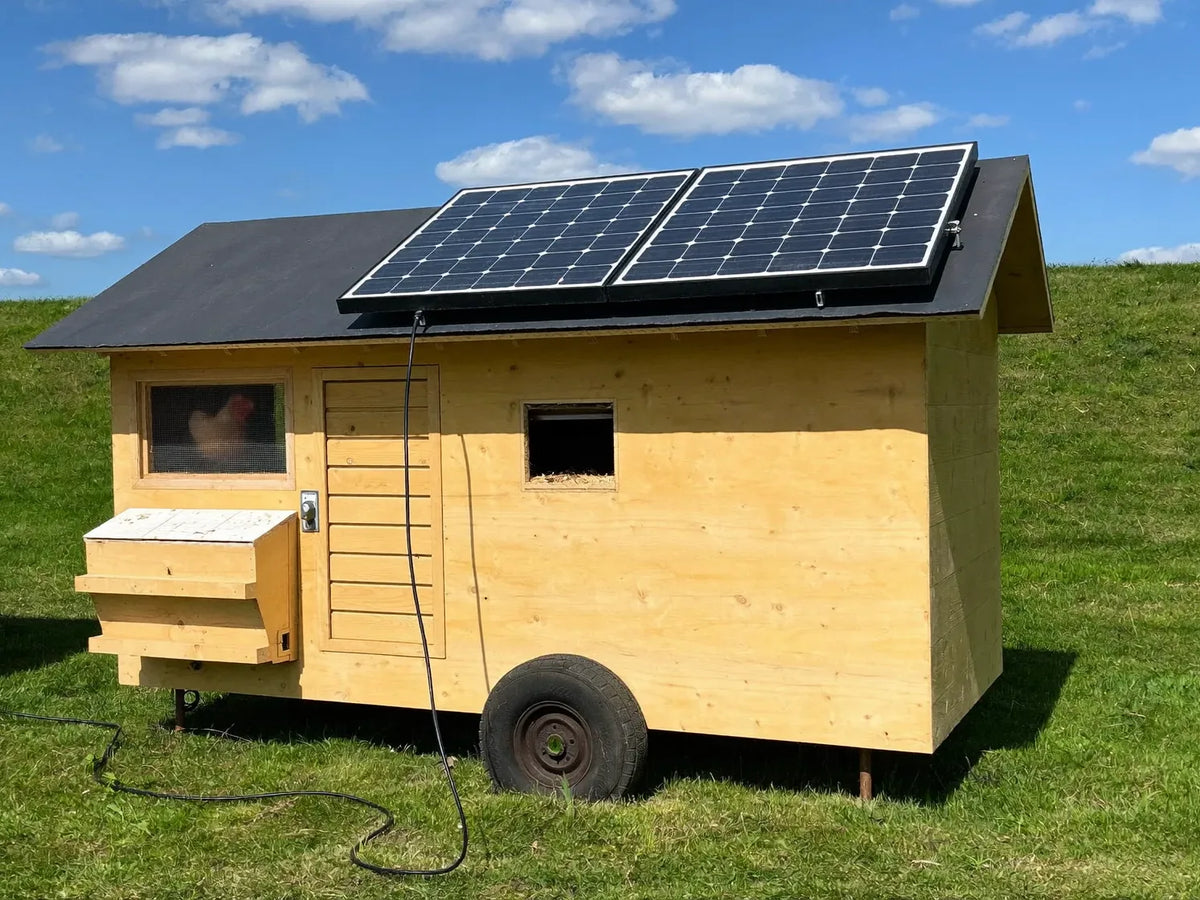
A solar powered chicken coop is a coop you bought plus a panel you added — nothing on the market generates its own power, so the word solar is not something to go hunting for on a coop page. The number that decides whether an add-on works is the panel's rating multiplied by your peak sun hours. A flat 10-watt panel collects about 64 watt-hours on an average July day in Minneapolis and about 13 in December. Pick the coop first, on flock size and whether it moves — the full coop list is where that starts — and hang the panel off whichever one you choose.
Solar definitions and sizing steps are quoted from one extension engineer's factsheets, flock guidance from two named services; the foot of the page says which are one voice, not two. The sun figures are NASA's twenty-year averages; the arithmetic on them is ours, shown so you can redo it for your address.
What does a solar powered chicken coop actually mean?
It means a coop with something solar bolted to it. No coop generates its own power, so what you are actually choosing is two things: the accessory, and the panel that feeds it.
Four solar add-ons turn up in backyard flocks, and they are not one decision. A light. A fan. An automatic pop-hole door. A radiant heater. They differ by two orders of magnitude in what they draw and they peak in opposite months, which is why bundling them into a single "go solar" plan produces a system that is wrong for all four.
Before you buy either, read the coop page for three things: a cable route or an outlet, a named mounting point, and any word at all about a fitting. Two false friends will try to look like one of the three while you do it. Assembly language — a socket set, a socket wrench — is about hand tools, not electrics. A care line about opening a door at first light is a time of day, not a lamp. Where a page gives you none of the three, plan on the coop providing no electrical anything and price the mounting hardware as a separate purchase.
The mounting point is the one that actually bites, because every solar accessory arrives with a panel that has to attach to something. Check what any named bracket is actually for before you count on it: a bracket on a coop page is often structural, holding a hen house square at its corners, rather than somewhere to hang an addition. Name the coop the bracket is on and we will put that to its manufacturer: what does the bracket bite into, and where.
Two of the four have their own pages here, so take them there: pop-hole doors, including the solar ones, in our guide to automatic coop doors, and heaters — a different scale of load entirely — in our solar coop heater guide, which sizes an array for one city by city in December. That leaves the light and the fan. Choose the coop before either of them: the coops built to move are where a panel earns its keep, because they are the ones with nowhere to plug in.
The day a small solar chicken coop panel really delivers
Less than the box implies, and the shortfall is seasonal rather than constant. A solar chicken coop panel is rated in a laboratory at an intensity the sky only sometimes reaches, so the honest planning number is not the rating — it is the rating multiplied by the hours your location actually delivers that intensity.
University of Maryland Extension defines the unit plainly. Modules "are rated under these standard test conditions which specify a solar irradiance of 1,000 watts per square meter (W/m²)," and that hour is "the equivalent of one peak sun hour, or full sun, which typically occurs between 9:00 AM and 3:00 PM on a clear, sunny day." Maryland also states the penalty in the same breath: "A solar irradiance of only 500 W/m², for instance, would likely result in half of the expected output."
| Where | Peak sun hours, July | Peak sun hours, December | 10 W panel, July | 10 W panel, December |
|---|---|---|---|---|
| Sacramento, CA | 8.31 | 2.02 | 83 Wh | 20 Wh |
| Phoenix, AZ | 7.34 | 3.05 | 73 Wh | 31 Wh |
| Dallas, TX | 6.59 | 2.63 | 66 Wh | 26 Wh |
| Minneapolis, MN | 6.38 | 1.33 | 64 Wh | 13 Wh |
| Atlanta, GA | 5.79 | 2.40 | 58 Wh | 24 Wh |
Thirteen watt-hours is a small number written out. It is one watt running for thirteen hours, or two watts running for six and a half. Read the December column next to the label on whatever you are about to buy, because a light, a waterer and a heater are all bought for that month.
Here is the part that gets left out, and it is the reason a cheap panel behaves so differently in the two halves of the year. NASA publishes what a surface collects lying flat and what it collects at the month's best fixed angle. Divide one by the other and a flat panel keeps between 98.5 and 99.9 percent of July's available energy at those five places — and between 50.6 and 62.7 percent of December's. July's best angle across the five runs from 3 to 12 degrees off horizontal, which is very nearly flat. Maryland's published rule points the same way without going as far: "A latitude minus 10 to 15 degrees will prioritize summer production." At these five latitudes that rule lands between roughly 18 and 35 degrees, so NASA's July optimum is flatter still — the rule is a year-round tilt biased toward summer, not a July-only one.
The panel that came taped to the accessory, lying flat where you put it, is close to correctly aimed for a summer load and roughly half-aimed for a winter one. Angle is what recovers the winter half, and our solar coop heater guide works the December tilt case through in detail rather than repeating it here.
Take the table as a description of a typical day and nothing more. A twenty-year average sets no floor under a bad week, it assumes no shade, and it says nothing about a pitched roof or a hot module. Maryland's own sizing procedure has a step after the one this table stops at: "Divide the ideal system power by a system derate factor to account for any system inefficiencies." Every figure in the columns above is the ideal, before that division. So read your own row, take the December number, cut it for losses and buy against that — and if you would rather have it checked against a specific coop and a specific accessory, send the coop and the accessory together and we will run the numbers with you.
Solar chicken coop fans are the one load whose season fits the sun
A fan is the only coop accessory whose busiest month is also the sun's best month. Solar chicken coop fans run hardest in July, when a flat panel at those five locations collects between 2.4 and 4.8 times what the same panel collects in December. The supply and the demand line up, which is not true of anything else on the coop.
University of Minnesota Extension is direct about why a fan exists at all in hot weather: "In most cases, you can manage heat in your flock through air flow." Our coop fan guide carries the rest of Minnesota's ventilation ranking; this post is about feeding a fan, not about justifying one.
None of that settles whether your coop needs a fan, and this post is not the place that answers it. Our coop fan guide works out the air-exchange arithmetic for a hen-house-sized box, puts the draw at about four watts at one end of that range and about nine at the other, and lands on "most backyard flocks do not" with the two exceptions named. Read that one first. Solar is a question about how a fan is fed, not about whether it earns its place.
Run those two draws against the July column rather than assuming a small fan is easy. Four watts for twelve hours costs 48 watt-hours, and the July column runs 58 to 83 before a single one of Maryland's losses comes off it — at Atlanta that is a fifth of headroom, which shading, wiring and a battery's round trip can take on their own. Nine watts for the same twelve hours costs 108 watt-hours, which no July row reaches even at full nameplate. Both draws come from Mississippi State's worst published fan efficiency, so treat them as the top of the range rather than the figure on your own fan. A panel that looks like a match for a small fan has no margin in it, and no match at all for a slightly larger one, in the sunniest month of the year.
Sizing is not the hard part of fitting one anyway. The hard parts are the hole the fan sits in and the shade the panel sits under, and only one of those gets easier when the power arrives by panel.
Air moving over a roost on a cold night is the failure mode to design against, and a solar fan has a built-in guard against it that a mains fan does not: it stops when the sun does. A panel-fed fan without a battery simply cannot run at 3am in November. Where that is the behaviour you want, skipping the battery is a feature rather than a saving. Which fan suits which coop is a pairing question, so tell us the fan and the coop in one message and we will check the draw against the month you actually need it — or start from the coops that come with runs, where a frame rail gives a panel something to clamp to.
Working out whether a small panel can carry a light and a fan through your worst month? Take 10% off the coop they hang in. GET MY 10% CODE
Why a solar coop light comes on at exactly the wrong time
Read the switch type before the wattage: a photocell means dark on, light off. For a garden path that is correct. For a hen house it is the one schedule the published guidance tells you not to run, and the reasoning is about where the birds sleep rather than about the bulb.
Minnesota's instruction for supplemental light is to "Provide supplemental lighting in the morning hours before sunrise." The sentence that explains it sits right beside it: "If you add light after sunset, the chickens will not be able to find their roost when the light turns off." A dusk-to-dawn photocell does precisely the thing that sentence warns about — it comes on at sunset and goes off when the cell runs down, in the dark, with hens on the floor.

Reading that as "a photocell is the wrong control for a hen house" is our conclusion, not Minnesota's wording, and it is worth saying so. Minnesota describes the risk; the fixture's switch type is our inference from it. The fix is a timer rather than a sensor, and Minnesota names it: "You can provide light using a regular lamp and a timer."
December is where the two problems meet. A light is a winter load, winter is when a flat panel is running at roughly half to two-thirds of its potential, and a fixture that dims as the battery sags is one that quits earliest on the longest nights. Sizing a coop light off a summer figure is how this goes wrong.
The University of New Hampshire is useful on the fixture itself: "LED bulbs and lamps work well as they don't generate the heat of an incandescent or fluorescent bulb," alongside the caution that you should "use a lamp that won't generate too much heat, as this can be a fire hazard." Low heat is the reason a small solar fixture suits a coop at all.
Whether to add light in the first place is a laying decision rather than a hardware one, and what belongs inside a coop answers it with the published hour and intensity figures. Whichever way that goes, buy the timer: it is the cheaper half of the fixture and the half that decides whether the light helps or hurts.
What a small panel bolts to, when nothing on the coop is meant for it
Probably nothing the page tells you about, so establish the mounting surface by looking at the coop rather than by reading about it. Three options exist and they are not equal.
The first is not to attach it to the coop at all. A panel on a small stake or a weighted base beside the run makes no hole in anything, can be aimed independently of the roof, and can be moved a foot to the left when the shadow line shifts. On a coop that gets moved anyway, one more thing to carry is a smaller cost than it sounds.
The second is a clamp or strap onto a run rail or a frame member, which is reversible and needs no tools. Rail diameter is the thing to measure before ordering a clamp, and it is rarely printed.
The third is a screw into the roof or a wall panel, and it is the one to think hardest about. Where the coop was bought finished rather than framed at home, check what its warranty says before you drive a fastener through a roof covering: a hole through shingle or felt is not a hole you can un-drive, and a hole is exactly the kind of change a warranty clause names first. Point us at a specific coop and we will have those terms sent to you.
Shading is the constraint that survives every mounting choice. Maryland states it flatly: "Solar panels are also sensitive to shading. Even partial or occasional shading can significantly reduce their energy production." A coop that moves re-decides its shade every time it moves, and the fence that shades nothing in July shades everything in December — the point our solar coop heater guide makes at a low December sun. The ground half of that decision sits in our lawn-friendly moving guide; the sun half is a thirty-second look at where the shadows fall at midday before you set it down.
Roof geometry is worth a glance too, since a fixed panel inherits whatever pitch it lands on — our coop roof guide covers what to look for. If you would rather drill nothing at all, take the first option: a panel on a stake survives a change of coop, and it suits the coops built to move better than any bracket would.
Solar power for a chicken coop solves a cord problem, not a cost one
Solar power for a chicken coop is bought for reach rather than for savings. The accessory loads here are small enough that grid electricity for them is trivial. What a panel buys is a coop that can stand anywhere on the grass without a lead trailing back to a wall.
Minnesota closes the obvious shortcut, and our coop fan guide and solar coop heater guide both quote it in full: extension cords are for short-term use, not for running power to a coop, and a permanent circuit is an electrician's job. A permanent circuit runs to a fixed point, and the whole argument for a coop built to move is that it does not stand at one.
The honest cost of going solar on a small load is not money. It is a battery that ages, a panel that needs wiping, and one more thing to check on a wet week in January. Maryland's two solar factsheets are written by the same extension engineer, so treat them as one voice rather than two, and that voice is blunt about which systems the load arithmetic bites hardest: "Detailed estimates of each electrical load are particularly important for off-grid and battery-integrated PV systems to ensure that sufficient power is available when needed." Write your own load list before you shop, then pick the coop it has to live on — a stake-mounted panel follows a coop around the garden, which is what the portable coops are for.
Which solar add-ons is a small panel actually good for?
The ones whose load is small and whose season is summer. Sorted that way, the five solar add-ons on this list split cleanly, and each one has a guide on this site that answers whether you want it at all.
| Add-on | When the load peaks | What the panel has to beat | Where the decision lives |
|---|---|---|---|
| Fan | July, the sun's best month | Very little. Supply is not the constraint | Coop fan guide |
| Light | December, the sun's worst month | Half a flat panel's potential, plus the switch type | This post, and what belongs inside a coop |
| Pop-hole door | Dawn and dusk, year round | A siting question that resets every time the coop moves | Automatic coop doors |
| Heated waterer | Deep winter, continuously | A load class the accessory panels are not built for | Coop water heater guide |
| Radiant heater | Deep winter, overnight | Hundreds of watts against the year's thinnest sun | Solar coop heater guide |
Read the table top to bottom and the ordering is load and season together, not the gadget. The fan is the easy one because it is small and it is a summer load. The light is just as small and lands in the wrong month. The door is small too, and its problem is siting rather than season. The bottom two are heavy and land in the wrong month as well, which is why an accessory panel does not reach them however hard you shop.
Ventilation needs no panel, no battery and no switch, and it beats every powered item on the list for a backyard flock. Our ventilation guide covers what four extension services publish about openings, and our summer prep guide covers shade, which does the fan's job for nothing. Get the openings right on the coop itself and most of this table stops mattering, which is the cheapest row of all — browse the full coop list with that in mind.
Our order of operations, and the cost of getting it backwards
We would fit a solar light before anything else, on a timer rather than a photocell, and we would size it against the December column. We would keep a fan and a lead in the shed for July instead of mounting one, and we would not put a heater or a waterer on an accessory panel at all.
Getting it wrong is cheap in one direction and expensive in the other. Oversize the panel for a light and you have wasted the price of a small panel. Undersize it and the light fails in the last week of December — the exact week it was bought for — with hens somewhere other than the roost when it goes out. The failures are not the same size, so the arithmetic is worth doing before the purchase rather than after it.
What we would not do is buy a coop for a panel. The accessory is the cheap, reversible half of this decision and the coop is the half you live with, so pick the coop on flock size, run area and whether you can actually move it, then hang whatever you want off it. If a listing says nothing about where a bracket goes, ask us and the fixing point comes back from its maker rather than from our guesswork.
The coops that let you chase the sun are the ones you can turn and reposition through the year: the coops built to move and the lighter portable coops are where that starts, and the coops that come with runs give a panel a rail to clamp to. Browse the whole range by flock size and say which one you have your eye on.
Sources: University of Maryland Extension, "Working on Solar: Panels and Power Output" FS-2022-0646 (Drew Schiavone, updated June 28, 2023) — accessed August 20, 2026 · University of Maryland Extension, "Working on Solar: Design and System Sizing" FS-2023-0655 (Drew Schiavone, updated June 24, 2024) — accessed August 20, 2026; the same author wrote both Maryland factsheets, so they are one voice, not two · NASA POWER Project, NASA Langley Research Center, Climatology API v2.9.7, parameter SI_EF_TILTED_SURFACE, 20-year monthly climatology January 2001 – December 2020 — queried August 20, 2026 · University of Minnesota Extension, "Caring for chickens in cold weather" (Colleen Carlson and Hannah Lochner, reviewed 2026) — accessed August 20, 2026 · University of Minnesota Extension, "Preventing heat stress in poultry" (Sally Noll and Sabrina Florentino, reviewed 2026) — accessed August 20, 2026; the same service as the cold-weather page above · University of New Hampshire Extension, "How Should I Take Care of Backyard Chickens in the Winter?" (Sean O'Brien, February 15, 2024) — accessed August 20, 2026
Frequently asked questions
What type of solar light to put in chicken coop?
An LED on a timer, mounted where a hen cannot reach it. The University of New Hampshire notes that LED bulbs and lamps work well because they do not generate the heat of an incandescent or fluorescent bulb, which is the fire risk in a dusty box. Pick a fixture with a separate panel on a lead, so the panel can sit in sun while the light sits inside.
How to hook up a windmill to power chicken coop?
We could not find an extension service publishing anything about small wind turbines for a coop, so we will not pretend to a figure. The sizing method is the same either way: write down each device's wattage, multiply by the hours it runs, and total the watt-hours. Maryland's load-estimate step applies to any off-grid source. Solar is simply the one with published data behind it.
What is a chicken coop?
A chicken coop is the enclosed, roofed house a flock sleeps and lays in: a roost bar to perch on, nest boxes to lay in, vents for air, and a pop-hole door out to a run. It is a structure rather than an appliance, which is why nothing about it is powered and every solar item on it is an accessory you add.