

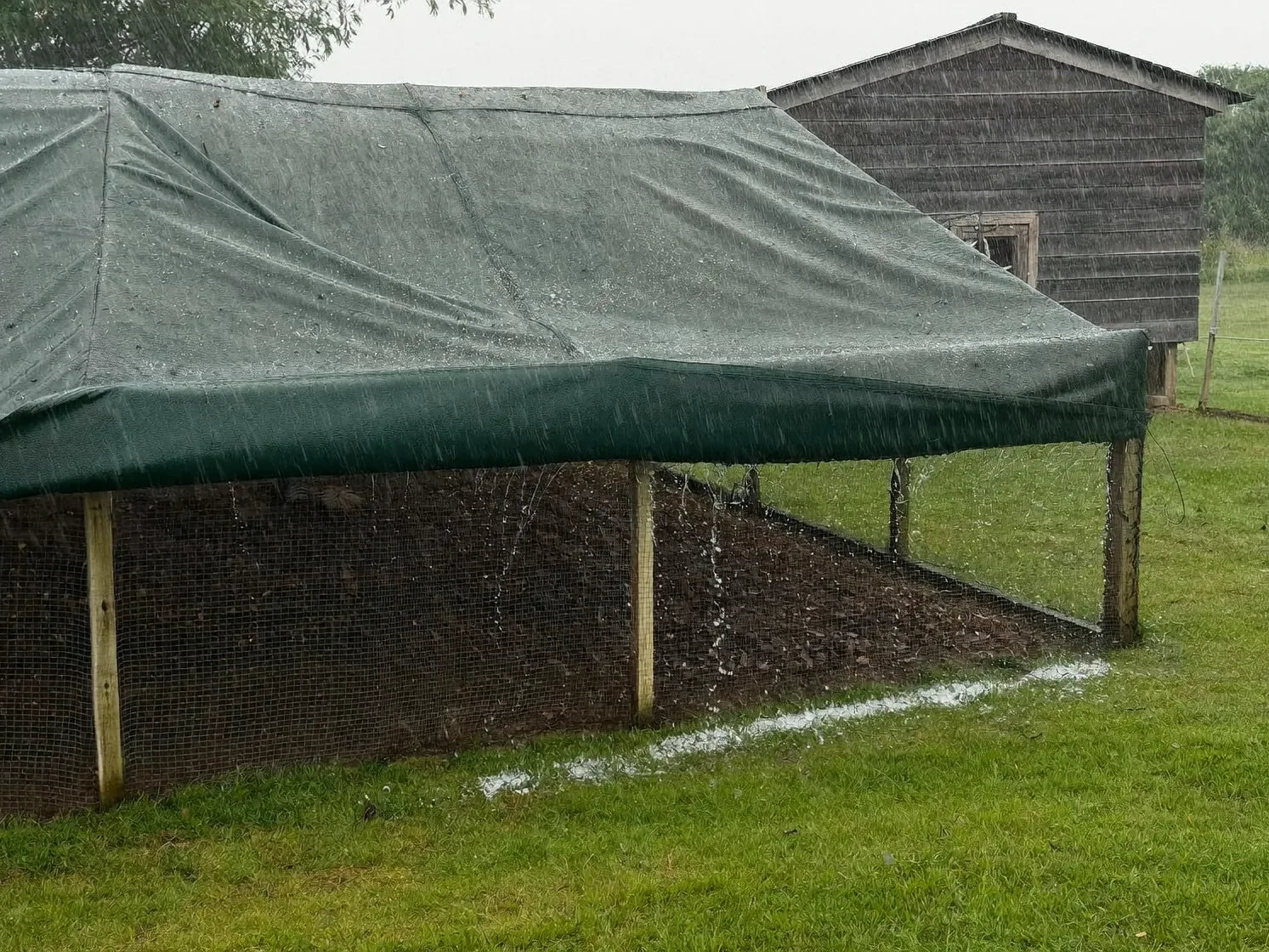
Tarps for chicken coops fix two problems and quietly create a third. A tarp keeps driving rain and wind off a run for very little money. It also blocks air, and a coop that can't exchange air turns damp and then smells of ammonia. So the rule is short: cover the run, never the vents. If you would rather buy the cover than rig one, start with the coops that ship with a run — and where a listing names a fabric without naming a number, say which coop it is and its manufacturer can put a figure on it for you; we will ask.
Every ventilation, moisture and fabric figure below comes from an extension service or a published agricultural-engineering fact sheet, each one cited underneath. The wind arithmetic is ours, built on one of those figures and shown in full so you can redo it for your own tarp.
Should the tarp go over the coop or over the run?
The run, in almost every case. A coop arrives with a roof over the birds; a run usually arrives open to the sky. A soaked run drives a flock indoors, which concentrates the droppings that create the moisture problem.
The honest appeal of a tarp is that it's reversible. A roof is a decision you live with; a tarp is one you can take back on a Saturday morning, when it turns out the rain was coming from the other direction. It also throws shade over part of a run in high summer, the job people forget.
Where it fails is over the birds' sleeping space. Penn State pairs a vapor barrier with insulation and ventilation rather than against them, and names the failure mode: "Failure to insulate or ventilate properly causes moisture to accumulate on the walls and ceiling in cool weather." Fabric stretched over the outside of a hen house is the sealing half of that sentence with none of the venting. Our roof guide covers what belongs over a coop.
Drape it like a lean-to, not like a dust sheet. Anchor the high edge along the coop's eave line or the top rail of the run frame, run it down and out to a lower tie line, and leave the far end open. Water then leaves at a known edge instead of pooling in the middle, and pooling is what tears grommets.
Leave at least one long side open, and choose which one on purpose. Penn State's siting instruction transfers directly: "Locate openings on the side away from prevailing winds." Cover the windward face and leave the sheltered face open, and you get the wind break without the sealed box.
For a gap you keep open, UNH's winter note suggests breathable fabric rather than plastic: "Some vent holes or a small window covered with burlap (not big enough to allow predators to enter) can achieve this but be sure that this is on a side of the structure away from prevailing winds." Burlap over an opening moves air; a tarp over the same opening doesn't.
If the coop rolls, there's a better first move. Turning the coop so its open side faces away from the weather costs nothing and blocks no air at all, and on a coop you already move on a routine it costs no extra trip — which is the argument for buying from the coops built to move before you buy any fabric.
The vent problem: what a tarp stops besides the wind
A tarp blocks air about as well as it blocks water, and a coop needs the water stopped and the air moving. Chicken manure is roughly 70 percent water, per University of Minnesota Extension, so every night's droppings load the air with moisture.
The University of New Hampshire sums the trade up in one sentence: "While the coop structure needs to keep out wind, rain and snow, it also needs to allow for interior moisture and ammonia gas from chicken droppings to escape." A tarp is very good at the first half of that sentence and blind to the second.
Penn State Extension names the tell when the balance is lost: "Dampness and ammonia build-up is a sign that there is not enough ventilation for the number of birds in the coop." Neither service publishes a vent area you can measure against — what they publish is qualitative, which leaves placement as the part you can actually get right.
UMN gives the check to run a week after you tarp anything: "If you smell ammonia or notice moisture collecting on objects or windows within the coop, you need to increase ventilation and clean up manure to help remove moisture." Do it at first light with the door shut, before the coop's had a chance to air out — by mid-morning the evidence has gone. Where the openings should sit is our ventilation guide, and if you cannot tell which opening on your coop is the vent and which is the window, name it and we will bring back the manufacturer's own answer.

Wind load: a tarp is a sail before it is a roof
Wind is what kills tarps, and the force climbs much faster than the forecast suggests. UConn Extension's John W. Bartok Jr. publishes the anchor figure: "An 80 mph wind creates a force of about 16 psf." Pressure rises with the square of the speed.
| Wind speed | Pressure | Force on 24 sq ft of tarp |
|---|---|---|
| 20 mph | 1.0 psf | 24 lb |
| 30 mph | 2.3 psf | 54 lb |
| 40 mph | 4.0 psf | 96 lb |
| 50 mph | 6.3 psf | 150 lb |
| 60 mph | 9.0 psf | 216 lb |
| 80 mph — UConn's published figure | 16 psf | 384 lb |
Angle the fabric away from the wind and it sees less; let it belly out, or tie it so a corner lifts, and the tie points see far more. Bartok's companion figure shows how fast uplift adds up, on a structure far bigger than a run — his worked example is a 30 ft by 72 ft tunnel: "The uplifting force on the roof from an 80 mph wind is about 220 lbs/linear foot." That is per linear foot of a 30 ft span, so it does not carry across to a cover a fraction of that width.
Snow is the quieter version of the same problem. Bartok puts a common fall at about 5 psf: "A 3" wet snow or 12" dry snow adds about 5 pounds/sq ft (psf) to the roof." Across a 24 sq ft footprint of cover that is 120 lb hanging on the tie points — less on a steep slope, far more anywhere the fabric bellies and the snow collects, which is why a heavy fall gets swept off rather than trusted.
Do the arithmetic on your own weather rather than on a rule of thumb. Take the gust speed your area really sees, square it, multiply by 0.0025, and multiply that by the square feet of fabric you are about to hang. If the answer is more than you would care to hold onto in one hand, that is your answer about how many tie points to use and how heavy the cord has to be — and it is the case for a run whose cover is part of the frame rather than lashed to it, which is what the coops that ship with a run are.
Tired of retying a tarp every October? Take 10% off a coop that arrives with its own cover. GET MY 10% CODE
What makes a good tarp for a chicken coop?
Four specs decide it, and only one of them is printed on most tarps: thickness, UV stabilizer, weave, and how far apart the grommets sit. A cheap tarp is a one-season material by design, not by accident — though the published service lives below are for greenhouse glazing film, the closest material anyone prints numbers for.
UMass Extension is blunt about why fabric dies outdoors: "the life of polyethylene films is limited due to degradation processes induced by sunlight and heat." The additive that buys years rather than months is named on the same page — "It contains an ultra-violet (UV) stabilizer that reduces degradation" — and the service life differs sharply: "Co-poly is a low-cost material that is good for one season," against greenhouse grade "warranted for 4 years or more."
Thickness is quoted in mils, and the only published range we could open is written for greenhouse film rather than for tarps: "one-year co-poly film is available in 3, 4 and 6 mil thickness." No extension service we read publishes a mil figure for a tarpaulin, so read the film numbers as the nearest reference point, not as a tarp spec. UConn's advice is to step up when the cover stays on — a 4 mil grade if it comes off before winter, "the stronger 6-mil greenhouse grade" if it stays. On an exposed site the same page prefers a woven material: "In windy locations, a woven polyethylene has given better service."
Both of those pages are worth reading, and they are not two opinions. John W. Bartok Jr. wrote the UConn page and the UMass page, so treat them as one engineering voice published twice. The ventilation chain earlier on this page is genuinely independent — Penn State, Minnesota and New Hampshire are three separate author teams. On fabric there is one authority here, not two.
| Spec | What it decides for you | Where the number actually lives |
|---|---|---|
| Thickness, in mils | Tear resistance, and how many retyings it survives | The tarp's own roll label, where mils are standard. Buy the fabric on the fabric's spec |
| UV stabilizer | One season, or several | The warranty. A stated number of years is the only version of this claim with anything behind it — "UV-resistant" and "anti-UV" are durability words, not ratings |
| Woven or scrim-reinforced | Whether a small tear stops where it started or runs the length of the sheet | The photo and the corner in your hand. A knitted or woven grid holds a cut; a plain sheet film does not |
| Grommet spacing | How much of the wind load each tie point carries | The tarp itself. Measure between two eyelets, then divide the force above by the grommets on the windward edge |
A description that names a cover material and then stops has not run out of facts, only of room. Name the cover and we will go after the thickness, the weave and the grommet spacing with its manufacturer.
How much does a chicken coop cover actually cover?
A cover is sized to the fabric, not to the floor, and the two get read as the same thing constantly. Check the description for a cover size, then check it for a floor area — and if it gives you both, do not assume the first shelters the second.
Multiply it out instead. A cover stated at 11 feet by 6.2 feet is about 68 square feet of fabric; put that beside a stated floor area of 286 square feet and it shelters under a quarter of the enclosure it sits on. Those are real figures off one published walk-in listing, and the multiplication runs the same way on any listing that prints both. Ten seconds, and it is the only way those two numbers ever get compared.
The wording to watch is the wording that names a material and no measurement — a waterproof tarpaulin, a UV-resistant run cover, a PVC curtain, a weather line of four adjectives in a row. Adjectives have no units, so two covers described identically can be built completely differently. Assume the thinner end when that happens, and ask before you order.
Ask, because both numbers were written down long before the fabric was cut: a cover dimension sits on the cutting drawing, and a weight sits on the roll's own label. Say which coop and both figures come back from its manufacturer with our request behind them — `sales@moveablechickencoop.com`, or start from the coops that ship with a run. What a cover is worth once winter arrives is in our winter care guide.
Rather not tarp it at all? These arrive with the run built in, and we'll confirm the cover dimensions before you order. SEE THE SPECS
When would we skip the tarp, and what does getting it wrong cost?
On the hen house, every time. Getting it wrong is cheap in money and expensive in time, and that's exactly why it goes unnoticed. A tarp that covers a vent doesn't fail visibly. It shows up six weeks later as bedding that won't dry, a smell at 7am, and a bird with a damaged comb. UMN names the mechanism plainly: "The main causes of frostbite are high moisture and cold temperatures." Powered air is the other lever, in our coop fan guide; the seasonal jobs a cover sits inside are in the winterizing checklist.
If you're tarping because the run has no cover, buying the cover is usually the better trade. A stated cover is a spec you can read before you commit, and a cover built onto a frame does not need retying in a gale. Start with the coops that ship with a run, and if you want to stand up inside the thing you are covering, the walk-in coops are the enclosures with the headroom — multiply the stated cover size out before you assume the fabric reaches across the floor.
Cover dimensions and fabric weight are what we will get from the manufacturer for you; the coops built to move hand you the other half of the answer, because a coop you can turn out of the wind needs less covering in the first place. Hand over the coop's name and the asking is on us.
Sources: University of New Hampshire Extension, "How Should I Take Care of Backyard Chickens in the Winter?" (Sean O'Brien, February 15, 2024) — accessed August 20, 2026 · Penn State Extension, "Small Scale Poultry Housing" (Gregory P. Martin and Phillip Clauer, updated June 25, 2026) — accessed August 20, 2026 · University of Minnesota Extension, "Caring for chickens in cold weather" (Colleen Carlson and Hannah Lochner, reviewed 2026) — accessed August 20, 2026 · UConn Integrated Pest Management, "Engineering High Tunnels for Better Performance" (John W. Bartok Jr., no date shown) — accessed August 20, 2026 · UMass Amherst Center for Agriculture, Food and the Environment, "Plastic Greenhouse Film Update" (John W. Bartok Jr., June 30, 2026) — accessed August 20, 2026. John W. Bartok Jr. wrote both the UConn and the UMass pages above, so the fabric guidance they share is one engineering voice published twice, not two services agreeing. The ventilation guidance is drawn from three separate author teams. The cover and floor figures worked through in the body (an 11 ft × 6.2 ft cover against a 286 sq ft floor area) are PawHut’s own published specification for a walk-in coop — accessed August 20, 2026.
Frequently asked questions
How to tarp a chicken coop?
Tarp the run, not the hen house. Fix the high edge along the coop's eave line or the run's top rail, slope it down to a lower tie line so water leaves at one edge, and leave the far end and one long side open. Keep the fabric below every vent, louver, window and eave gap on the coop itself.
How to measure a chicken coop for a tarp?
Measure the run, then add the drape. Take the length and width of the frame you want covered, then add the drop for each side you actually plan to cover - one drop for a lean-to, two if you cover both - plus about a foot at each tie line for wrapping and grommets. Check the listing for a stated cover size too, and read it as a fabric dimension rather than as the area it shelters.
How to keep rain out of chicken coop?
Start with the roof and the ground, not with fabric. Check the fasteners, the seam over the nesting box lid and the edge where the covering is stapled, because a roof leaks where it's interrupted. Penn State Extension puts the rest on siting: pick high ground that drains, and the floor and the run stop staying damp.
How to weatherproof a chicken coop?
Weatherproofing is three jobs, and fabric only helps with one. Keep water out at the roof covering, the seams and wherever the runoff lands. Cut wind at bird level by closing gaps at roost height. Leave the vents above them open, because Penn State Extension asks for ample air movement without a draft, and a sealed coop is a damp coop.