

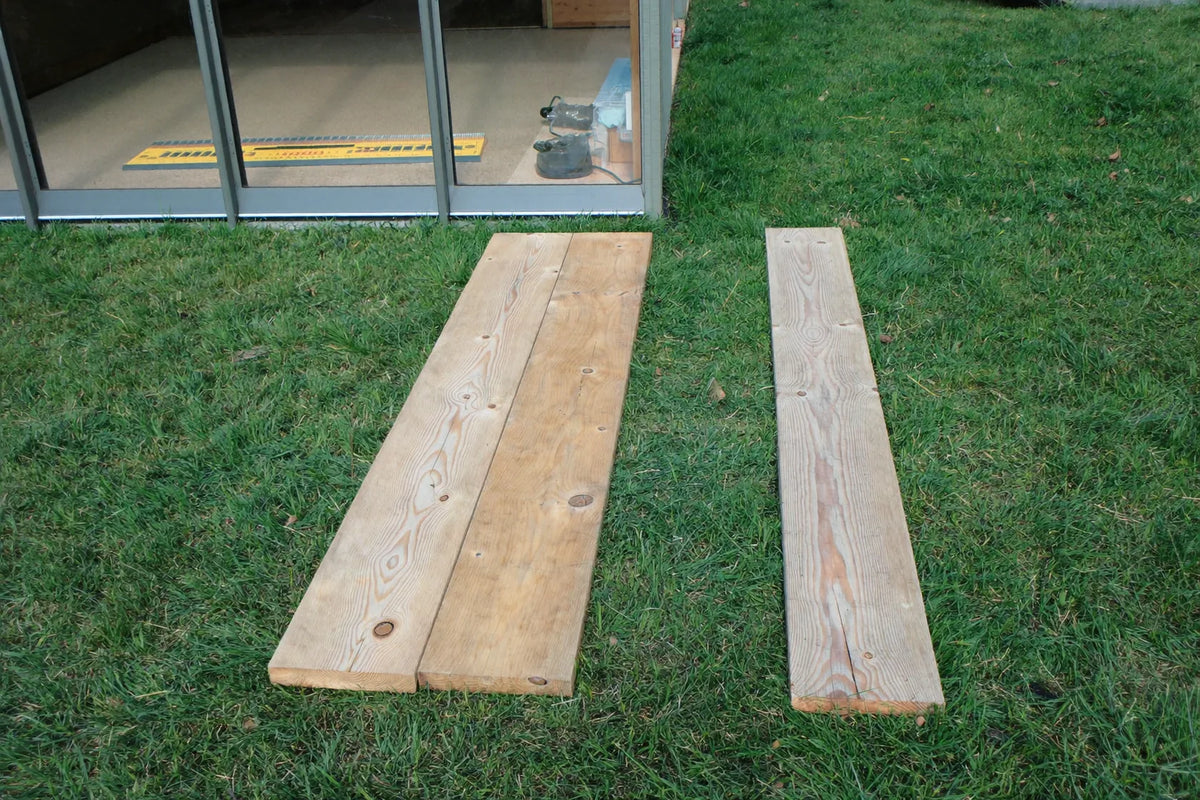
A chicken coop foundation is whatever spreads the coop's weight and holds its frame in one plane, and on a coop built to move that is a bearing surface you park on rather than anything poured. Level does more work than hard. A frame sitting on three corners racks, and a racked frame is why the latches stop lining up. The instruction worth applying whether or not your coop's listing prints it: level, solid supports under all four corners rather than bare lawn. The coops built to move are where the ground matters most, because they land on new ground every few days.
Every pad, subgrade and drainage figure below is lifted from named extension publications written about horse paddocks rather than poultry — that borrowing is said out loud wherever it happens, and the publications are linked at the foot.
What does a chicken coop foundation actually have to do?
A chicken coop foundation does three jobs. It spreads the weight so nothing sinks, it holds the frame in one plane so the doors and latches keep working, and it keeps timber out of standing water. Backyard coops need the first two far more often than the third.
Two very different answers satisfy those three jobs. A permanent foundation — a pour, a block course, a set of piers — buys stability by fixing a footprint for as long as it lasts. A bearing surface is a patch you park on: firm, flat, and somewhere else next month if you want it to be. What sits under and over the coop's own floor deck is a separate decision with its own published guidance, and this page is about the layer in between.
Researching the subject turns up an awkward hole. Small-flock housing publications do not print a foundation spec at all. Penn State's coop page stops at where to stand the thing — high, well-drained ground — and Virginia Cooperative Extension prints the same instruction from a page that shares its co-author, so read the pair as a single voice printed twice, not as two services in agreement. The seven checks that pick the patch are set out in our backyard-coop guide, and they end exactly where this page starts.
Swept for foundation, footing, subgrade, slab, geotextile and gravel, those poultry pages return one gravel sentence between them, and it is about a fence rather than a floor. The only published construction specs for a load-bearing pad in this family were written about horses, and what follows borrows from them with that said out loud.
Chicken coop footing: what actually carries the weight
Chicken coop footing is the contact between coop and ground, and there are only four kinds of it. Wheels, legs or feet, skids, and a continuous bottom rail. Each one delivers the same weight through a different amount of ground, which is what decides whether it sinks.
| What the coop stands on | How the weight reaches the ground | What it wants under it | How it fails |
|---|---|---|---|
| Two wheels and a lift handle | Two small patches at one end; the far end rests on the frame or a leg | Mown, firm ground along the wheel line | Wheels press into soft turf and the far end drops with them |
| Four wheels or swivel castors | Four small patches, all of them load-bearing | A smooth, level surface | Castors sink, and on rough grass nothing tracks straight |
| Legs or corner feet | Four points, the highest pressure per point of the four | A hard pad under every foot | One leg settles further than the rest and the frame goes out of square |
| Skids or runners | Two long lines, the lowest pressure of the four | Ground clear of tussocks, roots and stones | The runner lies in soil and stays wet |
| A continuous bottom rail | The whole perimeter, but only where the ground meets it | Ground already in the rail's plane | The rail bridges hollows and traps water where it does touch |
Pressure sinks a coop, not weight. The same house on four small castors presses harder into wet lawn than the same house on two long runners, because the load arrives through a fraction of the area. Put it in the yard: a four-inch wheel meets the lawn across a strip you could hide under a thumb, while a runner meets it along its whole length. Same house, same weight, and the ground feels one of them several times harder than the other. What wheel diameter buys you is worked through separately. The point here is only that a small contact patch is a deep one.
Ground instructions do turn up on coop listings, and they are worth hunting for before you order, because they tell you what the maker expects the thing to stand on. The wording to look for runs along two lines: rest all four corners on level, solid supports rather than directly on bare lawn, so legs do not sink into soft ground over time; and keep the base raised on its legs, clear of the ground, rather than bedded into it. Where the listing in front of you is silent, treat both as the default anyway — and if the leg spacing or the base construction is what your decision turns on, say which coop and we will take that straight to its maker. What that raised gap does about damp belongs to the flooring guide; what it does about load belongs here.
One vocabulary trap is worth clearing before anyone orders material. The word footing does two jobs in search results. In construction it means the part under the load. In the horse-paddock publications quoted below it means the top surface layer the animal walks on. Both come back for the same query, and they are opposite ends of the same build.
Why a level chicken coop base is a hardware problem
A chicken coop base that is out of level costs you doors, not looks. A coop is a box of square panels standing on ground that is never square, and when one corner loses its support the frame carries the twist itself. Latches and sliding doors go first, because they are the only parts with a tolerance you can measure in millimetres.
Racking is the word for it. Panels bolted into a rectangle stay rectangular only while all four corners sit in the same plane. Drop one and the rectangle becomes a very slight parallelogram, and nothing about it looks wrong from six feet away. The nest lid catches. The pop-door slide binds. The two halves of a hasp stop meeting.
Length makes racking worse, and the geometry is unforgiving about it. Divide any stated length by twelve to get the span the frame has to bridge: 43 inches is a little over three and a half feet of ground, and 153 inches is nearly 13 feet of it. A two-inch hollow that a short coop simply steps over is a hollow a long frame has to lie across, and the frame absorbs the difference.
The repair is cheap and it is the same everywhere. Put a spirit level on the floor in both directions, shim the low corner with something that will neither rot nor crush, and check it again after the first wet winter. Pads settle, and so does the lawn underneath them.
Our position, which is not the tidy one: for a coop you intend to move, do not chase perfectly level. Chase repeatably level. A patch you can get flat in five minutes with two pads is worth more than one immaculate pad you can never leave, because the whole argument for a coop that rolls is that next month it is standing somewhere else.

Found a patch that drains and sits flat? Take 10% off the coop that parks on it. GET MY 10% CODE
Chicken coop on skids: the foundation that travels
A chicken coop on skids rides on two runners under the frame, and those runners are the foundation. Skids are the only version on this page you take with you, because the bearing surface is bolted to the coop instead of being left behind in the grass when it goes.
Skids spread a load better than anything else on the list. Two long runners give a bearing line the length of the coop, which is why floorless pasture pens use them and why they cope with ground that would swallow a castor. Minnesota's mobile poultry hut and Kentucky's hoop pen both start from a timber base of exactly that kind, and the two builds are set out side by side in our cattle-panel guide.
What a skid charges for is drag and damp. A runner sits in permanent soil contact, which is the one condition the wood publications refuse to be vague about: ground-contact timber is a different specification from anything above it, and the skid is usually the first part of a wooden coop to go.
A coop built to move does it on wheels or on a lift handle, which is the same trade running the other way. A wheel is the easier move and the smaller contact patch, so it asks more of the ground it lands on and less of your shoulders. What moving a coop actually takes is where that bargain shows up in practice.
How much gravel for a chicken run, and what a published pad actually is
Gravel for a chicken run is an assembly rather than a layer, and nobody publishes one for hens. The two extension services that print a full recipe wrote it for horses, and it runs to four layers over an excavated base rather than a load of stone tipped onto grass.
| Layer, bottom up | What Minnesota specifies | The job it does | How it reads for a hen run |
|---|---|---|---|
| Subgrade | Remove 8 inches of the topsoil, making sure that the base is level | Takes out the soft organic layer that will not compact | The dig is the step home builds skip, and everything above it depends on it |
| Geotextile, first sheet | Woven fabric, chosen because it is durable and permeable | Lets water down while stopping stone sinking into soil | Transfers whole. It answers a soil problem, not a hoof problem |
| Base stone | 4 inches of crushed limestone sized 1.5 to 1.75 inches | The structural layer, angular so the pieces lock together | Thickness sized for a horse. An upper bound for hens, never a target |
| Geotextile, second sheet | A second layer, to keep the courses separated | Stops the two stone sizes migrating into each other | Transfers, and it is the layer most home builds leave out |
| Surface | A 4-inch layer of footing, unwashed fine gravel | The walking surface, raked and refreshed as it wears | Depth is negotiable for hens. Material is not |
Minnesota is blunt about why the assembly beats a heap of stone: "Constructing high-traffic pads with geotextile fabric and other materials is the best way to keep areas well drained during muddy seasons." The same page names the failure mode people walk into — "Avoid using footing materials that readily break down such as straw, hay and wood chips." Straw thrown at a wet run does not become bedding. It becomes mud with straw in it.
Penn State's paddock article, written by different authors at a different service, supplies the sentence that explains most disappointing home pads: "Small, homeowner-sized walk-behind compactors only supply enough vibration to compact about an inch (2-3 centimeters) of material". An 8-inch build therefore goes down in many thin courses rather than one delivery, and the same article is direct about what everything rests on — "As with any construction, a properly prepared subgrade is the foundation for a successful design."
Read all of that at the right distance. Both publications are sized for hooves. Their thicknesses tell you what a pad under a horse takes, so they are an upper bound for a hen run and prove nothing whatever about a minimum. What does transfer is the order of the layers and the named reason for each one, because those are arguments about soil and water rather than about load. A run pad built to horse spec is over-built for hens, and knowing that is worth more than copying it.
Poultry publications reach for gravel exactly once in this set, and not for the surface at all. The single mention sits inside the fencing advice, where gravel goes into the trench along the pen border as a deterrent against digging. Nothing in the small-flock literature says what a run should stand on, which is why the horse pages above are doing the work here, and how a run's perimeter gets buried and toed outward is set out in our run guide rather than repeated in this one.
One conflict deserves flagging before anyone orders stone. Gravel and wheels do not get along. A stone pad is a fixed installation and a rolling coop crosses it badly, so surfacing a run in gravel quietly commits you to a coop that stays put. If the coop is meant to move, gravel the strip the flock stands on all day and leave the coop a grass lane to travel down.
The awkward part: a foundation is what stops a coop moving
A foundation and a moveable coop want opposite things, and pretending otherwise helps nobody. A pour, a block course, a properly built gravel pad — every one of them buys stability by fixing a footprint, which is precisely the freedom a coop on wheels exists to protect.
The way out is not a compromise, it is a change of unit. A moveable coop's foundation is not one pad. It is the standard the ground has to meet at every stop: flat within an inch or two, firm enough that a wheel does not press in, drained enough that the frame is not standing in water by February. You are not building a foundation. You are keeping a list of places that already qualify, and adding a pair of pads to the ones that nearly do.
Reversibility is the part actually worth paying for. Being wrong about a parking spot costs an afternoon and two paving slabs. Being wrong about a pour costs a corner of the garden for as long as the concrete lasts, and no wheelbarrow undoes it.
Where the argument flips is narrow and real: a walk-in house that will never move, on ground that stays wet, with something digging under it. Hard bases were written for that case, and the walk-in enclosures are the coops that case was written for.
If your ground is flat and mown, the foundation question is mostly answered already and the coop is the decision that is left. The coops built to move ask least of a permanent base, and every one of them sits on the coops page. If a coop's base construction or the spacing of its legs is what your decision turns on, name it in an email and we will get the maker on record.
Sources: University of Minnesota Extension, “Managing mud on horse farms” (Aubrey Jaqueth; reviewed 2024) — the high-traffic pad build, layer by layer, and the footing materials to avoid; written for horses, not poultry — accessed August 22, 2026 · Penn State Extension, “Construction of Equine All-Weather Paddocks for Mud-Free Management” (Laura Kenny and Eileen Fabian; updated December 15, 2023) — subgrade preparation, geotextile load distribution and the walk-behind compactor limit; also written for horses — accessed August 22, 2026 · Penn State Extension, “Small Scale Poultry Housing” (Gregory P. Martin, Ph.D., PAS, and Phillip Clauer) — the siting instruction, and the only mention of gravel in this set, which is a fencing-trench deterrent rather than a run surface — accessed August 22, 2026 · Virginia Cooperative Extension 2902-1092, “Small-scale Poultry Housing” (Leonie Jacobs and Phillip J. Clauer) — prints the same siting instruction; Clauer co-authored both, so the pair is one text published twice — accessed August 22, 2026 · University of Minnesota Extension, “Raising chickens for eggs” — swept alongside the two housing pages; none of the three states a foundation, footing or pad specification — accessed August 22, 2026.
Frequently asked questions
How to build a chicken coop foundation?
For a coop that moves, do not build one. Clear the patch, take out tussocks and stones, check it with a spirit level in both directions and put a hard pad under every leg or wheel. For a house that will never move, the published method is an excavated base, woven fabric, compacted stone and a second fabric sheet before the surface goes on.
What is the best base for a chicken coop?
The best base is the one you can undo. Hard pads under the legs or wheels cost very little, keep the frame in plane and can be lifted and reset when the coop moves. A poured slab is stronger and fixes the footprint permanently, so it earns its place only under a walk-in house that is staying where it is.
How to build a chicken coop on cinder blocks?
Set the blocks solid rather than on end, on ground you have dug flat rather than filled, and put one under every load point instead of only the corners of a long frame. Check across the floor with a spirit level in both directions before the coop goes on. Blocks are a bearing surface rather than a fixing, and they do the levelling job only if they sit on firm ground themselves.
How to keep chicken coop from getting muddy?
Move the coop before the grass gives up, and keep water off the ground it stands on. Where a run stays put, the published fix is a layered pad rather than loose stone tipped on turf. Minnesota's mud guidance also names what not to use: materials that break down quickly, such as straw, hay and wood chips, end up as part of the mud.