

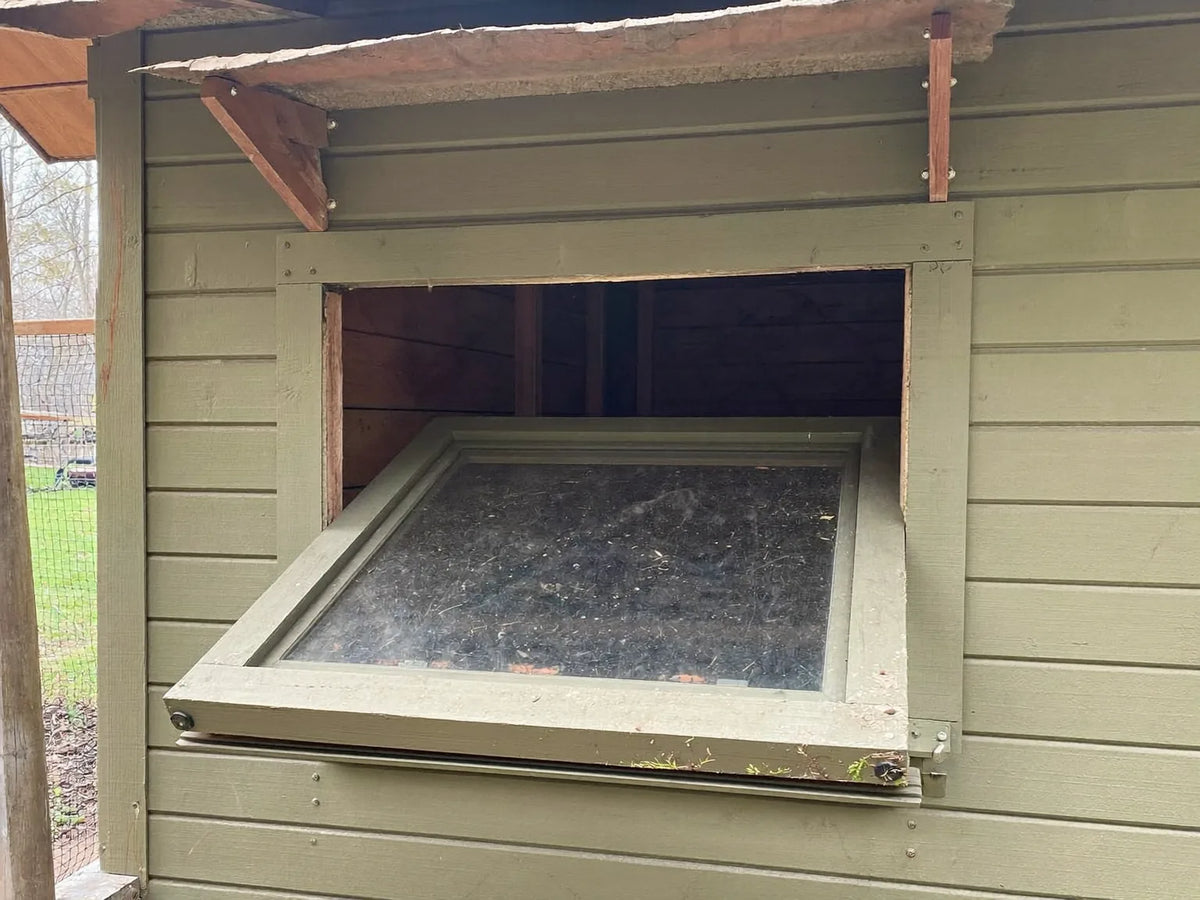
Chicken coop windows are the only openings in a coop wall that still have a job when they are shut. A door that is shut is a wall. A vent that is shut is nothing. A window that is shut is still passing daylight and winter sun into the house, which is why the pane matters as much as the hinge does. Total the window area a listing states, then total only the part that opens: on the spec worked below, three openings on one wall come to 242 square inches and 62 of them move. Ask us for the window spec on any coop whose listing stops at “transparent” — start at the full coop range.
Every line below on sills, screening, south-facing glass and winter frost is traced to a named extension page and linked at the foot; where a listing will not name the pane, we ask the maker rather than guess.
What do chicken coop windows actually do?
A window does three jobs in a hen house: it lets daylight in, it collects winter sun, and — only if it opens — it moves air. The first two of those happen with the window shut.
The third job is ventilation, and it is the only one that needs a moving part. Penn State Extension puts all three in one sentence: "Windows placed on the south side of the coop will also be a good source of light and warmth in winter and a good source of ventilation in summer." Virginia Cooperative Extension prints the same sentence with "southside" closed up. Phillip J. Clauer co-authors both pages, so that is a single author in two printings rather than two services agreeing.
University of New Hampshire Extension is a separate author team, and it sets the only published floor on the count: "There should be a door and at least one window, preferably on the south side of the coop." One. Not one per wall, not one per bird. One, and facing south if the site lets you choose.
Beyond that, the published guidance stops. No extension service we opened says what the pane should be made of, or how big it ought to be, or what should sit behind it when it is shut. They give you a compass bearing and a count of one. Whether a coop needs a window in the first place is answered from the builder's side in our guide to coop plans; this page starts from the assumption that you have one and want to know what it is doing.
So here is the distinction that decides everything else on this page. Glazing is what a window does when it is closed; an opening is what it does when it is not. One coop wall can carry both, at wildly different sizes, and the spec line will file all of it under a single heading marked "Windows". So read that heading as a question rather than an answer — which part of it moves? — and if nothing on the page tells you, ask before you order. Whether the moving part shifts enough air for the birds inside is a separate calculation, and it is done in our ventilation guide.
Chicken coop window ideas, sorted by what each one lets through when it is shut
Sort window ideas by what gets through with the window closed and the list stops being a mood board. A fixed pane passes light and heat and nothing else, for ever.
A shutter with no glazing passes nothing at all. A louver passes air you cannot switch off. Two of the five below do both jobs on command, and the published guidance has a preference between them.
| The opening | Closed, it passes | Open, it passes | What the published guidance says |
|---|---|---|---|
| Fixed glazed pane | Daylight, winter sun | Does not open | Penn State: south side, "a good source of light and warmth in winter" |
| Sliding sash | Daylight, winter sun | Daylight, air | Penn State: "Use sliding windows rather than windows which swing in or out" |
| Hinged sash that swings in or out | Daylight, winter sun | Daylight, air — and a perch | Penn State names this one as the type to avoid, and the reason is roosting |
| Shutter or hatch, no glazing | Nothing | Daylight, air, weather | Penn State: cover it with "heavy-gauge mesh wire or screening when opened" |
| Louvered panel | Air, always | Air, always | Not a window. It never closes, so sizing it is the ventilation guide's job |
Now hold the window line of the listing in front of you against that table. Phrases like "transparent", "2 sliding" or "top louvered vents plus a hinged, adjustable side window" each describe an opening and its behaviour. None of them describes a pane.
So check for the material word specifically — glass, acrylic, polycarbonate, plexiglass, PVC film. If none of those is on the page, the pane is unspecified, and "transparent" is a description of light getting through rather than of what it got through. Treat it as unknown rather than as glass, and put it on the list of things to settle before you pay.
Material is the gap we can close for you. Put that coop in an email to us and we will ask its manufacturer all three at once: what the pane is made of, whether it moves, and whether anything sits behind it.
Want to know whether a coop's window actually opens before you order it? Take 10% off it either way. GET MY 10% CODE
How small can a chicken coop window be before it stops being a window?
Small enough that almost none of it opens, and no published figure tells you where that line sits. The test that does work is arithmetic on the coop in front of you: of the window area the maker states, how much of it moves?
Here is that sum run on a published spec that dimensions three separate openings on one wall and files all three under a single heading: a transparent window at 7.9 by 22.8 inches, an openable one at 15 by 2.8 inches, and a sliding one at 7.1 by 2.8 inches.
| What the spec line calls the opening | Stated size | Area | Does it move? |
|---|---|---|---|
| Transparent | 7.9 in × 22.8 in | 180 sq in | No |
| Openable | 15 in × 2.8 in | 42 sq in | Yes |
| Sliding | 7.1 in × 2.8 in | 20 sq in | Yes |
| All three, totalled | — | 242 sq in | 62 sq in of it — about a quarter |
The bottom row is where the argument is. The stated window area comes to 242 square inches, and 180 of it — roughly three-quarters — is the pane that does not move. Both of the openings that do move are 2.8 inches tall. One heading on one spec line is covering three different objects: a tall fixed pane, a letterbox slot and a small slider.
The same three figures turn up in our ventilation guide, where they answer a different question — whether the airflow can be changed after the coop arrives. The sum and the share above are what they say about the glazing, and they are the reason "does it have windows?" is the wrong thing to ask a listing.
A small window earns its place when it opens, because a small opening you can shut is a control and a large pane you cannot is a fitting. So do the division before you pay: add up every stated window dimension, then add up only the ones the maker calls openable or sliding, and judge the coop on the second number. If the listing hands you no dimensions to divide, we will get them off the maker's drawing, so just say which one. Wheeled coops are a reasonable place to start looking.
The mesh behind the pane, and why the glazing is not the barrier
Mesh is what sits behind a coop window. Penn State Extension writes the requirement about the opening rather than about the glass: "Windows and doors must be securely covered with heavy-gauge mesh wire or screening when opened."
So the barrier is the wire. A pane is weather and light, and it is not hardware.
Virginia Cooperative Extension carries the same instruction minus its last two words: "Windows and doors must be securely covered with heavy-gauge mesh wire or screening." The two pages share a co-author, so that is one text in two printings rather than two services drawing the line in different places. Read together, the safe version is the wider one — mesh it, and stop worrying about which state the window is in when you walk away.
So search the listing for the word screen, mesh or hardware cloth anywhere near the window. A spec line that names the window but not what sits behind it has described the light and said nothing about the barrier — and those are not the same purchase. The answer exists; it is on the drawing the window was ordered from.
Wire gauge and mesh aperture are a decision of their own, and what the published guidance says about them — including where it goes quiet — is worked through in wire, gauge and latches. The window half is the quicker of the two to settle: name the coop and what sits behind that pane comes back from its maker before you commit.
Why do hens perch on windows, and what does Penn State say to do?
Penn State Extension names the window twice, and both times the reason is perching rather than air. The first instruction is about the ledge: "Remove perching areas such as window sills, nest box tops, or electric cords whenever possible."
A sill is a shelf at bird height, and a hen will use a shelf.
The second is about the sash: "Use sliding windows rather than windows which swing in or out so that the birds cannot roost on them." A window that swings inward hangs in the room as a horizontal bar, at exactly the height somebody chose for a window. A slider stays inside the wall and offers nothing to stand on.
Virginia Cooperative Extension prints both, lightly reworded — "Prevent perching in areas such as window sills, nest box tops, or electric cords whenever possible" and "Using sliding windows so that the birds cannot roost on them rather than windows which swing in or out." Same co-author again. One instruction, stated twice.
Both of those sentences get borrowed elsewhere, because extension print is thin on moving parts in a coop wall. Our door sizing guide quotes the sliding line and then hands it back, on the grounds that a rule about roosting settles nothing about a door. Nothing is borrowed here. The instruction was written about windows and this is a window, which makes it the only place on this site where it can be read straight.
Ignoring it costs you two things. A sill collects droppings, and droppings on the inside of a pane is the one mess that does not leave with the bedding. And a bird roosting in an open sash is a bird sleeping in moving air, which is the arrangement Penn State rules out separately for any vent or window opening over the perching area — where the bar itself belongs is worked out in our roosting guide. If you are choosing between coops today, the question to put to the seller is one line long: does the sash slide, or does it swing? Ask it before you order, and send it to us if the page will not say.

Winter condensation on the glazing, and what it is telling you
Water on the inside of a coop window means the air is wetter than the surface is warm. The pane shows it first, because glazing is the poorest insulator in the wall.
In a hen house, though, the wall is not far behind. Cornell Cooperative Extension's housing fact sheet puts numbers on the first half of that: "condensation occurs at windows because the temperature of the glass surface is low. Glass is a poor insulator. The R value (Resistance to heat flow) of a single glazed window is approximately 1; a double glazed window is approximately 2. Compared to a typical adjacent wall with an R value ranging from 11-20, the window is cold."
Cornell's comparison is drawn against a heated, insulated house, and a hen house is neither. The wall next to a coop window is a single fir panel or a sheet of galvanized steel with nothing inside it, so the gap between pane and wall is nothing like 1 against 11. The pane is still the coldest surface in the building — just by a much smaller margin, and that is why University of Minnesota Extension names two places to look instead of one: "If you smell ammonia or notice moisture collecting on objects or windows within the coop, you need to increase ventilation and clean up manure to help remove moisture."
Here is where a house and a coop part company. North Dakota State University Extension tells homeowners that "Excessive condensation or frost accumulation on windows may be one sign of too much indoor moisture or a cold window", and its remedy is to warm the glass by covering the window with plastic and to hold indoor humidity under 40 percent. Do that to a hen house and you have sealed over the one surface you were reading.
Poultry extension runs the other way on the same physics. Minnesota's winter instruction is to open the coop, not to close it: "Open a small door or window on warmer winter days." The difference is not a disagreement about condensation. It is a difference in where the water comes from. In a house you can stop making it — vent the dryer, run the extractor, take a shorter shower. In a coop the water is the flock and what the flock leaves on the floor, and Minnesota puts the fix in one sentence with the airflow: increase ventilation, and clean up the manure.
So the pane is a gauge, not a fault. Wiping it changes the reading and nothing else. Which openings to shut and which to leave alone through a cold month is the winter job, and it is set out in how to winterize a chicken coop. If a coop still runs damp on still nights with everything already open, the powered option and its real draw are in our coop fan guide. Tonight, though, do the free version: go out after dark and put a hand flat on the inside of the pane. Wet glass over dry walls is a ventilation reading, and it tells you which opening to leave cracked tomorrow.
Which wall would we put a window on, and what does being wrong cost?
South-facing, sliding, meshed, and not over the roost. Three of those four come straight out of Penn State rather than out of us. The fourth is ours, and it is the one that only applies to a coop you can move.
South, because the single payoff the published guidance names is seasonal: light and warmth in winter, air in summer, out of one opening. On a coop that stays where it was built, the compass bearing is decided once, by whoever poured the base, and you live with it for years. On a coop that rolls, the bearing is a setting. Turn the house a quarter turn when you move it and the same fixed pane can face the low January sun and then sit in shade through July — which is a light-and-heat argument, not an airflow one. Where to point the openings for air is the ventilation guide's call, and it does not always give the same answer.
Sliding rather than swinging, because Penn State says so and gives its reason. Meshed, because Penn State says that too and the glazing is not the barrier. Not over the roost, because the same page rules that out for windows and vents alike.
Being wrong costs different amounts depending on which way you get it wrong. A north-facing fixed pane is the expensive one: it is the coldest, thinnest part of the wall and it collects nothing in return for that. A swing-in sash is the cheap one, because you will find out inside a week — there will be a hen sitting on it. An unmeshed opening is the one Penn State is bluntest about, and it is also the cheapest of the four to put right — one question, asked before you order rather than after.
If a window that opens is what you are after, two shapes make it easier to get. Walk-in coops are tall enough to carry a side window above bird height, where a sill is a nuisance rather than a perch. A coop you can move lets you turn the same fixed pane toward the low winter sun instead of living with whichever way it was pointed on delivery day. And if the coop has to fit through a side gate first, start with the smallest ones on wheels.
Not sure what the pane is on a coop you have your eye on, or whether it slides? Tell us which one and the three answers come back from its manufacturer — what it is made of, whether it moves, and what sits behind it — before you order rather than after. Or go and look first: the coop range.
Sources: Penn State Extension, “Small Scale Poultry Housing” (Gregory P Martin, Ph.D., PAS and Phillip Clauer) — accessed August 21, 2026 · Virginia Cooperative Extension 2902-1092, “Small-scale Poultry Housing” (Leonie Jacobs and Phillip J. Clauer, April 28, 2023) — accessed August 21, 2026 · University of New Hampshire Extension, “Producing Your Own Eggs” (Kendall Kunelius; no date shown) — accessed August 11, 2026 · University of Minnesota Extension, “Caring for chickens in cold weather” (Carlson and Lochner, reviewed 2026) — accessed August 21, 2026 · Cornell Cooperative Extension, “Moisture Condensation at Windows” (Gwen Cukierski, Department of Design and Environmental Analysis, Cornell University; reviewed and revised 1999) — accessed August 21, 2026 · North Dakota State University Extension, “Eliminate Condensation on Windows” (no author or date shown) — accessed August 21, 2026. Penn State and Virginia Cooperative Extension share the co-author Phillip J. Clauer and reprint whole sentences of one another, so they are counted here as one voice rather than two.
Frequently asked questions
How many windows should a chicken coop have?
One is the only published floor. University of New Hampshire Extension writes that there should be a door and at least one window, preferably on the south side of the coop, and no extension service we opened sets an upper limit or a total area anywhere. The number worth counting is not how many panes a coop has, but how many of them open.
How to make chicken coop windows?
Cut the opening, fix mesh across it, then decide on the pane. Penn State Extension asks for heavy-gauge mesh wire or screening over any window that opens, and for sliding sashes rather than ones that swing in, so the birds cannot roost on them. A saw cut in a coop you bought cannot be taken back, so name it to us and the maker's warranty terms come back to you before a blade goes near a panel.
How much light in chicken coop?
A light level for a hen house appears in none of the extension services we opened. What they publish is a direction: Penn State and Virginia Cooperative Extension put the windows on the south side, and the same co-author signs both pages. Daylight through glazing is one question. Artificial light on a timer to keep hens laying is a different one, and it sits in our guide to a coop's interior fittings.