

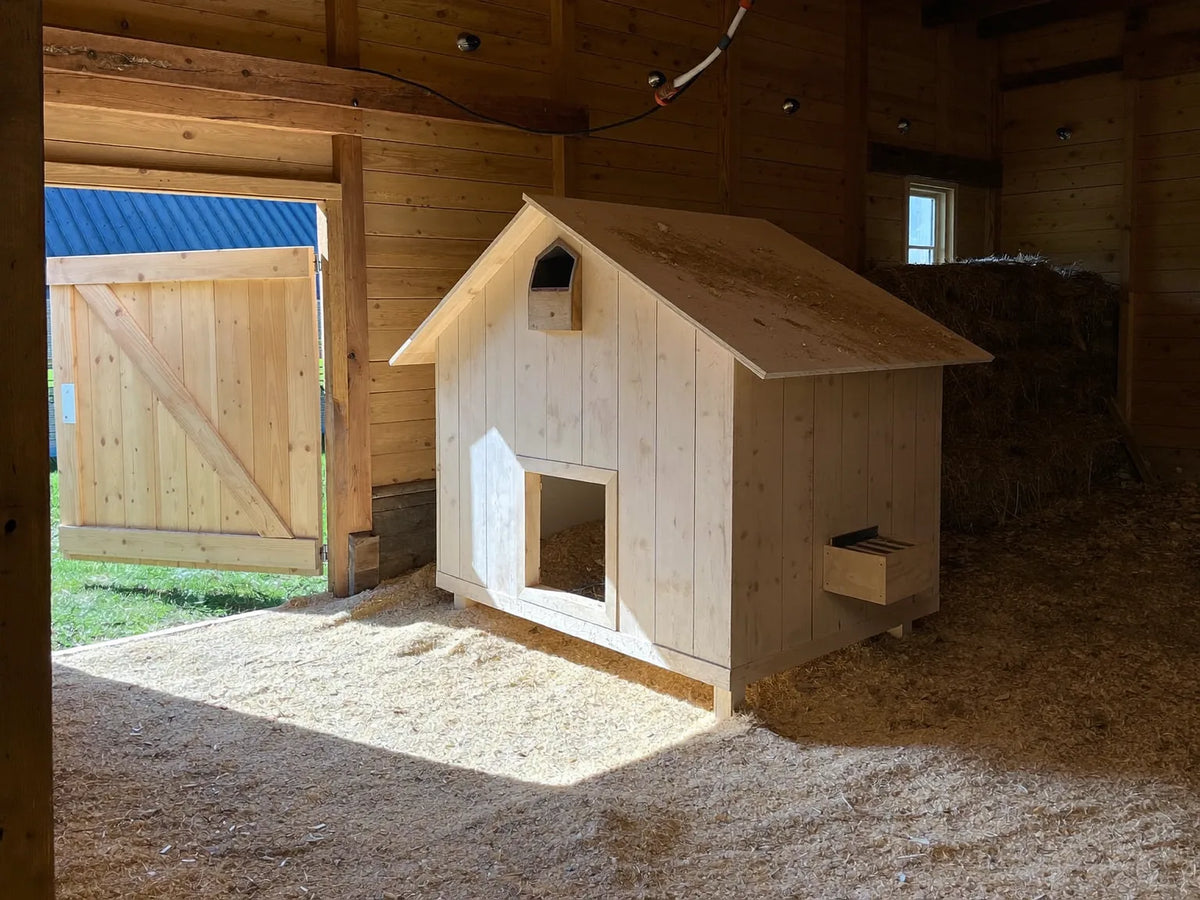
An indoor chicken coop is a coop kept inside a barn, shed or garage instead of out in the weather, and for most of those buildings it is a reasonable thing to do. What changes is the air. Once a coop is under a second roof, its own vents no longer exchange with the outdoors — they exchange with the building, and the building's openings decide what the birds breathe. Penn State Extension puts the poultry guideline below 25 ppm of ammonia and notes that a human nose does not register the gas until 20 to 30 ppm. Coops that can go in for a season and come back out again are the ones built to move.
The ammonia thresholds, box-stall dimensions and per-bird floor figures below are quoted from named extension services and linked at the foot; where a listing prints a length and no width, we get the width from the maker.
Is an indoor chicken coop a good idea?
In a barn, a shed or a detached garage, usually yes. Inside the house itself, no — that line is drawn by public health guidance rather than by housing guidance, and it is drawn firmly. University of Maine Cooperative Extension lists four ways to house a small flock, and the second one is the building you already own: "Use a portion of an existing structure such as a barn, garage or outbuilding and make changes by constructing a room or pen to keep poultry by building a suitable size pen."
Oklahoma State University Extension says the same thing from the cost side. Its backyard flock fact sheet notes that "in some cases, there may be buildings on the property that can be altered or renovated for the poultry enterprise with a minimum expense." An existing building is the cheapest good housing available to most people who have one.
The house is where the guidance stops. Minnesota Department of Health is unambiguous: "Do not let your live birds inside the house, especially into areas where food or drink is prepared, served, stored, or where young children have access." University of Tennessee Extension's Salmonella publication puts it in one line — "Do not bring backyard poultry inside the house, particularly the kitchen." Neither publication mentions a garage, and we are not going to pretend otherwise. What they establish is where the line sits and why it sits there, which is enough to think with when your garage shares a wall and a door with the kitchen.
So the trade is straightforward. You gain a weather shell you did not have to buy, a dry floor and somewhere to stand while you work. You give up daylight, you give up the air exchange the coop was designed around, and you take on the manure in a space you also use.
What an enclosed building does to coop ventilation
Every ventilation instruction in the small-flock literature is written about a house standing in open air, and putting that house inside a second building quietly changes the term the instructions depend on. The mechanism is a temperature difference, and a building flattens it.
University of Kentucky's Dr. Jacquie Jacob wrote the one extension page dedicated to small-flock ventilation, and the sentence that matters here is a conditional: "A constant flow of air exists if the outside temperature is cooler than the temperature at bird level inside the building." Read the condition rather than the conclusion. "Outside" means the air on the other side of the coop wall — and once the coop is in a barn, that air is barn air, warmer in winter than the field and, in a shut garage in August, capable of being warmer than the coop.
Be careful about how much that proves, because it is easy to overclaim. Jacob's sentence is an if, not an only if. It tells you when a constant flow exists; it does not say air stops moving when the outside air is not cooler. What it does establish is that the stated condition for a constant flow is no longer being met by the coop's own vents, and that nothing in the published literature tells you what replaces it, because none of it is written about a coop inside a building.
One service does name the outcome, and it is the only one we opened that does. Ashley Wright of University of Arizona Cooperative Extension, writing for the small-flock poultry extension service, says that "the insides of small coops or other enclosed buildings can become extremely stuffy". That sentence sits on a page about summer heat, which is the season it bites hardest in, and it is the closest thing in the published literature to a description of the case this page is about. Our summer prep guide draws on the same page for a different job: where shade fabric may and may not go.
The siting rule moves the same way. Our guide to where the vents go on a coop is built on the four services agreeing to put openings on the south or east side, away from prevailing winds. Inside a barn there is no prevailing wind at the coop wall. The rule does not disappear — it relocates to the building's own doors, windows and eaves, which are now the only openings connected to the weather.
Two siblings carry the rest of this. Powered air is the coop fan guide, and the balance between ventilation and draft at roost level is settled in the heated-coop guide. Neither changes indoors; what changes is which wall you are arguing about.
Can you keep chickens in a garage?
A detached garage works and an attached one asks a harder question. The building gives you a slab, a lockable door and a roof; what it does not give you is a second opening, and a single up-and-over door is one opening that is shut most of the time. That is the whole problem in one sentence.
The floor is the first thing to change your thinking. Concrete is easy to sweep and impossible to drain, and a coop with an open floor loses the mechanism it was built around — a chicken tractor works because the ground underneath it is fresh grass and the droppings go into it. Indoors there is no ground. Bedding depth and change cadence carry the whole moisture job instead, which is the argument our bedding guide makes in detail: ammonia is a moisture number before it is a material.
Then there is the housekeeping. Minnesota Department of Health asks you to "clean equipment and materials associated with raising or caring for poultry, such as cages or feed/water containers, outside the house, not inside." A garage attached to a kitchen is a building where that instruction gets awkward, and it is worth reading before you set up rather than after.
One thing we could not answer: no extension publication we opened addresses a vehicle, stored fuel or a running engine in the same enclosed space as a flock. The literature simply does not cover it. We are not going to invent a figure for it, and if you are parking a car in there, that unanswered question is the one we would think about hardest.
A coop that spends winter in the barn and summer on the grass has to be one you can move. Take 10% off one that rolls. TAKE 10% OFF
Chicken coop inside a barn: the jobs the building takes over
A barn takes over roughly half of what a coop is for, and the half it takes is the half you paid for. Weather, wind and the structural roof are the building's job now. Air, light, manure and the space each bird stands in are still entirely yours.
Start with what stops earning. A waterproof asphalt roof, a UV-resistant panel, a PVC curtain over the run — every one of those specs is money spent on weather that a barn already handles, and they carry on adding weight and cost under cover. Where those specs matter and how they are stated is our coop roof guide; the point indoors is that the ranking flips, and the specs you would have ranked third become the ones that decide.

What does not stop earning, in order: a floor you can clean, a droppings tray you can draw out without moving the coop, an opening you can walk a rake through, and a way to shut the birds in that does not depend on the barn door being closed. Those four are worth more under a roof than any weather spec on the listing.
There is a different project that people often mean by the same words, and it is worth separating. Making the shed itself into the coop — cutting a pop-hole, adding vents high on more than one wall, fitting roosts and nests to the walls you already have — is a build, and we cover it in the DIY coop guide. Putting a coop, or a penned-off room, inside a building that stays a building is what this page is about. The first is cheaper if the shed is spare. The second is the one that lets you take the coop back outside in April.
Does a coop fit in a barn stall?
Almost always, on the floor plan — and the floor plan is not the question you should be asking. Extension Horses states the two common box-stall footprints as a minimum of 10 ft by 10 ft and, more commonly, 12 ft by 12 ft, with partitions 7 ft high. Those are horse dimensions from a horse-facilities page; the only thing we are borrowing is the measurement of a structure, never a recommendation about birds.
Set the stated footprints against them. A 12 ft square is 144 inches on a side, a 10 ft square is 120.
| What you go out and measure | Why it usually is not the binding constraint | The number that binds instead |
|---|---|---|
| Stall floor area | A 12 ft box stall is 144 square feet of floor. Almost anything you can carry through a stall door sits inside that | Working clearance — how far a droppings tray draws out, plus somewhere to stand while you rake |
| The coop's overall length | A stated length tells you the coop fits along a wall. A stall is defined by the gap between two of them | Overall width. If the listing prints a length and no width, that is the figure to get before you order |
| The coop's overall height | Box-stall partitions are drawn at 7 ft, which clears the height of anything two people can lift | The doorway you have to get it through, and which way the stall door swings |
| Whether it fits at all | A 10 ft stall is 120 inches on a side, a 12 ft stall 144. Both swallow a backyard coop whole | Whether the stall is spare. An empty stall out-houses any coop you could stand inside it, several times over |
Row two is the one that catches people out. A listing that hands you an overall length and stops has told you the coop fits along a wall and nothing about whether it fits between two of them — and a stall is the second measurement, not the first. So read the dimension line for a width specifically, and treat a missing one as a question rather than a guess: it is one email to the maker, and we will send it for you.
Here is the part that argues against putting a coop in the stall at all. A 12 ft square stall is 144 square feet of floor. Run that through the honest capacity math at the published per-bird figures and the empty stall out-houses any coop you could stand inside it, several times over. If the stall is genuinely spare, University of Maine's advice is to build the pen rather than park a box in it. The coop earns its place when the stall is not spare, when you want the flock shut in something at night, or when the coop is going back outside in spring.
And fitting is not the same as working. A tray has to draw out, a door has to swing, and you have to stand somewhere while you rake. Subtract all three before you decide the numbers fit — then take the stall's short side, the doorway width and your tray clearance, send them to us with the coop you like, and we will tell you whether it works in there. Coops on wheels are the ones that come back outside in spring.
Indoor chicken coop ideas that change the outcome
Most indoor coop ideas are about the coop, and indoors that is the wrong object — the building is what changed, so the building is where the good ideas are. Layout inside the box is its own subject, and we take it apart in what goes where inside a coop. These six are about the shell around it.
- Pen the room instead of buying a box. University of Maine's second option is a pen built into a structure you already own, and it is the cheapest thing on this page if the space is spare.
- Move the ventilation argument to the building. Two openings on different walls, high, is the shape the literature keeps describing; the coop's own louvers are now exchanging with barn air, not weather.
- Put the coop where you can get all the way round it. Indoors nothing gets moved for cleaning, so a tray that draws into a wall is a tray you stop pulling.
- Bedding depth over bedding brand. There is no ground under an indoor coop to take the moisture, so depth and change cadence do all the work.
- Feed in metal cans, not bags. A building with feed in it is a building with rodents in it eventually; exclusion and storage are covered in the pest guide.
- Plan the way out. A coop that can be wheeled back onto grass in spring turns the indoor season into a season instead of a permanent arrangement.
Under heat the ranking changes again, and shade and air beat everything else. Where the shade itself should go, and what fabric over a run does and does not do for the air under it, is the job of our summer prep guide.
How do you know when the air in a closed building has gone bad?
Your nose is a real instrument with a published floor, and the floor sits at the limit rather than below it. Penn State Extension states it plainly: "Our human nose will not recognize ammonia until about 20 to 30 parts per million (ppm) has been reached. But poultry health guidelines suggest that ammonia be kept below 25 ppm for most birds." The page's own conclusion is the line worth remembering — "If humans can smell ammonia, that means it's over the recommended levels."
Two more sentences from the same page make it worse indoors. First, acclimation: "Even the casual visitor to a poultry barn will acclimate to an ammonia odor within about 20 minutes." Anyone doing half an hour of chores in their own barn is inside that window every day. Second, the gradient: "the ammonia level will typically be higher near bird level, particularly for floor-raised birds, than at our human head level in poultry barns." Penn State names the mechanism in the same paragraph — dilution from air exchange up high, accumulation down at the manure — which is why the reading has to be taken at bird level and why standing in the doorway tells you least.
There is a second sign that costs nothing. University of Maryland Extension: "If you smell ammonium fumes and see thick cobwebs in your coop, then the coop is not adequately ventilated." Cobwebs across a corner are a still-air record you can read on the way past. Treat that page as a relative of the Penn State and Virginia housing publications rather than an independent check on them — it cites Phillip Clauer throughout, and Clauer co-authors both of those.
If you want a number instead of a nose, Penn State's own answer is a colorimetric tube: a pen-sized glass tube that changes colour along its length, read like a thermometer. The diffusion version needs no pump — break one end, leave it at bird level for a few hours, read the scale — and Penn State recommends the 5 to 100 ppm range for most poultry houses. Our own ventilation guide tells you to use your nose, and outdoors that is a fair instrument. In a closed building, a tube at bird level is the version that still works after twenty minutes.
Would we keep hens in a building, and what does being wrong cost?
We would — in a barn or a shed, with two openings on different walls, and with a plan for getting the flock back outside. In a shut single-bay garage attached to a kitchen, we would not, and the reason is public-health guidance about the house rather than anything about coops.
What being wrong costs is slow and almost invisible, which is the whole problem. Ammonia does not announce itself until it is already over the guideline, your nose stops reporting it after twenty minutes, and the damage the literature describes is respiratory rather than dramatic. There is no bad morning to point at. You simply have a flock that does less well in a building you thought was doing them a favour, and by the time it is obvious the bedding has been wrong for a season.
The buying decision that follows is narrower than it looks. Under a roof, the weather specs stop earning and four things start: a floor you can clean, a tray you can draw, an opening you can rake through, and enough stated width to know it fits. Check the listing for that width before you check anything else. If it prints a length and stops, send us the model with the inside measurement of your stall or bay and we will come back with the figures before you order. Coops on wheels and coops that come with their own run are the two shapes that can spend a winter under a roof and go back out in April.
Sources: University of Maine Cooperative Extension, “Housing Your Pullets: Four Options and Other Considerations” (Richard Brzozowski, Poultry Specialist; no date shown) — accessed August 21, 2026 · Penn State Extension, “Detecting Ammonia in Poultry Housing Using Inexpensive Instruments” (Gregory P Martin, Ph.D., PAS and Eileen E. Fabian (Wheeler), Ph.D., updated January 10, 2026) — accessed August 21, 2026 · University of Kentucky, “Ventilation in Small and Backyard Poultry Flock Housing” (Dr. Jacquie Jacob; no date shown) — accessed August 21, 2026 · Oklahoma State University Extension AFS-8202, “Backyard Flock Production” (published March 2017) — accessed August 21, 2026 · Extension Horses, “Equine Facilities: Stall Dimensions” (Ashley Griffin, University of Kentucky, January 20, 2020) — accessed August 21, 2026 · Minnesota Department of Health, “Keeping Backyard Poultry” — accessed August 21, 2026 · University of Tennessee Extension D 181, “Backyard Chickens and Salmonella” (Tom Tabler and Lew Strickland, September 2022) — accessed August 21, 2026 · University of Arizona Cooperative Extension Service, “Managing Backyard Chickens During Periods of Extreme Summer Temperature” (Ashley Wright, MSc, Livestock Area Agent) — accessed August 21, 2026 · University of Maryland Extension, “Coop Construction – General Requirements” (updated September 15, 2021) — accessed August 21, 2026. Source independence: the Maryland page joins that lineage by citation rather than by byline — it cites Phillip Clauer five times in its own text, and Clauer co-authors the Penn State and Virginia housing publications our other guides quote. A byline check alone would pass it as a separate voice. It is not one, and nothing here is counted as agreement between it and them.
Frequently asked questions
How much indoor coop space per chicken?
University of Maine Extension puts indoor space at 2 to 3 square feet per bird, and opens the same page at about 3 square feet. Those figures sit at the low end of the published range, because University of Minnesota Extension goes to 5. Indoors the number matters more, not less, since a coop in a building gets no run unless you build one. Our size guide sets the services side by side.
How to build a chicken coop in an existing barn?
University of Maine Extension's second housing option is a room or pen built inside a barn, garage or outbuilding, and it is the cheapest route when the space is genuinely spare. The work that decides it is air: two openings on different walls, high up, in the building rather than in the pen. A coop earns its place when the stall is not spare, or when it is going back outside in spring.
How much natural light does a chicken coop need?
No extension service we opened publishes a quantity of natural light for a coop. University of Maine Extension says natural light is good for hens, that windows are how it gets in, and that light has to be provided in winter when day length is short. A windowless building supplies none of it, so the whole light budget moves indoors. The laying-light figures are in what belongs inside a coop.
How to build a chicken coop in a garage?
Frame a pen against two walls and leave the slab as the floor, deeply bedded. Concrete sweeps well and drains not at all, so bedding depth carries the moisture that ground would normally take. Keep the pen clear of the door track and of anything stored in fuel containers. Minnesota Department of Health asks that coop equipment be cleaned outside the house rather than inside it, which is worth planning before you frame anything.