

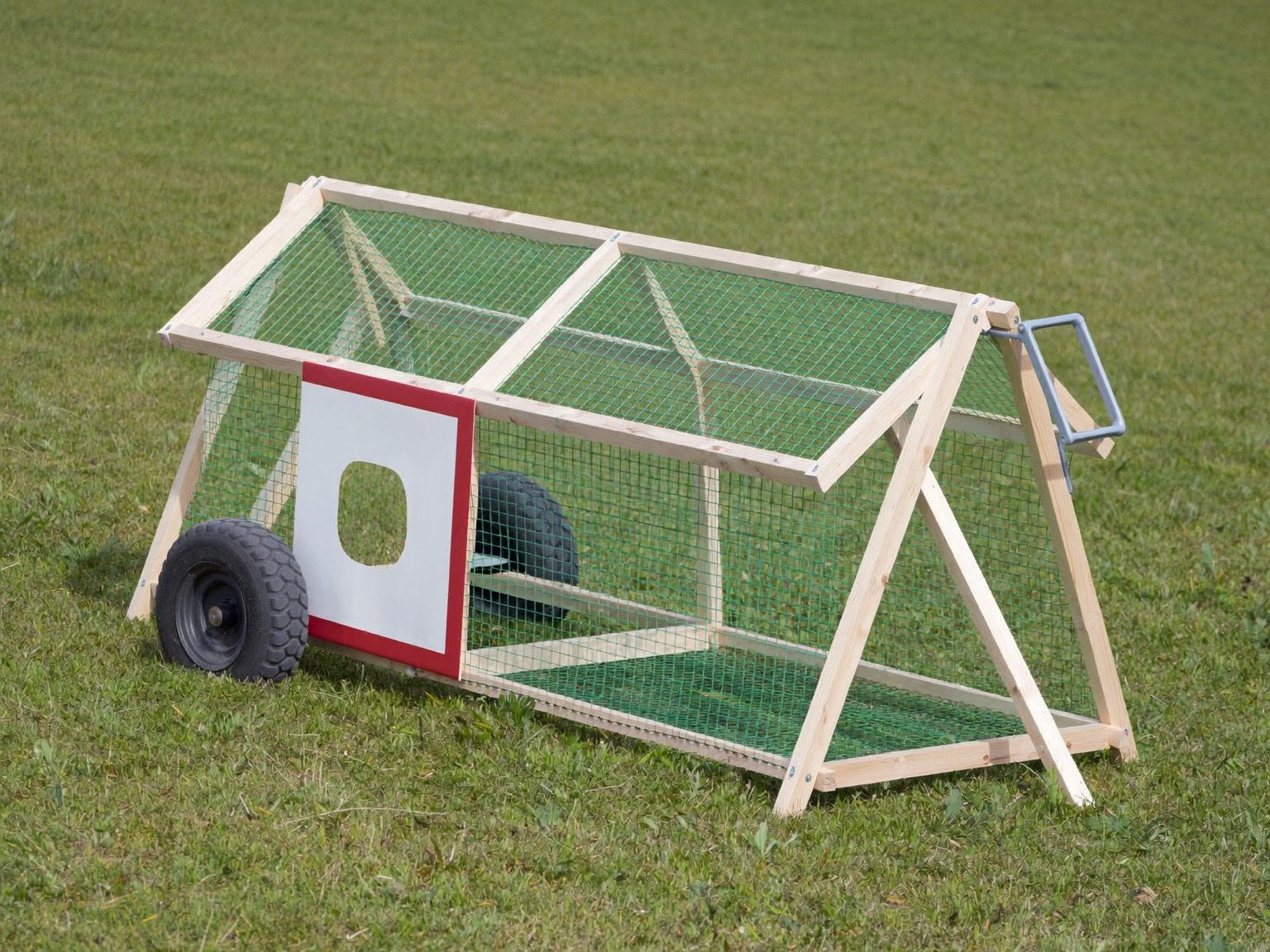
The number that decides whether a chicken tractor gets built and then moved is the weight at the handle. Of the tractor plans we have read, almost none print it. Footprint, cut list and hen count are the easy fields; weight at the handle depends on the finished weight and on where the axle sits under the load. Read a plan for those two before you read the drawing, and check the wheel diameter third — halve it, and you have the height of the tallest obstacle that wheel can climb. If you'd rather not cut anything, start from the coops built to move, and ask us for any wheel or clearance figure a listing leaves out.
Every weight and axle figure here is one you can measure with a tool you already own; the ground-line and ventilation instructions are quoted from five extension publications, two of which share an author, as the text says.
What makes a chicken tractor plan worth building from?
A tractor plan earns its place when it states the 8 fields that only exist because the thing moves. Dimensions and a cut list make a plan buildable. Weight, axle position and wheel diameter make it moveable — and those three go missing.
| What the sheet must state | Why it only matters on a tractor | What good looks like |
|---|---|---|
| Finished weight | Decides whether the build gets moved or parked | A lumber schedule you can total, plus the crew size the sheet assumes |
| Axle position | Sets how much of that weight lands in your hands | A dimension from the handle end to the axle, marked on the elevation |
| Wheel diameter and type | Decides what the wheel rolls over and what stops it | Diameter in inches, plus the surface the plan was drawn for |
| Ground clearance | Decides whether the lowest rail rides or plows | Measured at the lowest frame member, not at the floor |
| Frame section | The biggest single weight lever on the whole sheet | Nominal size per member, and which members carry the lift — light section where it only fills a frame, full section on every rail you'll lift by |
| The ground line | An open floor has to meet uneven ground somehow | A continuous base rail, and a drawn detail for the gap |
| How it gets moved | Lift and tow, push, or two people at both ends | Named, with the surface: "one person, mown lawn" |
| Whether the floor is open | An open base is what makes it a tractor at all | Drawn in section, never implied by a photograph |
The ordinary plan fields — overall dimensions, cut list, materials list, ventilation area, pop-hole opening, wire spec — belong on any coop plan, and we scored them against real commercial listings in what a coop plan should include. A static plan needs at most three of the 8 above. A tractor plan that skips them is a picture of a tractor.
The three numbers that decide whether you actually move it
Three numbers: finished weight, the weight at the handle, and ground clearance. Finished weight is the one plans occasionally state. Weight at the handle is the one you feel twice a week. Ground clearance is the one that stops the frame plowing the lawn.
Finished weight is the headline figure and the wrong one to shop on. A heavier tractor with the axle tucked under the load can lift lighter at the handle than a lighter one with the axle stuck in the middle. The handle is a lever and the axle is the fulcrum, so moving the fulcrum toward the load makes your end lighter. That is a design decision, made on paper, for free.
There is exactly one honest way to learn the weight at your handle, and it costs nothing. Finish the build, set a bathroom scale under the handle end, rest the handle on it and read the dial — keep a hand on the frame while you do it, because a scale is a gauge, not a stand. Write that number on the plan in pen. It's a measurement of a finished object, which is the only thing it can ever be.
The same rule holds when you are buying rather than building. Nobody can calculate a lift weight for you from a spec table: a calculated lift weight is a guess with a decimal point on it, and the person who finds out it was wrong is the one holding the handle in February. Ask instead what the finished coop weighs and where the wheels sit on the frame — those two answers together tell you far more than either alone, and we will get both from the manufacturer if you tell us which coop you are weighing up.
Ground clearance is the quiet one. Measure it at the lowest frame member, not at the floor, because the rail is what catches. Before you conclude a sheet or a listing has left it out, read the dimensions for "height to the floor" — the figure gets filed under that name rather than as clearance, and a stated 7.5″ is what it looks like when it does appear. On a build you're drawing yourself it costs one dimension line.
Where should the wheels and axle sit on a chicken tractor?
At one end, as close to the heavy end as the frame allows, on the largest diameter that fits. Wheels at one end let the other end lift. Wheels in the middle put the load on both of your arms at once.
Plans draw a wheel. They almost never dimension where it sits. Ask any sheet for a single measurement — handle end to axle centerline — and you have the number that sets your handle weight. It's also the cheapest thing in the whole design to change, right up until the moment you drill the frame.
Diameter is the other half. A bigger wheel rolls over more, and a plan that states a diameter without stating the surface it was drawn for has given you half a spec. Short mown grass forgives a small wheel. Tussocks, mole hills and tree roots don't, and they are where most tractors quietly stop being moved.
Four swivel casters look like an upgrade and behave like a shopping cart. Casters turn the job from lift-and-tow into push, which is easier on a hard flat surface and worse on turf, where the swivel wanders off line and a small wheel sinks. The move itself has a technique, and it is in how to move a chicken coop.
Take the same six fields again, this time with the place each number lives when neither the sheet nor the listing prints it. None of the six is unknowable. All six are gettable, and five of them you can get yourself.
| Mobility field | What it decides | How to get the number when nobody prints it |
|---|---|---|
| Wheel count | Whether you lift and tow, or push | Count it off the drawing or the photograph. It is the one wheel fact that is always visible, which is why descriptions lean on it: "built-in", "integrated heavy-duty", "large aluminum wheels" |
| Wheel diameter | What the wheel will roll over | Measure the wheel, or ask the seller for it in inches. Halve whatever you get: a stated 3.9″ wheel rides on an axle 1.95″ up, and that is the tallest thing it climbs |
| Axle position | How much of the weight lands at the handle | One dimension: handle end to axle centreline. On a build it is yours to choose; on a bought coop a tape measure settles it, and a phrase like "fitted to one side" already tells you the coop pivots rather than tows |
| Ground clearance | Whether the lowest rail drags | Measure at the lowest frame member with a rule. Read the dimensions for "height to the floor" first — that is a name this figure gets filed under |
| Assembled weight | Whether one person is enough | Total the lumber schedule, then add hardware, roofing and wire — that last group is the part people forget. On a bought coop, ask for it before you order |
| Lift weight at the handle | Whether it gets moved on a Tuesday | A bathroom scale under the handle end of the finished coop. Measured, never published, and it takes ten seconds |
So the plan world and the shop world go quiet on the same field, which is oddly reassuring: it isn't that your free PDF is careless, it's that the axle has never been treated as something worth printing. That is fixable one message at a time. Tell us which coop you're weighing up and we'll get the wheel diameter, the clearance and the weight from the manufacturer before you order — `sales@moveablechickencoop.com`, and the shortlist starts at coops built to move.
What a floorless plan has to show at the ground line
An open floor is what makes a tractor a tractor, so the sheet has to answer at the ground line what a fixed run answers with buried wire. Two details belong there: how the base rail meets uneven ground, and what closes the gap when it doesn't.
Virginia Cooperative Extension gives the ground-line instruction plainly: "With outside runs, bury the wire along the pen border at least 12 inches deep, and toe the fence outward about 6 inches." It explains the mechanism in one sentence — "By toeing the fence outward and burying it, the predator digs down right into more fencing." Penn State Extension carries the same passage almost word for word, and that is agreement rather than corroboration: Phillip Clauer co-authors both documents. The alternative both pages give for a fixed coop is heavier still — "If you are building a new facility, consider laying a concrete floor, and start the wall with one or two concrete blocks."
A tractor forfeits all of it. Nothing under a coop that moves stays buried, and the perimeter is new ground every time you move it, so the base rail is the only thing standing where the wire would have been. That trade is the point of the design, not a flaw in it — but a plan that never draws the bottom edge has quietly skipped the part of the build that changed. It's also the edge you move: go slowly enough that the flock walks forward with the pen, and look along the rail line before it travels, because a bird that doesn't move is a bird under the rail.
University of New Hampshire Extension frames the general problem as a tension — a coop tight enough to resist animal predators, "yet not so tight as to interfere with good ventilation." On a floorless build the tight part is the bottom edge, and it is the edge plans draw at the smallest scale on the sheet. Look for a base rail in one continuous plane, a drawn skirt or flap detail for hollows, and a stated surface. The hardware discussion — mesh, latches, aprons — sits in how predator-resistant a coop really is.
One definitional check while you are down there. If the sheet draws a solid floor or a droppings tray under the roosting end, you are building a coop on wheels rather than a tractor, and the difference decides your whole cleaning routine. We took that apart in what a chicken tractor is.

Are A-frame chicken tractor plans worth the headroom they cost?
An A-frame is the cheapest tractor shape to build and the most awkward to balance. It braces itself, so it needs little timber — but the mass sits low and spread out, putting the axle and the handle into an argument you settle on paper.
Headroom is the honest trade, and it is poor everywhere except along the ridge. The beginner case for the shape is made in what a coop plan should include; the tractor-specific problem is different. On an A-frame the covered end is the heavy end, so the wheels want to sit under it and the handle wants to be at the open end. Plenty of A-frame plans sidestep the balance question altogether by drawing lift handles at both ends and no wheels at all.
Read that for what it is: a two-person lift. Two-person moves happen when two people are available, and two people are available on Saturday. Some small A-frames do lift by one adult on a lawn and some don't, and the sheet almost never tells you which — so the plan should state the surface and the crew it assumes, instead of leaving you to find out with a hand on each end.
Our own A-frame sheet is drawn at 4 × 8 ft, floorless, with 12 sq ft of raised covered end over 20 sq ft under the frame, stated for 3–4 hens. Size the covered end from the flock, not from the shape, using the same honest capacity math as any other coop. And if the headroom is the dealbreaker, the closest bought equivalent is a coop on wheels rather than a tractor — the floor is the difference, and the lighter end of what we carry sits in portable coops.
If the cut list reads like two weekends, take 10% off a coop that rolls instead. TAKE 10% OFF
Hoop and cattle-panel tractors: the lightest frame per square foot
A hoop tractor is a cattle panel bent over a timber base: almost no cutting, and the least timber per square foot of any tractor shape. The weight ends up in the base rails, which is exactly where you want it when the axle goes underneath.
When the national extension poultry site points at a portable design, it reaches for panels too. Written by Dr. Jacquie Jacob of the University of Kentucky, it sends readers to "a small pasture poultry ark" from the University of Wisconsin and "a hoop pen for larger pasture poultry flocks" from the University of Kentucky, built over cattle panels. Panels are a materials answer to a weight problem: the arch carries itself, so the timber stops being structure and becomes ballast.
The hoop's problem is the mirror image of the A-frame's. It's light enough that wind turns into a design field, so a hoop plan owes you two things a rectangle doesn't — how the base is weighted or pinned, and how much of the arch is covered. The more of the hoop the cover wraps, the more the whole tractor wants to leave. The rule the Clauer extension pages give for what is left uncovered stays simple: "Ample air movement without a draft is essential."
Our hoop sheet runs 5 × 10 ft, floorless, 15 sq ft under cover with 35 sq ft of run, stated for 4–5 hens. It and the A-frame are the two sheets drawn floorless; three of the six move, and all six are in the free plans PDF.
How big can a large chicken tractor get before one person can't move it?
We haven't found anyone who publishes that ceiling, and we won't invent one. The limit isn't a finished weight — it's the weight at your handle, on your ground, in the wet. Axle position and wheel diameter move that ceiling further than frame size does.
Large tractor plans usually respond to length by adding wheels instead of moving the axle, and the two are not the same fix. Four wheels is the caster trade again, on a bigger frame. Bought coops show the same instinct: counts get stated as 2 or 4, and the four-wheel ones lean on words — "4 universal (swivel) wheels", "4 heavy-duty" — where a diameter would have settled it. A count is not a capability, and neither phrase tells you what the thing weighs.
Past the point where one person struggles, you have four honest options and only four. Fit a bigger wheel. Move the axle nearer the load. Add a lever bar or a dolly for the lift, so the wheels only have to roll. Or build two smaller tractors and split the flock, which is the option people dismiss and then wish they had taken. There is a fifth if you would rather not solve it twice: buy the frame with the wheels already sized and hung, from coops built to move.
The cost of guessing high is specific. A tractor that needs two people gets moved when two people exist, and by then the ground underneath has had a full week of one flock standing on it. University of Minnesota Extension's trigger for portable housing is condition-based for exactly this reason: "Simply move the location of the house when manure begins to build up." A tractor you can only move on weekends is a tractor that meets that trigger late, every time.
Free chicken tractor plans in PDF: what a free sheet leaves out
Free tractor plans are worth downloading and worth reading skeptically. The good ones give you dimensions and a cut list. The field we keep watching them skip is weight, and the field none of them can give you — not one, ever — is the weight at your own handle.
Extension services are the underrated source, and the designs named above — an ark, a hoop pen — come free, from services that publish the bird-space figures alongside them. University of Minnesota Extension makes the case for moveable shelter in a sentence about pasture and cleaning time, and what that sentence does and doesn't promise is unpacked in what a chicken tractor is.
Our set is honest about the same limit. What each sheet carries is listed on the plans page; what none of them carries is a finished weight, because timber varies, hardware varies, and half of what a coop ends up weighing gets added after it's in the yard. What a sheet can hand you is a lumber schedule you can total before you buy.
Run one test on any free tractor plan you download. Does it dimension the axle, and does it state a wheel diameter with the surface it was drawn for? If the answer is no twice, treat the wheels on that drawing as a starting point and budget for changing them.
Which one would we build for ourselves, and what would we skip?
For ourselves, the hoop. Put the axle as far under the covered end as the frame will take without the far end going light, fit the largest wheel the base carries, and weigh the handle with a bathroom scale before calling it a one-person tractor.
Then write that number on the sheet, because next spring you won't remember it.
What we would skip: four fixed casters on grass, a wheel-free two-person lift on anything bigger than an ark, and any plan that draws a wheel without a diameter next to it. We would also skip sizing the tractor for the flock you might have in two years. Size it for the person who has to move it every week, then buy a second one if the flock grows — the arithmetic that works for coops does not work for levers.
Get this wrong and the failure is quiet. Nothing breaks. The tractor just stops moving — weekly, then whenever you remember, then never — and a tractor that stops moving is a small fixed run with a bare patch under it. That is the exact outcome the wheels were there to prevent, and it costs you the entire reason you spent the weekend building the thing.
If the honest answer is buy instead of build, the cost comparison on both sides is in build or buy — and the field to check first is still the floor.
Buying is the shortcut, and it's a fair one. A bought coop arrives with the weight already carried, the cuts already made and the wheels already on, so you spend the weekend moving it instead of building it. Start with the coops we carry that move, or the lighter portable coops if you'd rather lift than tow. Where a listing doesn't state the floor, ask us and we'll get it from the manufacturer.
Sources: Penn State Extension, "Small Scale Poultry Housing" (Gregory P. Martin and Phillip Clauer) — accessed August 11, 2026 · Virginia Cooperative Extension, "Small-scale Poultry Housing" (publication 2902-1092; Leonie Jacobs and Phillip J. Clauer — Clauer co-authors the Penn State page above, so the two are one lineage rather than two independent sources) — accessed August 11, 2026 · University of Minnesota Extension, "Raising chickens for eggs" — accessed August 11, 2026 · University of New Hampshire Extension, "Producing Your Own Eggs" — accessed August 11, 2026 · eXtension Poultry, "Housing Design for Small and Backyard Poultry Flocks" (written by Dr. Jacquie Jacob, University of Kentucky) — accessed August 11, 2026. Wheel, clearance and floor phrasings quoted above are observed on published backyard-coop listings, including a 3.9-inch wheel diameter, a 7.5-inch height to the floor, and a "fitted to one side" wheel position stated by PawHut on wooden mobile coops — accessed August 11, 2026.
Frequently asked questions
How to build a chicken tractor?
Work in this order: size the frame from the flock, choose the frame section, then decide where the axle goes before you cut anything. Build the base rails first, since they carry the load and set the ground line. Add the hoop or A-frame over them, then the wire, then the wheels and handle last, so the axle can still move if the balance is wrong.
How often should you move a chicken tractor?
Often enough that the ground underneath recovers, and the plan decides how often that is, because the footprint it draws sets how fast the patch wears out. Three hens under a 4 × 8 ft A-frame go longer between moves than the same three under a 2 × 6 ft ark, which argues for sizing generously on paper. The trigger itself is in what a chicken tractor is.
How to build an A-frame chicken tractor?
Cut two identical triangles, join them with a ridge and base rails, sheet the covered end and wire the open end. The geometry braces itself, so the infill can stay light — the base rails can't, because they carry the frame every time you lift it. The part worth slowing down for is the axle: set it under the heavier covered end, not in the middle, or the handle will lift far heavier than the finished weight suggests.
How to build a movable chicken coop?
Decide first whether the floor is open or solid, because that one choice changes the whole build. An open base makes it a chicken tractor and puts the birds on grass; a solid floor or a droppings tray makes it a coop on wheels that cleans at the tray instead. Our guide to what a chicken tractor is covers the difference. Either way, axle position and wheel size decide whether it actually moves.