

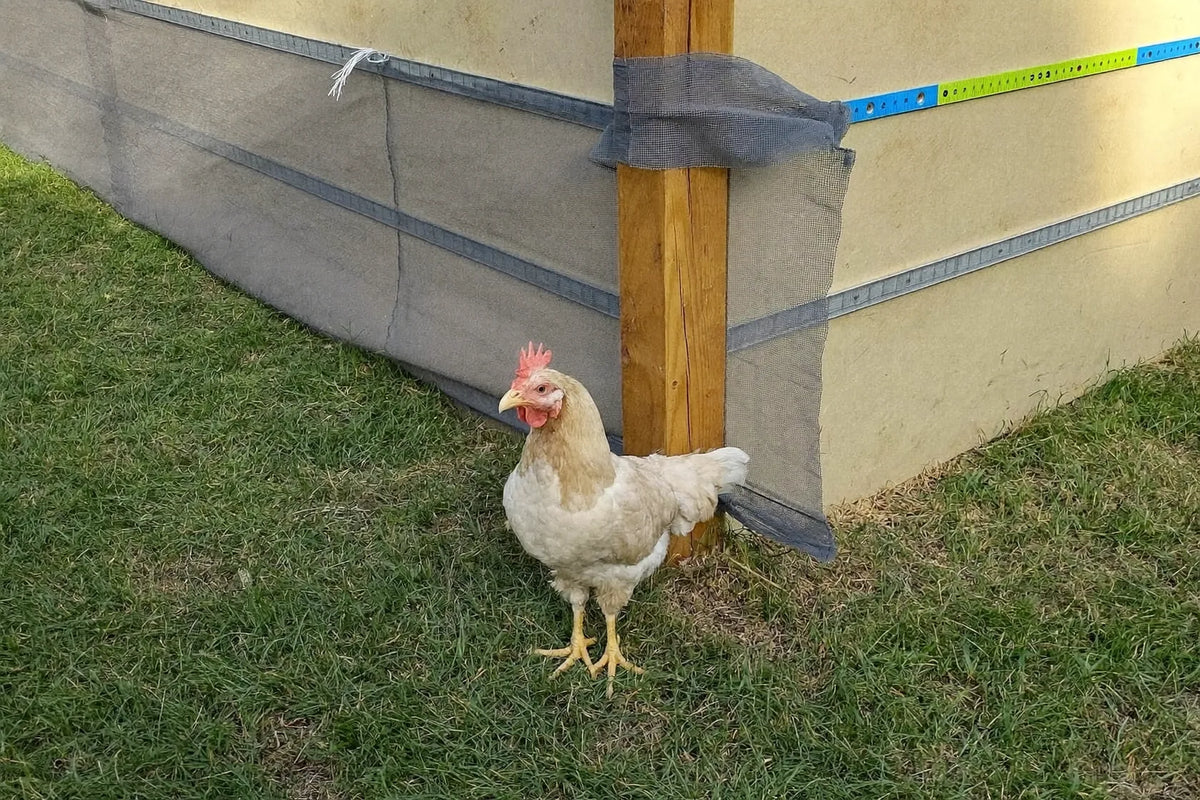
A chicken run goes up in five stages, and only the last one is easy to reverse. Mark the footprint, set the corner posts, open the ground line, hang the mesh, then decide the top. How to build a chicken run turns on that third stage, because the ground line is the part that decides what you buy. Virginia Cooperative Extension asks you to bury the wire at least 12 inches deep and toe it outward about 6 inches, and those 18 inches come off the same roll as the fence you stand inside. If you would rather not work through the sequence at all, the coops that arrive with the run already framed have settled every one of these decisions for you.
Ground allowance, burial depth and the predator findings all cite back to four named extension publications. The fence arithmetic is ours, shown in full; where nothing is published, this page says so.
How do you build a chicken run?
Five stages, in one direction: mark the footprint, set the corner posts, open the ground line, hang the mesh, decide the top. Only the top is genuinely reversible. Everything below it is buried, stretched or stapled into the stage before it.
A run and a hen house go wrong in different places. A coop is a set of surfaces, one at a time, and our coop build guide works through those. A run is one continuous edge that has to hold its line for 60 or 80 feet, and an edge cannot be adjusted in one place without moving everywhere else.
| Stage | What it settles | What changing it later costs |
|---|---|---|
| Mark the footprint | Ground area, and the length of fence you will buy | Everything. The footprint is the run |
| Set the corner posts | Where the tension goes and how square the rectangle is | Digging out concrete, or living with a rhomboid |
| Open the ground line | How the mesh terminates at grade — and how tall the roll has to be | Taking the mesh back off to re-trench |
| Hang the mesh | Standing height, and where the seams fall | A day of unstapling, and a roll you cannot return |
| Decide the top | Cover, shade and overhead protection | An afternoon. This is the reversible one |
Run down the last column and the job sorts itself. The one decision you can defer is the one most people agonise over, and the four you cannot defer are the ones that get made with a tape measure in ten minutes on a Saturday morning.
Area is not a shape, and fence is sold by the foot
Every published space figure for a run is an area, and none of them is a shape. Birds use area. You buy perimeter — and two runs with the same square footage can differ by almost 20 percent in fence.
For the per-bird areas themselves, our outdoor run guide sets out what each extension service publishes and where the two tables disagree, and the size guide carries the flock arithmetic. This section starts one step after them: you have an area, and you need a rectangle.
Here is the arithmetic on a shape you can go and pace out. Take a long, narrow walk-in enclosure stated at 9.2 feet wide by 31.2 feet deep — multiply those two and you get 287 square feet of ground. Now walk the outside of it: 2 × (9.2 + 31.2) = 80.8 feet of fence line.
Lay the same 287 sq ft out as a square and the sides come to 16.9 feet, which is 67.8 feet of fence. Same ground, same birds, 13 feet less fence. That is the general rule and it only runs one way: for a fixed area, a square is the least fence there is, so every other rectangle costs more.
| Footprint | Ground | Fence line |
|---|---|---|
| 9.2 ft × 31.2 ft (the long, narrow case) | 287 sq ft | 80.8 ft |
| 12 ft × 23.9 ft | 287 sq ft | 71.8 ft |
| 14 ft × 20.5 ft | 287 sq ft | 69.0 ft |
| 16.9 ft × 16.9 ft (square) | 287 sq ft | 67.8 ft |
| 6 ft × 47.8 ft | 287 sq ft | 107.7 ft |
None of which makes a long run wrong. A strip down the side of a garden is often the only shape the ground allows, and a 31-foot strip gives a bird further to walk before it meets a corner. Just price the shape before you commit to it, because the fence is not the only thing that scales with perimeter — so do the posts, the trench and the hours in it. Squaring the rectangle up is the one saving on this whole build that makes the run cheaper and better at the same time.
How to construct a chicken run once the corners are set
A run fence carries almost no vertical load. What it fights is racking — the sideways lean that turns a rectangle into a parallelogram — plus whatever a stretched roll of mesh pulls on the corners.
The corners therefore do the structural work on a run fence, and the intermediate posts only stop the mesh sagging between them.

Set the corners first and square them off each other, then space the intermediate posts to suit the mesh rather than the ground. A roll that sags between posts will be pushed inward by every bird that leans on it, and the sag always shows up at the bottom edge, which is the edge you least want loose. Brace the corners diagonally if the run is long enough that you cannot see one end from the other without turning your head.
Corners are also where the money should go. An intermediate post that leans can be re-set; a corner that leans has already pulled the fence line out of true on both sides of it. Cattle panels are one way to buy rigidity instead of building it, and our cattle panel guide works through what that shape commits you to.
No extension service in this library tells you how to frame any of that. The one sentence the literature offers on designing a small-flock structure is written about the hen house and is quoted in full in our coop build guide; nothing anywhere addresses the fence. So what is written above about corners and spacing is our reading, and so is everything below about height — labelled as ours every time it appears.
If the run has to bolt onto a coop that arrived finished rather than one you framed yourself, stop before you drill. A screw through a panel or a roof covering is not something a warranty always survives, and it is not reversible. Say which coop the run has to meet and we will pin those terms down with its maker before you make the hole.
Working out how much fence a run costs before you dig? Put 10% off toward a coop whose run arrives framed and squared. GET MY 10% CODE
What burying the wire takes out of the roll
At least 18 inches of any mesh roll you buy for a run never stands up. The buried leg and the toed-out foot are cut from the same width of wire as the fence, so the trench is paid for out of the height.
Virginia Cooperative Extension states the ground line plainly: "With outside runs, bury the wire along the pen border at least 12 inches deep, and toe the fence outward about 6 inches." Twelve down and six out is 18 inches of roll, spent before anything stands up.
Almost nobody converts the burial instruction into a purchase. A 48-inch roll buried and toed out to those figures leaves a fence about 30 inches tall — under knee height on a person, and low enough that the discovery usually happens after the mesh is stapled on.
| Mesh height you buy | Spent below grade (12 in down, 6 in out) | Fence that stands up |
|---|---|---|
| 36 in | 18 in | at most 18 in |
| 48 in | 18 in | at most 30 in |
| 60 in | 18 in | at most 42 in |
| 72 in | 18 in | at most 54 in |
At most, because Virginia's depth is a floor rather than a target — it says at least 12 inches — so a deeper trench takes more of the roll, never less.
Penn State Extension prints the same passage with the inch mark rather than the word. Its edition also carries a clause Virginia's does not: "If you bury the fence with medium sized course gravel most animals are less likely to try and dig at the base of the fence." Gravel in the trench is the cheapest upgrade in this whole build, and only one of the two printings mentions it.
Penn State states the premise on its own line too — "Animals always dig at the base of a fence" — where Virginia folds it into a subordinate clause. Read the pair as one text in two editions, not as two services agreeing: Phillip J. Clauer's name is on both. His co-authors differ — Gregory P Martin at Penn State, Leonie Jacobs at Virginia Tech.
Cheap is a real constraint on a run, and the trench is where it gets decided. Spend below grade and save on the top: netting a run later costs an afternoon, while re-trenching one later means taking the mesh off first, and mesh does not come off in a condition you would want to put back. A short roll bought to save money in March is not a saving. It is a second roll in August, plus the labour of removing the first one.
There is a second way to finish the ground line, and it changes what you buy rather than only what you dig. An apron is a separate strip laid outward at grade instead of a leg turned down into a trench, which means the fence roll keeps its full height and you order a second, narrower run of mesh for the skirt. Our predator guide sets out why it works and how wide it wants to be, and nothing here is a promise about any animal — it is a description of where the material goes. What a run that moves gives up at this edge is worked through in the outdoor run guide, and the floorless case is in our tractor plans guide.
Does a chicken run need a roof?
Cover the top or leave it open, and either way that decision sets the run's height — which is the one dimension the published guidance never gives you. It is also the only stage of the build you can genuinely change your mind about afterwards.
We read all four of the extension pages this site works from in full, looking for a number: Penn State's and Virginia's small-flock housing publications, University of New Hampshire's egg guide and University of Minnesota's. Not one of them puts a height on a run fence. The word post appears on none of them. Every height any of them publishes — roosts, nests, the top lip of a feeder, the ceiling light — is measured up from the coop floor and belongs to the hen house.
So the run's height and its structure are the two things you supply yourself. That is a gap in what is published, not a gap in what is known, and worth stating plainly, because the search results are full of confident numbers with nothing behind them.
Our reading, offered as ours: pick the height from the tallest thing that has to get inside, then buy the roll that leaves that standing after the trench takes its 18 inches. A run you can stand up in gets raked. A run you crawl into gets raked once. The walk-in structures in the range are sized on exactly that premise: a person standing up inside.
The cover itself is a separate purchase from the fence, and a stated cover size is not a covered area — our tarp guide does that multiplication on a listing that publishes both figures. What the extension services publish about covering a run, and the one overhead spacing figure any of them gives, is set out in the outdoor run guide rather than repeated here.
Chicken run blueprints: what a drawing settles, and what the ground decides
Search for chicken run blueprints and the honest finding is what is missing: not one published plan drawing in this library is of a run. Of the services here, only Virginia Cooperative Extension prints plans at all, and all three of them are houses.
The three are Plan No. 6188 for 50 to 65 hens, a 20 by 20 foot layer house, and an 8 by 8 foot layer house for 15 to 20 hens. Virginia's Figures 1 to 3 are photographs rather than drawings, so there is nothing else on the page to look at.
Virginia's plan set has a run-shaped hole in it, and the hole is strange. The same document gives the run its own column in the space table and tells you how deep to bury its wire, then draws the building and stops. Our 12-hen guide published the 15-to-20-hen finding first and the coop build guide established that Virginia is the only service printing plans at all; the missing run drawing is what is new here.
Published plans are easy to find, and worth using — but know what a downloaded drawing can and cannot settle. It settles geometry — lengths, angles, a cut list. It cannot settle your ground, and a run is more ground than structure. What separates a usable sheet from a decorative one is covered in our free plans guide.
A run drawing that does not state a mesh height and a burial depth in the same view is a drawing that has skipped the only stage where those two numbers interact. Check for that before you print anything.
Chicken run plans: turning a drawing into a materials order
Chicken run plans give you a shape. What you take to the counter is a quantity — so many feet of fence, a roll of one particular height, and enough posts to hold both up — and on a run, two of those three are worked out rather than read off the sheet. Any plan that hands you all three has quietly guessed at your ground.
The fence line is the first of the two. A drawing states a footprint, and a footprint is ground; the length you buy is the way round it, and the two do not track each other. Laid out as a long strip rather than a square, the same square footage is a different order of fence, and the shape table above puts figures on the difference. Do that sum in pencil on the sheet, before it turns into an order.
The standing height is the second, and it belongs to you because the depth does. A sheet that prints both of those numbers still has not printed the one you will be looking at, which is whatever the trench leaves standing. Run the roll table above against whatever height the plan assumes, and run it before the order goes in rather than after.
Where the drawings themselves come from is a fair question, and our own answer is free: the printable builds we send out carry cut dimensions and a materials list for the house. Reading a coop plan properly, including the one field most of them skip, is the subject of our coop plans guide. Neither sheet can mark your footprint out for you, and that is the one job on this list that has to happen on the actual grass.
DIY chicken run, or a run that arrives already built?
Build it if the shape of your ground is unusual. Buy it if you want the frame square on day one. A DIY chicken run wins on fit; a bought run wins on the four stages you cannot reverse.
Two more reasons land on the build side, and neither is about money: wanting to extend the run later, and wanting to own the trench rather than a delivery. The honest case for building is the footprint. A run you build is the shape your yard actually is, and the perimeter table above is the argument for drawing that shape yourself. The honest case against is that the two stages carrying every published instruction, the ground line and the mesh, are also the two that punish a wrong guess hardest, and there is no published height to guess against.
Here is where we come down. If the run has to be a specific shape, build it, and spend the budget below grade. If the run just has to exist, buy the enclosure and put your weekend into the birds. A plan sheet cannot tell you what a given structure actually states before you commit. We can. Name the coop and we will pull the run dimensions, the frame material and the mesh spec out of its manufacturer, blank fields included.
Where the run meets the coop there is a gate, and that is its own small build with its own decisions; our run door guide has it. And if the five stages read like five weekends you do not have, that is a fair conclusion — it is the whole reason a finished enclosure exists. A flat-pack kit is a different way to buy the same enclosure, and it is not a defeat. The coops that arrive with the run attached have made all five decisions already, and the full range sorts by the same footprint you would have marked out.
Sources: Penn State Extension, "Small Scale Poultry Housing" (Gregory P Martin, Ph.D., PAS and Phillip Clauer, updated June 25, 2026) — accessed August 22, 2026 · Virginia Cooperative Extension 2902-1092, "Small-scale Poultry Housing" (Leonie Jacobs and Phillip J. Clauer, April 28, 2023) — accessed August 22, 2026 · University of New Hampshire Extension, "Producing Your Own Eggs" (Kendall Kunelius; no date shown) — accessed August 22, 2026 · University of Minnesota Extension, "Raising chickens for eggs" (Betsy Wieland and Nora Nolden; Sabrina Florentino, reviewed in 2025) — accessed August 22, 2026. Penn State and Virginia Cooperative Extension share co-author Phillip J. Clauer and reuse whole sentences from each other; they are one text in two editions, never two services independently agreeing.
Frequently asked questions
How to level ground for chicken coop?
Cut down to the high point rather than filling up to the low one. Fill settles for years, and a run stands on its fill the whole time. Lay a straight board across the footprint with a level on it, work corner to corner, and mark what has to come off before a post goes in. Slope running across the fence line is worse than slope running along it, because it opens a gap under the mesh.
How to add a run to a chicken coop?
Build the run to meet the coop, not the other way round. The coop is already square and already sited, so treat it as the fixed object: set the two posts nearest it first and pull the fence line off them. The opening where the two meet is its own small build with its own hardware, and our run door guide covers it. Check the warranty before you drill into a coop you bought.
How to clean chicken coop run?
Most of the answer is decided at the build, not at the rake. A gate wide enough for a barrow decides whether litter leaves the run or just gets moved around inside it. A mesh edge that finishes cleanly at grade gives you something to rake against instead of a fringe of wire to catch on. For what the published cleaning schedule actually asks for, our outdoor run guide has it.
How to build a chicken coop and run?
As two builds with two different orders, sharing one wall. A coop is a set of surfaces that can each be got right on its own, and our coop build guide sets out the order those decisions come in. A run is one boundary that has to hold its line the whole way round, which is the five stages above. Square the coop first, then mark the run's footprint out from the wall it will meet.