

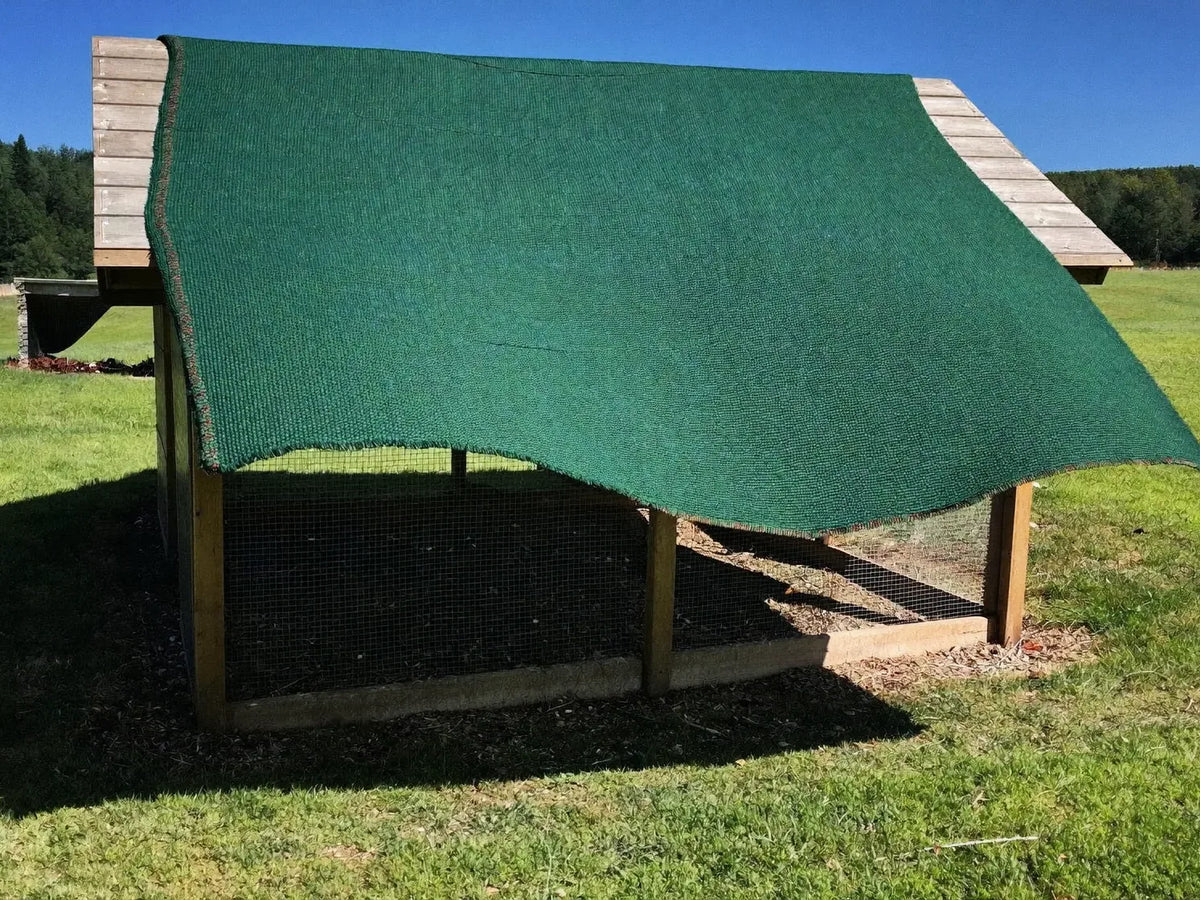
Shade cloth for a chicken coop is knitted or woven fabric sold by the share of sun it blocks, from 10 percent up to 90 percent. It puts shade over a run that has none for very little money, and Penn State Extension names it as a simple way to do that in a pasture or a run. What fabric cannot do is follow the sun. Cloth fixed to one rail in May shades that same patch in July, while the flock crowds into whatever corner is dark at four in the afternoon. On the coops built to move the wheels do the job the cloth cannot, and we chase the shade numbers the listings leave blank.
Shade-fabric specifications here come from a greenhouse engineering fact sheet, the poultry guidance from three named extension services, all linked at the foot. Greenhouse figures that do not transfer to a wire run are named as such rather than borrowed.
What does shade cloth for a chicken coop actually do?
Shade cloth stops a share of the sunlight before it reaches the birds, the run floor and the coop wall. The fabric is rated by shade percentage, and that percentage describes the weave you bought rather than the temperature underneath it.
Four things throw shade over a run, and they are not equally good. In the order we would spend on them:
Move the coop. Free, blocks no air, and re-decides itself every time the sun does. It only works if the coop rolls.
Knitted shade cloth. The cheap fix for a run that is staying put. It passes air, which is the whole reason it beats a tarp overhead.
Planting. A hedge or a young tree on the west side is the best shade there is and the slowest to arrive. Worth starting anyway.
A solid cover. Tarpaulin, PVC, a board. Excellent against rain and the worst of the four against heat, because it stops the air along with the light.
Everything below is about the second one, and about how the first quietly makes it unnecessary.
John W. Bartok Jr., the agricultural engineer whose greenhouse fact sheets UMass Amherst publishes, describes the material plainly: "woven or knitted shade fabrics from materials such as polypropylene, saran, polyethylene and polyester", "available in several degrees of shade from 10% to 90%". Two details earn their place over a run. "Most materials are ultra-violet stabilized and have a life of about 10 years", and lock-stitched knitted polyethylene "will not fray or rip-run when cut". A weave you can cut to the width of a run without hemming the edge is worth more in a backyard than one more shade point.
The temperature figures on that page do not travel, and it is worth being exact about why. Bartok reports research by Dr. Dan Willets at North Carolina State University finding that "the percentage shade ratings were accurate but the reduction in total energy was only half of the shade percentage due to conduction of heat from the material to the glazing", and that "A 50% shade reduced radiation about 10°F". Glazing is the mechanism in that sentence: heat conducts out of the hot fabric into the greenhouse skin it lies against. A wire run has no skin to conduct into. So the shade rating carries across to a coop and the degrees do not, which is why you will not find us printing a temperature drop for a shade cloth.
Colour is the one spec two separate sources put the same way. Bartok: "A black or green material although it gives longer life will conduct more heat than a white material." Penn State's poultry page says it about buildings — "black materials absorb heat, while white materials reflect it away from the structure." Bartok's is a greenhouse sentence again, but the absorbing half travels: a dark fabric gets hotter than a pale one wherever it hangs. So buy pale over dark when you get the choice, and if you would rather not buy fabric at all, the coops built to move are the ones that solve this by rolling thirty feet east.
How much shade for chickens is enough?
No extension service we opened publishes a percentage, a square footage or any number at all for shade for chickens. What they publish is that the shade has to exist, has to be reachable, and has to sit where the birds are in the afternoon.
Penn State is direct: "On hot, sunny days, shade is critical for keeping poultry cool." The next sentence says where it should come from — "Pastures should have some sort of structure or trees to provide shade." Ashley Wright of University of Arizona Cooperative Extension, writing for the small-flock poultry extension service, puts shade in a set of three: "Shade, water, and ventilation are the three most basic needs to keep chickens comfortable during the summer."
Minnesota ranks it differently, and where the sentence sits on the page is the interesting part. "Provide shade for pastured poultry or decrease sun exposure in the barn" is the last line of Minnesota's heat-stress page, under a heading called Other practices, after ventilation, feeding, water, electrolytes and vitamins. The same page states the priority order out loud: "Increasing ventilation to remove heat from the birds should be your first priority." Shade is real, cheap and worth doing. It is not the headline treatment in the literature, and a guide about shade cloth ought to say so.
The temperature numbers attached to this question are facts about hens, not about coops. Minnesota puts the thermoneutral zone "between 60 and 75 degrees Fahrenheit"; what happens above it is walked through in our coop fan guide. Penn State prints the same 60–75°F range under a different author. Both pages then qualify it in the next breath: Minnesota with "These temperatures can shift depending on humidity, care and building conditions", Penn State with "The temperatures at which major heat stress happens can vary among species, breeds, and even individual birds."
No coop carries a temperature rating, then, and no shade cloth carries a poultry rating. Penn State's practical substitute is a thermometer where the birds actually stand: "Adding thermometers at bird level in their coops or runs can also help to gauge what the temperature is really like in their environment." So hang one at bird level under the raised part of the coop and read that, not the one on the north wall at eye height — and if the run you are shading is one you have not bought yet, the coops that ship with a run are where to start measuring.
Shade for a chicken coop: what the box already casts
A coop throws shade before you buy any fabric. The roof shades the hen house, a raised floor shades the ground beneath it, and a solid wall shades whichever side the sun has left. What almost never reaches a product page is a number for any of it.
Where a page does break the floor area up level by level, read the two figures in the right order. The raised roosting level is the part that casts the shadow; the ground-level run beneath it is what has to fit under that shadow. So the smaller of the two numbers is your shade and the larger one is the space it has to cover — which is the opposite of the way most people read a spec table, and it is why a coop that looks generous at ground level can still leave the flock nowhere dark to stand. Raised coops with an open underside are the ones where that arithmetic is worth running, and the portable coops are where you will find them.
Check the wording next, because it is easy to read a durability claim as a shade claim. Anti-UV and UV-resistant describe the material's own life in the sun — a roof that resists chalking and splitting — not the shade it throws. When a page uses either phrase and gives you no percentage, no overhang and no covered area, take it as a spec about the fabric's lifespan and assume nothing about the ground beneath it.
Penn State adds the part no cover can do for you: "In an attached run or around your coop, ground cover like grass will help prevent sunlight from reflecting back onto the coop." Bare dirt bounces light and heat back up under a coop; grass does not. The caveat stays attached on the same page — "Vegetation should be kept trimmed to a reasonable length, though, to avoid impeding ventilation or attracting and harboring rodents." A coop that moves onto a fresh patch every week or two keeps grass under it by design, which is most of the case for the coops built to move.
Fabric shades one spot all summer. There is 10% off a coop you can park in a different one. TAKE 10% OFF
How do you fix shade cloth to a coop or a run frame?
Fix the cloth to posts or to the run frame wherever you can, and to the coop itself only when you must. Penn State lists three mounts that need no carpentry at all, and a slope that keeps water moving beats a tight, flat span.
Penn State's three, in its own words: "Fence post extensions can be used to stretch shade cloths to cover a smaller run." · "Temporary electric fence posts may also be a good option for installing shade cloths, offering greater flexibility in larger areas." · "Use them on their own or fix a shade cloth to the coop or a corner of the run to form a lean-to-type structure." A lean-to sheds a July downpour off one low edge instead of holding it in the middle, and a pocket of water is what tears eyelets out of a hem.
If the coop came finished from a maker rather than out of your own garage, its warranty terms are worth reading before you drive a screw or a staple into a panel. Fixings into painted fir are holes you cannot un-drive and they open a path for water into the end grain, so tell us what you own and its maker can say what a staple through that panel does to the terms; we will ask. Cable ties round a rail and a batten clamped to the frame both come off clean in October.
Where the cloth goes decides whether it works at all. Wright's page makes the case with an example worth stealing: shade rigged on the eastern side of a run can throw its shadow "entirely outside the area your birds can access" by late afternoon. Her instruction is specific — "Positioning shade in the middle or west end of the chicken run ensures that chickens will have access to shade during the hottest times of day: midday to afternoon." Penn State's version of the same idea: "Add shade strategically to cover more of the house and pasture during the hottest part of the day."

Cloth over a run is not cloth over a vent. Wright draws that line too: "An outdoor run with a shade cover may not need further ventilation, but the insides of small coops or other enclosed buildings can become extremely stuffy." Keep fabric clear of every louver, window and eave gap on the hen house — where those openings belong is our ventilation guide, and when air will not move on a still day the coop fan guide covers the powered version.
Plan the fixing as temporary for one more reason. Penn State's summer page wants shade in July; the housing page, written by different authors, wants sun in January: "Face the front of the coop, the windows and outside run to the south which allows the sun to warm and dry the coop and soil." So fix it so it comes off in one go and you get both seasons — ties and battens, not screws through a panel. Taking it down again is a job on our fall checklist — and a run frame with a top rail makes both fixings easy, which is worth looking for in the walk-in coops before you buy anything to tie to.
What size shade cloth do you need for a chicken run?
Measure the run, halve it, add a foot at each edge. That is the whole method, and it turns a shopping decision nobody else will make for you into two multiplications you can do standing in the garden with a tape.
No extension service publishes a shade area for poultry, so the half is our target rather than the literature's — chosen because it leaves the flock somewhere dark to stand at midday without giving up the sunny half they will crowd into in April. The arithmetic under it is yours, and it works on any run.
Measure the footprint. Length times width in feet. That is the ground you are working with, and it is the only number the cloth actually has to answer to.
Take half of the length. Cover the run's full width so the shadow spans it, and cover half its length. On an eight-foot run that is four feet.
Add the edges. A foot at each tie line for wrapping and fixing, and six inches a side for the rails. So the panel you want is the shaded length plus two feet, by the run width plus one foot.
| Run footprint | Ground area | Half of it means covering | Panel to buy |
|---|---|---|---|
| 6 ft × 3 ft | 18 sq ft | 3 ft of the length, full width | 5 ft × 4 ft |
| 8 ft × 4 ft | 32 sq ft | 4 ft of the length, full width | 6 ft × 5 ft |
| 10 ft × 4 ft | 40 sq ft | 5 ft of the length, full width | 7 ft × 5 ft |
| 12 ft × 6 ft | 72 sq ft | 6 ft of the length, full width | 8 ft × 7 ft |
Round up to the next roll size rather than down. Cloth comes in fixed widths, and a panel that lands an inch short of the far rail has nothing to tie to; a panel that overshoots gets trimmed, and the knitted weave from the first section is the one that takes a cut without running. Where the shadow lands is a separate question from how big it is, and it is the reason the panel wants to sit over the middle or the west end rather than the east — the fitting section above has the specifics.
The shade percentage is the decision to spend the least time on. Size settles whether the shade reaches the birds at all; percentage only settles how dark it is once it does. Fifty percent over half a run and seventy percent over half a run both give a flock somewhere to be, and neither gives you a temperature.
If the run came with the coop, measure the frame before you buy any fabric. Where a page states the run's dimensions you can run the table above straight off it; where it doesn't, name the coop for us and its manufacturer can supply the run's length and width — `sales@moveablechickencoop.com`, or start from the coops that ship with a run.
Shade cloth, a tarp, or the wheels: what would we do?
We would move the coop first, hang cloth second and keep a tarp for rain. Shade you can push across a lawn costs nothing per season and blocks no air at all, so fabric over a fixed run is the answer for a coop that has nowhere to go.
Move it early in the day. Minnesota's heat list includes "Delay activity in the barn, such as moving birds or litter conditioning", so handling a flock adds heat at exactly the wrong hour — a coop that needs to be in shade by noon gets rolled at first light, not at two in the afternoon. Thirty feet to the east side of a hedge is a two-minute job on a coop that rolls, and doing it without stressing the flock is covered in our moving guide.
Getting shade wrong is cheap and quiet, so it goes unnoticed for a season. Cloth pinned to the wrong rail shades an empty corner from June to September while the flock packs itself under the coop. A solid cover thrown over a small hen house to make shade does something worse: it trades sun for stale air, and you find out a week later by smell. Weave that passes air is the whole difference — a shade cloth is not a tarp, and a tarp is not shade.
If you would rather buy the shade than rig it, read the run first. The coops that ship with a run name a cover wherever the maker states one. The walk-in coops are the frames tall enough to stand in, and the likeliest to state a fabric over the mesh. The mobile coops let you park the box under a tree at nine in the morning.
Cover material is what a manufacturer states; a shade percentage is what we will ask them for. Paste us the link to the coop in your basket and we will chase the covered dimensions, or open the full coop list and settle the shade before the first ninety-degree week.
Sources: Penn State Extension, "Summer Flock Care: Keeping Your Birds Cool and Comfortable" (Torey Fischer, M.S., updated July 31, 2026) — accessed August 20, 2026 · University of Minnesota Extension, "Preventing heat stress in poultry" (Sally Noll and Sabrina Florentino, reviewed 2026) — accessed August 20, 2026 · University of Arizona Cooperative Extension, "Managing Backyard Chickens During Periods of Extreme Summer Temperature" (Ashley Wright, MSc) — accessed August 20, 2026 · UMass Amherst Center for Agriculture, Food and the Environment, "Shade for Cooling Greenhouses" (John W. Bartok Jr., University of Connecticut, 2013) — accessed August 20, 2026 · Penn State Extension, "Small Scale Poultry Housing" (Gregory P. Martin and Phillip Clauer, updated June 25, 2026) — accessed August 20, 2026
Frequently asked questions
How hot is too hot for a chicken coop?
No published figure exists for the building itself. University of Minnesota Extension puts the thermoneutral zone for most poultry between 60 and 75 degrees Fahrenheit, with behaviour changing as the air nears 85 and core body temperatures reaching lethal levels as it nears 100 without relief. Those are facts about the bird, and Minnesota says they shift with humidity, care and building conditions. Hang a thermometer at bird level and read that instead of guessing from the porch.
How to shade a chicken coop?
Shade what the flock actually uses at midday: the run, the sunny wall of the hen house and the ground under both. A raised coop already shades the space beneath it, so the gap is usually the open half of the run. Fabric or a tarp over an existing frame is the quick version, and it is worth fixing so it comes off again in the fall, when you want that sun back.
How to prep ground for chicken coop?
Start with what the ground does with the sun. Penn State Extension says ground cover like grass in an attached run or around the coop helps prevent sunlight reflecting back onto the coop, and that it should be kept trimmed so it neither impedes ventilation nor harbours rodents. Bare dirt bounces heat back up; a coop you move keeps grass under it without any work.