

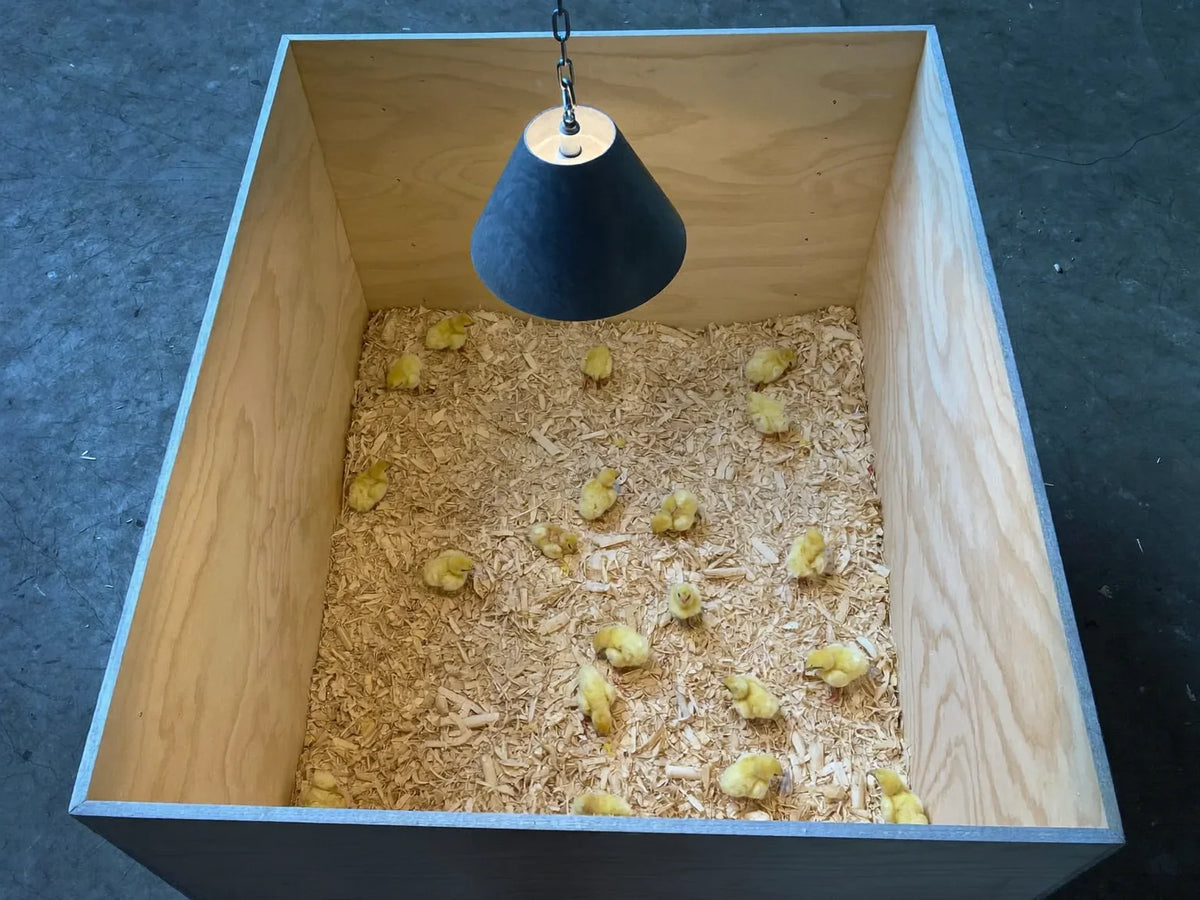
A chick brooder box is sized by the week, not by the flock. Penn State Extension asks for a quarter of a square foot per chick in the first week, three quarters by week three and a full square foot from week five — six times the starting figure by the time the birds are eight weeks old. A coop is sized for the far end of that ladder: birds that are dry, feathered and roosting. So shop for the stated enclosed hen-house floor area — a stated area is the only figure this arithmetic can use, and where a listing gives only an overall footprint, name the model and the enclosed figure comes back from its maker. Start from the coops for sale.
Brooding floor areas, the traction warning and the feathering line each come from a named extension publication, cited below. The chick specs a coop listing leaves out, we will ask the maker for.
How big does a chick brooder box need to be?
A chick brooder box needs a quarter of a square foot per bird in week one and a full square foot per bird from week five, on Penn State Extension's published table. Six chicks start inside 1.5 square feet and need nine by week eight.
Two US extension publications print a floor-space ladder for chicks, and they run at different speeds. Penn State's is a five-step table headed "Summary Of Brooding Requirements". University of Missouri Extension's G8351 climbs in two steps to eight weeks, then hands the birds to a growing table that keeps going after Penn State's has stopped.
| Age of chicks | Penn State, sq ft per bird | Missouri G8351, sq ft per bird | Six chicks need (Penn State) |
|---|---|---|---|
| Week 1 | 1/4 | 1/2 — its first band runs 0 to 4 weeks | 1.5 sq ft |
| Weeks 2–3 | 1/2 | 1/2 | 3 sq ft |
| Weeks 3–5 | 3/4 | 1/2 to week 4, then 1 | 4.5 sq ft |
| Weeks 5–8 | 1 | 1 | 6 sq ft |
| 8 weeks and up | 1-1/2, "increase appropriately as birds grow and for larger breeds" | 2, to twelve weeks | 9 sq ft |
| 12 weeks and older | no separate row | 3 light breeds, 4 heavy breeds | — |
The gap is widest on day one and it closes by week five. Missouri asks twice Penn State's figure in week one, because Missouri holds one number across four weeks where Penn State steps three times; by week three or four the coarse band puts Missouri below Penn State instead. At weeks five to eight the two land on the same square foot a bird. They are separate texts by separate authors — Penn State's is Gregory Martin and Phillip Clauer, Missouri's is Jesse Lyons — so the agreement in the middle of the ladder is real agreement.
University of New Hampshire Extension publishes no chick floor figure at all. Its instruction is a test rather than a number: "Make sure there is enough space for the chicks under the light without crowding or smothering and that there is enough space in the pen so that all of the chicks can escape from the heat." Three brooding publications, two floor-space ladders, and the third deliberately measures the same thing with birds instead of a tape.
Where each ladder ends is the finding worth carrying to the checkout. Penn State's last brooding row is 1-1/2 square feet a bird, and Table 1 on Penn State's own separate housing page gives adult laying hens 1.5 square feet inside. Same number. Missouri's ladder ends higher, at 3 square feet for light breeds and 4 for heavy, which is where Virginia Cooperative Extension puts adult laying hens. Read that as one publisher landing on its own adult figure and another landing near a different publisher's, not as three services agreeing: Penn State's brooding page, Penn State's housing page and the Virginia publication all share the co-author Phillip Clauer, and matching numbers across that set are a shared author rather than corroboration.

Penn State's chick guard turns out to be the same table drawn as a circle, and the arithmetic is ours rather than published. The instruction reads: "A chick guard 18 to 24 inches high and 6 to 10 feet across is sufficient for 100 chicks." A six-foot circle encloses 28.3 square feet, which is 0.28 square feet per chick against Penn State's own week-one quarter. The ten-foot end encloses 78.5 square feet, or 0.79 a chick, against its own three-to-five-week three quarters. Missouri's ring — "12 inches high arranged in a circle 6 feet in diameter" and, in its own words, "A diameter of 6 feet should provide plenty of space for 50 chicks" — works out at 0.57 a chick against Missouri's own half. Every one of those rings sits five to thirteen per cent above its own publisher's per-bird row.
Scope that before you reach for a compass. Both ring figures are written for fifty to a hundred chicks, so the diameter does not scale down to a backyard batch of six — what scales is the area per bird. The two published guard heights do not explain each other either, at 12 inches in one publication and 18 to 24 in the other.
Heat is the other half of a brooder and it has its own ladder, which we publish in full in our heat lamp guide — the week-one target, the weekly step down, and each publication's wording beside the row. Space and heat come down together, and only one of them needs measuring with a tape.
Why a chicken chick coop is not a small hen house
A chicken chick coop and a hen house are different buildings because a chick cannot yet hold its own body heat, cannot grip a smooth floor, and fits through gaps a grown bird never reaches. Every fitting a coop arrives with was sized for the adult bird.
Virginia Cooperative Extension writes the dividing line into a single sentence: "Poultry can handle cold very well if they are dry and are fully feathered (lost their down)." Penn State's housing page prints the same sentence without the feathering clause, and our winter care guide already flags that those two pages share a co-author. The parenthetical is the part that matters here. Down is not a coat, and a bird still wearing it is outside the condition every cold-weather instruction on this site assumes.
Floor surface is where a bought coop and a brooder disagree most sharply. Penn State is blunt: "Remember... never brood young fowl on slippery surfaces like newspaper or wood floors. If the young lack good traction, they may develop permanent leg damage." A removable droppings tray under the hen house is what makes a coop quick to clean, and it is also a sheet of slick metal or plastic. Penn State names newspaper and wood floors and does not name a tray — extending its rule to a tray is our reading, not Penn State's, and it follows from the reason the rule gives rather than from the examples it lists. Check for a tray on the listing, and if there is one, plan to cover it with litter or lift it out before a chick ever stands on it.
Wire is the other surface, and there the published figure is exact. "Three-eighths-inch mesh wire floored brooders work well for most fowl," Penn State writes, with a named exception: "don't raise bantam chickens, game birds, or miniature waterfowl on wire, as their hocks often will drop through the mesh and become trapped." Three eighths of an inch is a fraction of the aperture a run panel uses. So check the listing for a mesh aperture or a wire gauge before you assume the run will hold a two-week-old bird, and when the figure isn't printed, assume it will not. That assumption is ours rather than a published one, and it is the cheap direction to be wrong in. Say which coop and we can have its maker answer that in a line.
Water is the small one that catches people out. Penn State asks for "one quart of water for every 25 chicks" and then sets the design rule: "Use drinkers the young can reach but not fall into." A hen's drinker is a hazard at that age, and Penn State's own fix for the smallest breeds is to "place marbles or pebbles in the water tray so that they can drink but not fall into the tray and drown."
Roosts, nest boxes and a ramp all belong to the bird the chick becomes. Penn State publishes a perch height above the floor for standard chickens, which our roost guide sets out and works through per bird, and the traction rules for a raised entrance sit in our ramp guide. None of those fittings is doing any work in week one.
Worked out the floor area your chicks will need by week eight? Take 10% off the coop they graduate into. GET MY 10% CODE
Why the move date is not a size question
A move date is the one question on this page we do not answer, and the reason is that no extension publication we opened prints one. What they print instead is a condition — heat no longer required, the bird feathered — with the calendar running behind it. Which day that lands on is the brooder-exit decision, and it is a decision about the bird rather than about the box it is standing in.
Read the direction of that carefully, because it is easy to over-claim. Every condition those publications state is a condition for removing heat. Moving a bird into a coop also hands it weather, ground, a run and whatever visits the yard at night, and not one of the publications opened for this page ties those to an age. Whether a coop needs any heat once the birds are in it is a separate question with its own published answer, which our guide on heated coops sets out.
The floor plan answers only its own half, and it does answer that. Penn State's space column reaches its adult laying-hen figure at eight weeks and stops climbing, so on that publication the brooder stops asking for more room on exactly the week the space demand levels off. That is a fact about the table, not a date to move birds on.
A chicken coop with brooder space: what has to be true
A chicken coop with brooder space needs three things at once: a stated enclosed floor area, a box inside it that can be kept draft-free, and a floor a chick can grip. Penn State assumes the case rather than forbidding it, and writes an instruction for "small brood boxes or coops".
Penn State's own wording for a small box is how the same page allows newspaper as a base and bans it as a surface: "line the bottom of the brooding area with 6 to 10 pages of newspaper as a base. Then put a layer of paper towel on the top of the newspaper for traction." On litter the figure is "a base layer of 2-3 inches of clean, dry litter", with sawdust and other fine material avoided early "to limit excessive litter consumption" — bedding depth and material for the grown flock is a different calculation, and our bedding guide runs it. Penn State's one-line design rule for the enclosure itself is short enough to memorise: "The brooding area should be draft-free."
So find the enclosed hen-house floor area on the listing in front of you — the figure for the shut-in house, not the overall footprint — and read your own answer straight off the table. Six chicks are walked up Penn State's rungs and Missouri's.
| Enclosed hen-house floor the listing states | Six chicks fit until | What that means for the purchase |
|---|---|---|
| About 5 sq ft | Week five on Penn State's ladder; week four on Missouri's | A brooder for the first month and no longer. Buy it only if the birds have a run to move into by five weeks — see the coops with runs |
| About 6 sq ft | Week eight on both | Covers the whole published brooding ladder for six birds, then becomes a small adult house. The tidiest single purchase at this flock size |
| About 13 sq ft | Past week eight on Penn State's; week twelve on Missouri's | Room to keep six birds shut in through a bad week without recalculating anything. This is the band to shop if the flock might grow |
| Two stated levels, e.g. 13.2 sq ft over 20.8 sq ft | Same as above on the enclosed level alone | Count the enclosed level only. The level below is usually open to the ground, which is run rather than brooder |
| A whole-enclosure figure with no separate house — a walk-in, say | Can't be answered from that number | There is no separate house to divide, so brood in a box inside it. Look at the walk-in coops for the standing room that makes that easy |
| Only an overall footprint, no enclosed area at all | The ladder can't be run from the page | This is the one number to get before you order. Name it for us and its maker can settle it |
Know which way that arithmetic runs before you lean on it. Dividing a stated area by a published per-bird figure gives a ceiling on how many birds of that age fit, and it is only valid in that direction: it proves a box runs out, never that a box is adequate. It says nothing at all about heat, draft, or whether the hen house can be shut against a rat overnight. The distinction underneath is worth naming too — a stated floor area is a measurement, while a stated hen count is a claim, and the two are printed side by side on the same listing.
Run the smallest row both ways and you can see why an adult rating answers nothing here. Five square feet of stated main house holds twenty chicks at Penn State's week-one quarter and three at its eight-week row — and a coop with exactly that interior can carry a maker's rating of 2–4 hens on the same page. One stated area, one arithmetic, four wildly different answers depending on the age of the bird standing in it, which is exactly why the chick question and the coop question are not the same question. Whether the adult end of a rating like that is generous is worked through in our coop size guide.
Heat inside a small wooden hen house is the constraint that decides most of these, and it is not a floor-area problem. Penn State's clearance rule and the interior heights that do get printed are set out in the heat lamp guide, and the short version is that a hen house is a small box on purpose. Name the coop and three chick specs go to its manufacturer for you: the hen-house interior height, the mesh aperture, and whether the house shuts off from the run — `sales@moveablechickencoop.com`.
How the brooder ladder ends where the coop question starts
Six chicks are six hens by autumn, so the coop is bought on the adult figure and never on the chick one. The published adult spread is wider than anything on the brooding tables, and which end of it you build to depends on which service you open.
Our coop size guide sets out where each of those per-bird constants comes from and why they disagree, and the capacity study runs the honest capacity math across stated floor areas so you can see which claims survive it. Neither is restated here. What this page adds is the rung before them: the brooder ladder and the adult figure are continuous, and Penn State's own two tables join at 1.5 square feet a bird.
A first batch of six chicks is a small laying flock by autumn, so that is the size to shop. Our four-hen guide prices that flock against the published figures, and the coops with runs are where a stated house area and a stated run area appear on the same listing.
What we would do with a first batch of six
Brood in a box you can lift, then move the box — not the birds — into the coop. A brooder gets cleaned every few days for eight weeks, and the thing that decides whether that happens is whether you can pick it up and carry it to a hose.
Buy the coop on the eight-week figure and up, never on week one. A container that fits six chicks in week one is 1.5 square feet, which is a storage tub; the same six birds want six square feet by week five and nine by week eight. Sizing the first box to the whole ladder is the cheapest version of this, because the alternative is buying three boxes in two months.
What being wrong costs is published, and it is not money. Penn State's warning about traction ends in "permanent leg damage". Missouri's warning about pulling heat too early ends in respiratory trouble, and its warning about crowding is that birds "may pile up or smother if they do not have enough space or if they are frightened". Every one of those is a consequence of getting the box wrong, and none of them is a consequence of getting the coop wrong — the coop's mistakes arrive later and are usually fixable.
Where we would not follow the published guidance to the letter is the guard ring. A six-foot cardboard circle is written for fifty to a hundred chicks and makes no sense for six; the useful part of the instruction is the reason — keep them near the heat, stop them piling into corners, and give them room to walk away from it — which a rectangular box with rounded corners satisfies at a tenth of the size. Say that out loud rather than shrink a published figure and pretend it still applies.
Give us the number of chicks you are starting with and the coop you like, and the hen-house interior area, the interior height and the mesh aperture all reach its manufacturer together — those are the three specs a chick keeper needs, and one email gets all three. Then start where an enclosed house arrives as its own stated component: the coop kits for a first small flock, or the coops for sale if you would rather look at everything in one place and send us a shortlist.
Sources: Penn State Extension, “Brooding of Domestic Fowl” (Gregory P. Martin and Phillip Clauer, updated June 25, 2026, reviewed by Dr. Michael Hulet) — accessed August 21, 2026 · Penn State Extension, “Small Scale Poultry Housing” (Gregory P Martin, Ph.D., PAS and Phillip Clauer, updated June 25, 2026) — accessed August 21, 2026 · University of Missouri Extension G8351, “Small Flock Series: Brooding and Growing Chicks” (Jesse J. Lyons, June 1999, revised September 2017) — accessed August 21, 2026 via the Internet Archive, because the publisher’s own URL returns HTTP 403 · University of New Hampshire Extension, “Brooding and Caring for Chicks” (no author or date shown) — accessed August 21, 2026 · Virginia Cooperative Extension 2902-1092, “Small-scale Poultry Housing” (Leonie Jacobs and Phillip J. Clauer, April 28, 2023) — accessed August 21, 2026. Penn State’s two pages and the Virginia publication share the co-author Phillip Clauer. Stated enclosed hen-house floor areas quoted here (5 sq ft from a 38″ × 22″ main house; 6.1 sq ft from a 28.25″ × 31″ living area; 13 sq ft from a 53.9″ × 37.4″ inner house; a 13.2 sq ft second level over a 20.8 sq ft first level; a 286 sq ft whole-enclosure walk-in figure) and the 2–4 hen rating set against the 5 sq ft house are each a manufacturer’s own published wording, including PawHut.
Frequently asked questions
How to build a chicken coop for baby chicks?
Build a draft-free box with a floor they can grip. Penn State Extension asks for a base layer of 2 to 3 inches of clean, dry litter, or newspaper topped with paper towel for traction, plus a guard that keeps chicks near the heat and out of the corners. Size the floor to week eight, not week one.
What size wire for chicken coop floor?
Penn State Extension states three-eighths-inch mesh for a wire-floored brooder, and warns against wire at all for bantam chickens, game birds and miniature waterfowl, whose hocks drop through the mesh and get trapped. Grown birds usually stand on a solid floor over a droppings tray. Check the listing for a stated aperture before you assume a run is chick-tight, and when no figure is printed, ask us: the aperture comes back from the manufacturer.