

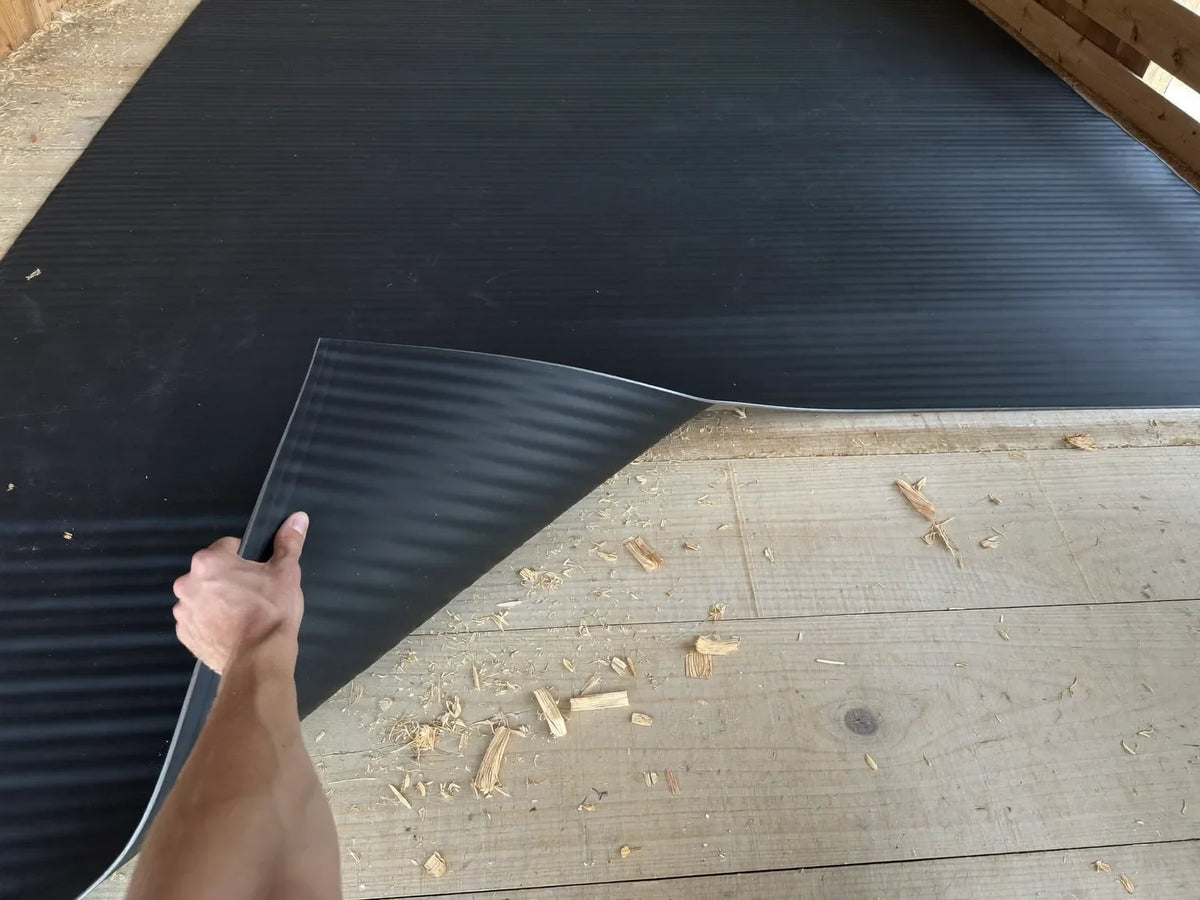
A rubber mat on a chicken coop floor turns a surface that soaks into a surface you can wipe, and that is the whole of what it does. It absorbs nothing, so the bedding above it still has to. Penn State's horse-stable flooring publication sorts every floor material into porous or impervious, and that property belongs to the material rather than to the animal standing on it — which is the only reason a horse publication is any use to a hen keeper. A mat is an aftermarket decision about a floor you already own, so settle the floor first. Name the coop and we will have its floor dimensions out of the manufacturer before you cut anything. Start from the coops we carry.
One poultry publication mentions rubber mats; the rest of this evidence was written for horses, so every transferred line names its mechanism and its species. All five are linked at the foot.
What does a rubber mat do that a bare coop floor does not?
It stops the floor drinking. A bare timber panel takes up whatever gets past the bedding and holds it; a rubber sheet does not, so the liquid stays on top where a scraper and a hose can reach it. Nothing else about the coop changes.
Penn State Extension puts the whole of stable flooring on one axis: "The two major categories of stable flooring materials depend on whether the material is porous or impervious to wetness." That publication is about horse stalls, not hens. What makes it usable here is that porosity is a property of a material rather than a fact about the animal on it — the same page says wood "may become slick when wet and is difficult to disinfect due to wood's porous nature", and a fir panel does not become less porous because the bird on it is small.
Penn State's small-flock housing publication asks for the outcome without naming a material: "Use building materials which will be easy to clean and disinfect." Which materials those are is a question our sand guide opens and our guide to what a coop floor is built from closes. A mat is the retrofit answer: it does not change what the floor is made of, it changes what the top surface is.
The trade has two sides. A porous floor takes the moisture and keeps the smell — Penn State again, on stalls: "Floors that allow urine to be absorbed and travel down through the flooring material layers can retain odors." An impervious floor keeps the moisture where you put it, which is better only if you are the sort of keeper who takes it out.
Which is why the first question is not which mat but what floor, and there are four answers. On a solid timber or panel floor a mat has a real job: it stops the panel drinking. On a coop with a pull-out droppings tray the tray is already an impervious floor you can carry to the tap, and a mat mostly duplicates it. On a wire or slatted floor there is nothing to protect and a mat would close the gaps the floor exists to leave open. And on a floorless frame standing on grass there is no panel at all, so the money belongs in the coop rather than in the covering. Two of those four make the mat worth buying and two make it redundant, which is why the floor spec settles this and the mat catalogue never will. Our bedding and flooring guide takes the four apart properly, and the two redundant branches are where most coops built to move sit.
The published record on rubber mats for chicken coops is one sentence
One extension publication names them. University of Maryland Extension's coop-construction page says: "Laying down a solid floor such as concrete or rubber mats will make maintaining clean facilities much easier." That is the entire poultry literature on rubber mats for chicken coops that we could open, and it is a clause inside a sentence about something else.
Worth knowing where that clause comes from. Maryland's page cites Phillip Clauer six times in its own body, and the sentence next to the mat clause — concrete and a course of blocks to stop things digging under the walls — is near-identical to Penn State's. Penn State's own small-flock housing publication contains the word "rubber" zero times and the word "mat" zero times, checked on the raw page. So the rubber-mat clause is Maryland's own addition to a paragraph it inherited, not a second service independently arriving at the same advice.
Everything else published about rubber matting for animals is written for horses and cattle. We read two horse-stall publications from two universities — Penn State's and Nebraska's G1876 — and they have no author in common, no citation of each other, and different wording, so where they agree the agreement is real. They also have nothing to say about birds. The rule we followed for every line below: transfer it only if the source itself names the mechanism, and say in the same breath that the source is about a horse.
| What the horse-stall publications state | The mechanism the source names | Does it transfer to a hen house? |
|---|---|---|
| Nebraska: "When installing rubber mats the floor should be level and well-packed." Penn State: mats "are installed on top of an even, compact surface" | A mat is a sheet, not a structure. It takes the shape of whatever is under it | Yes. Geometry of a flexible sheet, with no animal in it. In a coop the "base" is the floor panel or the tray, and it is already flat or it is not |
| Penn State: "the base of the mat should be grooved to help remove any urine that leaks through joints from the surface" | Liquid gets past a mat at the joints and the edges, not through the middle | The mechanism yes, the remedy no. A stall's underside drains into a packed base or a channel. A coop floor is a sealed panel inside a box, so there is nowhere for what gets under to go |
| Nebraska: "Bedding should be used in conjunction with mats to absorb urine." | An impervious surface cannot absorb, so something above it must | Yes. The mat is not a bedding substitute in either species. What depth of bedding a coop wants is settled in our bedding and flooring guide |
| Penn State: mats "will reduce the amount of bedding that is needed to provide cushioning, or textured models can even be used alone" | Cushioning, for an animal that weighs half a ton and lies on it | No. A hen's litter is doing moisture, not cushioning, and a mat removes no moisture. The one saving the horse publication offers is the one a coop cannot take |
| Penn State: a smooth surface "allows the mats to 'walk' and bedding chaff in the cracks eventually pries mats up and apart" | Two mechanisms in one sentence: an animal shifting a heavy mat, and chaff migrating into a gap | Half. Chaff in a gap needs no horse. A hen cannot walk a mat the way a horse can, so only the gap half is carried over here |
| Penn State: "Untextured mats are slippery when wet." | Stated for a horse getting up and lying down | Unanswered. Nothing we could find publishes anything about a hen's footing on a wet mat. We are not going to invent it |
Sorting the floor out before the coop lands? Take 10% off the coop half of the job. TAKE 10% OFF
Where does the water under a mat go?
Nowhere, in most coops. Penn State's stall publication says the underside of a mat "should be grooved to help remove any urine that leaks through joints from the surface" — an instruction that assumes somewhere for it to drain to. A coop floor is a panel with walls on four sides, so what gets under the mat stays under it until you lift it.
Two paths take liquid under a mat and neither is a defect in the mat. The first is the joint between two pieces. The second is the perimeter, where a mat that stops short of the wall leaves the exact strip that runs wettest. Penn State's answer for a stall is a graded base underneath; Nebraska's is fewer pieces, ideally one, fitted tight. Only the second of those is available inside a hen house.
What it costs is a litter question rather than a wood question, and the poultry literature does price it. Penn State's ammonia publication states that "Even a slight 5% increase in litter moisture from 20 to 25% at 75°F (24°C) can result in a 140% increase* in ammonia release!" — the asterisk is the page's own footnote mark, and the figure is measured in commercial houses, not backyard coops. No source we opened measures litter sitting on a mat in a small coop, so read that as what moisture is worth rather than as what a mat does.

A bare timber floor hides some of the water from you by drinking it, and a mat hands all of it back — an improvement only if you are removing it. Where the water comes from in the first place sits in our guide to coop ventilation.
The edges are where a coop mat fails
The middle of a mat looks after itself. The edges do three things: they lift, they collect, and they hide the strip of floor a scraper never reaches. Penn State describes exactly that failure — mats that shift, and bedding chaff working into the joints and prying them apart — and Nebraska's answer to it is the one-piece instruction above.
Penn State describes the failure in a stall exactly: without a secure connection between pieces, "bedding chaff in the cracks eventually pries mats up and apart". A horse's weight is doing part of that work and a hen's is not. Chaff working into a gap is not doing anything a horse is needed for — a bird scratching sends bedding sideways all day, and the gap is where it lands.
Nebraska's instruction is the one to copy, and it is a shopping instruction rather than a fitting one: mats "should be one piece or a minimal number of pieces" and they "should fit tightly to each other and to the stall walls". One piece cut to the floor beats four tiles every time, because every joint you remove is a joint that cannot leak or lift.
Rubber matting is sold in three shapes and that instruction sorts them for you without needing a single price. A roll is one continuous sheet you cut to the floor: no joints at all inside the coop, which is the shape Nebraska's sentence points straight at. Interlocking tiles are the opposite - every tile edge is a joint, and a hen scratching all day is a chaff-into-joints machine. A stall mat is a fixed rectangle, usually far bigger and heavier than a hen house needs, so it is a cut-down job rather than a drop-in one. Buy for the fewest joints and the lightest piece one person can lift out weekly, and the format decides itself.
Cut the mat, not the coop. Trimming a rubber sheet with a straightedge and a sharp blade takes ten minutes and touches nothing you bought. Fastening one down is a different decision. A screw through a painted fir floor cannot be taken back out of a coop you bought, and it gives water a route into the end grain, so before anything is driven, ask us at sales@moveablechickencoop.com and the manufacturer's terms on a fixing come back to you.
Will a mat fit the coop you already own?
Probably, but not to a number you can look up in an ad. Two figures decide it: what the hen-house floor panel is made of, and the inside rectangle of the floor itself. Read the listing for both. Where either is missing, the answer is a tape measure or a question, never a guess. And where a droppings-tray dimension is printed, start from that: it is the figure this whole job hangs on.
| Where the mat would go | What it has to do there | What that means for what you buy |
|---|---|---|
| The hen-house floor panel | Cover a rectangle nobody has printed for you, and reach the corners where the walls meet the floor | One piece, cut on site. Measure the inside of the house at floor level in both directions and write down the smaller of any two readings — coops are rarely as square as the drawing |
| A pull-out droppings tray | Sit inside a shallow lip and still leave depth above it to hold bedding | Thickness is the deciding spec here, and coop trays are shallow — 1.4 inches deep is a published example. Work out what lip you have left before you buy, using the arithmetic below |
| The ground, under a run or a coop that moves | Nothing useful. There is no panel to protect, and a mat puts a lid over the grass the flock is out there to use | Skip the mat and spend it on the coop. This is the branch the coops built to move live on |
The tray row is where the arithmetic bites, and it is arithmetic you can redo on your own tray in ten seconds. Penn State states the common stall-mat thicknesses as "from 1/2 to 3/4 inch thick" and Nebraska sets a minimum of five-eighths of an inch — horse-stall figures, chosen for an animal that weighs half a ton, so treat them as the top end of what a coop needs rather than as a target. Take a published coop-tray depth of 1.4 inches: drop a three-quarter-inch mat in and you have 0.65 inch of lip left, and at half an inch you have 0.9. Subtract your mat from your lip, and whatever is left is all the bedding the tray can hold. What that lip is meant to hold, and how much of the house floor the tray covers in the first place, is worked out in our guide to what fits inside a coop.
So the mat question turns into two questions for the manufacturer, and they are questions we will ask on your behalf: what is the floor panel made of, and what are its inside dimensions. Point at the coop and we will chase both before you order. Coops with a run attached have a second floor to think about — the run's ground — and those sit together on our coops with runs page.
Rubber mat, sand or shavings: the best floor covering for a chicken coop
There is no single best floor covering for a chicken coop, because two different jobs get called by the same name. A mat changes what the floor's top surface is made of. Bedding changes what sits on top of the floor. Buying one instead of the other is the mistake worth avoiding.
A mat is a surface. It is permanent until you lift it, it absorbs nothing, and its whole value is that it can be wiped and it stops the panel underneath taking on water. Bedding is a consumable. It absorbs, it is thrown away, and it is what the published guidance actually specifies — depth, dryness and a schedule, all of which our bedding and flooring guide sets out with the numbers attached.
Sand behaves like a bedding rather than a surface, whatever it looks like going in: it absorbs, it gets scooped, and it gets replaced. Sheet vinyl and linoleum sit on the surface side with the mat, and the liner question — whether a fixed sheet is worth it at all — is answered in that same bedding guide, which owns it.
Our position, and it is a position rather than a summary: pick the bedding first, because it is the thing with published guidance behind it, then decide whether the panel underneath needs protecting from what gets past. On a coop whose floor you can already lift a tray out of, it usually does not.
So do them in that order and you will spend less. Settle the bedding with our bedding and flooring guide, then look at your floor once and ask a single question: can I lift this surface out and rinse it? If the answer is yes, you have already bought the thing the mat was for.
How do you clean a rubber mat in a coop?
Take it out. A mat you clean in place is a mat with a wet underside you never see, and the underside is the surface that matters. Lift it, scrape and rinse both faces, let both dry, and put back a floor that is dry on both sides.
Penn State's stall page gives the one warning worth carrying over, and it is about the tool rather than the animal: "A mat surface makes stall cleaning easy but care must be taken with forks to prevent cutting the surface." Cut the surface and you have made a porous floor with a rubber lid on it. In a coop the tool is a scraper, and the instruction is the same one.
Weight is the place where a coop beats a stable outright. Penn State notes it takes several people to shift stall mats, and gives the reason: a four-foot by six-foot mat weighs about 100 pounds. A mat cut for a hen house is a fraction of that area, so the weekly lift that is impossible in a stall is easy in a coop — provided you bought a size one person can pick up. That is a buying decision, not a cleaning one.
The one published warning about any laid-in surface in a hen house is about exactly this. Penn State says some producers cut carpet pads for their nest boxes, and that these "can easily become contaminated with bacteria and harbor mites" if they are not removed and cleaned or replaced often. The mechanism is porosity plus staying put, and it is the test a mat has to pass: a mat that never comes out is a carpet pad that happens to be waterproof on one face. Where the rest of the interior collects muck, and what shortens the job, is covered in our guide to a coop interior that cleans quickly.
When we would skip the mat
We would skip it in three situations, and between them they cover a lot of backyard setups: a coop with a pull-out tray that already does the job, a coop that moves onto fresh grass, and any floor where the mat would have to go down in four pieces. In each case the mat adds a surface to clean without removing one.
The tray case is the common one. A tray is already an impervious floor you can carry to the tap, so putting a mat in it buys you a second removable layer and costs you lip depth. If the tray is doing its job, the mat is one more thing to lift rather than one less thing to scrape.
The moving case splits in two, and the split is the floor. On a floorless frame rolled onto clean ground every few days there is no panel to protect, and a mat would put a lid over the grass the flock is there for — the argument our guide to moving a coop instead of cleaning it makes in full. On a wheeled coop with a solid floor, the move is already breaking up the accumulation a mat guards against, so the mat buys less than it would on a coop that stays put.
Where a mat does earn its place, it is on a fixed timber floor you cannot lift, in one piece, cut to the walls, taken out weekly. That is a narrow recommendation and it is the honest one. If you are still choosing the coop, the floor is the spec to settle first, because it is the one you cannot change after delivery: browse the coops we carry, pick the one you keep coming back to, and the floor panel and its inside dimensions will be out of the manufacturer before you buy anything to put on it.
Sources: University of Maryland Extension, “Coop Construction — General Requirements” (Dr. Jon Moyle; updated September 15, 2021) — accessed August 21, 2026. This is the only small-flock publication we found that names a rubber mat at all, and its housing guidance is not independent of the Penn State material below: it cites Phillip Clauer six times in its own body · Penn State Extension, “Horse Stable Flooring Materials and Drainage” (Eileen E. Fabian (Wheeler), Ph.D.; prepared by Eileen Wheeler and Jennifer Smith Zajaczkowski; updated May 19, 2016) — accessed August 21, 2026. Written about horse stalls, and quoted here only where the page states the mechanism itself · Nebraska Extension, “Housing for Horses: Flooring for Stalls”, G1876 (Kathleen P. Anderson, Extension Horse Specialist; issued July 2008) — accessed August 21, 2026. Also about horses, and the one source here independent of every other: no shared author, no cross-citation. Where it and Penn State agree on mat installation, that agreement is real · Penn State Extension, “Small Scale Poultry Housing” (Gregory P. Martin, Ph.D., PAS and Phillip Clauer; updated June 25, 2026) — accessed August 21, 2026 · Penn State Extension, “Detecting Ammonia in Poultry Housing Using Inexpensive Instruments” (Gregory P Martin, Ph.D., PAS and Eileen E. Fabian (Wheeler), Ph.D.; updated January 10, 2026) — accessed August 21, 2026. Three of these five pages share an author across the Penn State set — Gregory P. Martin on the two poultry pages, Eileen E. Fabian (Wheeler) on the ammonia page and the stable-flooring page — so nothing here is counted twice as two services agreeing. The 1.4-inch droppings-tray depth used in the arithmetic above is a published manufacturer specification — stated for a 43-inch wooden coop on wheels (tray 35.2 × 21.1 × 1.4 in) and by PawHut for its 59-inch mobile coop (two trays, 24.4 × 36.4 × 1.4 in each), accessed August 21, 2026.
Frequently asked questions
How to disinfect chicken coop with dirt floor?
You cannot, in the sense the word usually means. University of Maryland Extension is blunt about the surface: "Packed dirt or sand is adequate, but not recommended to use for flooring because they are difficult to clean." A disinfectant needs a surface it cannot soak into. On dirt, the working method is to strip and replace the top layer, or to lay a cleanable floor over it and disinfect that instead.
What to line chicken coop floor with?
With one piece rather than four, cut to the walls, and chosen for whether it lifts out. A liner is a surface, not a bedding, and it absorbs nothing: Nebraska Extension's stall guidance is that "Bedding should be used in conjunction with mats to absorb urine." Whatever you line the panel with, the absorbent layer still goes on top of it. Depth and material are settled in our bedding and flooring guide.
How to keep chicken coop floor dry?
Air first, then removal. A coop floor is dry because moving air is taking water out of the building faster than the flock puts it in, and because the wet litter leaves weekly rather than staying. Sealing a wet floor under anything makes it wetter, not drier. Our guide to coop ventilation covers the air half, which is the half most small coops get wrong.