

Wood chips for a chicken coop work when the pieces are small and stay dry, and straw works when it is chopped short and changed before it mats. Both fail on particle size, and the only size figure in the published litter record is one inch. Absorbency splits them further apart than the bag labels do. Pine chips hold 3.0 lb of water per pound of bedding and hardwood chips 1.5, against 2.2 for wheat straw. How much of either you buy is set by the enclosed floor area, and where a maker leaves that figure out we will get it for you before you buy a single bale. Start from the coops we carry.
The particle-size limit, the caking findings and the absorbency and density figures are quoted from the three publications that print them, all linked at the foot. The per-cubic-foot arithmetic is ours, with its limits stated beside it.
What size should wood chips for a chicken coop be?
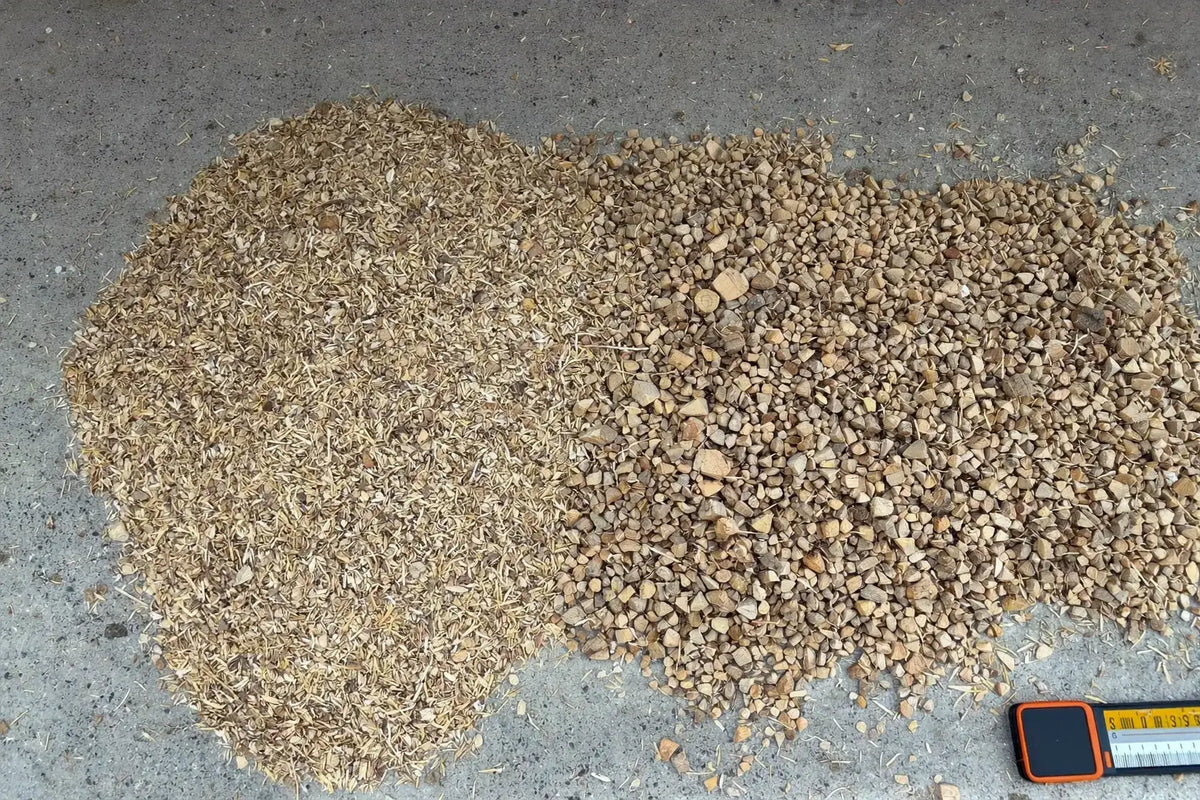
Under an inch, on the only number anybody has published. The University of Kentucky's small-flock litter guidance, writing about pine bark, states that "when particles are larger than 1 inch, increased incidence of litter caking occurs." Bagged garden chip and bark mulch generally run coarser than that.
Wood chips covers four different things on a shelf. Arborist chip is whatever came out of a chipper that morning, mixed species, pieces from a fingernail to a playing card. Bark mulch is the outer layer, sold by the bag for flower beds. Playground chip is screened and sized. Wood shavings are a different product again — thin curls off a planer, and the material the poultry literature is actually written around.
Size is the axis those four differ on, and it is the axis the litter record cares about. University of Georgia Extension's bulletin on litter quality lists "Pine or hardwood bark" with a single instruction attached: "Similar to chips or shavings in moisture absorption capacity. Medium-sized particles preferred." Two land-grant services, one number and one adjective, both pointing at the same thing.
The honest limit on that inch is worth stating plainly. Kentucky writes it about bark, not about chips, and Georgia's chips row gives no size at all. So there is no published particle size for wood chips as such, and the nearest figure comes from the coarse wood product sitting next to them. Our sand guide uses that same sentence from the opposite direction, to show that this literature does print a threshold where one exists.
Straw gets the same inch from the opposite direction, which is the part no page seems to put together. Kentucky again: "If straw is used, it should be chopped to one inch or less." Then the reason: "The length of the straw is more important than the type of straw. Straw that is too long will mat over more quickly." Our bedding comparison publishes that sentence as one row in a six-material scorecard. Read the two sentences together and one publication has drawn the same line twice — once for a plant material, once for a wood one. The failure on the wrong side of it is the same failure both times.
Before you buy either one, settle the question underneath it, because the coop floor changes how much you need and sometimes whether you need any. A solid floor wants a real bed, deep enough to stir and turn over. A droppings tray wants a shallow scatter, where the particle size matters far more than the volume does. A wire or slatted floor drops most of the load through and takes very little on top. A floorless frame on grass takes none at all beyond the sleeping box. Four floors, four completely different order quantities from the same bale price. All four are laid out in our bedding and flooring guide. Settle which one you have, then take a tape to it - that is the entire shopping list.
Straw for a chicken coop, and the word both services reach for
Caking. Two land-grant publications written by different people at different universities both name it as straw's problem, and neither hedges. Kentucky: "Straw is difficult to manage and is prone to caking." Georgia: "Considerable tendency toward caking. Mold growth can also be a disadvantage."
Two sources are not two voices until you check, so we checked. Strip both pages to plain text, normalise, and intersect every run of six or more words: the Kentucky litter article and Georgia's Bulletin 1267 share none. Zero spans at six words, zero at seven, zero at eight. Different institutions, different author teams, no shared text — so on this point they really are two readings rather than one document printed twice. The same test on a different pair of extension pages found ten shared spans. Our composting guide says so plainly, because its two sources have a common lineage.
| Material | University of Kentucky | University of Georgia |
|---|---|---|
| Chopped straw | "prone to caking"; chop to one inch or less; "It may take more heat to keep straw dry." | "Considerable tendency toward caking. Mold growth can also be a disadvantage." |
| Wood chips | No chips entry. The nearest is pine stump chips: performance "has been good", but "breast blisters are often a problem for meat chickens raised on this material" | "Used successfully but may cause increased incidence of breast blisters if allowed to become too wet." |
| Bark | As effective as pine shavings for broilers, but "particle size, moisture content (which affects mold content), and the number of wood splinters in the bark can be major concerns" | "Similar to chips or shavings in moisture absorption capacity. Medium-sized particles preferred." |
| Hardwood shavings | Not named separately; the recommendation is softwood | "Often high in moisture and susceptible to dangerous mold growth if stored improperly prior to use." |
Read the chips column and the charge against them is a different one. Neither service accuses chips of caking; both attach the same worry to wetness, and Georgia names the consequence as breast blisters rather than a hard floor. Kentucky adds one line about straw that is the one that matters in a cold-climate coop: "It may take more heat to keep straw dry."
Caking is slower than it looks. A bed does not go from loose to hard overnight. Mississippi State University Extension defines it in one sentence — "When litter begins to retain moisture it will clump together, which is referred to as caking" — and then gives the clock: "it takes a long time (days and in some cases, maybe weeks) for moisture levels in the litter to build up enough for cake to form." Cake is a fortnight of small mistakes, not a bad night. Where the air moves decides most of it, and that is its own decision, worked through in our guide to coop ventilation.
Does straw or wood chips hold more water?
Per pound, pine chips do: 3.0 lb of water per pound of bedding against 2.2 for wheat straw. Both figures come from one Rutgers fact sheet written for horse stalls. No poultry publication we opened states an absorbency figure for either material.
The poultry record's silence on absorbency matters more than the ranking does. Kentucky's litter article names thirteen bedding materials and gives an absorbency number for none of them. Georgia's bulletin says an effective bedding "must be absorbent" and prints no figure. So the only numbers available were measured for a species with a stall and a shovel, not a hen with a roost. Every coop page quoting them is quoting a horse document. Our hemp guide works through why the protocols behind those figures are not stated. Treat any single multiple as an indication rather than a measurement.
Then the unit problem, which flips the answer. Absorbency is published per pound of bedding. Bedding is bought, carried and laid by volume — a bale, a bag, a barrow, a depth across a floor. Rutgers prints a density table too, on the same page, and multiplying the two gives pounds of water per cubic foot of fresh material. Nobody appears to do it.
| Material | Density, lb per cu ft | Water absorbed, lb per lb | Water per cu ft |
|---|---|---|---|
| Straw, loose | 2.5 | 2.2 (wheat) | 5.5 lb |
| Straw, chopped | 7 | 2.2 (wheat) | 15.4 lb |
| Wood shavings, loose | 9 | 2.0 (pine) | 18.0 lb |
| Sawdust | 12 | 2.5 (pine) | 30.0 lb |
| Wood chips | No density published | 3.0 (pine) / 1.5 (hardwood) | Cannot be computed |
Per pound, wheat straw beats pine shavings — 2.2 against 2.0. Per cubic foot, shavings hold 18.0 lb against chopped straw's 15.4, and they out-hold loose straw by more than three to one. Same two materials, same fact sheet, opposite winner, and the only thing that changed is which unit you shop in. Straw's density is what does it: at 2.5 lb per cubic foot loose, straw is the lightest bedding on the table, and light is another word for mostly air.
The chips row is the one that should stop you, and it is the reason this page exists. Rutgers publishes no density for chips, so the 3.0 figure cannot be turned into a barrow-load. You can say a pound of pine chips holds more water than a pound of straw. You cannot say what a bucket of it does, because nobody has weighed the bucket.
Which leaves you one practical instruction, and it is a good one. Shop by the cubic foot, not by the multiple on the bag: measure the house floor, pick your depth, and buy the material that holds the most water in the volume you are actually going to lay. Our bedding and flooring guide runs the depth-to-volume arithmetic for you.
Chosen between straw and chips? Take 10% off the house whose floor area decides how much of it you buy. TAKE 10% OFF
Pine chips for chickens, and the chips that are not pine
Species changes the number by more than the material does. Rutgers puts pine chips at 3.0 lb of water per pound and hardwood chips at 1.5 — a factor of two — while wheat straw sits between them at 2.2. A load of unnamed chips could land on either side of straw.
Softwood is what the poultry record recommends. Kentucky's litter article names pine, spruce and hemlock as the wood to look for. Every wood entry in it that carries a performance finding is a pine product: pine sawdust, pine bark, pine stump chips. Hardwood appears in Georgia's table twice, and both times with a caveat attached rather than a recommendation.
Arborist chip is the awkward case, because it is usually mixed and rarely named. A tree crew tips whatever it cut that day, and nobody writes a species on the pile. If the hardwood-chips figure is the right one for a given load, a cubic yard of free chip is holding half what a pine bag would.
The hardwood literature carries one loud warning, and it does not transfer. Rutgers rules out "black cherry or walnut wood products" for horse bedding, and gives the mechanism: black walnut "shavings will cause laminitis or founder, so all hardwood shavings are often avoided on the chance that walnut is mixed in." Laminitis is a hoof disease. A hen has no hoof, and the word walnut appears in none of the four poultry publications we opened for this page. So the warning is a horse warning by its own wording, and repeating it at a flock would be borrowing an alarm we cannot ground.
What does travel is the shape of the concern rather than the diagnosis. Unnamed mixed wood is unnamed mixed wood, and the horse literature is nervous about exactly the load a tree crew drops. Ask which species before you spread a truckload. Or put it on the run path instead of under the roost, because the run is a different problem with a different tolerance.
Chip you make yourself carries a fifth question. Kentucky is direct about recycled pallet wood: chopped pallets have been used as poultry bedding, but "wood pallets may have held toxic materials", "some wood pallets may be tainted with paints, fuels, pesticides, solvents, and other flammables", and "it is important to make sure that there are no nails in the resulting material." A cable reel, a stack of offcuts or a dismantled crate belongs to the same family — timber with a working life somebody else already spent. Our guide to wooden coops covers what a reel build is and is not. Anything that might have been treated belongs in our pressure-treated wood guide rather than in a chipper.
Does the roost change which one you want?
Yes, and it is the strongest argument for keeping two materials in the shed. The heaviest load lands in a strip under the bar overnight, and the rest of the floor gets a thin scatter through the day. One bed is doing two jobs at two different intensities.
Under the bar you want the material that gives water back, because that patch never gets a rest. Georgia's whole framing of litter is absorb-and-release rather than absorb alone, and a material that takes moisture in and holds it is a material that cakes. Straw's published charge sheet is exactly that, twice. How much lands there and what to put under it is worked through in our droppings board guide.

Across the open floor the problem is displacement, not saturation. Rutgers files one comment against straw in its bedding characteristics table: it "shifts easily exposing bare floor if not deeply bedded or if animal is very active." The mechanism named there is animal activity, and a hen's whole day is animal activity — she scratches, and by evening the straw is in a ridge against the wall with bare board where she was working.
Coarse chip resists that, which is its real advantage over straw and has nothing to do with water. Heavier pieces stay where they are put and interlock instead of drifting. The trade is that the same interlocking makes chip harder to turn over, and turning is how a bed dries. University of New Hampshire Extension's litter instruction is to keep the bed loose and stirred, not merely deep. How deep it should go in the first place is answered in our bedding and flooring guide.
The floor underneath decides how much of this applies to you at all, and what that floor is built from is its own question in our coop flooring guide. A shallow pull-out tray holds a scatter rather than a bed, and a coop with no floor under the run has no litter to buy there. On a coop you move onto fresh grass the littered area shrinks to the sleeping box, which is small enough that the cheaper material stops being the point.
What each one leaves behind in the compost heap
Straw disappears and wood does not. Rutgers states the mechanism in one sentence: "wood products (especially pine) will break down much slower than straw and many cause nutrients to be released more slowly from the manure." The bedding you choose in August is still deciding your garden's nitrogen the following summer.
Both materials pass Kentucky's sixth test for good litter, which is that it "be able to be repurposed after being used as bedding material." Passing is not the same as behaving alike. A heap of straw and droppings is close to a working compost recipe on the day you barrow it out. A heap of chip and droppings is a slow woody pile that will sit until the wood catches up.
Neither outcome is wrong, and the decision is about your calendar rather than the material. A keeper with a vegetable bed and a spring deadline wants the material that rots on their schedule. A keeper who just needs the stuff gone can let a chip heap take its time in a corner. The ratios, temperatures and safe intervals for either heap are in our composting guide, and they are the same arithmetic whichever bedding started it.
One caution belongs on both piles rather than one. Kentucky's first requirement of good litter is that it "be nontoxic to the birds (including being free of mycotoxins that can be produced during certain fungal contaminations)". Mould is a storage problem before it is a coop problem. Rutgers notes that "straw can also be musty and moldy", and Georgia's own warning about damp hardwood is about wood stored badly, not wood used badly. Keep either one dry and off the ground before it ever reaches the hens.
Which would we buy, and what does being wrong cost?
Chopped straw if it is already stacked on your property, small softwood chip or shavings if you are buying a bag, and garden bark mulch in neither case. Bark mulch fails the one published size rule, and the failure it causes is the failure both services warn about.
Our stance on unnamed chip is the cautious one. Free arborist chip is good value on a run path and a gamble under a roost. You do not know the species, the moisture it arrived at, or the size spread, and two of those three carry published consequences. Run the load through your hands first. If most pieces are longer than your thumb, they sit outside the only threshold anyone has printed, and the bed will pack rather than breathe.
Being wrong here costs a Saturday and a smell, not a flock. The wrong material cakes over a fortnight, the caked patch stops absorbing, and the ammonia you notice is a bed that gave up a week or more ago. The published fix in every source we opened is air and dryness rather than a better bag. Upgrade the bedding while ignoring a shut vent and you have spent money on the wrong half of the problem.
One number sets your bill, and it is the one to go looking for on any listing before you order: the floor area of the enclosed house. It turns a depth into a volume, and a volume into bales or bags a year. Where a listing does not print it, ask rather than estimate. A note to sales@moveablechickencoop.com with the coop in it gets the house dimensions back from the manufacturer before you buy a single bale. That is a faster answer than measuring a bale twice. Start from the full range of coops, or, if a run is in the plan, from the coops with a run attached - the house floor still sets the bedding bill either way.
Sources: Poultry Extension, “Litter Material for Small and Backyard Poultry Flocks” (Dr. Jacquie Jacob, University of Kentucky) — accessed August 21, 2026 · University of Georgia Extension, Litter Quality and Broiler Performance, Bulletin 1267 (Michael P. Lacy, Casey W. Ritz and Brian D. Fairchild; published with full review October 15, 2024) — accessed August 21, 2026 · Rutgers NJAES Cooperative Extension, Horse Manure Management: Bedding Use, Fact Sheet FS537 (Michael Westendorf and Uta Krogmann, September 2013) — accessed August 21, 2026 · Mississippi State University Extension, Poultry Litter Management, Publication P2738 (Tom Tabler and Jessica Wells) — accessed August 21, 2026 · University of New Hampshire Extension, Producing Your Own Eggs (Kendall Kunelius) — accessed August 21, 2026
Frequently asked questions
Can you put hay in a chicken coop?
Hay is not straw, and it behaves worse on a floor. Straw is the hollow stem left after grain is harvested; hay is dried forage cut for feed, so it arrives leafier, damper and more tempting to eat. University of Georgia Extension files “chopped straw, hay or corn stover” in one row with one verdict: considerable tendency toward caking, with mould growth a further disadvantage. Hay does better in a compost heap than under a roost.
Where to buy straw for chicken coop?
Farm and feed stores carry bales year round, and garden centres sell smaller compressed bales that cost more per pound. A local grain farm is usually cheapest, and bales are freshest in late summer after harvest. Ask for wheat straw, which the University of Kentucky names as the type most commonly used for litter, and ask whether it is chopped. Squeeze a handful first: a musty smell means mould, and mould belongs nowhere near a coop.
How often to change straw in chicken coop?
No publication we opened states an interval for straw, so caking sets the date rather than the calendar. Mississippi State University Extension puts cake formation days, and sometimes weeks, after moisture starts building in litter, and straw carries a published tendency to cake that shortens the gap. New Hampshire gives the standing instruction: “Very wet litter near the water or feed should be replaced.” Stir often, pull wet patches early, strip the bed when it stops going loose.
What kind of mulch for chicken coop?
Bark and garden mulch are usually the wrong particle size for a coop floor. The only published limit in the small-flock litter record says pieces larger than one inch raise the incidence of caking, and bagged mulch is normally coarser. University of Georgia Extension rates bark as similar to chips for moisture absorption, but states that medium-sized particles are preferred. Dyed or part-composted mulch adds a history you cannot check.