

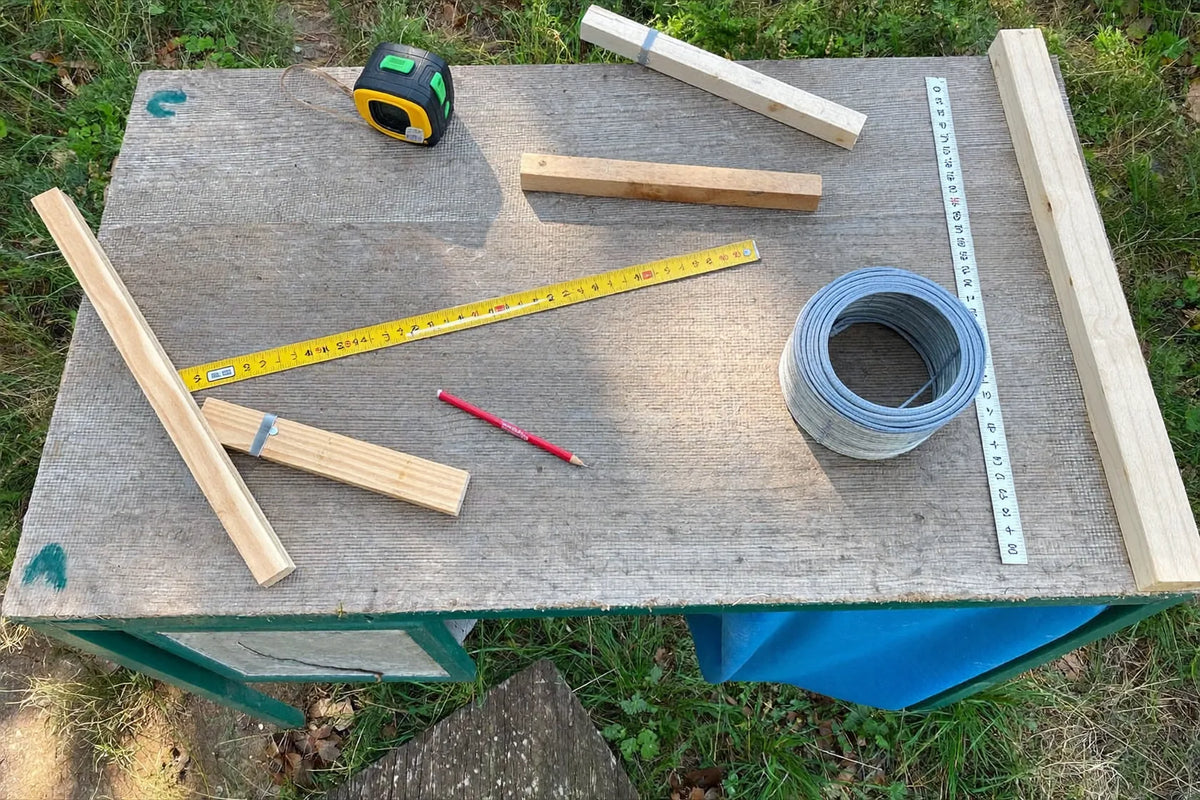
A chicken coop idea is only worth keeping once you can say which of your constraints it answers and what it takes back in return. The 16 DIY chicken coop ideas below are grouped by constraint — short on money, short on ground, short on time, or tired of looking at a plain box — and each one names the measurement, the trade or the arithmetic it commits you to. Nothing here sends you off to somebody else's yard for the detail. If you would rather the shape arrived already settled, start with the coops themselves.
The space allowances, the injury sentence and the one published line about where coop plans come from belong to a named extension service and are credited at the foot of this page; the grouping into constraints and the trips-a-year arithmetic are ours.
Chicken coop ideas, filed by the problem each one solves
There are 16 ideas here, in five groups, and each group answers exactly one constraint. Find the constraint you actually have, read that group first, and skip the others without guilt. An idea that answers a problem you do not have is decoration.
Filing an idea by what it looks like leaves you nothing to act on. Filing it by the problem it answers tells you in one line whether the problem is yours.
| The constraint you actually have | The ideas that answer it | What that group takes back |
|---|---|---|
| More time than money | Ideas 1–4 | Judgement. Every call a filled-in spec row would have made for you becomes yours to make |
| Ten minutes a day, not an hour | Ideas 5–8 | Work now, once, in exchange for fewer trips later |
| Not enough ground | Ideas 9–12 | Head height, arm's reach, or the option of a bigger flock later |
| Ground that keeps going bare | Ideas 13–14 | Weight. Anything that moves has to stay light enough for whoever moves it |
| A plain box you dislike looking at | Ideas 15–16 | Nothing at all, while the joke stays on a surface. Floor area, the moment it becomes the outline |
Read the third column before you read the ideas. Every entry on this page takes something back, and what it takes is almost never the thing the photograph was showing you.
One thing this page does not do is put a figure on any of it. What a build comes to, what a finished coop comes to and what a low price gives up are three separate questions with three separate answers, and they live on our build-or-buy guide, what a chicken coop costs and what the cheapest coops give up first. Sorting comes first, because you cannot price a decision you have not made. Pick your row and read that group.
What does a low budget chicken coop idea ask for instead?
Judgement, mostly. A low budget chicken coop idea moves work from a manufacturer onto you, and the part that moves is rarely the sawing. It is the deciding that a filled-in spec row would otherwise have done on your behalf.
- Adapt a shell that is already standing. A structure that is already up has settled its floor, its walls and its site before you arrive. What is left to you is three openings: the pop-hole the birds use, the vent line above their heads, and a door wide enough to reach the back wall through. Measure all three on the shell before you commit to it, not after.
- Let the material you already have set one dimension. Pick the module before the drawing. Measure the longest usable length in the pile, decide whether one person has to carry it, and let that be the wall facing the weather. A build sized to your material wastes no cuts. A build sized to a drawing wastes whatever the drawing did not know you had.
- Peg out the run before you site the house. Virginia Cooperative Extension recommends 3 to 4 square feet inside per laying hen and 10 square feet each in the outside run. Divide one by the other: 10 over 4 is 2.5, and 10 over 3 is 3.3. So the fenced ground is somewhere between two and a half and three and a third times the house, whichever end of the indoor range you take, and it is the bigger structure of the two. Peg its corners first and let the house sit inside them.
- Keep only the ideas with a dimension attached. Virginia is the one publication in the small-flock housing literature that says out loud where coop ideas come from, and all it says is that those building a new coop "may find a range of plans on the internet". It ranks none of them. So sort your saved ideas into two piles: the ones carrying a floor area, a wall height or an opening size, and the ones that are only a shape. What a plan sheet should contain names what the second pile is missing.

Virginia also prints the one low-budget idea in the whole literature that is not a building at all. Under predation it notes that "A protective dog kept near your coop can also work well to discourage predators and unwanted visitors." That is Virginia's claim rather than ours, and it is worth knowing that the published list of things that help is not made only of hardware. What hardware can honestly be said to do is its own question. If what you want is those three openings arriving already cut and sized, that is precisely what a coop that turns up as a kit is for.
Cheap chicken coop ideas that do not come back later
The ones that remove a job instead of adding a feature. A cheap chicken coop idea earns its keep on frequency, so count how many times a year the job happens before you judge it. An idea that saves a minute at the door beats one that saves an hour once.
| The job | How often | Times a year | What an idea can do about it |
|---|---|---|---|
| Let them out, shut them in | Morning and dusk | 2 × 365 = 730 | Put the latch where one cold hand can work it without a torch |
| Collect the eggs | Daily | 365 | Move the nests to a wall you can open from outside |
| Top up feed and water | Daily, or every other day | 180 to 365 | Site them so the lid you lift is the one you can reach standing up |
| Pull and empty the droppings tray | Weekly | 52 | Leave the tray its own length of clear ground on the side you stand |
| Strip and scrub the whole interior | Spring, autumn, and after trouble | 3 to 6 | One opening you can reach every corner through beats three small hatches |
| Build it or assemble it | Once | 1 | The only line in this table you finish and never repeat |
Counted your trips to the coop and want fewer of them? Your 10% code arrives by email. SEND MY 10% CODE
- Pull the muck out from outside. A tray that slides out of the coop's side turns the weekly clean into a two-minute job with dry boots. The specification no photograph shows is the clearance: a tray needs its own length of free ground on the side it comes out. Measure the gap between that wall and the fence before you decide which way round the coop stands.
- Put the nests on a wall you can open from where you stand. A lid you lift from outside turns 365 entries into 365 reaches, which is the largest single change you can make to a daily job. Check the hinge height against your own comfortable reach, and check which way the lid swings before you fix it — the nesting box guide argues the floor-slope half of it.
- Find the two parts that could be one. A door that folds down as a ramp is one hinge line doing two jobs, and one thing to maintain instead of two. Count the parts you plan to hinge, then look for a pair that already share a wall and a purpose — our ramp and access guide settles how steep and how wide that flap has to be.
- Fewer openings, each of them bigger. Three small hatches cost three latches, three seals and three things to find in the dark. Measure the deepest point of the floor from the door you plan to use: if the back wall sits past your reach, every strip-out turns into a crawl.
None of those four is a thing anybody photographs, and that is the point of putting them on a list. The easy-clean interior runs the same sum for cleaning alone. Add up the times-a-year column for the jobs you would genuinely be doing, then re-order your own saved ideas by that total.
Which small chicken coop ideas actually gain you room?
Only the ones that add floor. Small chicken coop ideas split three ways: ideas that add floor, ideas that add height above floor you already had, and ideas that add fittings. Just the first changes how many birds fit.
- Count floor, not features. At the published indoor allowance of 3 to 4 square feet a laying hen, one more bird wants 3 to 4 more square feet of floor. A shelf supplies none of it. A hook supplies none of it either. Measure the floor in feet, multiply the two sides, then divide by four rather than by three — dividing by the bigger allowance gives you the smaller flock, and the smaller flock is the one that fits. What you land on is a number no fitting can move — how the published figures disagree is a page in itself.
- Stack rather than spread, then check the head height under it. Standing the house on legs hands its footprint back as shaded ground. Small coops makes the case for the layout; what a listing rarely settles is the clearance underneath. Measure from the ground to the underside of the raised floor, and if a hen cannot stand up under there, it is storage rather than run.
- A second level counts only when a bird can get onto it and turn around. A ramp with nothing to arrive at is a decoration. Look for a landing wide enough to turn on and a gap at the top a bird walks through rather than squeezes through, and treat anything narrower as a shelf you happen to own.
- Take one thing out. In a house with no spare volume, every object added is subtracted from somewhere a bird was standing. One roost. One tray. One door. Subtractive ideas photograph badly, which is exactly why a gallery never shows you one.
Judge every small-coop idea on one question: does it change the floor, or does it change what is standing on the floor. Work out which of your saved ideas does the first, then shop for that one — the compact hen houses are where the small footprints sit.
Coop ideas for ground that keeps going bare
Two ideas, and they answer a ground problem rather than a coop problem. Bare, sour earth under a coop means the birds are standing on the same patch for too long, so the fix is either to stop them doing that or to accept the patch and manage it.
- Make it movable instead of making it bigger. Fresh ground is not extra floor area. Moving a coop resets what is underfoot and changes nothing inside it, so the square feet each bird needs stay exactly where they were. What moving buys you is the ground; what it costs you is weight, because everything you bolt on has to be pushed by whoever pushes it. Why moving works is that argument in full.
- Give the coop one lane and keep the lane clear. A coop that only ever travels one line has one route to check, and you check it once rather than before every move. Peg the lane at both ends, keep the hose, the wheelbarrow and the raised bed off it, and move along it by one coop length at a time so the ground behind gets the longest rest the garden allows.
Both entries turn on measurements you can take today, and our size guide lists which ones to take. If the ground is the problem rather than the coop, the hen houses on wheels are the shortcut. Where a listing does not give you an assembled weight, name the coop to us and we will get that figure from its maker while you are still choosing.
Funny chicken coop ideas: when does the joke become the building?
When it stops sitting on the surface and starts being the outline. A novelty coop stays harmless while the joke is a colour, a nameplate or a shape sawn into a gable end, because none of those touch the floor area, the openings or the air.
- Keep the joke on a surface. Paint it, name it, hang something on the wall of it. A surface can be redone in an afternoon and it costs no floor area, no opening and no airflow. Surfaces are the layer you are allowed to change your mind about, so spend the funny chicken coop ideas there and nowhere else.
- Do not let the joke set the outline. A coop shaped like a giant egg has no flat wall to hang a nest box on. A phone-box shape puts floor area a fifth of the way up, where nothing can use it. A themed build also adds trim, edges and fixings, which is the list Virginia's injury section asks you to go back over: "These extra measures could eliminate any injury to you or your birds and may prevent damage to the coop as well."
Our position is not that novelty is a mistake. A building you enjoy walking out to in January is a building you walk out to in January, and liking the look of a coop is a perfectly good reason to keep an idea. It is a poor first filter, though, because the look is the only quality on the page that nothing can contradict. What a style word actually buys takes that apart properly. Where two of your ideas both work, let the one you like win, and put them beside coops you can compare side by side.
The two entries we would build, and the one we would drop
Numbers 5 and 8: the tray you pull from outside, and the single opening you can reach the whole floor through. Both remove a job that repeats, both keep paying on a schedule rather than once, and both are invisible in a photograph, which is why no gallery will ever sell you either.
The one we would drop is any fitting added to a small house. A tight coop carries no spare volume, so a shelf, a hook or a second perch is subtracted from somewhere a bird was standing. Where a house is small, the improvement is nearly always removal, and removal never reaches an ideas gallery because there is nothing to point a camera at.
Getting it wrong runs in two directions, and they are not equally repairable. Choose a surface you tire of and you will know inside a month, and a surface repaints. Choose an outline that fights the job — a shape with no flat wall, a floor you cannot reach across, a door you have to kneel at — and nothing repairs it. You find that out slowly, twice a day, through the dark half of the year. How we would compare two candidates is the method, and the mistakes buyers make is the list.
If you would rather have the outline settled and spend your ideas on the fit-out, that is a good answer, and it is what a finished coop is for. The coops built to be moved answer the bare-ground row in the first table, and the coops that bring their own run answer the not-enough-ground one. Send us the coop you are drawn to and we will put the interior height, the perch length and the pop-hole size to its manufacturer while you decide — or if you already know which of the 16 you are building around, sort the coops by that one thing.
Sources: Virginia Cooperative Extension 2902-1092 (APSC-186NP), “Small-scale Poultry Housing” (Leonie Jacobs, Assistant Professor, School of Animal Sciences, Virginia Tech; and Phillip J. Clauer, Poultry Extension Specialist, Department of Animal and Poultry Sciences, Virginia Tech; publication date April 28, 2023) — opened and quoted verbatim August 23, 2026.
Frequently asked questions
How to build a diy chicken coop?
Start from the problem rather than the picture. Settle the flock size and the patch of ground first, then work from something that states dimensions instead of something that only shows a shape. Virginia Cooperative Extension notes that people building a new coop “may find a range of plans on the internet”, and ranks none of them. Our guide to building a coop step by step carries the sequence itself.
Ideas on how to build a chicken coop?
Keep them, then convert them. An idea earns its place when it answers a constraint you actually have — money, ground, time, or a plain box you dislike looking at. Once one survives that test it still has to become a floor area, a wall height and an opening size before anybody can cut wood. Our coop plans guide is where that conversion happens.
What to make a chicken coop out of?
Whatever you can close up, clean down and cut an opening into. Timber, steel and plastic all work and all behave differently in weather and under a hose, so the material is more a preference than a rule. What decides a build is a dry floor, air moving above the birds without a draft on them, and a door wide enough to reach every corner through. Our timber guide takes the common choice apart.
How to convert a playhouse into a chicken coop?
Treat it as a shell that has already settled your floor and your walls, then test the three things it was never drawn for: whether the floor stays dry, whether air can move through it above the birds, and whether you can reach the far corner to clean it. Openings sized for a child are usually the easy half. Our kennel conversion guide runs the same tests on a similar shell.