

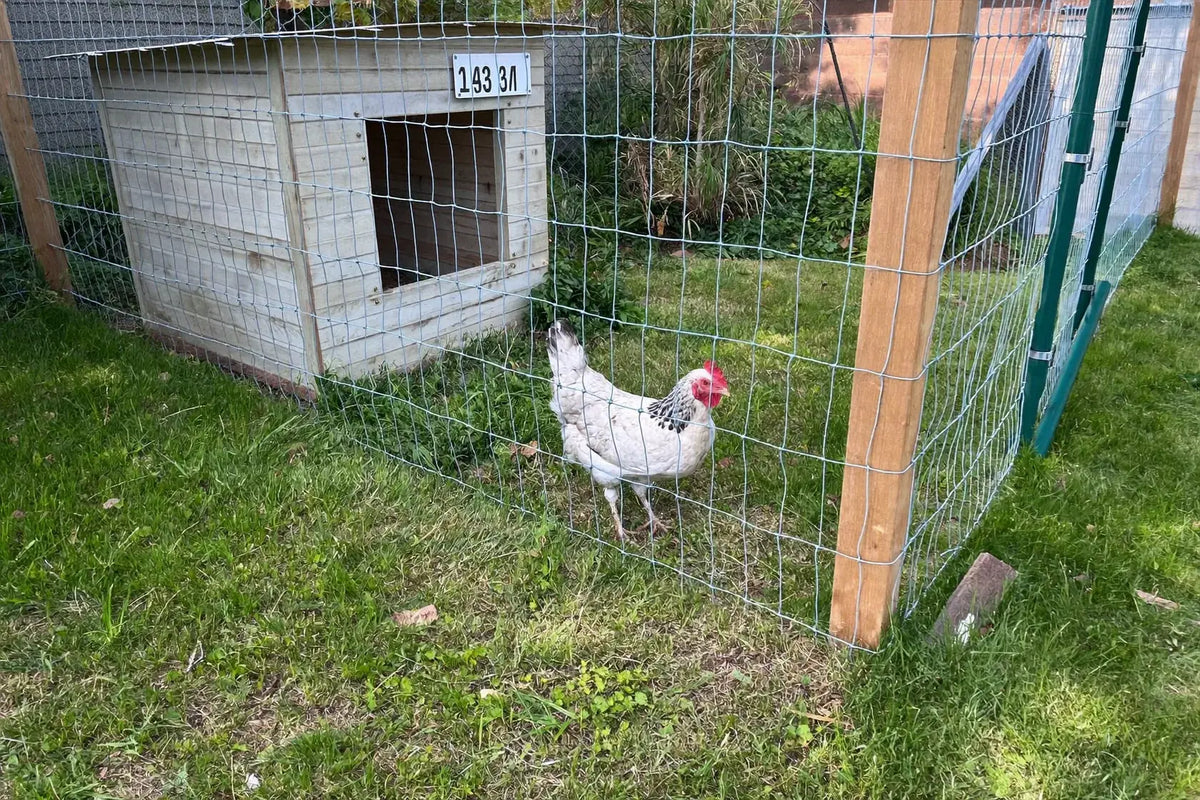
A dog kennel chicken coop is a chain-link kennel turned into a chicken run, with the hen house inside it or butted against the outside. The panels hand you the perimeter, the tedious half of any run. They hand you no housing: the federal standard for a dog's outdoor enclosure asks for a shelter with a roof, four sides and a floor, and says nothing about ventilation, a perch or a nest. That same rule sizes the floor from the length of the dog — a 30-inch dog, 9 square feet — because it was written for one animal, not a flock. Measure your gate opening, then work from the stated dimensions of the coops built to move.
The shelter requirement, the floor-area formula keyed to a dog's length and the digging warning below are quoted from the Code of Federal Regulations and named extension services, linked at the foot; the gate arithmetic is ours, settled with a tape.
What is a dog kennel chicken coop?
A dog kennel chicken coop is two structures wearing one name: a chain-link kennel doing the job of the run, and a hen house that has to come from somewhere else. The kennel supplies a perimeter and a gate. Nothing about it is housing.
Three things come free with the panels. The enclosure is rectangular, so its area is a length times a width rather than an awkward curve, and a hen house sits in a corner without wasting the shape. The gate is a real gate, hung on a frame, with a latch already fitted. And the panels are usually tall enough to walk into, which is the difference between cleaning a run and crawling into one.
Three things do not come with them: a shelter, a roof over most of the footprint, and a closed line where the wire meets the grass. Each is a separate decision, and only the first can be bought.
Every upcycled coop splits the same way, into a perimeter you inherit and a shelter you do not, and a kennel is where that pattern gets interesting. A trampoline frame gives you a ring of tube and no specification at all — nobody ever wrote down what it should keep out, because it was jumping equipment. A kennel is different: it is a manufactured animal enclosure, and animal enclosures have a published rulebook. Reading it is the fastest way to find out what you have actually bought.
Whether any of this beats simply buying the house is a cost question rather than a design one, and our homemade coop guide works that out against a finished coop.
The kennel was specified for one dog, not for a flock
Every dimension in the federal dog-enclosure rule is a function of one animal's body. Floor area comes from the dog's length. Interior height comes from the dog's head. Nowhere in the section is there a per-occupant multiplier, because a kennel was never expected to hold a group that grows.
The arithmetic is published in full, so you can run it yourself. 9 CFR 3.6 says to "Find the mathematical square of the sum of the length of the dog in inches (measured from the tip of its nose to the base of its tail) plus 6 inches; then divide the product by 144." A 30-inch dog gives 36 squared, which is 1,296 square inches, which is 9 square feet. An 18-inch dog gives 4. A 42-inch dog gives 16. The height rule works the same way: the interior "must be at least 6 inches higher than the head of the tallest dog in the enclosure when it is in a normal standing position".
Two scope limits, both worth stating before anyone quotes this at a neighbour. These standards sit under the Animal Welfare Act and bind a named list of people: "Each dealer, exhibitor, operator of an auction sale, and intermediate handler shall comply in all respects with the regulations set forth in part 2 and the standards set forth in part 3 of this subchapter". A private back garden is not on that list. These are also regulated minimums, so a backyard chain-link kennel is normally a good deal bigger than the figure the formula returns. The point is not that your kennel measures 9 square feet. It is that the number it was designed against came from a body length.
Now the part that decides how much work the conversion is. Nothing in 9 CFR 3.6 states a mesh aperture or a wire gauge for a wall. The only mesh dimension in the whole section is about the floor — suspended-floor strands "greater than 1/8 of an inch in diameter (9 gauge)", written to protect a dog's feet.
Read the silence the careful way round, because the inference only runs one direction. No published wall figure does not mean chain link fails; it means nobody ever specified the wall against anything small, so there is no number to design your mesh to. Our guide to coop hardware makes the wire decision. This post does not, and neither does the rulebook.
The honest counterweight belongs in the same breath, because it cuts against everything above. The rule does ask an enclosure to "Keep other animals from entering the enclosure", right beside asking it to "Contain the dogs and cats securely". Both directions are in there. What is missing is a dimension, not an intention.
| The question | What the dog rule states | What poultry housing guidance states | What the conversion still owes |
|---|---|---|---|
| How much floor? | 3.6: the square of the dog's length plus 6 inches, divided by 144 — one animal's body | Penn State's Table 1 gives square feet per bird, by bird type, under the heading Minimum Space Requirements for Poultry | A bird count before a footprint — the size guide does that division |
| What the shelter must be | 3.4: shelters must contain a roof, four sides, and a floor | Penn State: A good poultry house protects the birds from the elements (weather), predators, injury and theft. | Nest boxes and a perch — neither word appears anywhere in 3.4 or 3.6 |
| Air | The ventilation requirement sits in 3.2, which is the indoor section. The outdoor section states none | Sourced separately, in our ventilation guide | A vent plan, because the structure you inherited was specified without one |
| What is kept out | 3.6: enclosures must Keep other animals from entering the enclosure — stated, with no aperture attached to it | Penn State: Animals always dig at the base of a fence. | A mesh decision the dog rule never made |
| What the ground may be | 3.4: floors may be of compacted earth, absorbent bedding, sand, gravel, or grass | A buried perimeter, if the run stays put — worked through in our run guide | A ground line, and a decision about whether this run ever moves |
| Cold | 3.4: where acclimation is unknown, dogs and cats must not be kept in outdoor facilities below 50°F | A winter question, answered in our cold-climate guide | A house the flock lives in through the whole winter, not one they are lifted out of |
The last row does more work than it looks like it does. The dog rule can assume the occupant gets brought indoors when the weather turns. A flock does not get brought indoors, so the shelter you drop inside those panels is doing a job in February that the panels were never asked to do. Which makes the shelter the thing to spend on, not the perimeter — you already have that. Start where the February requirements are met: coops built to stand out in it.
Chicken coop using dog kennel: the gate decides which hen house gets in
The binding dimension is the gate leaf, not the kennel's floor area. Whatever hen house goes inside has to pass through that opening standing up, or arrive as a flat pack and be assembled where it will live. Measure the clear opening between the hinge post and the latch post, not the frame.
Gate widths are a maker's choice and vary, so yours is the only one that counts. For a coop to go through assembled, the smaller of its two plan dimensions has to clear that opening. The spread is wide enough to matter: a stated narrow side of 26 inches and a stated narrow side of 53.8 inches are both real figures on backyard hen houses, and a gate that swallows the first will refuse the second.
| What your gate opening does to the coop you want | Why that is the binding check | What to do about it |
|---|---|---|
| The opening is narrower than the coop’s stated width | The smaller of the two plan dimensions is the one that has to clear the gate. Overall length never enters this sum | Buy a flat pack and assemble it where it will live, or stand the house against the outside of a panel and cut a pop-hole where the two meet |
| Wide enough for the width, but the coop is taller than the gate head | A gate frame is a ceiling as well as a pair of posts, and a wheeled house carries its floor high | Measure the head height before you order. Filter on stated height first among the smallest coops on wheels |
| Wider than both | Nothing about the gate is deciding anything for you | Stop measuring the opening and start measuring the ground inside the panels — that is what now sets the flock size |
| The listing states a length and no width | You cannot run the check at all, because the number it turns on was never printed | Send us the model. We will get the overall width and height from the manufacturer before you order |
So read the dimension line for a width specifically, not just a length. A listing that gives you an overall length and stops has said nothing about the number this turns on — which is a question rather than a dead end, and one we will put to the maker for you. Reading the same stated figures as areas rather than as clearances gives a different and equally useful picture, and our small coop guide works that one through.
A coop stated at 26 inches across goes through almost any gate a person walks through. One stated at 53 inches across almost certainly does not, which leaves two options: build it inside the enclosure from a flat pack, or stop trying to get it in. Standing the house against the outside of a panel and cutting a pop-hole where the two meet turns the kennel into a run the birds walk out into — and moves the work from carrying to cutting. Pop-hole sizing is its own decision, not a detail.
Measured your kennel gate and found the coop is wider? Take 10% off one that fits through it. GET MY 10% CODE
What happens where the panels meet the ground?
Chain-link kennel panels stand on a bottom rail, with the wire ending at ground level and a gap under the rail wherever the ground is not perfectly flat. Penn State is blunt about where the attention goes: "Animals always dig at the base of a fence."

Two kinds of traffic use that line, and only one of them is nocturnal. Virginia Cooperative Extension's predation publication puts it plainly: "Yet owned and feral cats and dogs may prey on birds or eggs in the flock any time of day." Dogs are on its list of daytime predators, and its evidence table maps dead injured birds to a dog or a weasel and missing adult birds to a bird of prey, bobcat, coyote, dog or fox. The kennel you are converting was built to hold one animal on the inside. Any interest from the outside is a job the panels were not sold to do.
The same publication then puts the dog on its prevention list too — "Use a guard animal such as an alpaca, a guard dog, a donkey or even geese" — which is a fair summary of how this actually goes in a yard. One dog is the reason you own the kennel and another is the reason you are worried about it. One note on the sourcing: Virginia's author co-wrote a third publication with Penn State's co-author, so read that housing page and this predation publication as one connected body of work rather than two independent votes.
Closing the ground line is the real work, and there are two versions of it. A run that stays where it is can have its perimeter buried, and what that involves is set out in our run guide. A run you might move cannot bury anything, so the substitute is a skirt of mesh laid flat on the grass and pinned outward, lifted and re-pinned every time the enclosure shifts.
What none of that decides is what the mesh itself should be. The chain-link fabric already on your panels was chosen against a dog, and the rulebook attached no aperture to it. Our coop hardware guide covers the wire question properly, and it is the next thing to read before you buy a roll of anything. If you would rather the mesh decision arrived already made, a coop that comes with its own run has made it at the factory.
Dog house chicken coop: a roof, four sides and a floor, and nothing about air
A dog house meets a written specification, and the specification is unusually short. Outdoor shelters for dogs must be "large enough to allow each animal in the shelter structure to sit, stand, and lie in a normal manner, and to turn about freely", and "must contain a roof, four sides, and a floor". That is close to all of it.
Notice what the sentence is measuring: posture, not area. Sit, stand, lie, turn — four things a body does, with no number beside any of them. So a dog house that is correctly sized for its dog tells you nothing at all about how many hens it holds. You have to measure the inside yourself and divide it by a published per-bird figure, and our capacity study is where that division is done honestly.
One requirement transfers cleanly. The rule asks the shelter to "Be provided with a wind break and rain break at the entrance", which is exactly what a pop-hole on the weather side of a coop wants too. The rule also draws a line that is worth reading twice: "Metal barrels, cars, refrigerators or freezers, and the like must not be used as shelter structures." Even the short specification has a floor below which it will not go.
Three words never appear in the outdoor housing section or in the enclosure section at all: ventilation, perch, nest. That is not us paraphrasing; it is a search over the complete text of both. The federal ventilation requirement for dogs does exist — "Indoor housing facilities for dogs and cats must be sufficiently ventilated at all times when dogs or cats are present" — and it is written for indoor facilities. The outdoor section, which is the one a garden dog house sits under, carries none.
So the conversion list is short and non-negotiable: air, a perch, a nest box. Air is the easiest of the three to skip, because a dog house feels snug and snug is the wrong target — our ventilation guide has the reasoning and the openings. The other awkwardness is that a dog house is one volume with one opening, so collecting eggs and cleaning both happen through the same hole, on your knees. Our easy-to-clean interior guide is about exactly that geometry, and the cost case for converting a shell rather than buying one is worked out on its own page. If the answer comes out on the buying side, the houses that already have the three things on that list are here.
Can a converted kennel still move?
Chain-link kennel panels come apart — they are clamped or bolted at the corner posts — so the enclosure is portable in the sense that it can be dismantled and rebuilt somewhere else. That is a different thing from moving it with birds inside, on a Tuesday, in ten minutes.
The ground under it decides most of this. A kennel standing on turf can be walked to a new patch, panel by panel, if you have somewhere to walk it to. A kennel on a poured pad or a bed of gravel is not going anywhere, and the ground beneath it stops recovering the day the birds arrive — what happens to ground that never gets a rest is the argument our whole shop is built on. Put one panel on a bathroom scale before you plan a layout around moving it — that is the only weight figure that will be true for your panels.
Our position is that the honest split is a fixed run and a mobile house. Leave the panels where they are, treat them as the enclosure they were sold as, and buy a hen house that can be wheeled out of the gate and onto fresh grass whenever the ground inside needs a break. A wheeled house stating two 3.9-inch wheels and 7.5 inches of clearance under its floor, for instance, has small wheels by any standard — and still enough to walk it out of an enclosure and back in. How to move a coop covers the technique, and our rolling coop guide covers what actually rolls on grass rather than on a patio.
What we'd keep from the kennel, and what we'd buy
We would keep the panels and the gate, and buy the house. The perimeter is the boring, expensive, fiddly part of a run, and a kennel hands it to you finished, square and already latching. The house is the part with published requirements behind it — dry, ventilated, with somewhere to perch and somewhere to lay — and it is the part where a bad decision shows up in November rather than in July.
The cost of being wrong runs in opposite directions on the two halves. A run that turns out slightly small is an irritation you live with. A shelter that cannot be ventilated, cannot be reached into, or cannot be shut at dusk has to be rebuilt in the weather, and the free kennel does not soften that.
One caution if you are joining a bought coop to a kennel panel. Drilling a fixing through a wall, or cutting a pop-hole into a panel, is a modification, and a manufacturer's warranty terms may treat it as one. Send us the model before you reach for the drill and we will find out what its terms actually say.
Penn State's last line on protection is the one worth ending on, because it is the one a kennel already half-answers: "To protect the birds from theft, lock your building and pens securely whenever you are not home." You have the lock. What you do not yet have is the building.
Send us your gate's clear width and the inside dimensions of the enclosure, and we will tell you which coops go through assembled, which have to be built in place, and which ones stand outside the panel with a pop-hole between them — and where a maker has not published a width, we will ask them for it. You do not have to wait for us to start. If the house is going inside the panels, the portable coops are the ones to measure first; if it is standing outside as the flock's shelter, the coops built to move are the ones that suit birds on grass. If the kennel turns out to be scrap after all, a coop with its own run does both jobs in one delivery — or open the whole range and send us your gate measurement with the two you are choosing between.
Sources: Penn State Extension, “Small Scale Poultry Housing” (Gregory P. Martin, Ph.D., PAS, and Phillip Clauer; updated June 25, 2026) — the four jobs of a poultry house, the digging-at-the-base line and the theft instruction — accessed August 22, 2026, read from raw bytes · Virginia Cooperative Extension APSC-192P, “Predators for Free-Ranging Poultry” (Leonie Jacobs, September 28, 2023) — the daytime predator list, the evidence table and the guard-animal line — accessed August 22, 2026. Its author co-wrote a third publication with the Penn State page’s co-author, so the two are read here as one connected body of work rather than as independent agreement · US Code of Federal Regulations, 9 CFR 3.4, “Outdoor housing facilities” — the shelter specification, the ground materials and the cold-weather restriction — accessed August 22, 2026 · 9 CFR 3.6, “Primary enclosures” — the floor-space formula, the interior-height rule, the containment and exclusion requirements and the suspended-floor strand diameter — accessed August 22, 2026 · 9 CFR 3.2, “Indoor housing facilities” — the paragraph (b) ventilation requirement, quoted to show where it sits — accessed August 22, 2026 · 9 CFR 2.100, “Compliance with standards” — who the part 3 standards bind — accessed August 22, 2026. These are Animal Welfare Act standards for regulated dealers and exhibitors, not a building code for a private garden.
Frequently asked questions
How to turn a dog kennel into a chicken coop?
In this order: close the ground line, put a shelter inside, then fit it out. The panels are already the run, so the first job is the gap under the bottom rail, where Penn State says animals always dig. The second is a hen house, because the federal rule the kennel was built to asks a dog shelter for a roof, four sides and a floor and nothing more. Perch, nest box and ventilation come last and come from you.
How to attach chicken coop to dog kennel?
Stand the coop against the outside of a panel and cut a pop-hole where the two meet, so the birds walk out of the house into the run. Bolt the coop to the panel frame rather than to the wire, which carries no load. Close the leftover gap around the join before you close anything else — it is the one opening you made yourself. Drilling a bought coop may affect its warranty, so check the terms first.
How to dog proof a chicken coop?
Height and the ground line, in that order, because a dog goes over or under rather than through. Virginia Cooperative Extension names dogs among daytime predators and maps dead injured birds to a dog or a weasel in its evidence table. A solid, latched door the birds are shut behind at dusk does most of the work; the wire and latch specifications are in our coop hardware guide.